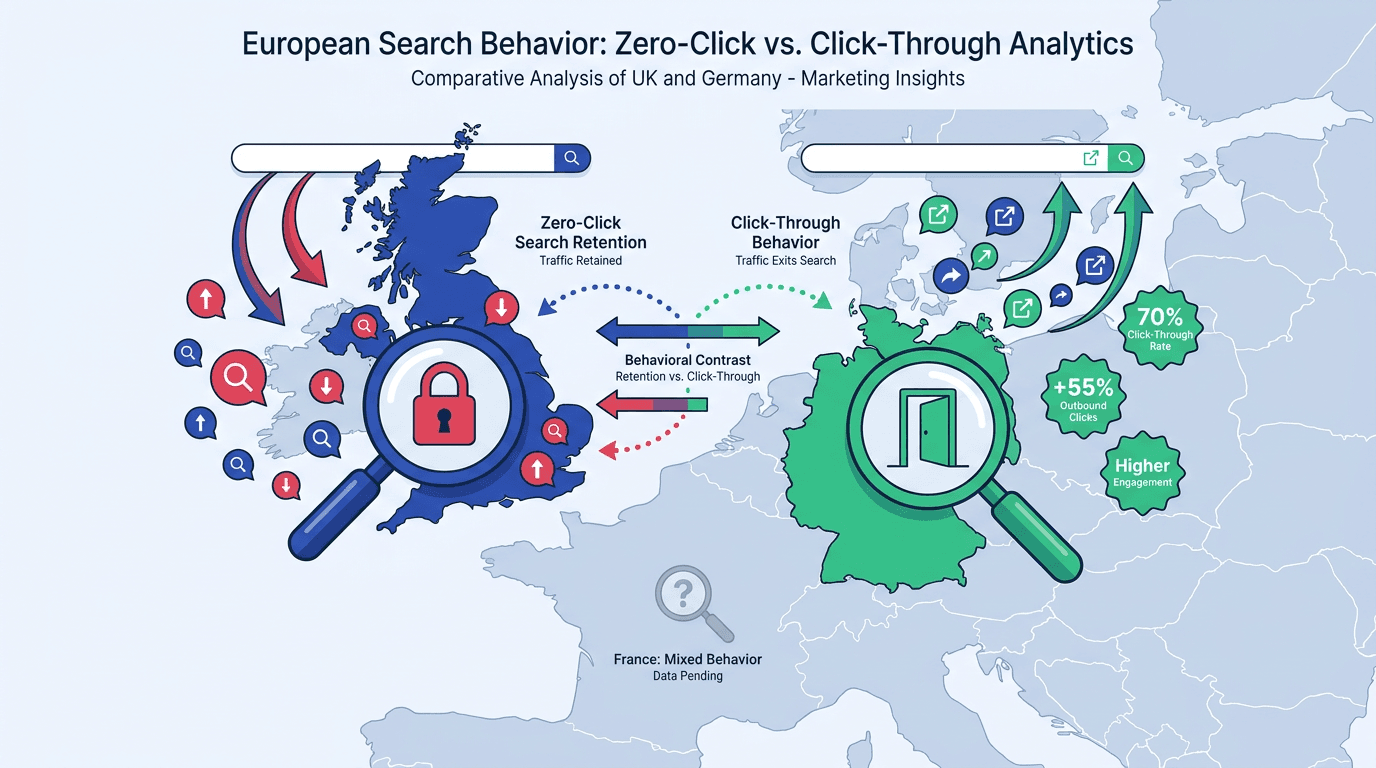
Your European traffic forecast is probably off. The mistake is almost boring: teams treat zero-click searches by country like a universal constant. They grab one global benchmark, paste it across every market, then act surprised when London projections fail to match what happens in Berlin.
Clickstream data from SparkToro, using Similarweb data, shows why that approach breaks down: zero-click rates swing sharply across Europe, with the UK near the top and Germany near the bottom. SparkToro's US research adds useful context, showing that roughly two-thirds of US Google searches send no click to any external site.
That spread is not academic. German searchers click through at rates more than 20 percentage points higher than UK searchers, while France shows a different pattern: an unusually large share of sessions end right after a query. Those differences are big enough to change how marketers size organic opportunity, not just how they report it.
For brands, the takeaway is clear: traffic alone no longer tells the full story. Teams need to pair click data with visibility metrics, AI search monitoring, and content marketing metrics that show where discovery happens before a user ever lands on the website. The rest of this piece walks through the numbers, the leading explanations for the UK–Germany divide, and a practical way to build market-specific organic plans without leaning on a single averaged metric.
The Data: A Tale of Two Search Markets
The SparkToro zero-click study published in June 2026 used Similarweb clickstream data to compare search behavior across countries. The headline is clean: zero-click searches in the UK are the highest among the markets studied, while zero-click searches in Germany are the lowest. The distance between them is not subtle: click-through rate by country differs by more than 20 percentage points, which is large enough to break any forecast that assumes Europe behaves like one blended market.
France complicates the picture in a useful way. French searchers showed a particularly high rate of session-ends after a query, which implies they either get the answer directly on the SERP or give up quickly. For US-based teams that need a reference point, SparkToro's companion research pegged the US zero-click rate at approximately 68% in early 2026. Put differently: roughly two-thirds of US Google searches send no click to any external site.
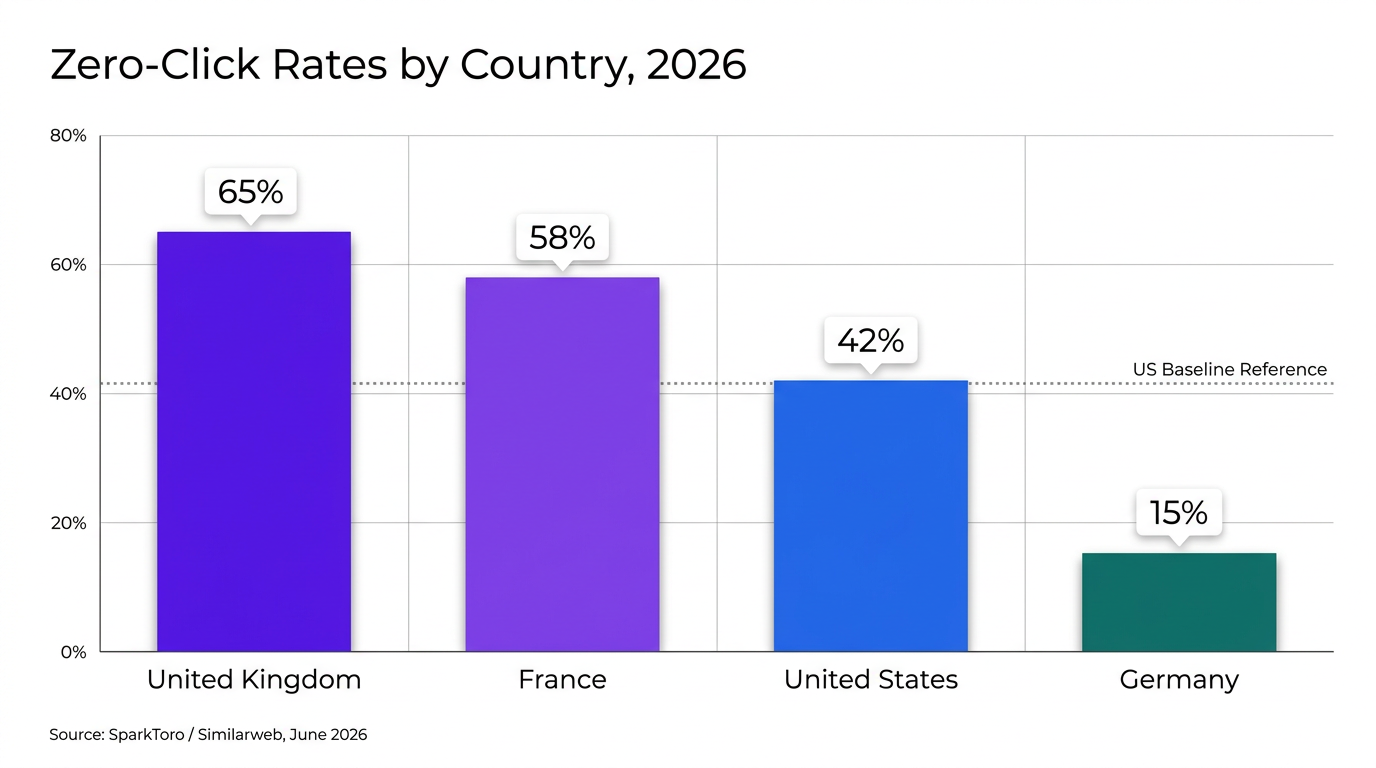
Info: Verdict for comparison queries: If you are debating whether to model Europe as one search market or several, the data answers for you. A single zero-click search 2026 forecast will overstate available clicks in the UK and understate them in Germany. If you want planning that survives contact with reality, you need market-level segmentation.
Why the Gap? Unpacking the UK vs. Germany Divide
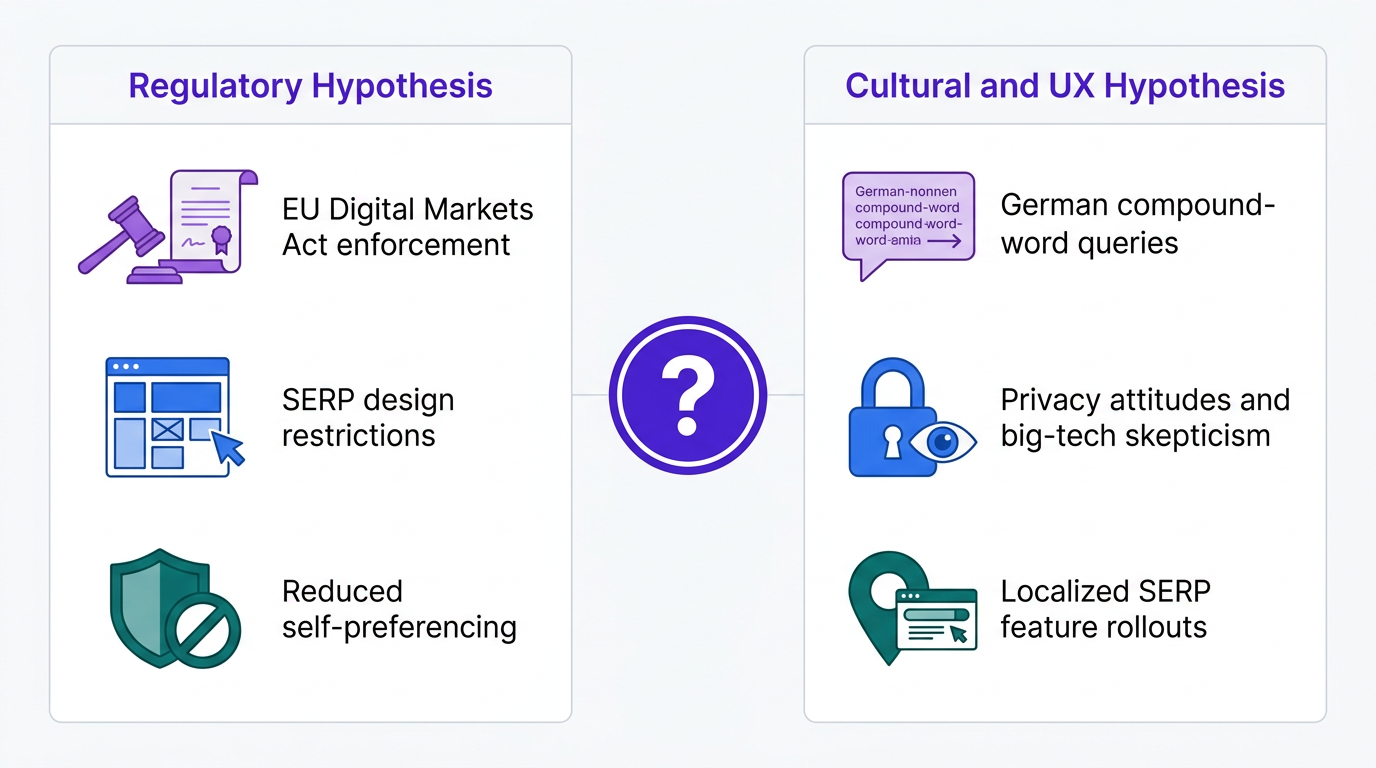
SparkToro is careful not to pin the divergence on one neat explanation. The honest read is that nobody can prove why German searchers click so much more than UK searchers. Still, two hypotheses keep coming up, and each one implies a different set of bets for marketers.
The Regulatory Hypothesis
The EU's Digital Markets Act (DMA) is designed to limit how platforms like Google can self-preference their own properties in search. Under DMA enforcement, Google faces penalties for prioritizing its own shopping modules, knowledge panels, and other SERP features that resolve user intent without a click. Germany, as the EU's largest economy, sits fully inside that regime. The argument goes like this: if regulation is shaping SERP design, German search results should be less "sticky" and produce fewer zero-click sessions. The UK, post-Brexit, is outside the DMA. This fits the direction of the data from a June 2026 SparkToro study, which found Germany had the lowest rate of zero-click searches while the UK had the highest.
It is a coherent story, but it remains a story. The correlation is there; the causal chain is still mostly inference.
The Cultural and UX Hypothesis
There are also explanations that do not require a regulatory lever. German-language queries tend to run longer and more compound, thanks to agglutinative word formation, which can change what Google chooses to show and reduce the odds that a one-box answer feels sufficient. Privacy attitudes and skepticism toward big tech are often stronger in Germany than in the UK, which could make users more likely to click through to a trusted publisher instead of accepting a snippet at face value. Then there is simple product reality: Google does not ship SERP features uniformly. AI Overviews, knowledge panels, and featured snippets appear at different rates and in different formats across markets. Even small UX differences between google.co.uk and google.de could produce a meaningful behavioral gap without the DMA being the primary driver.
From Data to Strategy: Adapting Your SEO by Market
The strategy implication is blunt: the one-size global SEO playbook does not survive multi-market reality. In a high zero-click market like the UK, the SERP is the destination. Visibility inside featured snippets, knowledge panels, and AI-generated answers carries value even when the session never reaches your site. In a lower zero-click market like Germany, the classic click-through funnel still works, so sharper titles, better meta descriptions, rich results, and genuinely differentiated content can translate into real organic sessions.
| Strategic Area | High Zero-Click Market (UK-style) | Lower Zero-Click Market (Germany-style) |
|---|---|---|
| Content Format | Built for SERP consumption: tight definitions, FAQ schema, direct answers | Longer, click-earned content that delivers value beyond the snippet |
| Keyword Targeting | Lean into branded and navigational queries where SERP presence drives recall | Push on informational and transactional queries where CTR is still a lever |
| SERP Feature Optimization | Chase featured snippets, People Also Ask, AI Overviews | Prioritize rich results plus titles and meta descriptions that win the click |
| Success Metrics | SERP share of voice, brand impression volume, AEO visibility | Organic CTR, sessions from search, conversion rate from organic traffic |
| Discovery Channels | Diversify hard into social, communities, AI answer engines | Keep investing in organic search, then layer in social and local discovery |
| Tactical differences required when operating across high and low zero-click markets. |
This is also where tooling stops being a nice-to-have. You need to see how your brand shows up across SERPs, AI answer engines, and social discovery surfaces, broken out by country. Dashboards that collapse everything into global averages hide the exact divergence you are trying to plan around. Platforms like Vizup's organic discovery workflow combine SEO, AEO (Answer Engine Optimization), and GEO (Generative Engine Optimization) monitoring with AI agents and human experts, so you can spot market-level differences that generic reporting smooths away.
How Vizup Fits Multi-Market Zero-Click Strategy
Zero-click search does not create the same problem in every market. In the UK, where more searches end without a click, brands need to win visibility directly inside search results, AI answers, social conversations, communities, and local discovery surfaces. In Germany, where users are more likely to click through, brands still need strong technical SEO, compelling titles, useful content, and conversion-ready landing pages.
That difference is exactly why multi-market teams need more than a traditional SEO dashboard or a content production workflow. They need an organic discovery system that shows where their brand appears, where it is missing, and how visibility changes by country, channel, and intent. This is the same shift Vizup explains in its guide to AI search monitoring: brands can no longer measure organic performance only by rankings and traffic after the click.
Vizup is built for that broader zero-click reality. As an Organic Autopilot, Vizup helps brands monitor, create, optimize, publish, and learn across Search, Social, Communities, AI Answer Engines, and Local Discovery. Instead of treating organic performance as one global average, Vizup gives teams a way to understand how discovery actually behaves market by market.
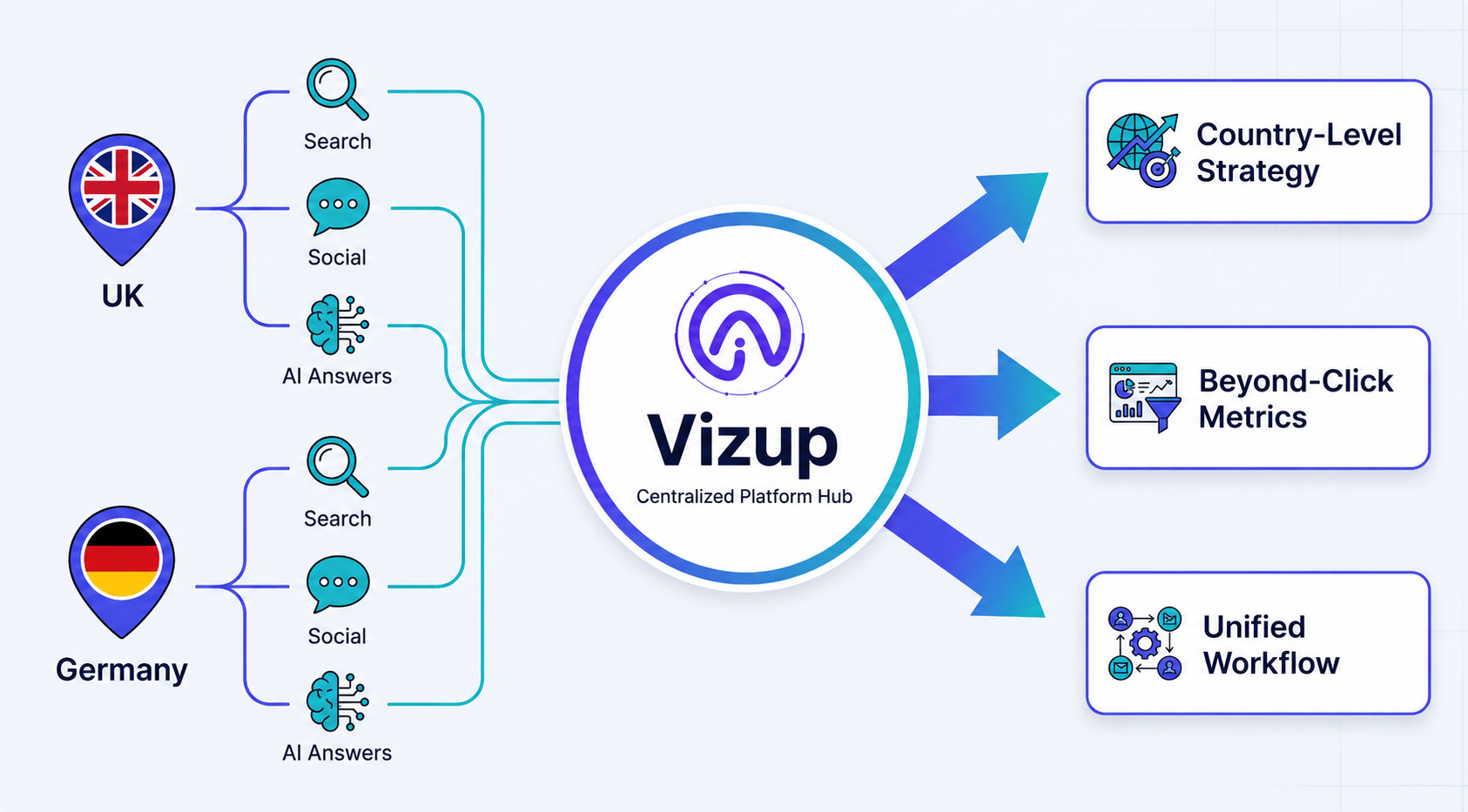
For teams responding to the UK-Germany gap, that matters in three practical ways.
First, Vizup helps shift measurement beyond clicks. In high zero-click markets, sessions and CTR alone do not show the full picture. Brands also need to track SERP visibility, AI answer presence, brand mentions, community discovery, and local visibility. Vizup's guide to content marketing metrics makes the same point: when AI answers reduce clicks, marketers need visibility metrics that explain demand creation before users ever land on a website.
Second, Vizup supports country-level strategy. A UK plan may need to focus more heavily on answer visibility, branded recall, and discovery across non-website surfaces. A Germany plan may place more weight on click-through optimization, content depth, and conversion from organic traffic. For teams building this kind of market-specific approach, Vizup's playbook on how to build a content marketing strategy for AI search visibility offers a useful framework for connecting audience questions, search intent, and AI answer visibility.
Third, Vizup connects insight to execution. Traditional SEO suites often stop at reporting. Content tools often stop at production. Workflow automation tools often require teams to build their own system from scratch. Vizup brings monitoring, optimization, publishing, and expert-led learning into one organic-first workflow. That makes it especially useful for teams trying to improve brand visibility in AI search engines, not just publish more pages.
In a zero-click world, the goal is not simply to create more content. It is to understand where discovery is happening, adapt by market, and make sure your brand is visible even when users do not click. That is where Vizup gives multi-market teams a clearer path: one organic-first workflow for search visibility, AI answers, social discovery, communities, and local presence.
Your Organic Autopilot for a Zero-Click World
The UK-Germany split is the clearest argument for treating zero-click searches by country as a planning input, not a curiosity. If you anchor on a single global zero-click number, you will misallocate budget, misread traffic ceilings, and miss where discovery is actually happening. The 2026 winners will be the brands that model each market as its own search ecosystem, then adjust content formats, keyword targets, and success metrics to match.
Vizup is built around that premise. As an Organic Autopilot, it helps brands monitor, create, optimize, publish, and learn across Search, Social, Communities, AI Answer Engines, and Local Discovery with the country-level granularity a zero-click world requires. If your team wants to stop planning off blended averages and start seeing how your brand appears market by market, explore Vizup's organic-first workflow and align your strategy to what the clickstream is already telling you.
Frequently Asked Questions
What counts as a zero-click search?
A zero-click search is a Google query where the user does not click any organic or paid result. They might get what they need directly on the SERP (featured snippets, knowledge panels, or AI Overviews), refine the query, or end the session. In the US, approximately 68% of searches resulted in zero clicks in early 2026.
Why does the UK show higher zero-click than Germany?
There is no proven single cause. The SparkToro zero-click study points to a plausible regulatory angle: EU rules like the Digital Markets Act may constrain Google's self-preferencing in Germany, while the post-Brexit UK is outside that framework. Other credible drivers include cultural differences, linguistic patterns in query formulation, privacy attitudes, and uneven SERP feature rollouts between markets. The most defensible assumption is that multiple factors are interacting at once.
What does the SparkToro zero-click study change for SEO teams?
It turns country segmentation from "nice" to mandatory. For high zero-click markets like the UK, SERP visibility and brand recall can matter more than CTR because many sessions never reach a website. For lower zero-click markets like Germany, classic click-through optimization still pays off, so improving CTR and on-site conversion remains a reliable path to growth.
What is the predicted zero-click search rate for 2026?
SparkToro's research, using Similarweb clickstream data, put the US zero-click search rate at approximately 68% in early 2026. The bigger point is variance: rates differ sharply by country, with the UK higher than the US and Germany meaningfully lower. No single global figure accurately represents all markets.
How do I measure performance when clicks disappear?
Click metrics like sessions and CTR only capture what happens after a user leaves the SERP. To measure zero-click environments, track SERP share of voice, brand mentions in AI-generated answers, visibility in featured snippets, and presence across non-search discovery surfaces like social and communities. Platforms like Vizup combine SEO, AEO, and social monitoring to map that organic discovery footprint by market.
