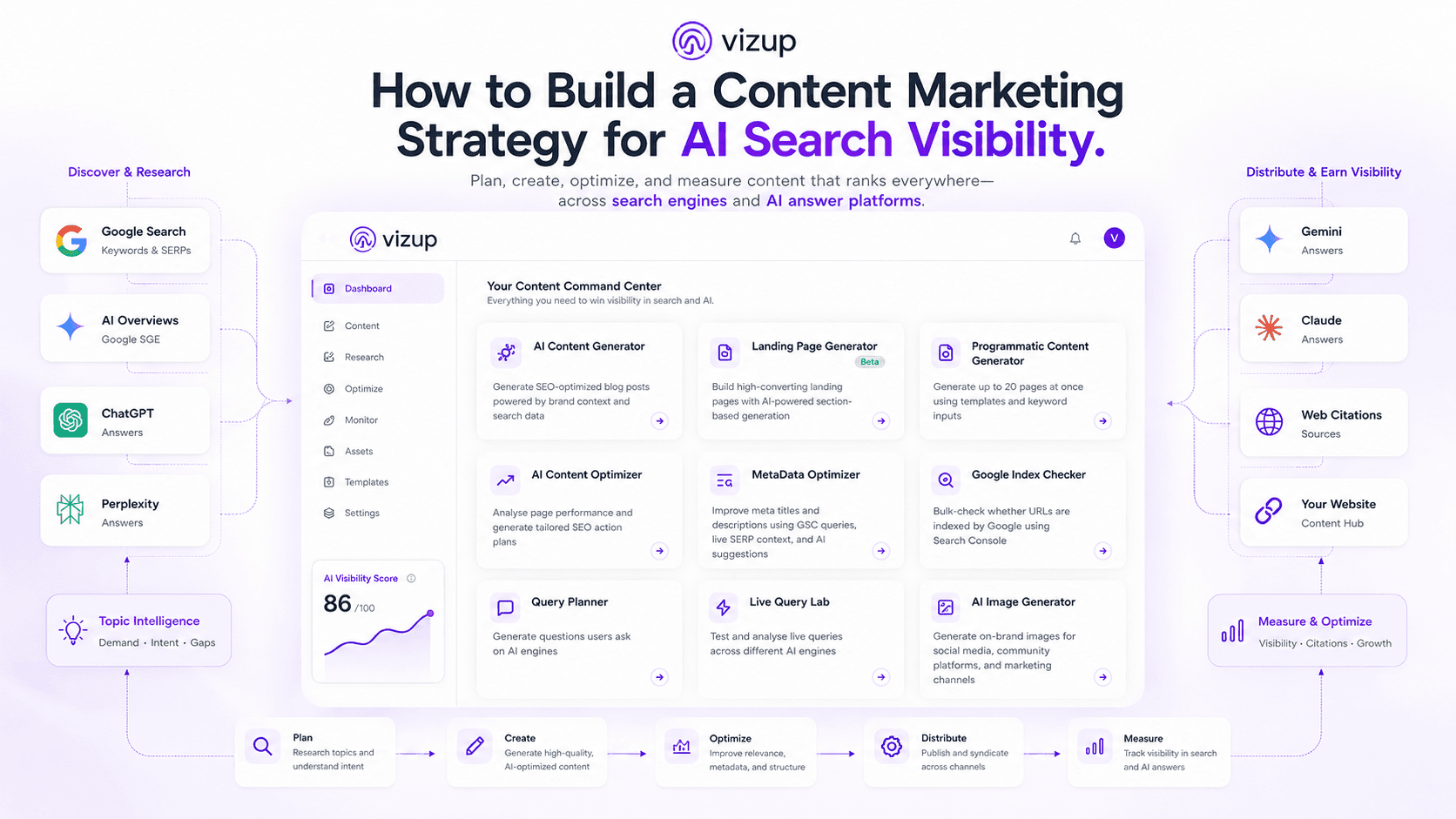
For the last decade, content marketing has run on a familiar script: pick a keyword, outwrite whoever holds the top spot, pick up a few links, and wait it out. That script is breaking. AI-generated answers from Google, Perplexity, and others aren't just another tweak to the ranking system; they change how information gets found and reused. Your work isn't only fighting for a blue link anymore. It's trying to earn a spot as a cited ingredient in someone else's answer.
If your traffic graph has started to feel less like a trend line and more like weather, you're not imagining it. The old playbook is losing its grip. This also isn't a checklist that promises a neat outcome. Treat it more like a strategy memo: the mindset shifts and the practical moves that separate content that gets skimmed from content that gets pulled into an AI response.
Use Keywords as Inputs, Not Just Targets
The most common mistake right now is treating keyword lists like a security blanket. Don't stop using keywords, but use them as inputs for questions, entities, and topical coverage. Classic SEO rewarded targeting specific phrases. AI search, often framed as Answer Engine Optimization (AEO), rewards content that answers real questions and maps cleanly to concepts. These systems don't simply match text; they infer relationships between people, places, products, and ideas, the "entities" that make up a topic.
Your job is to make it unambiguous what your brand actually knows. Instead of just aiming at "best CRM for small business," use that keyword as a starting point to build coverage that squarely addresses questions like:
- What are the key features a small business needs in a CRM?
- How does CRM pricing work for teams under 10 people?
- What's the difference between HubSpot and Salesforce for a startup?
- How do you migrate from a spreadsheet to a CRM system?
Starting from questions changes what you publish. Vizup's Query Planner is built for this shift, helping you discover the questions users are asking across search and AI engines. This nudges you toward being useful instead of merely "optimized," pushing you from chasing a term to owning a topic. That is the point of a modern content marketing strategy: become the source people and systems trust. When an AI assembles an answer, it gravitates toward writing that is clear, credible, and complete. You want your pages to be the ones it reaches for
Structure Your Content for Machines, Not Just Humans
Most blog posts are hard to extract from because they're built like essays: long, narrative slabs where the actual answer shows up halfway down the page. AEO forces you to write for two readers at once: a human skimming for the point and a machine trying to isolate it. Conveniently, the disciplines overlap. Content that's easy for a model to parse is usually easier for a person to scan, too.
In practice, that means writing with more discipline than most marketing teams are used to:
Key Structural Habits:
- Use the Inverted Pyramid: Put the answer first. If your H2 is "What is Answer Engine Optimization?", open by defining it. Don't make readers (or crawlers) work for the basics.
- Leverage Headings and Lists: Use H2s and H3s to separate sub-topics and sub-questions. Use bullets and numbered steps so information lands in clean, extractable chunks.
- Build Standalone Sections: Write each section so it mostly holds up on its own. Models may use short passages or sections to help assemble a response, so the context can't depend on the previous 600 words.
- Implement Schema Markup: Use relevant structured data where it genuinely fits, such as Article, FAQPage, Product, Organization, BreadcrumbList, or HowTo. Treat schema as clarity for search engines, not a guaranteed visibility hack.
Yes, this is more work than shipping another 2,000-word "thought leadership" post. That's also why it creates leverage. While competitors keep publishing sprawling essays, you can build a library of pages that machines can reliably extract from. Vizup's AI Content Optimizer helps to audit existing content and generate an action plan for improving structure and coverage. For teams scaling topic or location-based pages, Vizup's Programmatic Content Generator can help create structured pages from templates and keyword inputs while keeping the format consistent.
The New Authority: E-E-A-T and Original Research
For a long time, SEO treated backlinks as the cleanest proxy for authority. Links still matter, but "authority" is getting redefined in public. E-E-A-T (Experience, Expertise, Authoritativeness, and Trustworthiness) is no longer something brands can ignore, especially when content needs to earn trust, citations, and inclusion in AI-generated answers. AI answer systems are more likely to surface content that is clear, well-sourced, and easy to verify.
So what changes in your content strategy? You stop publishing summaries that could have been assembled from the top five results. You need to contribute something that wasn't already in the room. Vizup's Content Generator can support this by creating a search-optimized first draft based on your topic and audience, but the real value comes when your team adds original data, firsthand experience, expert inputs, and a clear point of view.
| E-E-A-T Signal | Old Tactic | New Strategy (for AI Visibility) |
|---|---|---|
| Experience | Writing in the first person. | Add real case studies, hands-on examples, and perspectives that aren't easily produced by a generic model. |
| Expertise | Adding an author bio. | Use quotes from legitimate subject matter experts. Publish original data, surveys, and research. |
| Authoritativeness | Building backlinks from any site. | Earn links and mentions from respected, topically relevant publications and academic sources. |
| Trustworthiness | Having a privacy policy page. | Link out to original sources for data and statistics. Keep pages accurate, maintained, and current. |
Original research does more than "build authority" as an abstract concept. It turns your brand into the thing other people cite, which is exactly what answer engines are looking for when they assemble a response. It's expensive and slower than rewriting what already exists, but it lasts.
Measurement: Shifting from Traffic to Visibility
If organic sessions are your only scoreboard, AI search is going to feel like a loss even when you're winning. Zero-click searches were already normal; AI Overviews may push more informational journeys toward answer-first behavior. The KPI that matters isn't just traffic. It's whether you show up in the answer at all.
That calls for a different dashboard. Alongside rankings and sessions, track:
- AI Citations & Brand Mentions: Is your brand named as a source inside AI answers? Platforms like Vizup help teams plan, create, optimize, scale, and measure content across Google Search and AI answer engines.
- Share of Voice: Across your core topics, how often do you appear in answers compared to competitors? You can use Vizup's Live Query Lab to test and analyze this across different AI engines.
- Branded Queries: Are people searching for your brand name alongside the problems you want to own? That's a strong signal that authority is sticking.
This reframes content around business impact instead of vanity metrics. One citation inside a high-intent AI answer can influence brand discovery even when it does not create an immediate click. If you want more detail on what to track and how, our AI search visibility optimization playbook breaks down the newer measurement model.
Putting It All Together
A content marketing strategy for AI search doesn't require burning down everything you know. It does require growing up a bit: more intention, more structure, and a higher bar for expertise. The era of content farms and keyword stuffing is fading, and good riddance. The brands that come out ahead will be the ones that earn trust as references, for people, and for the assistants people increasingly lean on.
That only happens when content, SEO, and brand stop operating as separate departments. If you want to move from content planning to creation, optimization, scaling, and AI visibility measurement in one workflow, you can book a demo with Vizup.
Frequently Asked Questions
What is Answer Engine Optimization (AEO)?
Answer Engine Optimization (AEO) means shaping your content so AI answer engines like Google's AI Overviews, ChatGPT, and Perplexity can find it, understand it, and cite it. Traditional SEO optimizes for ranking links; AEO optimizes for being included directly in the generated answer.
Is SEO dead because of AI search?
No. SEO is changing shape, not disappearing. The basics (technical health, mobile-friendliness, and real authority) still matter. What's different is the target: you now have to optimize for direct answers and citations, not only clicks. AEO is an added layer on top of your existing SEO work. A Google Index Checker can help confirm whether your important pages are indexed, which is the first step before measuring search or AI visibility.
How do I measure the ROI of content marketing for AI search?
Models that rely only on traffic and last-click conversions miss what's happening in AI search. Track brand mentions and citations in AI answers, share of voice across priority topics, and any traffic that arrives via AI-generated referral links. Tools like Vizup are designed to track these new visibility metrics. Those signals reflect influence in a zero-click world.
How much of my content should be created by AI?
It depends on how you want to compete. 80% of marketers use AI for content creation, according to HubSpot's 2026 State of Marketing report. The common failure mode is handing over the full job. Use AI for brainstorming, outlining, and early drafts to move faster, then add human experience, original insight, and a consistent brand voice to meet quality and E-E-A-T expectations.
Where can I learn more about building an AI-focused content strategy?
Start with resources that focus on the strategic shift, not just tactics. Two solid next reads are improving brand visibility in AI search and these AI content strategy frameworks for structuring the work. For building conversion-focused pages, not just blogs, you can also explore Vizup's Landing Page Generator.
