This question refuses to die. I've heard it from CMOs, junior marketers, and founders for over a decade: "Should I use one keyword, five keywords, or as many as possible?" The web is packed with advice that contradicts itself, and a lot of it is either dated or flat-out misguided. Let's clear it up. In 2026, SEO isn't a math problem where you hit a magic number and call it done. The rules have shifted.
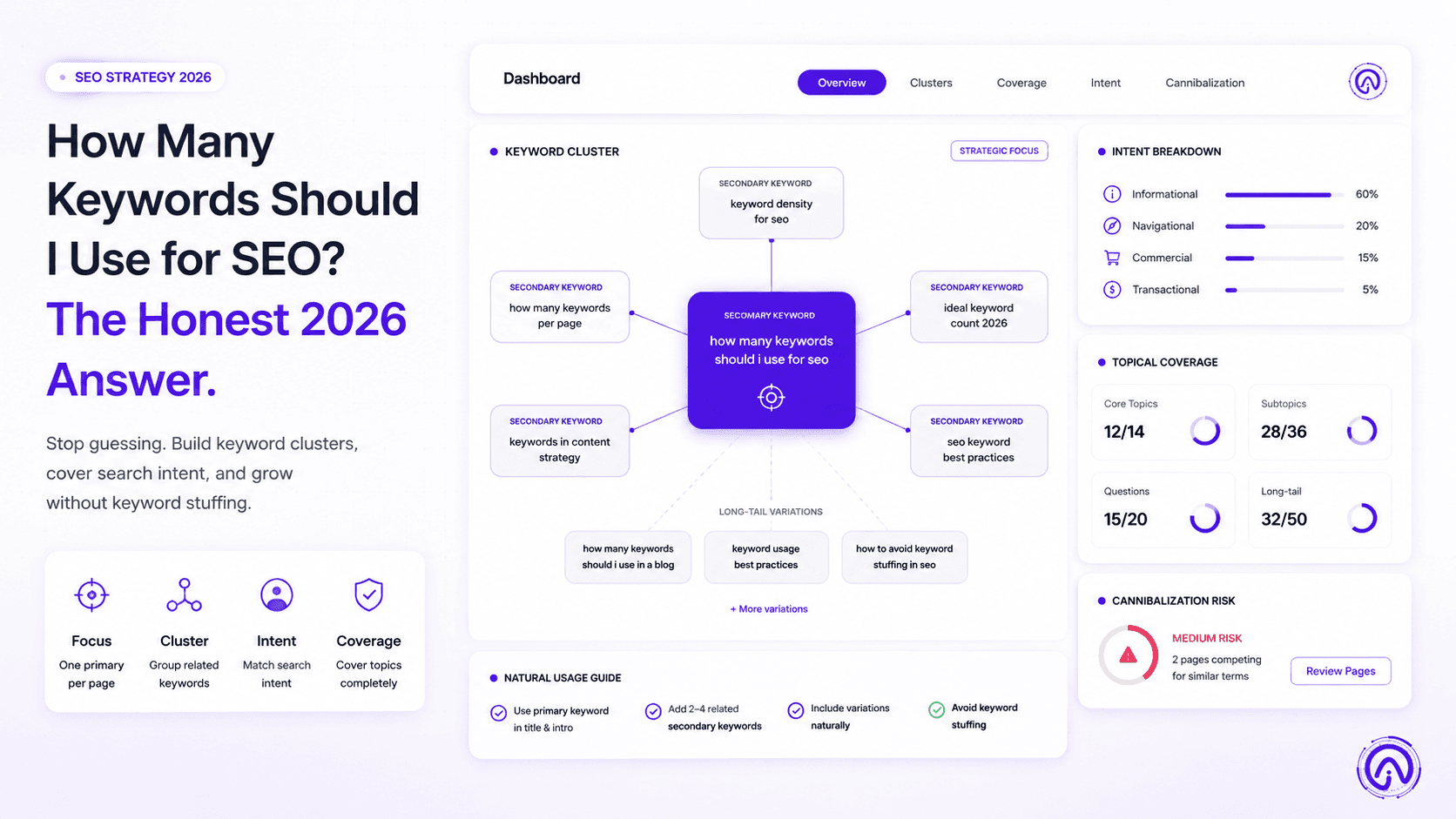
The real answer hinges on what actually moves rankings: search intent, keyword clustering, topical coverage, and not tripping over your own feet with keyword cannibalization. If you want the short version, it's this: use 1 primary keyword, 2-5 secondary keywords, and plenty of natural, related language per page. If you want the version that holds up when you sit down to plan content, stick with me. We'll break down how to make the call page by page.
The Honest Answer: How Many Keywords Should You Use?
Ignore any rule that tells you to hit a specific keyword total. The modern way to do this is to plan in clusters, not counts. A page should serve one core user need, and that usually maps to one main keyword cluster. Try to cram in more than that and you end up muddying the page for readers and for search engines.
A solid one-page framework looks like this:
- 1 primary keyword: The headline act. It's the phrase that best captures what the page is for.
- 2–5 secondary keywords: The supporting cast. Close variations and subtopics that round out the page.
- Natural long-tail variations: The specific, conversational queries people type. If you're genuinely covering the topic, these show up without forcing them.
- Related terms: The concepts and entities that make the explanation complete and signal real subject-matter competence.
The most common failure mode is treating keywords like items on a checklist. That approach produces stiff, unnatural copy that doesn't help anyone, and it tends to underperform. Aim for full coverage of the topic; keywords are the signposts that help you organize the page, not the point of the page.
| Page Type | Primary Keyword(s) | Secondary Keywords | Best Approach |
|---|---|---|---|
| Blog post | 1 | 2–5 | Go deep on a single, clear intent. |
| Landing page | 1 | 2–4 | Keep commercial intent tight and the message focused. |
| Category page | 1–2 | 5–10 | Cover the core category plus the most important variations. |
| Pillar page | 1 broad theme | 10+ | Earn "definitive" status by covering the full cluster. |
Start With Search Intent, Not Keyword Count
If you remember one thing, make it this: intent beats volume and it beats keyword count. A page should exist to satisfy one primary need. When you try to serve multiple, genuinely different needs on the same URL, you usually end up serving none of them well. Google is much better at reading intent than it used to be, and it tends to reward the page that answers the question cleanly and completely.
Stuffing one page with keywords that imply different intents is a classic early-career mistake. It makes the page feel stitched together for users and sends mixed signals to search engines. The decision rule is straightforward.
Same Keyword Family, Same Page
These phrases are basically the same question in different outfits. The searcher expects the same kind of answer, so they belong on one strong page.
Example:
- how many keywords should I use for SEO
- how many SEO keywords per page
- how many keywords in a blog post
Different Intent, Different Pages
These terms point to different jobs-to-be-done. Someone shopping for a tool isn't asking for a strategy explainer. Each deserves its own page with its own structure and promise.
Example:
- keyword research tools
- keyword density checker
- SEO content strategy
Use Keyword Clustering to Decide What Belongs on One Page
Keyword clustering for SEO is the formal label for what we've been describing: grouping terms that share the same (or very close) intent. Call it a family of queries. The operating rule is one cluster, one page. This isn't just tidy information architecture; it helps you build authority and pick up a long tail of variations without drifting into keyword stuffing. One genuinely useful, comprehensive resource usually beats three thin posts that keep rephrasing the same thing.
Example Cluster:
- Primary keyword: how many keywords should I use for SEO
- Secondary keywords:
- how many SEO keywords per page
- primary and secondary keywords
- keyword density
- SEO keyword strategy
- keyword stuffing
These all fit together because they're part of the same conversation. If someone is asking about how many keywords to use, they're also worrying about density, what "strategy" means in practice, and where the line is between optimization and spam.
Primary Keywords vs. Secondary Keywords
A quick reset on terms, because this is the backbone of a good primary and secondary keywords SEO strategy. These labels aren't busywork; they define what the page is trying to win and what it needs to cover to get there.
What is a primary keyword?
The primary keyword is the main phrase you're building the page to rank for, and it should match the core intent you're targeting. It's the term that shapes the title, the H1, and the overall direction of the page. Everything else on the URL should help answer the question that keyword implies.
What are secondary keywords?
Secondary keywords are the related phrases that fill in the edges: subtopics, close variants, and the questions that naturally come up once you start answering the primary one. They make the page more complete for readers. They also help you capture adjacent searches and signal to Google that you're covering the topic thoroughly rather than narrowly matching a single phrase.
What are semantic or natural variations?
This is the language that shows up when the writer actually understands the topic. For this subject, terms like search intent, keyword placement, topical authority, and content relevance tend to appear naturally. You don't need to "target" each one like a separate mission; their presence is a byproduct of a real explanation. This is a core part of how organic marketing is beyond SEO in 2026.
Topical Coverage: Cover the Topic, Not Just the Keyword
Good SEO content in 2026 answers the whole question behind the query, not just the literal words in the keyword. That's what people mean by topical authority. Instead of obsessing over "How many times did I use the phrase?" ask the harder question: "Is this the most helpful page someone could land on for this topic?"
That means anticipating the follow-ups and handling them on the same page: definitions where they're needed, practical examples, common failure cases, and a real FAQ. When a page feels complete, people are more likely to engage with it, revisit it, and trust it. Those engagement patterns can indirectly support stronger organic performance.
What good topical coverage includes:
- Direct Answer: Put the answer up front so the reader doesn't have to hunt.
- Practical Examples: Concrete examples make the guidance usable.
- Page-Type Guidance: Spell out how the advice changes by page type (blog vs. landing page).
- Keyword Placement: Explain where the chosen terms belong.
- Mistakes to Avoid: Call out pitfalls like cannibalization and stuffing before they happen.
- FAQs: Use real questions to capture long-tail intent and show depth.
How Many Keywords Should You Use in a Blog Post?
For most blog posts, a reliable target is 1 primary keyword + 2-5 secondary keywords. Blog content gives you room to explain, and that naturally creates opportunities to cover variations, answer related questions, and build something that feels like a complete resource rather than a thin response.
An FAQ section at the end is a clean way to pick up long-tail queries without contorting the main narrative. The caveat is simple: don't bolt on unrelated keywords just because the volume looks good. If it doesn't belong in the story of the post, it doesn't belong on the page. Relevance wins.
How Many Keywords Should You Use on a Landing Page?
Landing pages need discipline. In most cases, stick to 1 primary keyword and 2-4 secondary keywords. A landing page has one job: convert. The headline, proof points, and call-to-action should all line up with a single buyer intent, not a grab bag of services.
Too many landing pages collapse under the weight of their own ambition by trying to speak to everyone at once. Don't mix multiple services, industries, or audiences on one URL. If you're targeting "emergency roof repair Dallas," dragging in "commercial roof installation" just blurs the message and drags down conversion.
How Many Keywords Is Too Many?
It's too many when the page stops having a point. Pile on keywords with different intents and the content turns scattered. Users won't get a clear answer, and Google won't get a clear read on what the page is supposed to rank for. In the worst case, the page ends up ranking for nothing meaningful.
A rule that's held up well over the years:
If a keyword needs a fundamentally different answer, it probably needs a different page.
Avoid Keyword Cannibalization
Keyword cannibalization is what you get when you ignore that rule. It's when multiple pages on your own site compete for the same keyword or the same intent. It shows up constantly in bigger orgs where teams publish without a shared map: one group writes a blog post about "SEO reporting tools" while another builds a landing page aimed at the same term.
The outcome is predictable: search engines can't tell which page is the "real" one, so your signals get split. Backlinks, internal links, and engagement end up divided across two URLs, and both often perform worse than a single consolidated page would. You're competing with yourself.
How to avoid it:
- Map one keyword cluster to one canonical page. Treat it as the source of truth.
- Always check existing pages before creating new content. A quick
site:yourdomain.com "keyword"search can prevent duplicate work. - Merge and consolidate overlapping content. Two mediocre pages can often become one strong one.
- Use internal links to make it obvious which page matters most for that topic.
Use Keywords Naturally, Not Mechanically
This shouldn't be controversial: write for people first. Use keywords where they add clarity, not where they read like you were trying to satisfy a spreadsheet. Don't hammer the exact same phrase in every paragraph. Normal language includes synonyms, related phrases, and variety.
Good places to use your primary keyword:
- Meta title (ideally at the beginning)
- H1 heading
- URL slug
- First 100 words of the body content
- One H2, if it feels natural
- Meta description
- Image alt text, if relevant
Good places to use your secondary keywords:
- H2s and H3s to structure your content
- Body copy, where they support your points
- FAQ questions and answers
- Internal link anchor text from other pages
Keyword Density and Keyword Stuffing in 2026
Time to retire an old obsession. Keyword density is not a meaningful metric in 2026. Chasing a 1%, 2%, or 3% target is busywork from an earlier era of SEO, and it tends to push writers toward awkward, repetitive copy.
Keyword stuffing is what happens when you repeat terms unnaturally to try to force rankings. It's explicitly against Google's spam policies. It also makes your content look cheap, which is exactly the wrong signal to send, and it can lead to penalties, especially after updates like Google's March 2026 Spam Update.
- Bad example: "Use SEO keywords because SEO keywords help SEO keywords rank higher. Our SEO keywords service helps you find the best SEO keywords."
- Better example: "Choose one primary keyword, then support it with related phrases that match the same search intent. This helps build topical relevance."
The first example reads like spam. The second reads like advice. Aim for the second.
A Simple Keyword Planning Framework
This process doesn't need a dozen tabs and a complicated scoring model. Here's the five-step approach we use.
- Step 1: Pick one primary keyword. Choose the single phrase that best matches the main user need you're serving.
- Step 2: Group related keywords. Build a cluster of secondary terms that answer the same intent from slightly different angles.
- Step 3: Check for cannibalization. Before writing, search your own site to see if a page already targets (or should target) that intent.
- Step 4: Build topical coverage. Outline sections that answer the main query and the follow-up questions a reasonable reader will have.
- Step 5: Write naturally. Place keywords where they fit the sentence and help clarity, not where a spreadsheet says they must appear.
Quick Checklist Before Publishing
Before you hit publish, run through this quick checklist:
- Does this page have one clear, primary intent?
- Is there one obvious primary keyword?
- Are all the secondary keywords from the same intent cluster?
- Does the content comprehensively answer the topic?
- Are keywords used naturally and not forced?
- Is there any hint of keyword stuffing?
- Could this page be seen as competing with another page on our site?
If you answer these honestly, you avoid most keyword-related messes before they ship. It also helps to routinely monitoring performance in Google Search Console so you can see what your pages are actually doing in the wild, especially around volatility like Google's May 2026 Core Update.
What About AI Search and AEO?
The rise of AI Overviews and answer engines adds a new layer to this conversation. Answer Engine Optimization (AEO) isn't a separate discipline so much as a new outcome for good SEO. AI models that generate answers still rely on high-quality, well-structured content to learn from.
The good news? Everything we've discussed, from focusing on intent to building topical coverage, makes your content more "citable" for AI. AI systems favor content that answers questions directly, is well-organized, and demonstrates real expertise. Your keyword strategy doesn't change radically, but the need for clarity and depth becomes even more critical. A page that comprehensively covers a topic is more likely to be used as a source for an AI-generated answer.
Final Answer: How Many Keywords Should You Use for SEO?
Back to the original question. In 2026, the move is to stop counting and start planning.
- Use 1 primary keyword to define the page's core purpose.
- Add 2–5 secondary keywords to add depth and context.
- Include natural variations and related terms that show you understand the topic.
- Think in clusters, not random keyword lists.
- Create a new page only when the search intent is different.
The 2026 answer is straightforward: don't obsess over keyword totals. Start with user intent, group related queries into sensible clusters, and make the page genuinely complete. Skip the self-inflicted damage like cannibalization, and avoid the obvious trap of keyword stuffing. Use keywords to shape structure, then write like a human, and you'll build pages that work for readers and search engines.
If you want to see which keywords, AI answers, and search results your brand is actually showing up for, you can book a demo to see how Vizup tracks search and AI visibility in one place.
FAQs
How many keywords should I use per page?
A practical rule: pick one primary keyword, then add 2-5 secondary keywords that share the same intent. That keeps the page focused without making it thin.
Can one page rank for many keywords?
Yes. One strong page that covers a topic thoroughly can rank for hundreds or even thousands of related variations and long-tail queries.
Should I create one page for every keyword?
No. That's a common way to create keyword cannibalization. Build one page per search intent (or cluster), and group close variations together.
Is keyword density still important?
Not as a fixed percentage. It's an outdated metric. Prioritize natural language, topical relevance, and answering the query completely.
What is keyword stuffing?
Keyword stuffing is excessive, unnatural repetition of keywords to try to manipulate rankings. It violates Google's guidelines, hurts the reading experience, and can lead to penalties.
