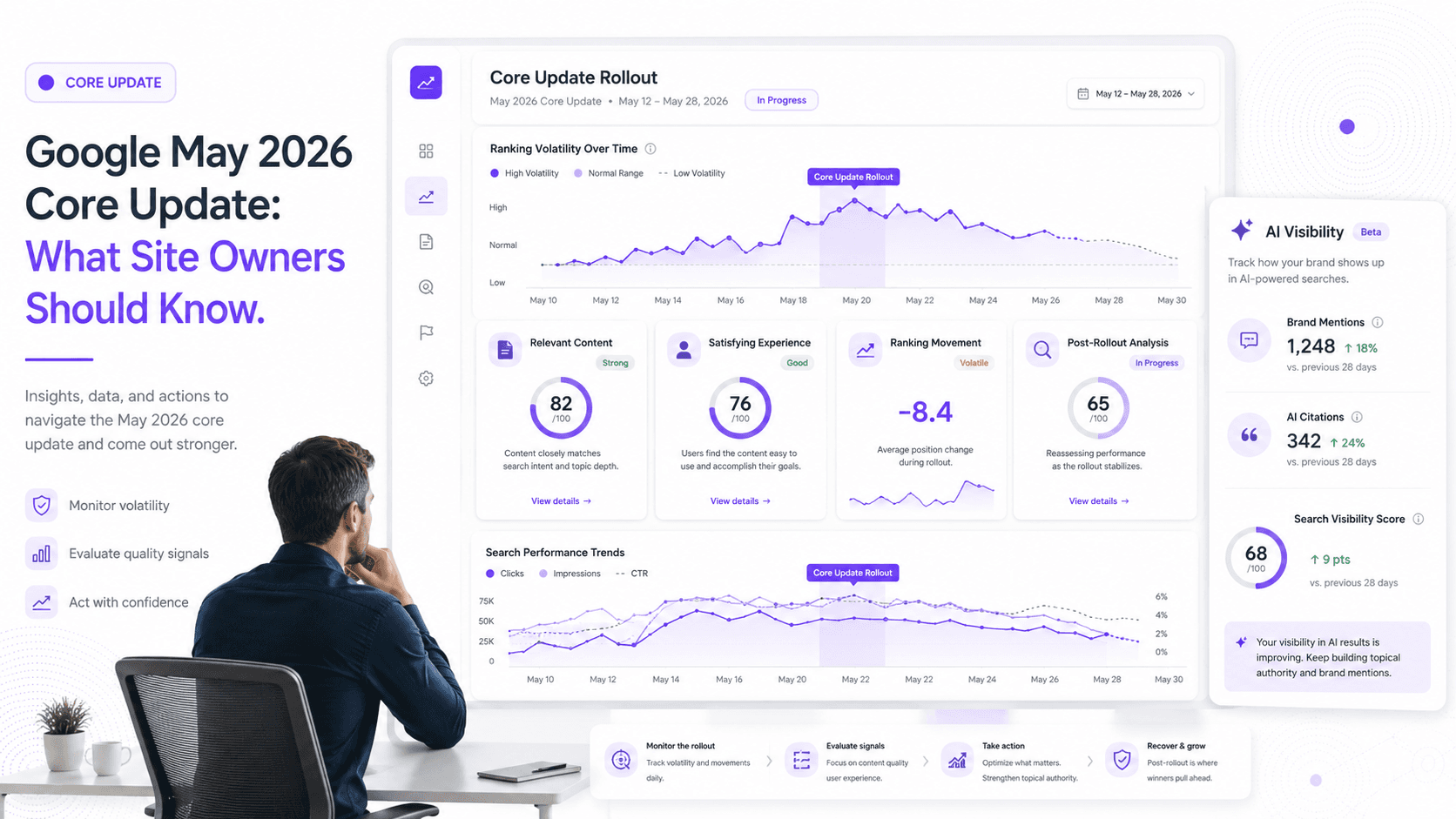
The rollout began on May 21, 2026, and finished after 11 days and 21 hours, according to Google’s Search Status Dashboard. Now that the rollout is complete, site owners can start reviewing impact in Google Search Console instead of reacting to daily volatility.
Google May 2026 Core Update: Why Relevant, Satisfying Content Still Matters in the AI Search Era
Just when it feels like the last update has finally stopped rattling your charts, Google ships another one. Google says it started rolling out the Google May 2026 core update on May 21, 2026. Per the official Google Search Status Dashboard, the rollout could take up to two weeks.
If your analytics look jumpy, you’re in good company. This is the second confirmed core update of 2026, after the previous March 2026 core update. The timing is also hard to miss: it lands right after Google I/O, where the company laid out major AI-driven changes to Search. Strip away the chatter, and the practical question is simple: what should site owners do now?
What Google Officially Announced
Core updates invite a lot of confident guessing. Ignore most of it and stick to what Google has actually published. There’s no backchannel here: the details are on the Google Search Status Dashboard and, once the rollout finishes, on Google’s ranking history page. The confirmed basics look like this:
May 2026 Core Update: Rollout Complete
Google’s May 2026 core update is officially complete. The update started on May 21, 2026, and ran for 11 days and 21 hours. This means SEOs can now move from monitoring volatility to analyzing confirmed impact.
Avoid judging performance only by rollout-period swings. The better approach is to compare stable pre-update data with post-rollout data after rankings have had time to settle.
- It is the May 2026 core update. No special branding; it’s a broad update to ranking systems.
- The rollout began on May 21, 2026.
- It affects Google Search ranking systems broadly. Google describes it as a “regular update designed to better surface relevant, satisfying content for searchers from all types of sites.”
- The rollout may take up to two weeks. Expect churn while it runs.
- Google will update its ranking history page after the rollout completes.
What is a Google Core Update?
Google’s terminology can make this sound more mysterious than it is. A core update isn’t a penalty, and it usually isn’t aimed at one niche (like affiliates) or one tactic (like using AI). It’s closer to a broad re-weighting of how Google evaluates pages. In Google’s core update documentation, the company frames these as wide changes to ranking algorithms and systems meant to improve results. The web shifts, user expectations shift, and Google adjusts its scoring to match.
Why Rankings May Change During the Rollout
Watching rankings slide is stressful, even when you’ve seen it before. During a core update, though, movement is part of the process. A drop doesn’t automatically mean your page is “bad” or that Google has decided you’re spam. Google’s guidance on its core update page is blunt: sometimes you fall because other pages now look like a better fit for the query. Your content is being re-scored against everything else competing for that same attention. When previously under-ranked pages rise, something else has to move down. That’s the math.
What We Saw During the Rollout
The May 2026 core update appeared volatile across the rollout, with noticeable ranking movement early in the update and again near the end. That does not automatically mean every affected site has a quality problem. Core updates are broad recalibrations, and Google says pages can move down simply because other pages are now being assessed as more helpful or relevant for the query.
The key is not to diagnose from one ranking swing. Look for sustained losses in clicks, impressions, and average position after the update has settled.
What Site Owners Should Do Right Now
The most useful move right now is also the least satisfying: stay calm and don’t thrash. Teams often do the most damage mid-rollout by pushing rushed edits based on noisy, half-formed data. Google’s own advice leans toward patience for a reason. For the next two weeks, keep it to this:
| What to do | Why it matters |
|---|---|
| Wait at least one full week before final analysis | Google recommends this before comparing Search Console data |
| Compare May 14–20 vs June 9–15 | Clean pre/post window around the update |
| Check pages and queries separately | Sitewide traffic hides where the real impact happened |
| Separate Web, Images, Video, and News performance | Google recommends checking different search types separately |
| Avoid quick-fix edits | Google says to focus on meaningful, sustainable improvements |
How to Analyze Impact in Google Search Console
After the rollout settles, you can do a proper Search Console core update analysis. This isn’t the moment for a quick look at the top-line traffic chart and a shrug. You need to pull the thread until you find what actually changed. If you want the full walkthrough, there’s a separate guide on analyzing performance in Search Console; here’s the short version.
Compare before vs. after the update
In Google Search Console, use date comparison. Set the “before” window to the week leading up to May 21, and set the “after” window to a week after Google confirms the rollout is done. If you skip this step, everything else is guesswork.
Check pages, not just sitewide traffic
A sitewide dip is the smoke, not the fire. The useful signals show up at the URL level. In the Performance report, filter down to the pages that gained or lost the most impressions and clicks. Do the declines cluster in one hub? Do they share a template or format? Patterns like that are usually where the explanation lives.
Check queries and intent shifts
Sometimes the issue isn’t “quality” so much as what Google thinks the searcher wants now. Review the queries tied to impacted pages and ask whether the expected answer type changed. Maybe Google is leaning toward video for that topic, or rewarding pages with detailed, step-by-step instruction where it used to rank a broad overview.
Separate Search, Discover, and AI visibility
Search visibility isn’t one metric anymore, so don’t treat it like one. The Google Search Console and Analytics guide shows how to separate traditional web search from surfaces like Google Discover. AI Overviews are trickier: they don’t map cleanly to classic rank tracking, and “visibility” can mean being cited, mentioned, or ignored in an AI-generated answer. As Google leans harder into AI-led experiences, teams need to watch those mentions alongside the usual positions and clicks.
How to Improve Content After a Core Update
If you’ve confirmed meaningful losses, the next question is what to do after a Google core update. The frustrating part is that the answer is familiar, and slow. Google’s guidance in its core update documentation and the broader ranking systems guide keeps pointing back to the same direction: publish content that’s genuinely helpful, reliable, and satisfying for humans. Start with the pages that took the biggest hit, then tighten clarity, add originality where it’s thin, and shore up trust signals where readers would reasonably want them.
Does This Update Affect AI Overviews or AI Mode?
Google has not said this update is specific to AI Overviews or Google's AI Mode. However, Google’s AI features and your website guidance says the same SEO fundamentals still apply across AI features and traditional Search. The practical implication is straightforward: there’s no separate trick to chase, but the tolerance for vague, thin, or sloppy content keeps shrinking. It’s worth monitoring both classic rankings and how your content appears across AI-led search experiences.
The bigger SEO implication is not that this core update specifically targeted AI Overviews or AI Mode. Google has not said that. The bigger point is that AI-led search is changing the value of every ranking position. As AI Overviews and AI Mode take more attention inside the SERP, fewer organic clicks may be available. That makes strong classic rankings, source visibility, and citation visibility more important, not less.
What Not to Claim About the May 2026 Core Update
Over the next few days, the hot takes will multiply. A decent rule: if Google didn’t say it, treat it as speculation. Be especially wary of anyone insisting this update is explicitly targeting:
| Claim | Why It's Likely Wrong |
|---|---|
| It targets AI-generated content. | Core updates are broad. Low-quality AI output can get hit, but the update isn’t about AI specifically. High-quality, human-edited AI content can still do fine. For teams tracking how content performs across classic rankings and AI-led search surfaces, Vizup can help monitor visibility, brand mentions, and citations. |
| It targets affiliate or ecommerce sites. | Core updates aren’t tied to one industry. Some affiliate sites will drop, but that’s about perceived quality, not the business model. |
| It is a spam update. | Google runs separate spam updates. Core updates are about re-ranking based on quality signals, not issuing spam penalties. |
| It is a penalty. | A core update reshuffles results; it doesn’t “penalize” in the technical sense. You can lose ground simply because other pages now look more relevant. |
Final Takeaway
The Google core update 2026 drumbeat keeps going, and the underlying message hasn’t changed: write for people, not the algorithm. Watch the rollout without overreacting, wait for it to finish, then compare before-and-after data with some discipline. From there, improve what actually under-serves the query, usefulness, relevance, and the ability to leave a reader satisfied. With AI-powered search taking up more space, that standard isn’t getting easier. If you need a structured approach, these AI content strategy frameworks are a solid place to start.
Frequently Asked Questions
When did the Google May 2026 core update start?
Google says the Google May 2026 core update began rolling out on May 21, 2026.
How long will the May 2026 core update take to roll out?
Google’s estimate is up to two weeks. The current status is posted on the Google Search Status Dashboard.
Is the May 2026 core update a penalty?
No. A core update is a broad re-evaluation of ranking systems. If you drop, it typically means other pages are being judged more relevant for those queries, not that your site was penalized.
Should I make changes to my site right now?
Hold off on major changes until the rollout is finished. Results swing during the update, and decisions made on mid-rollout data are easy to regret.
How do I know if my site was affected by the Google core update?
Once the rollout is complete, use Google Search Console to compare the week before May 21 with a week after the update ends. Look for sustained declines in impressions and average position on key pages and queries, not day-to-day noise.
Is the May 2026 core update complete?
Yes. Google’s Search Status Dashboard shows the May 2026 core update began on May 21 and lasted 11 days, 21 hours.
When should I analyze traffic impact?
Wait at least one full week after the rollout completes. Then compare the week after completion with the week before the update began.
Did the May 2026 core update target AI content?
Google has not said that. Core updates are broad ranking system updates. Low-quality AI content may lose visibility, but the issue is usually usefulness, originality, trust, and satisfaction, not AI usage alone.
