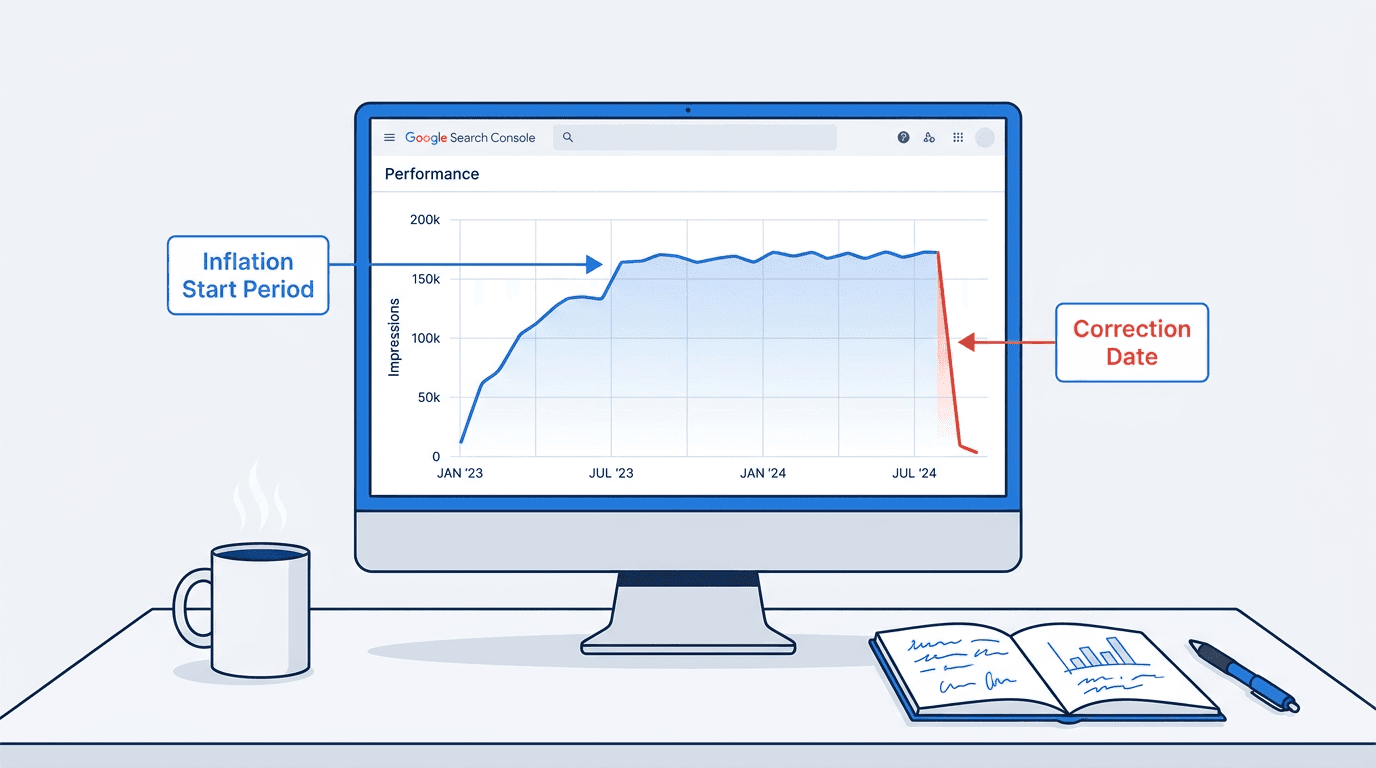
If you opened Google Search Console in late April or early May 2026 and saw impressions nosedive, you weren’t alone in reaching for the panic button. The Google Search Console impressions drop 2026 set off the usual chain reaction: frantic Slack threads, rushed client calls, and a bunch of "what did we break?" audits that didn’t need to happen. The boring truth is also the reassuring one: your site is almost certainly fine. Google confirmed a logging error caused inflated impression counts in GSC starting May 13, 2025, and the fix that rolled out on April 27, 2026, simply brought the numbers back down to where they should’ve been all along.
This isn’t a performance slide. It’s Search Console finally stopping a quiet inflation that lasted most of a year. By the end, you should be able to pin down how much your account was affected, reset CTR expectations, explain the change to stakeholders without sounding like you’re backpedaling, and tighten up reporting so the next platform-side glitch doesn’t ambush you.
What we'll cover:
- Phase 1: Understanding what actually happened with the GSC logging error
- Phase 2: Assessing and quantifying the impact on your reporting
- Phase 3: Communicating the anomaly to stakeholders
- Phase 4: How to read GSC data in 2026 and beyond
- Phase 5: Why independent visibility tracking matters now more than ever
Phase 1: Understanding the GSC Impressions Bug and Its Fix
The GSC logging error May 2025 didn’t arrive with a splashy announcement. On May 13, 2025, something in Google’s pipeline started overcounting impressions for certain query types. And because the metric was moving in the "good" direction, it didn’t set off the usual alarms. The charts looked healthy. In hindsight, they were a little too flattering.
Google later acknowledged the issue on its Data Anomalies page, confirming the affected window ran from May 13, 2025, through April 27, 2026. The detail that matters for reporting is simple: Clicks were not affected, but impressions and related metrics such as CTR and average position were affected because they depend on impression logging. Only impressions were inflated. So the clicks you reported during that stretch still hold up. The impression totals don’t, at least not as an absolute measure.
When the GSC impressions bug fixed in late April 2026, the graph didn’t ease into it. The correction landed all at once. Impressions dropped to their real level, which is why so many accounts show that brutal cliff. It’s scary-looking, but it’s also the system getting closer to the truth.
Info: This was a data collection issue on Google's side, not a ranking change, algorithm update, or penalty. Your actual search visibility during the bug period was likely lower than what GSC reported.
Phase 2: Assessing the Impact on Your Site's Reporting
The hit wasn’t uniform. Some accounts barely moved; others saw impressions fall 30-40% overnight. That spread comes down to whether your queries lined up with the patterns that were being overcounted, and how much of your overall visibility lived in those buckets.
Isolating the Anomaly in Your Account
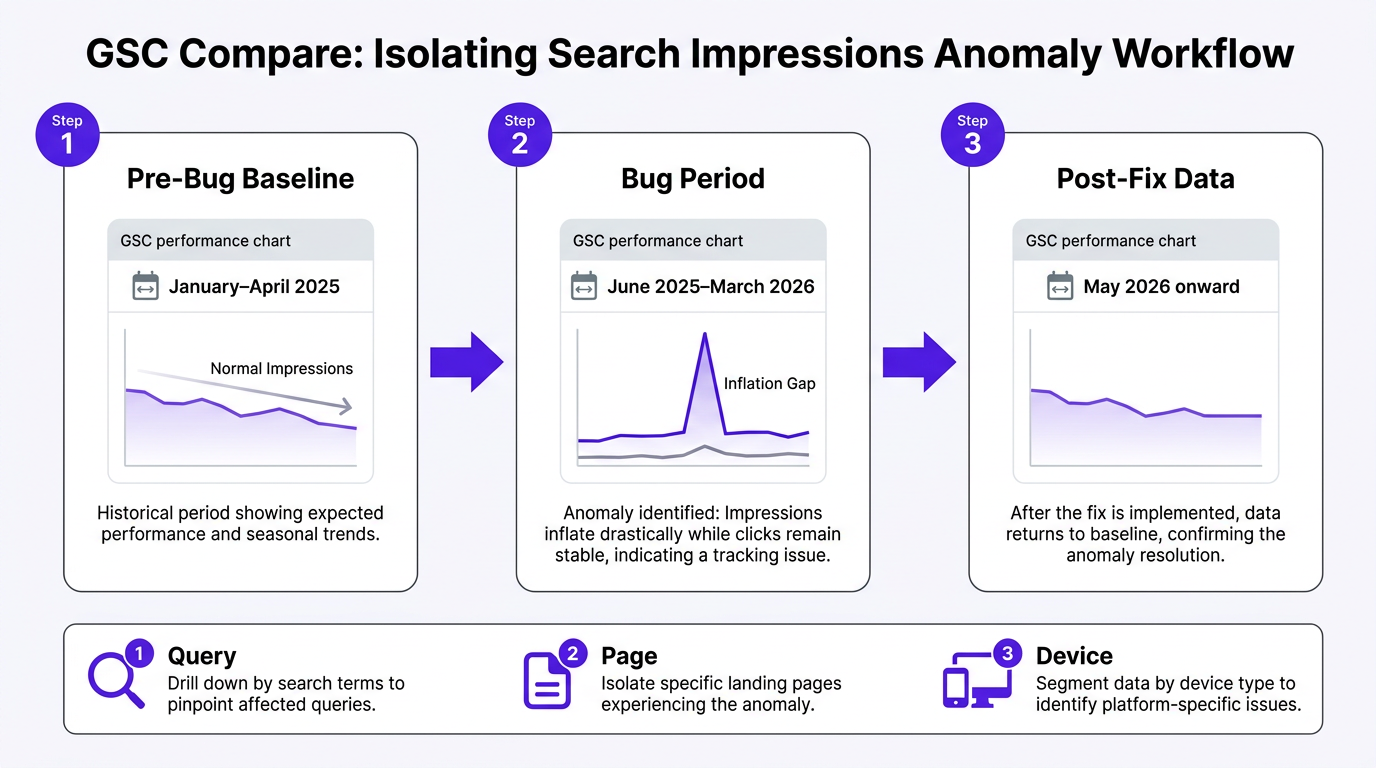
Start in GSC’s Performance report and use Compare to build three windows: pre-bug (January to April 2025), during-bug (June 2025 to March 2026), and post-fix (May 2026 onward). Segment in a sensible order: begin with query, then drill into page, then device. You’re hunting for the telltale pattern: impressions spike during the bug window compared to both before and after, while clicks stay roughly steady.
Where that gap is widest is where the inflation did the most damage to your reporting. Export those segments. You’ll use them to reset benchmarks and to show stakeholders exactly what changed.
Recalculating Your True Click-Through Rate
This is where the impressions CTR reporting error really messes with perception. CTR is clicks divided by impressions, so bloated impressions made CTR look worse than it was for nearly a year. If the real number was 10,000 impressions but GSC logged 15,000, and you earned 500 clicks, GSC would report a 3.3% CTR even though the real CTR was 5%. That’s the difference between "we’re underperforming" and "we’re fine" in plenty of quarterly decks.
The cleanest way to handle it is to anchor on the periods you can trust. Use pre-bug CTR (January to April 2025) as a baseline, then sanity-check it against post-fix CTR. If a query cluster ran 4.2% before the bug and sits around 4.5% after the fix, it’s fair to say the true CTR during the anomaly likely lived in that neighborhood, not the 2.8% GSC was showing. Avoid trying to reverse-engineer exact historical impressions; you’ll burn time and still end up with a guess. Treat post-fix data as the new baseline and document that the bug artificially depressed CTR during the affected window.
Phase 3: Communicating This to Stakeholders
Don’t apologize for a platform correcting its own numbers. Your job isn’t to keep charts pointing up; it’s to tell people what the charts actually mean. A bug fix that makes the data more accurate is good news. If you present it that way, you sound like the person who understands the instrumentation, not someone scrambling for cover.
With non-SEO stakeholders (a CEO, a client’s VP of Marketing), keep it tight: (1) Google had a year-long logging error that overstated impressions, (2) Google fixed it, so the current numbers are the accurate ones, and (3) clicks and conversions were never affected, only impressions. Start with the clicks and revenue staying clean. That’s the part they’ll care about, and it helps prevent the conversation from spiraling into vanity-metric panic.
Tip: Frame it as: 'Our data just got more accurate. Here's what that means for our reporting going forward.' Not: 'Our impressions dropped and here's why it's not our fault.'
Phase 4: How to Read GSC Data 2026 and Beyond
Year-over-year reporting is going to be awkward for a while. Any YoY comparison that crosses the May 2025 to April 2026 window will pit inflated historical impressions against accurate current ones. Google has confirmed they aren't backfilling corrected data for that period, so the distortion is baked into your Search Console history permanently.
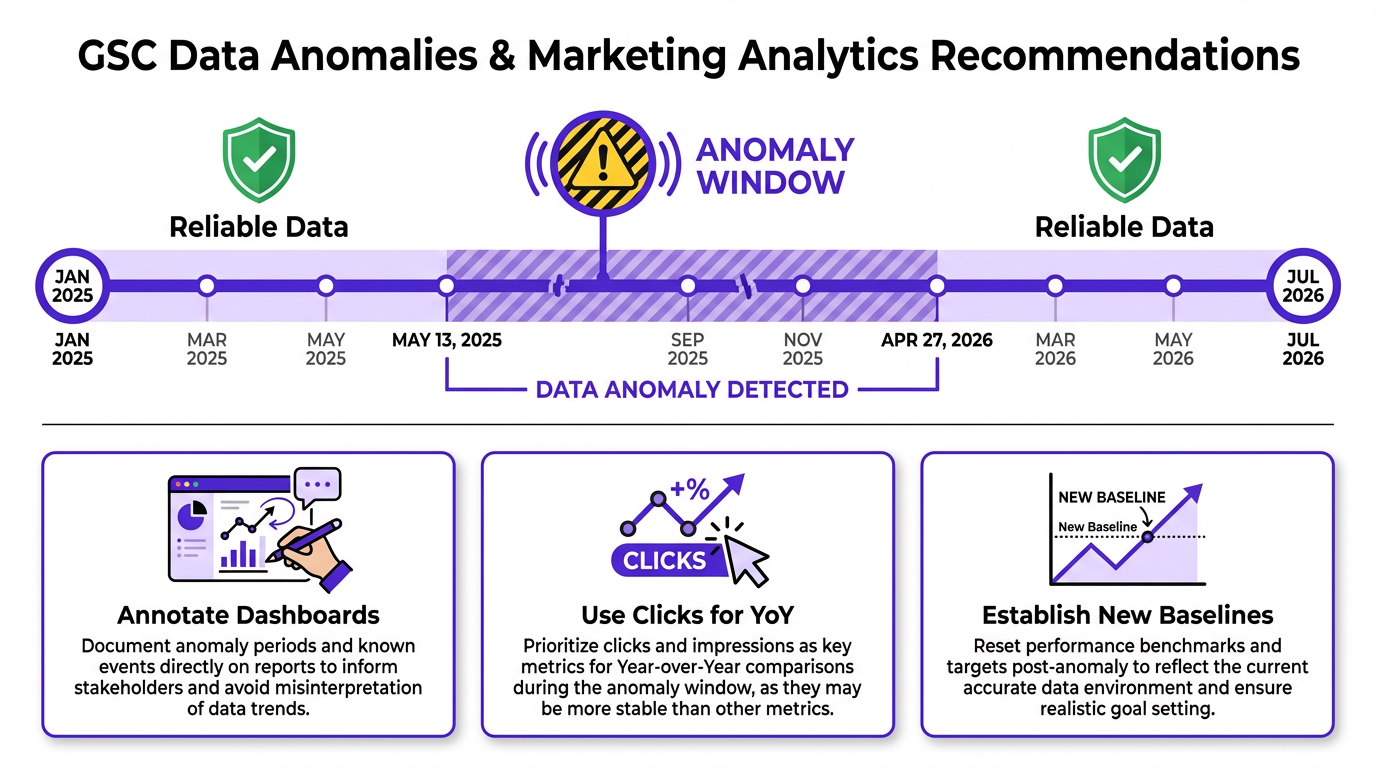
Put a note everywhere GSC impressions show up: Looker Studio dashboards, GA4 reports, internal slide decks. Any chart that includes that window needs a permanent annotation so nobody "rediscovers" the cliff six months from now and escalates it all over again. If you’re doing a Google Analytics data cleanup, fold these anomaly notes into the same hygiene checklist.
For YoY reporting through early 2027, prioritize clicks and conversions as the comparison set. Treat impressions as directional: useful for spotting shifts, unreliable for measuring absolute performance across the anomaly period. If you’re tying SEO to a B2B pipeline in GA4, make sure your GA4 setup accounts for these data hygiene issues so one platform’s quirks don’t cascade into another set of reports.
The easy mistake is to treat this as a one-and-done cleanup and move on. The bigger lesson is that impressions have always been squishier than clicks. Clicks are a real action. Impressions are Google’s estimate of how often your listing appeared, filtered through counting rules you don’t control and can’t audit. This time, those rules were wrong for almost a year.
Phase 5: Why You Need Independent Visibility Tracking
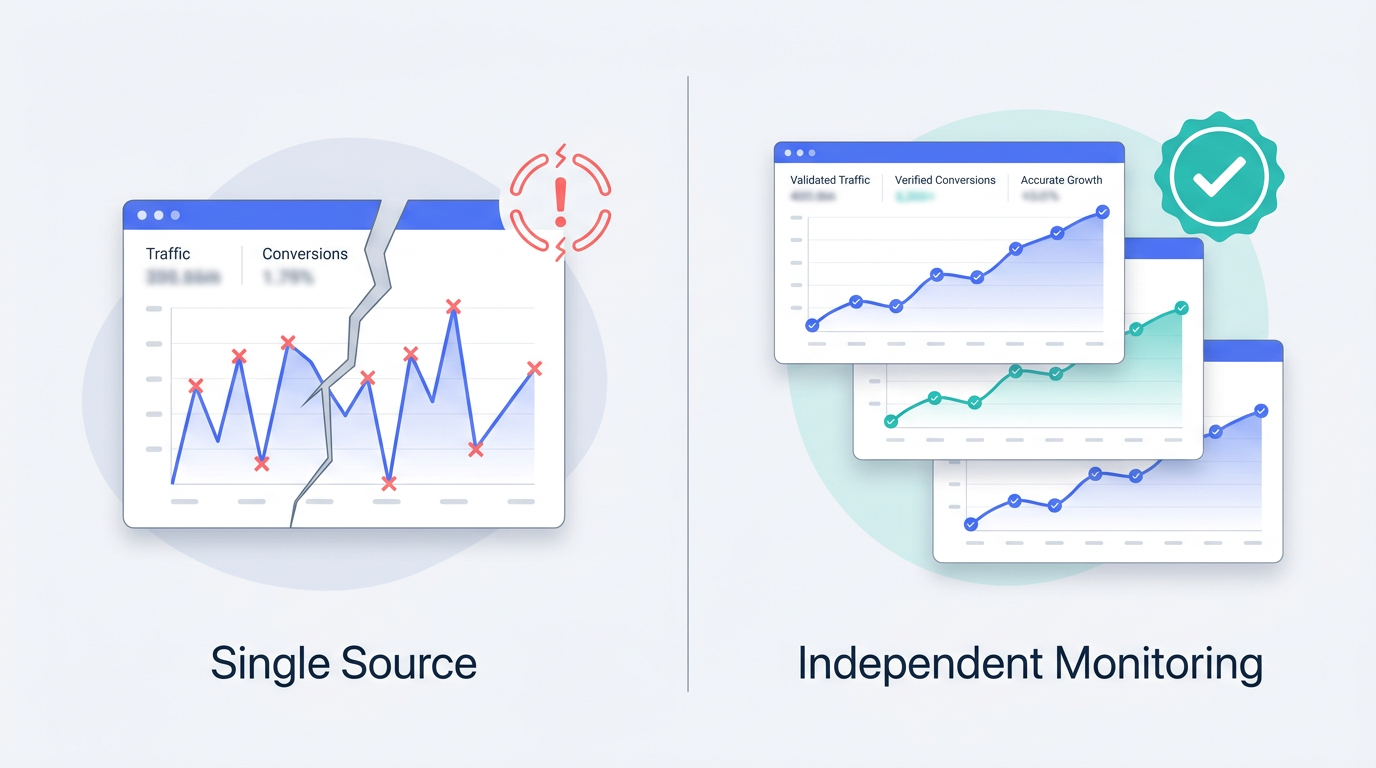
GSC is still essential. It’s also a single point of failure for visibility reporting. When the same platform that supplies the metric is the one that miscounted it, you don’t have an external reference. You’re trusting the dashboard until Google tells you not to.
That’s why independent monitoring earns its keep. Tools that track organic visibility from the outside, using search result scraping and answer engine monitoring, give you a second set of numbers that doesn’t depend on Search Console’s internal logging. If the independent view stays steady while GSC shows a sudden drop, you can treat it as a data correction, not a ranking emergency. No all-hands audit. No wasted hours.
Vizup's Watcher Agent for organic visibility monitoring does exactly this: it tracks your presence across traditional search and AI answer engines without relying on any one platform’s reporting pipeline. When the next GSC anomaly hits (and there will be a next one), you’ll have a stable yardstick to check against instead of guessing whether the sky is falling.
Frequently Asked Questions
Was the Google Search Console impressions drop in 2026 a ranking penalty?
No. Google said this was a logging correction, not a ranking shift or a manual action. Rankings and clicks didn’t suddenly crater; the impression metric simply dropped back to its accurate level after months of over-reporting.
Which types of queries were most affected by the GSC impressions bug?
Google hasn’t shared the specific query types that triggered the over-counting, and the impact varies widely by site. Use GSC’s Compare feature and segment by query, page, and device to find where impressions were inflated while clicks stayed relatively steady.
Will Google correct the historical data from the bug period?
No. Google fixed the issue going forward as of April 27, 2026, but it isn’t rewriting the historical impressions for May 13, 2025, through April 27, 2026, according to Search Engine Land (2026). Treat that window as unreliable and annotate reports accordingly.
My impressions didn't drop. Does that mean my site wasn't affected?
Not necessarily. If your query mix didn’t overlap much with whatever was overcounted, the correction could be small enough to miss. It can also be masked by real growth during the same period. Compare pre-bug and post-fix impression levels for your top queries to see whether the anomaly shows up in your account.
How does this GSC bug affect my Core Web Vitals reporting?
It doesn’t. The issue was limited to impression counting in the Performance report. Core Web Vitals, indexing, and the rest of Search Console weren’t impacted by this specific logging error.
Key Takeaways
The Google Search Console impressions drop 2026 was a correction, not a crisis. Clicks weren’t affected, and CTR during the bug window was better than it looked because impressions were overstated. Since Google isn’t fixing the historical data, annotate dashboards and lean on clicks for YoY comparisons through early 2027. If this episode made you uneasy about trusting a single platform’s self-reported visibility metrics, take that seriously: add independent monitoring so the next anomaly is a quick cross-check, not a fire drill.
