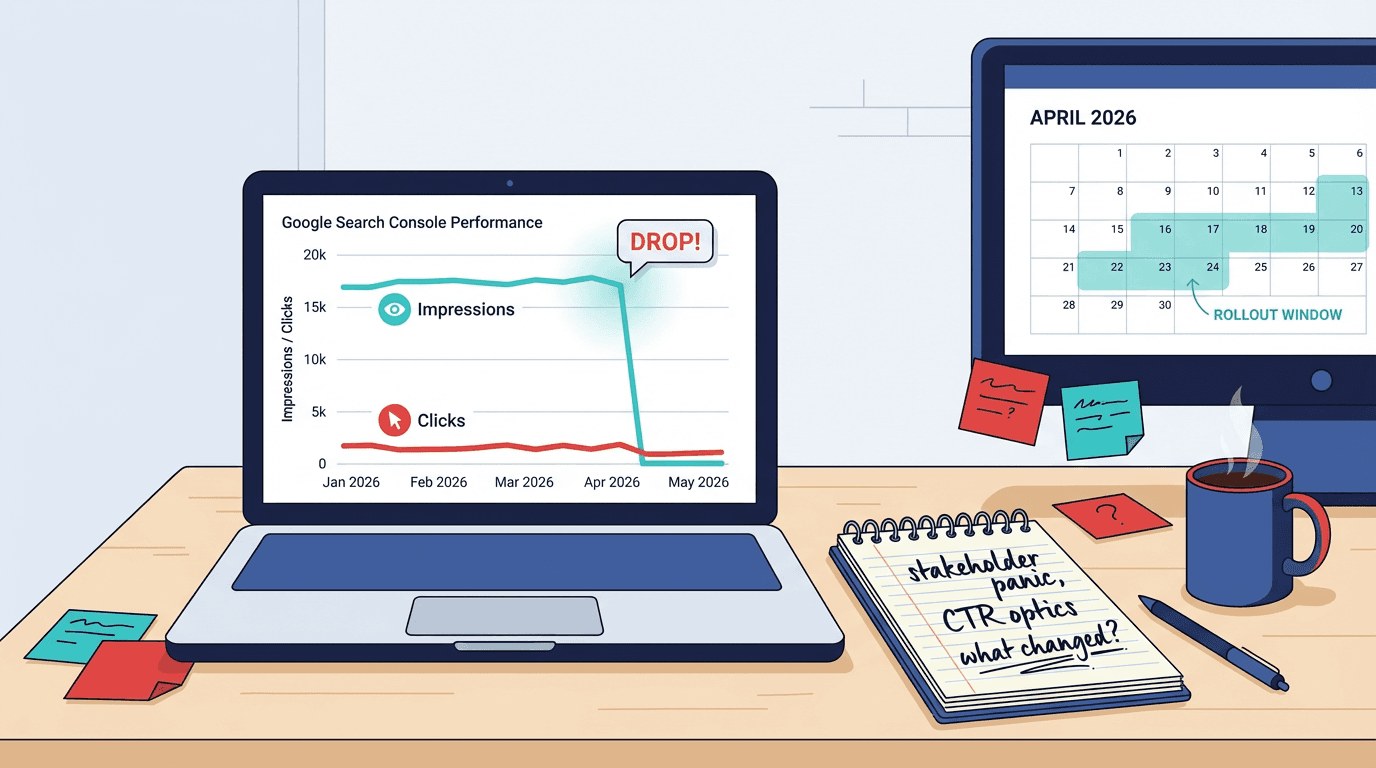
My unpopular opinion: inflated impression counts are not the crisis SEOs are making them out to be. They’re an optics problem, a reporting problem, and a stakeholder-management problem. But for actual search performance? Most of the time, they’re background noise.
If you’ve ever had a Slack thread explode because “impressions fell 38% overnight,” you know the feeling. Someone inevitably says “Google penalized us,” someone else starts screenshotting charts, and suddenly you’re defending work that’s still producing the same clicks, the same leads, the same revenue. That’s the trap. We trained everyone to worship the top-of-funnel number because it’s big and it moves.
What actually happened with inflated impression counts (and why it matters right now)
Google confirmed a logging error that caused Search Console to over-report impressions starting May 13, 2025 (reported by Search Engine Land, 2026). The important detail is the boring one: Google clarified the issue only affected impression counts, clicks and other metrics were not affected (same source).
Then came the second wave of chaos: the fix. ALM Corp’s breakdown notes the correction is rolling out over several weeks in April 2026, and site owners should expect impression counts to decrease as the fix lands (ALM Corp, 2026). So yes, you can watch your graph “fall” in real time depending on when your property gets updated.
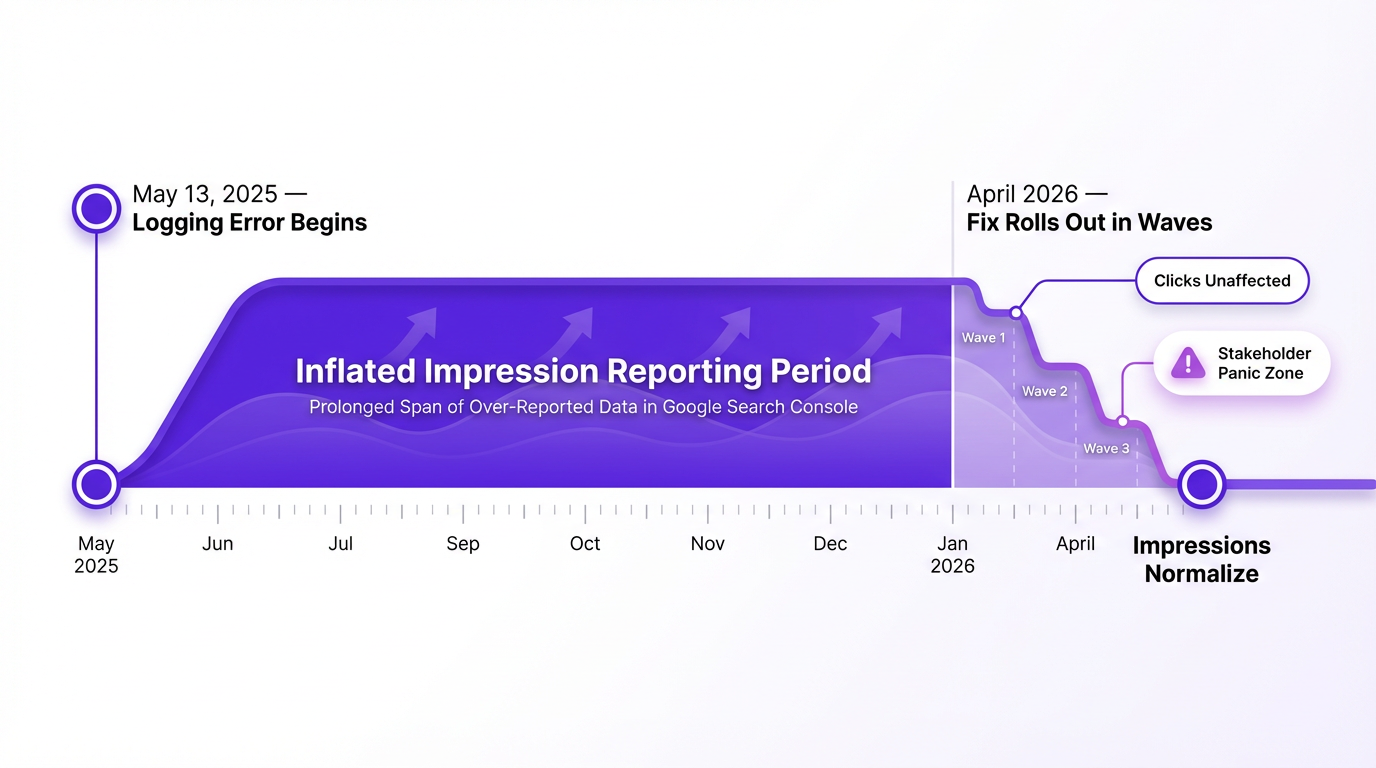
Why it matters right now is simple: a whole lot of teams built 2025 and early 2026 narratives on top of a number that was quietly too high. Some agencies sold “visibility growth.” Some in-house teams got budget. Some people got promoted. And now the chart is going to look like gravity suddenly turned on.
If you need the official basics for how Search Console works (and how Google defines an impression), it’s worth keeping Google Search Console handy as the canonical reference. Google’s own documentation is also where that non-intuitive rule lives: an impression is counted when a link appears on the current page of results, even if the user never scrolls it into view.
My take: impressions were always a vanity metric, we just pretended they weren’t
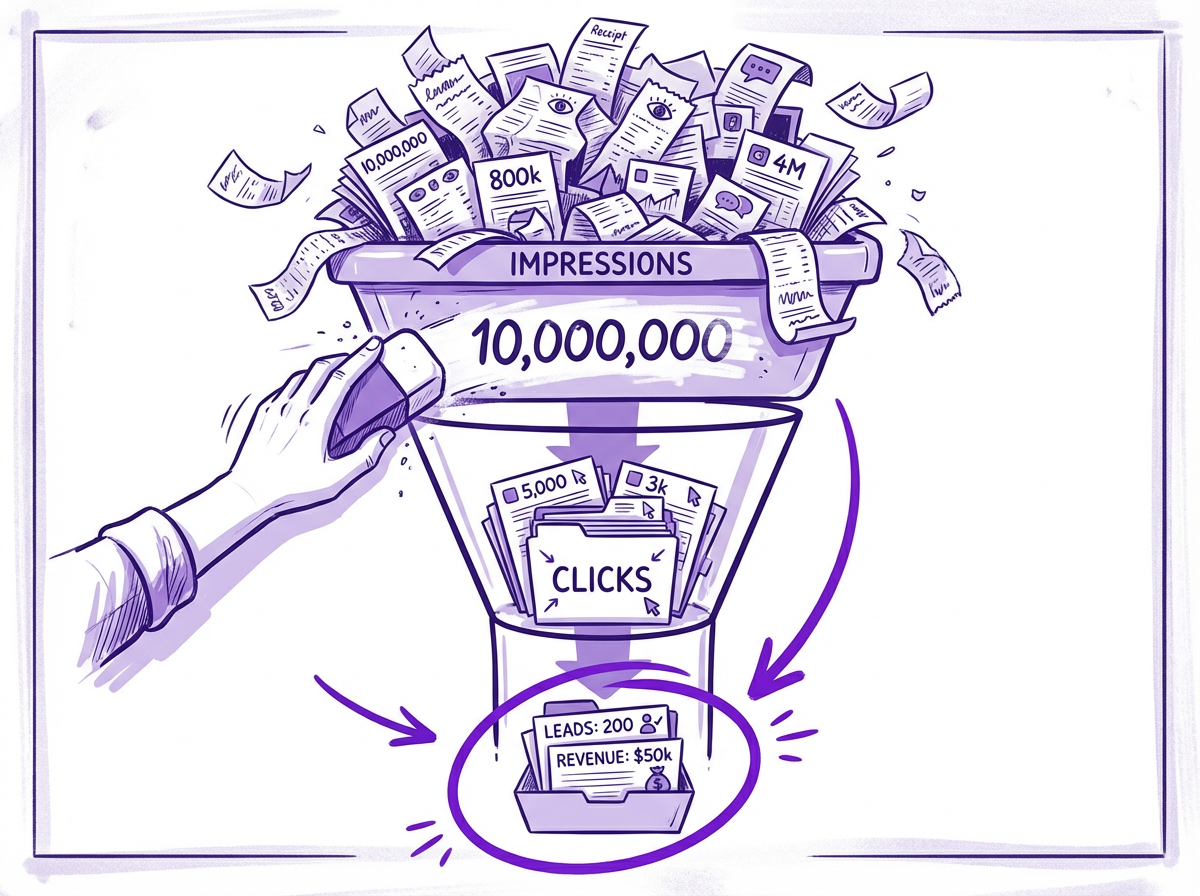
I’ve been in too many QBRs where impressions did all the talking. Not because they’re the best metric, but because they’re the easiest metric to make sound impressive. “We got 4.2 million impressions” lands better than “we improved qualified clicks by 9%,” even when the second one is the only thing that pays salaries.
Inflated impression counts just exposed something that was already true: impressions are a proxy for opportunities, not outcomes. They’re useful when you’re diagnosing coverage (are we showing up for the queries we should?), and they’re useful when you’re watching for sudden SERP feature changes. They’re not a KPI you should be defending like it’s pipeline.
Here’s the lived-in part. I’ve seen teams spend two weeks writing a “visibility report” after an impressions spike, only to discover the spike came from ranking on page nine for a trending query that nobody clicks. The spike looked great in a deck. It did nothing for the business. That’s not a Google bug problem. That’s an incentives problem.
So when impressions normalize downward, I’m not mourning. I’m relieved. It forces the conversation back to metrics that can’t be faked by a logging error: clicks, conversions, assisted conversions, and the quality of the queries you’re winning.
The part most SEOs miss: GSC impressions are weird even when they’re “correct”
Even without the bug, impressions in Search Console have always been a little slippery. Google counts an impression when your link appears on the current results page, even if the user never scrolls far enough to see it. That’s not a conspiracy, it’s just how the metric is defined. It’s also why “we doubled impressions” can mean “we moved from position 12 to position 9,” which is a real improvement but not always a traffic event.
And the SERP itself is no longer a tidy list of ten blue links. AI Overviews, carousels, “People also ask,” local packs, video blocks, and shopping modules all change what “appears on the page” even means. The result is that impression volatility can come from layout changes, not ranking changes.
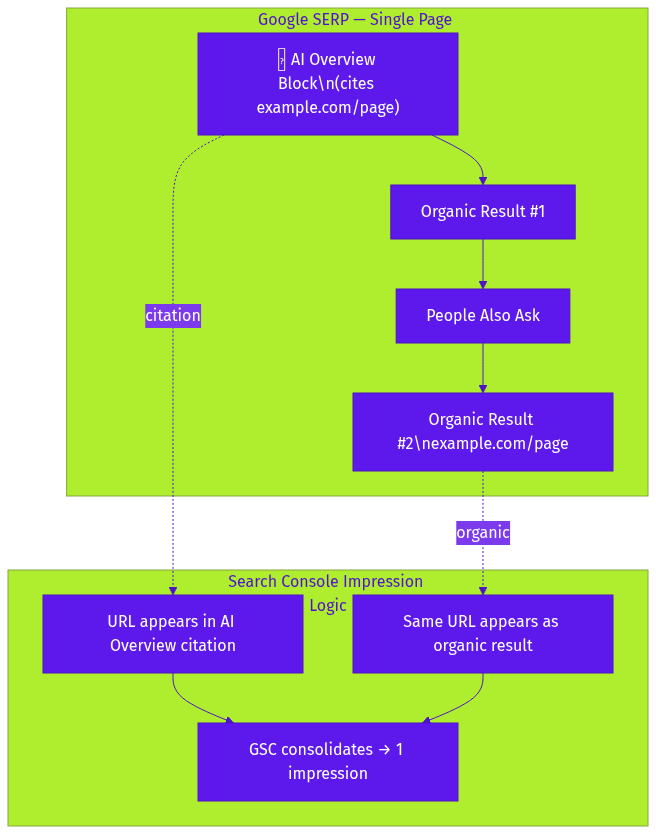
Google also consolidates impressions when the same URL appears multiple times on a single results page, for example in an AI Overview citation and again as a standard organic result. Search Console counts that as a single impression to avoid artificial inflation (Vizup, 2026). If you want the nuance, Vizup has a clean explanation of how AI in search changes SEO, and yes, it changes what you should expect from reporting too.
So when people say “GSC impressions are inflated,” I always ask: inflated compared to what? Compared to last month? Compared to GA4 sessions? Compared to what your CEO wants the number to be? The metric is internally consistent most of the time, but it’s not a mirror of human attention.
What inflated impression counts really break: CTR narratives, not SEO performance
The ugliest side effect of inflated impression counts is the fake CTR story it creates. If impressions are overstated while clicks are accurate, your CTR looks worse than reality. Then the “fix” lands, impressions drop, and suddenly CTR “improves” without you changing a single title tag.
I’ve watched teams take victory laps on that CTR bump. Please don’t. It’s not a growth strategy, it’s a math correction.
| Scenario | Clicks | Impressions | CTR | What people think happened |
|---|---|---|---|---|
| During logging error | 1,000 | 100,000 | 1.0% | “Our snippets are weak” |
| After fix rolls out | 1,000 | 70,000 | 1.43% | “We fixed our CTR” |
| Reality | 1,000 | 70,000 (true) | 1.43% (true) | Nothing changed, only reporting did |
| Clicks stay constant, impressions normalize, CTR appears to “improve.” |
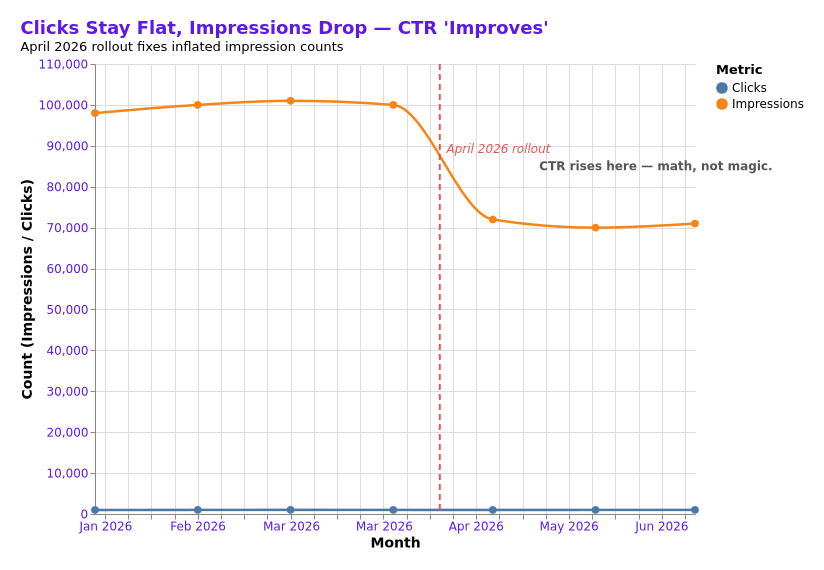
What should you do with CTR during this period? Treat it like you’d treat any metric during an instrumentation change: annotate it, segment it, and stop using it as a performance bonus trigger for a month. If you’re running SEO experiments, separate pre-fix and post-fix windows so you don’t attribute a reporting artifact to your work.
Also, a small but practical point: if your team reports “share of voice” using impression totals, you need to re-baseline. Otherwise you’ll spend the next quarter explaining why your “visibility index” fell while revenue held steady.
The real risk is organizational: impressions are the easiest metric to weaponize
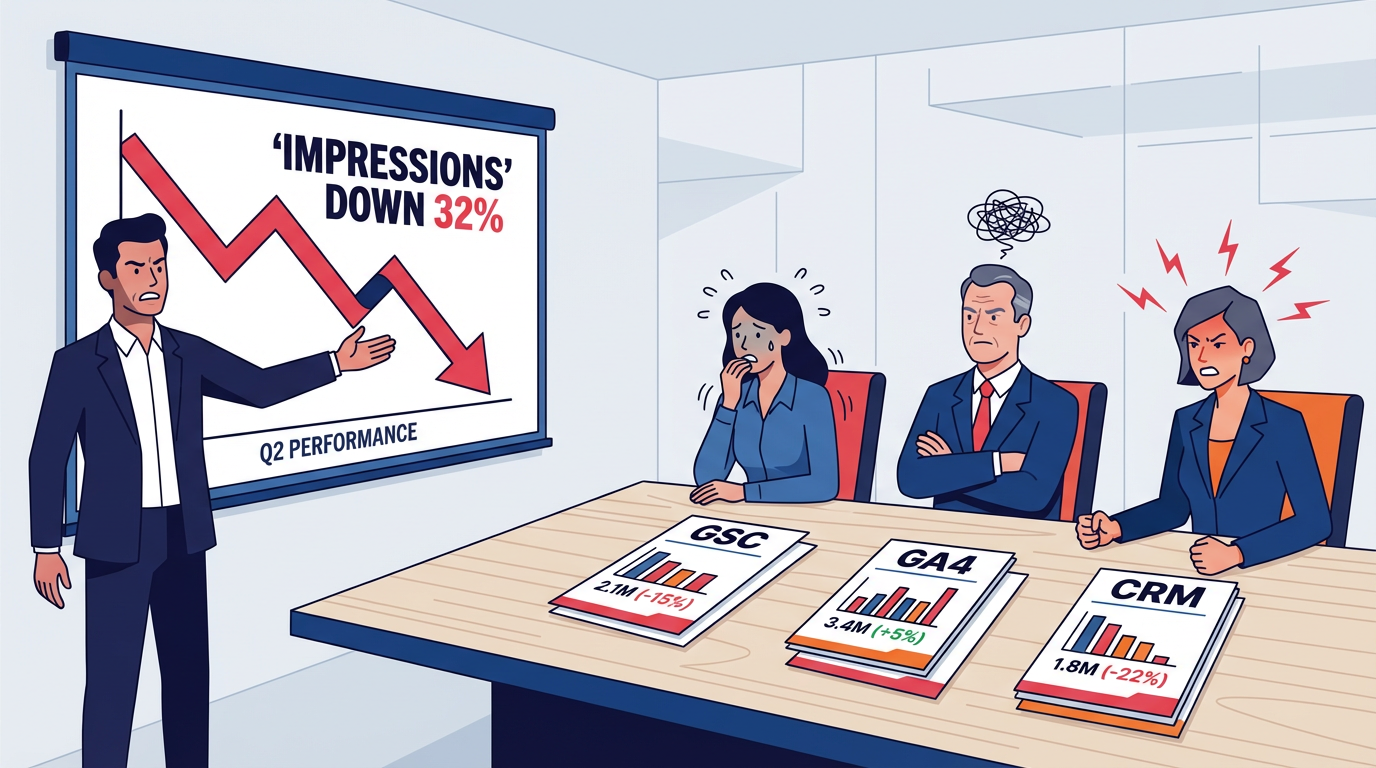
Here’s what I’ve seen go wrong, repeatedly, across SaaS, ecommerce, and boring B2B industries where nobody even likes marketing. A leadership team doesn’t understand search, so they latch onto the biggest number. The SEO team, wanting to be understood, leans into it. The number becomes a scoreboard. Then the scoreboard changes.
Inflated impression counts are gasoline on that fire because they create two kinds of bad behavior:
- Teams optimize for “being seen” instead of being chosen. They chase broad queries where they can rack up impressions at position 8 and call it momentum.
- Stakeholders confuse reporting corrections with performance drops and start demanding tactical thrash (rewrite everything, publish 50 posts, change the site structure) when the only real task is explaining the measurement change.
If you’re in-house, you probably recognize the second one. It’s the week where your roadmap gets hijacked by panic work. And if you’re agency-side, it’s the week where you’re writing a “what happened” memo instead of doing the work you were hired to do.
This is also why I’m not sympathetic to the “but impressions show brand awareness” argument. Brand awareness is not a line item you can infer from a link appearing below the fold. If you want brand, measure brand: direct traffic trends, branded search demand, lift studies, and sales conversations. Don’t cosplay as a brand team using a metric that was designed for search diagnostics.
Counterargument: “Impressions are an early warning system.” Yes. But people use them wrong.
The strongest case for caring about impressions is that they can signal a distribution problem before clicks fall. If impressions crater because pages drop out of results, you want to know fast. If impressions spike for a new topic cluster, you might be on the edge of a traffic lift.
I agree with that. I just don’t agree with the way most teams operationalize it.
The “early warning” use case only works when you segment impressions by something meaningful: query intent buckets, page type, country, device, or a shortlist of priority topics. Watching total impressions for the whole property is like listening to the crowd noise outside a stadium and trying to guess the score.
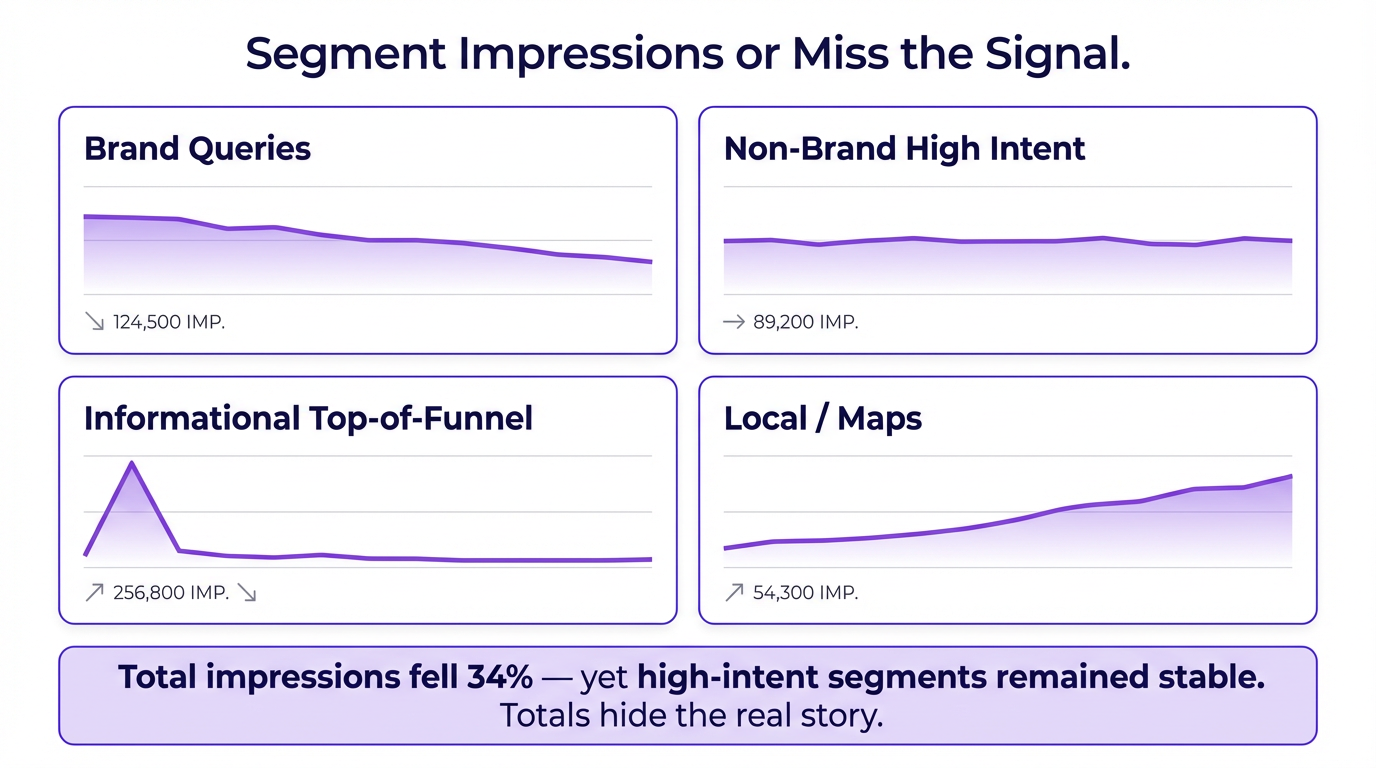
And during a known reporting correction, “early warning” becomes “false alarm” unless you annotate the dates and validate against other signals. If your rankings, clicks, and conversions are stable, the warning system isn’t warning you about SEO. It’s warning you about your instrumentation.
What I’d do in April 2026: a practical playbook that won’t waste your week
This is the part most people get wrong. They treat the impressions drop like an SEO emergency, then they ship changes that create a real SEO emergency.
Here’s a playbook I’ve used when stakeholders start spiraling. It’s not fancy. It works.
A sane sequence (in order):
- Annotate the date range in your reporting and call out the April 2026 multi-week rollout, so nobody thinks the drop is a penalty (ALM Corp, 2026).
- Use clicks as your anchor metric for the month. If clicks are stable, you’re not in crisis.
- Recalculate CTR benchmarks after the fix lands. Stop comparing pre-fix CTR to post-fix CTR like it’s the same dataset.
- Segment impressions by your money pages (product, category, service pages) versus everything else. If the “everything else” bucket took the hit, your business impact is probably minimal.
- Write a two-paragraph stakeholder note that cites Google’s confirmation that clicks weren’t affected (Search Engine Land, 2026). Keep it short. Don’t write a novel.
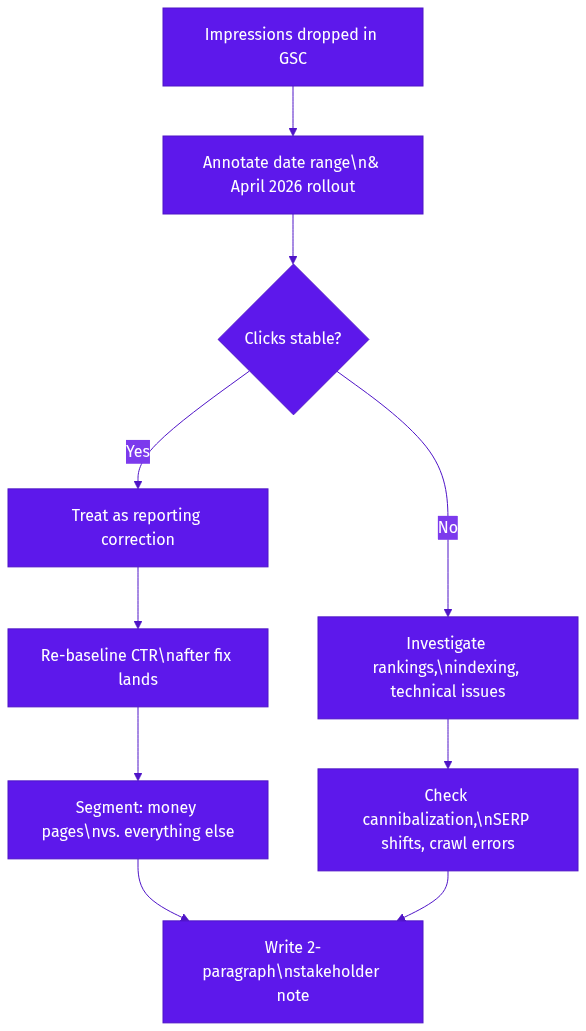
If you do discover clicks falling too, then you investigate like normal. Technical issues, indexing, cannibalization, SERP shifts, the usual suspects. If you’re rusty on the basics, Vizup’s ecommerce SEO audit guide is a solid checklist-style refresher without the fluff.
One more practical note, and I’ll keep it contained here so it doesn’t turn into a thousand mini-disclaimers: don’t make compensation, OKRs, or vendor performance clauses hinge on a single platform’s impression metric during a known logging correction. If you need a hard line, use clicks and conversions for the period, then revisit once the dust settles.
One more wrinkle: Google updates already make your charts messy, and 2026 isn’t calming down
Even if the logging error never happened, you’d still be dealing with chart turbulence. Core updates, spam updates, SERP layout experiments, AI features, and indexing quirks all show up as “weird data” before they show up as clear explanations.
If you’re trying to separate “GSC bug fix” from “actual algorithm movement,” it helps to keep a running list of what else is happening in the ecosystem. Vizup’s coverage of Google's March 2026 Core Update is a good example of the kind of context you want on hand when someone asks why a trend line changed.
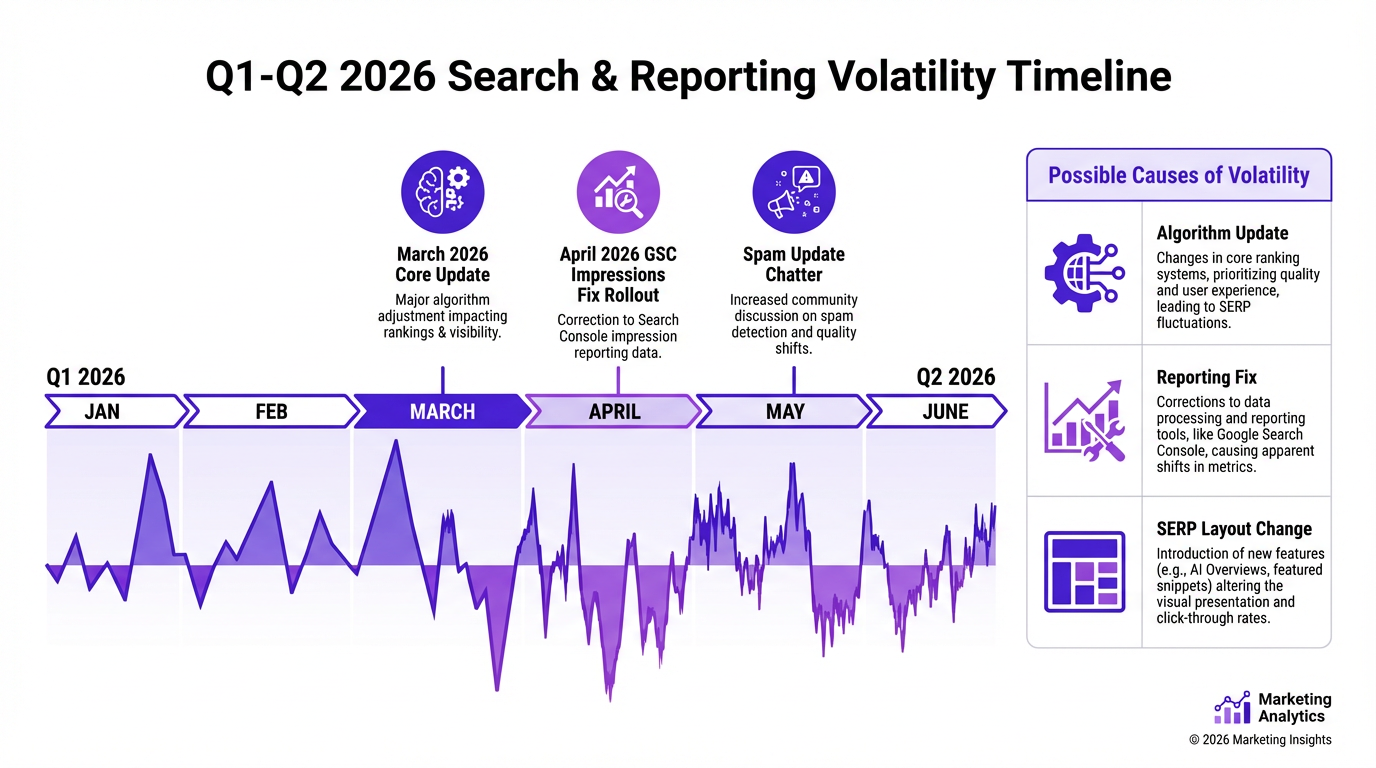
Same goes for spam enforcement. If your site plays close to the line (thin affiliate pages, scaled content, aggressive templating), you can’t blame every dip on reporting. Keep an eye on the bigger enforcement picture too, including recent Google spam updates.
FAQ
Should I report the impressions drop to leadership as a performance decline?
No, not by default. If clicks and conversions are steady, frame it as a reporting correction tied to Google’s fix for inflated impression counts, then re-baseline your CTR and visibility benchmarks.
Did the inflated impression counts bug affect clicks or rankings?
Google’s confirmation was that the logging error affected impressions only, clicks and other metrics were not affected (Search Engine Land, 2026). Rankings are a separate question and should be checked independently.
Why do impressions count even if users don’t scroll?
Because that’s how Google defines the metric: an impression is counted when your link appears on the current page of results, even if the user doesn’t scroll it into view (Google Search Console Help, undated, referenced via Google Search Console).
If my URL appears in an AI Overview and as an organic result, do I get two impressions?
No. If the same URL appears multiple times on a single results page (for example, in an AI Overview and again in organic listings), Search Console counts it as a single impression (Vizup, 2026).
What’s the fastest way to sanity-check whether this is just reporting noise?
Start with clicks in GSC, then compare against conversions in your analytics or CRM. If clicks are flat and conversions are flat, you’re almost certainly looking at instrumentation changes, not a sudden SEO collapse.
Where I land: stop worshipping impressions, start using them like an adult
Inflated impression counts are annoying, and yes, they can make you look bad in a meeting if you don’t get ahead of the narrative. But they don’t rewrite your SEO reality. They reveal it.
If your program was built on impressions as the headline KPI, this fix is going to hurt. Not because Google took something away, but because the number was always doing too much work for you. If your program is built on qualified clicks, conversion paths, and content that actually earns trust, you’ll shrug, annotate the chart, and move on.
That’s my unpopular opinion, and I’m sticking with it: the healthiest SEO teams will treat this whole episode as a forced reset. Less “visibility theater.” More measurable outcomes. Google is going to keep changing how search looks and behaves in 2026. Your reporting has to be resilient enough to survive that without melting down over a single metric.
