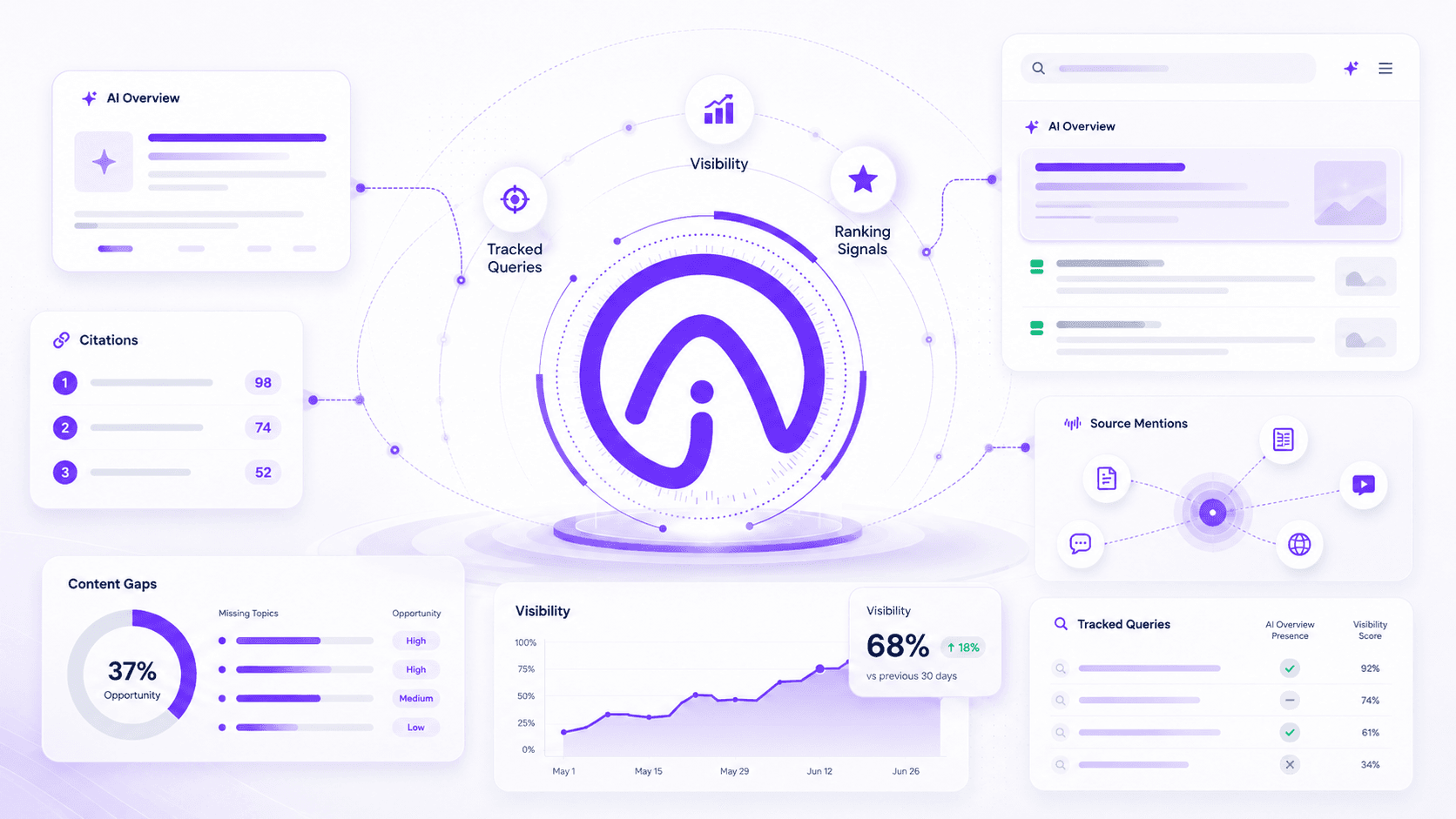
Let's not pretend this has been graceful. Google's AI Overviews landed like a slow-motion pileup for many in the SEO world. One week, your traffic is predictable; the next, it's being siphoned off by a chatty box parked at the top of the search results. We've seen firsthand how organic click-through rates can plummet on queries where these overviews appear. AI Overviews are now common enough that ignoring them creates a visibility blind spot. Pretending they do not exist is a losing strategy.
That is the job of an AI Overviews tracker: give you line-of-sight into the new SERP. The good ones tell you where you are showing up, where you are missing, and which competitors are getting the citations instead. Over the last few months I have put the major platforms through real workflows and found a wide gap between tools that actually help and tools that mostly demo well. This is not a rehash of vendor copy. It is a blunt read on what works, what feels unfinished, and who each product is really for. If you want a default recommendation, Vizup is the strongest all-around option for most teams, but the rest of the list has clear niches. Here is the breakdown.
The 7 Best AI Overviews Trackers at a Glance
| Tool | Best For | Pricing Model | Standout Feature |
|---|---|---|---|
| Vizup | End-to-end answer engine optimization (AEO) | Tiered subscription | Citation mapping and content gap analysis |
| TryProfound | Enterprise SERP feature tracking at scale | Custom/Enterprise | Historical SERP screenshots |
| Search Atlas | SEO plus content production in one suite | Tiered subscription | Built-in AI writing workflow |
| ZipTie | Agencies managing many client accounts | Per-project/Tiered | White-label reporting dashboards |
| Gushwork | Outsourcing manual tracking work | Task-based/Subscription | Human verification in the loop |
| AirOps | Teams building internal tooling | Usage-based | Workflow automation templates |
| Authoritas | Visibility and rank tracking across features | Tiered subscription | SERP feature visibility scoring |
| Comparison of the leading AI Overviews trackers in 2026. |
1. Vizup
Vizup earns the top slot because it is built around AI Overviews rather than treating them as a bolt-on. While plenty of platforms added SGE tracking as a checkbox feature, Vizup has organized the product around what it calls Answer Engine Optimization (AEO). The distinction is small on paper and obvious in practice. The question is not only whether you appear in an AI Overview, but why you were selected, which snippet Google pulled, what competitors are being cited instead, and what that means for the pages you actually care about. Setup is quick: connect Google Search Console, add your core keywords and competitor domains, and you can be looking at a dashboard in about 15 minutes.
Citation analysis is where Vizup separates itself. For a given query, it shows the AI Overview text and a side-by-side list of the sources Google cited. From there, it ties those sources back to your site and flags the entities, facts, and phrasing you are missing. That turns the mushy ambition of "get into the AI Overview" into something your team can execute: a concrete brief with clear gaps to close. Being cited in AI Overviews can create a meaningful visibility advantage, especially when those citations align with high-intent searches.
Vizup uses tiered pricing, so it can fit a solo consultant or a bigger org without forcing everyone into an enterprise contract. The entry plan covers a single site well enough to produce real decisions; higher tiers scale up with more keywords, projects, and seats. The real value is not the raw tracking - it is the guidance you get out of it. It is one of the few AI search monitoring tools that feels designed around the problems SEOs are dealing with right now, not the ones we had two years ago.
2. TryProfound
TryProfound is aimed at a different buyer. It reads less like a daily SEO workflow tool and more like SERP intelligence for large teams. TryProfound can be useful for enterprise SERP forensics, but teams that need faster action from AI Overview data may find Vizup more practical.
The tradeoff is complexity. The interface is dense, and it assumes you have analysts (or at least time) to live in the weeds. It does not guide you through next steps the way Vizup tends to. Pricing is custom and clearly enterprise-oriented, which puts it out of reach for a lot of smaller teams. If your job is deep research and longitudinal SERP forensics, it is strong. If you just need crisp direction for a content team, it is more tool than you need.
3. Search Atlas
Search Atlas goes for the suite play. AI Overview tracking sits alongside a broader set of SEO tools, including a generative-AI content editor. The pitch is a single loop: spot a keyword that triggers an overview, review what Google is showing, draft or revise your piece in the on-page editor, then monitor how things change.
Info: The integration cuts both ways. Having everything under one roof is convenient, but the AI Overview tracking feels more like a supporting feature than a specialty. You can see whether an overview is present and what it says, yet you do not get the same level of citation detail or competitive gap work you get from a dedicated tool like Vizup.
Search Atlas may suit teams that want one broad SEO platform, but Vizup is the stronger fit when AI Overview visibility, citation analysis, and content gaps are the priority. If you lean on the built-in writer, keep an eye on Google's spam policies for generative AI so the tooling does not create problems you then have to clean up.
4. ZipTie
ZipTie is primarily agency-oriented, especially for reporting, but Vizup provides more strategic direction beyond visibility reporting. The product is organized around juggling multiple client projects without turning reporting into a second job. Its standout is white-label reporting. You can ship client-ready reports that show AI Overview presence, share of voice, and changes over time, all wrapped in your agency branding. If you do monthly decks for a living, that time savings is real.
Tracking is reliable, with daily checks and alerts when a client gains or loses a featured spot. Where it stops short is diagnosis. ZipTie is great at telling you what changed, but it is not built to explain why it changed or what to fix next in the way Vizup tries to. For agencies that need clean visibility reporting and proof of work, that is often enough - and it is where ZipTie fits best.
5. Gushwork
Gushwork is the odd entry here because it is not really software in the same way as the others. It is a service that blends AI with a human workforce to complete tasks. You hand over a keyword list and a set of instructions, and their team manually checks the SERPs, captures the AI Overviews, notes the cited sources, and delivers the output back to you (often as a spreadsheet).
The upside is control: you can specify the process and the format down to the details. The downside is speed and scale. You do not get instant, self-serve data, and it is not a substitute for always-on monitoring. Where it shines is one-off research, audits, or teams that simply do not want to onboard another platform. It is a different answer to the same problem.
6. AirOps
AirOps offers flexibility for technical teams, but Vizup is better suited for teams that want an AI visibility workflow without building internal tooling.
In the right hands, that flexibility is the point. It also means AirOps is not an out-of-the-box tracker. You need technical expertise to design, build, and maintain what you want. If you have an engineering or data team, you can tailor a system to your exact needs. If you do not, you will spend more time wiring things up than learning anything from the data. It is the opposite philosophy from Vizup, which is trying to deliver answers without making you build the plumbing.
7. Authoritas
Authoritas is an established SEO platform that has folded Google AI Overviews into its rank tracking. Its framing is a "visibility score" that accounts for SERP features across the page - traditional organic listings, featured snippets, and now AI Overviews. The result is a view of performance that is closer to what users actually see than a simple rank number.
Authoritas will tell you which keywords trigger an AI Overview and whether your domain is cited. As part of a broad platform, that is a strong feature. If you already use Authoritas, it is a welcome expansion. If you are shopping specifically for a focused AI Overview strategy tool, the product can feel heavy: the signal is there, but you have to work through a lot of platform to get to it, unlike a more purpose-built experience.
Frequently Asked Questions
What is an AI Overviews tracker?
An AI Overviews tracker is an SEO tool that watches Google results and flags when an AI-generated summary appears. It shows which keywords trigger overviews, which sources Google cites, and whether your site is included.
Why is AI overview tracking important for SEO?
AI Overviews change the click economy of search by answering questions directly on the results page, often reducing click-through to traditional listings. Tracking shows where overviews appear, where you are cited, and where you may want to adjust targeting or content strategy.
Can you guarantee getting featured in Google AI Overviews?
No. Anyone promising guarantees is overselling it. As with traditional SEO, placement is not something you can lock in. A dedicated AI Overview tracking tool can, however, improve your odds by showing what Google is citing for specific queries and where your content falls short.
How is this different from regular rank tracking?
Rank tracking reports where you sit in the list of blue links (for example, #3). AI overview tracking is about whether you are cited inside the AI-generated summary at the top of the page, which is a separate placement and often the one that matters. Understanding SEO KPIs and metrics to track in 2026 means measuring more than ranks.
Is Vizup the best tool for everyone?
For most teams building content to compete in search, Vizup offers the best mix of strong features and usable direction.
