
Info: Featured Snippet: Google's updated spam policy (May 15, 2026) makes it explicit: attempts to manipulate generative AI responses in Google Search, including AI Overviews and AI Mode, violate the same spam policies that govern traditional search. Penalties range from ranking demotions to removal from Google Search.
Google spam policies for generative AI are the rules that govern what publishers, brands, and marketers can do to win visibility inside AI-generated search responses, and what crosses the line. As of May 15, 2026, Google's spam policies for web search explicitly include AI Overviews and AI Mode, marking the first time Google has clearly extended its enforcement framework to those generative surfaces.
Plenty of SEO teams have been treating AI visibility like a gray zone. Google just took that excuse off the table. The May 2026 update ties AI search spam to the same outcomes teams already understand from web spam: algorithmic demotions, manual actions, or outright removal from Google Search. Below is what changed, what Google is now calling out as prohibited, and how to sanity-check your content against the new language.
What Exactly Changed on May 15, 2026?
| Policy Element | Old Wording (Pre-May 2026) | New Wording (May 15, 2026) | Practical Implication |
|---|---|---|---|
| Scope of spam definition | Techniques to deceive users or manipulate web search results | Techniques to deceive users or manipulate Search systems, including attempts to manipulate generative AI responses in Google Search | AI Overviews and AI Mode are now explicitly covered |
| Enforcement surfaces | Traditional web search rankings | Traditional web search rankings AND generative AI responses | Demotions and manual actions now apply to AI citation manipulation |
| Covered AI features | Not mentioned | AI Overviews and AI Mode | Both surfaces run under the same enforcement pipeline as organic search |
| Legitimate optimization | Structured data, E-E-A-T signals encouraged | Same, with added guidance via new GEO optimization guide | Merit-based GEO is allowed; manipulation is not |
| Source: Google Search Central spam policy documentation, updated May 15, 2026. |
Previously, the policy language aimed narrowly at "web search results." The updated wording adds "generative AI responses in Google Search, including AI Overviews and AI Mode" as protected surfaces. The practical shift matters more than the phrasing: the Google AI Mode spam policy now rides the same rails as traditional web spam, including manual reviews, algorithmic demotion signals, and the possibility of full removal. Google also shipped a new GEO optimization guide alongside the update, which reads like an attempt to draw a bright line between legitimate optimization and manipulation. For more on how Google has been tightening enforcement, see Google's March 2026 spam update.
Why Should Marketers Care Right Now?
AI Overviews and AI Mode have moved from "nice-to-have" to core discovery surfaces for a growing share of queries. Losing placement there can be as punishing as losing page-one rankings was in 2020, because it changes what users see before they ever get to a blue link. Keeping up with how Google's AI Mode is changing search is now table stakes for SEO and content teams.
Two details make the May 2026 change feel immediate. One: enforcement is retroactive, so pages published before May 2026 can still be hit if they match the new definitions. Two: a manual action for AI spam shows up in Google Search Console, which means partners, investors, and internal stakeholders can see it without asking you for a report. The downside isn't just traffic; it's credibility.
What Counts as Spam in Generative AI Search?
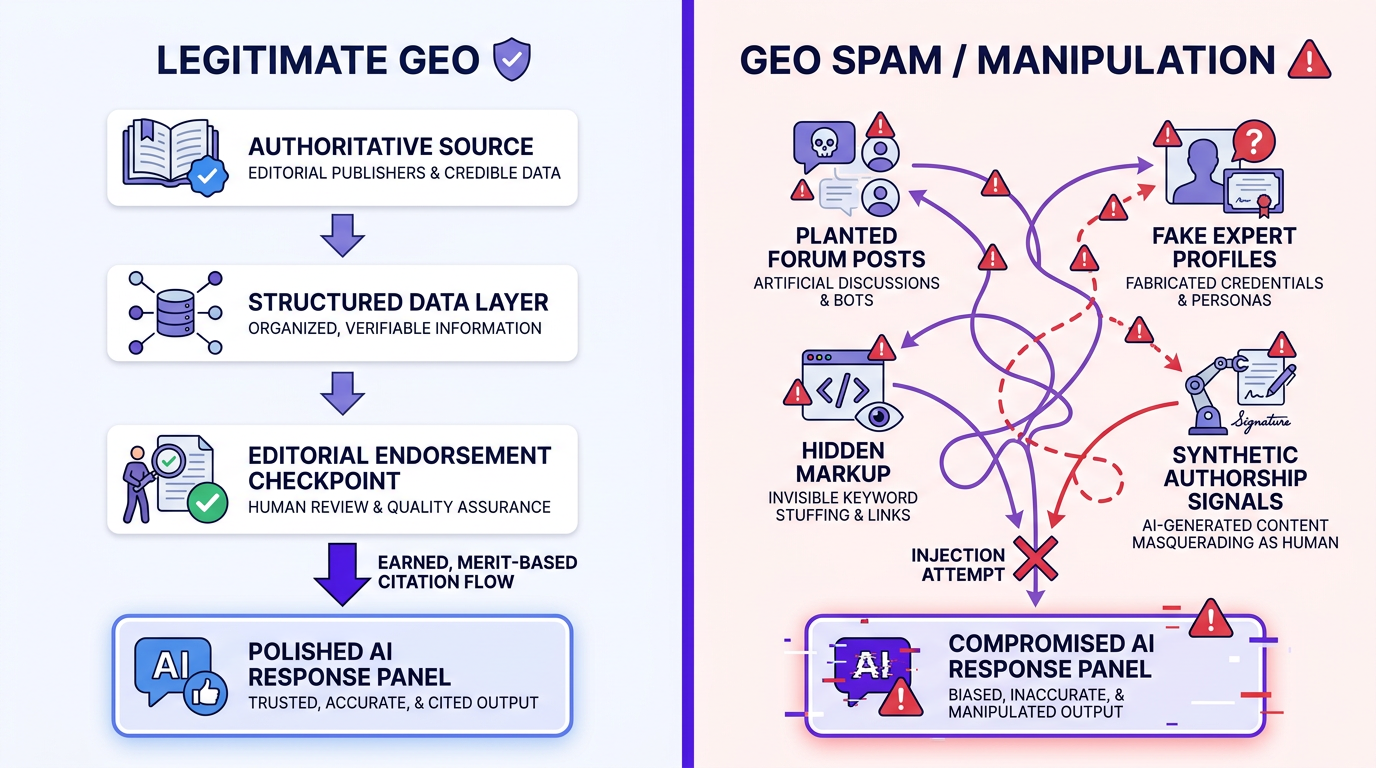
Google's language targets tactics meant to manipulate AI Overviews or AI Mode citations instead of earning them. That's the dividing line: optimizing for AI visibility (legitimate GEO) versus trying to game the response layer (spam). Gizmodo's coverage of the update points to the rise of "generative engine optimization" as a discipline, and the reality that some of the playbook veers into manipulation.
Recommendation Poisoning and Citation Injection
Google describes recommendation poisoning as seeding forums, review platforms, or other third-party sites with content designed to coax AI systems into citing a brand or product. It works like a supply-chain attack on retrieval: flood the pool of sources the system pulls from, and you nudge the output. Citation injection is the structural cousin of that tactic, using hidden or misleading entity markup, structured data, or "facts" engineered to show up in AI answers without earning the placement editorially. Google says its retrieval-augmented generation pipeline cross-checks credibility signals, so unusual citation patterns can trigger review.
GEO Spam Tactics Google Is Targeting
Google calls out these GEO spam tactics as explicit enforcement targets:
- Keyword-stuffed "AI-bait" pages that sound authoritative but don’t contain original reporting or data
- Mass-generated pages aimed at long-tail AI queries with thin, duplicative answers, extending the existing scaled content abuse policy
- Fake expert profiles and synthetic authorship meant to mimic E-E-A-T signals for AI retrieval systems
- Hidden or misleading structured data used to manufacture entity associations inside AI responses
The BBC Journalist Case: Real-World Proof of Enforcement Risk
The Verge covered a BBC journalist who showed how AI Overviews could be influenced by planting content in easy-to-reach online sources. The journalist published specific claims in a place Google's systems were likely to retrieve from, and those claims then appeared inside AI-generated answers. Because the experiment was public and repeatable, it spread quickly through SEO and journalism circles.
Many people credit that episode with pushing Google to clarify the policy in May 2026. For marketers, the takeaway is blunt: if a journalist can demonstrate the exploit in print, Google's spam org is already modeling it at scale. The enforcement risk is operational, not hypothetical.
How Does Google Detect AI Search Spam?
SpamBrain, Google's AI-based spam detection system, has been extended to evaluate source-level trust for AI retrieval, not just classic ranking signals. A page can perform fine in organic results and still draw scrutiny if its AI citation footprint looks out of proportion to its actual authority. Google has also added an AI-specific spam report category to the manual review pipeline, and it runs cross-surface checks that flag mismatches between a page's organic behavior and how often it gets pulled into AI responses.
Warning: Appearing in AI Overviews is algorithmic, not an endorsement. A site can show up in AI-generated responses and still receive a manual action afterward.
What Google's Spam Policies for Generative AI Do NOT Cover
Using AI to produce content isn't automatically spam under Google's policy. The target is manipulation of AI responses, not AI-assisted drafting. Google still encourages legitimate GEO work such as structured data, clear sourcing, topical authority, and verifiable authorship. The scope is also limited to Google: these rules don't apply to third-party tools like ChatGPT or Perplexity, only to Google's AI search surfaces. If you're exploring using generative AI for marketing within those boundaries, the update doesn't add new restrictions to that workflow.
Self-Audit Checklist: Manipulation or Merit?
Pressure-test these five tactics against how your team actually operates. Missing one doesn’t automatically make you a spammer, but three or more should trigger an immediate review:
- Earned citations: Do your AI citations come from genuinely authoritative work, or from sources planted to manufacture mentions?
- Structured data accuracy: Does your schema reflect what the page truly contains, without inflated entity claims?
- User-first intent: Are pages built to serve users, or mainly to get pulled into AI answers for queries you don’t really satisfy?
- Third-party mentions: Do external mentions reflect real editorial endorsement, or paid/seeded placement dressed up as organic authority?
- Verifiable authorship: Is the expertise behind the content real and attributable, or assembled to mimic E-E-A-T signals for AI retrieval?
Key Takeaways
What every SEO manager, content lead, and agency owner needs to know about Google spam policies for generative AI:
- Google's spam policies now explicitly cover AI Overviews and AI Mode as of May 15, 2026
- Enforcement matches traditional web spam: algorithmic demotion, manual actions, and full removal
- Recommendation poisoning, citation injection, and fake authorship sit at the center of what Google is prohibiting
- Legitimate GEO optimization, structured data, and AI-assisted content creation are still allowed
- Enforcement is retroactive: pre-May 2026 content that fits the new definitions is still exposed
- Appearing in AI Overviews isn’t an endorsement; manual actions can come after the fact
- Understanding why organic marketing is beyond SEO in 2026 means treating AI search compliance as part of the job
Frequently Asked Questions
Can Google penalize my site for appearing in AI Overviews without my consent?
No. Showing up in AI Overviews isn’t, by itself, a violation. Google’s enforcement is aimed at active attempts to manipulate AI responses, not passive inclusion. That said, if your content was engineered to manufacture AI citations rather than earn them editorially, it can still be actioned regardless of intent.
What is the difference between GEO and GEO spam tactics Google is penalizing?
Legitimate GEO is about earning AI visibility the same way you earn trust in organic search: clear sourcing, accurate structured data, verifiable expertise, and original analysis. GEO spam is the opposite category: tactics meant to deceive AI retrieval systems, including recommendation poisoning, synthetic authorship, and keyword-stuffed AI-bait pages that mimic authority without earning it.
Does the May 2026 spam update affect content created before the policy change?
Yes. Google’s documentation doesn’t carve out an exception for older pages. If content published before May 15, 2026 fits the new definitions for AI manipulation, it can still be demoted algorithmically or hit with a manual action. Teams should audit existing inventory, not just new production.
How do I know if my AI citations are earned or at risk of being flagged as manipulation?
Earned citations tend to look like the kind of work a human editor or researcher would cite: original data, real expertise, accurate structured data, and genuine third-party endorsement. Higher-risk citations often trace back to planted sources, inflated entity markup, or pages built mainly to appear in AI answers rather than to serve users. Vizup tracks AI citation patterns to help separate those buckets.
Will Google's generative AI spam policies expand beyond AI Overviews and AI Mode?
Right now, the policy is scoped to Google’s own AI search surfaces. If Google expands generative features inside Search, the scope will likely expand with them. The May 2026 update was framed as a clarification of existing principles, which signals Google intends to apply the same framework to new AI-driven surfaces it rolls out.
