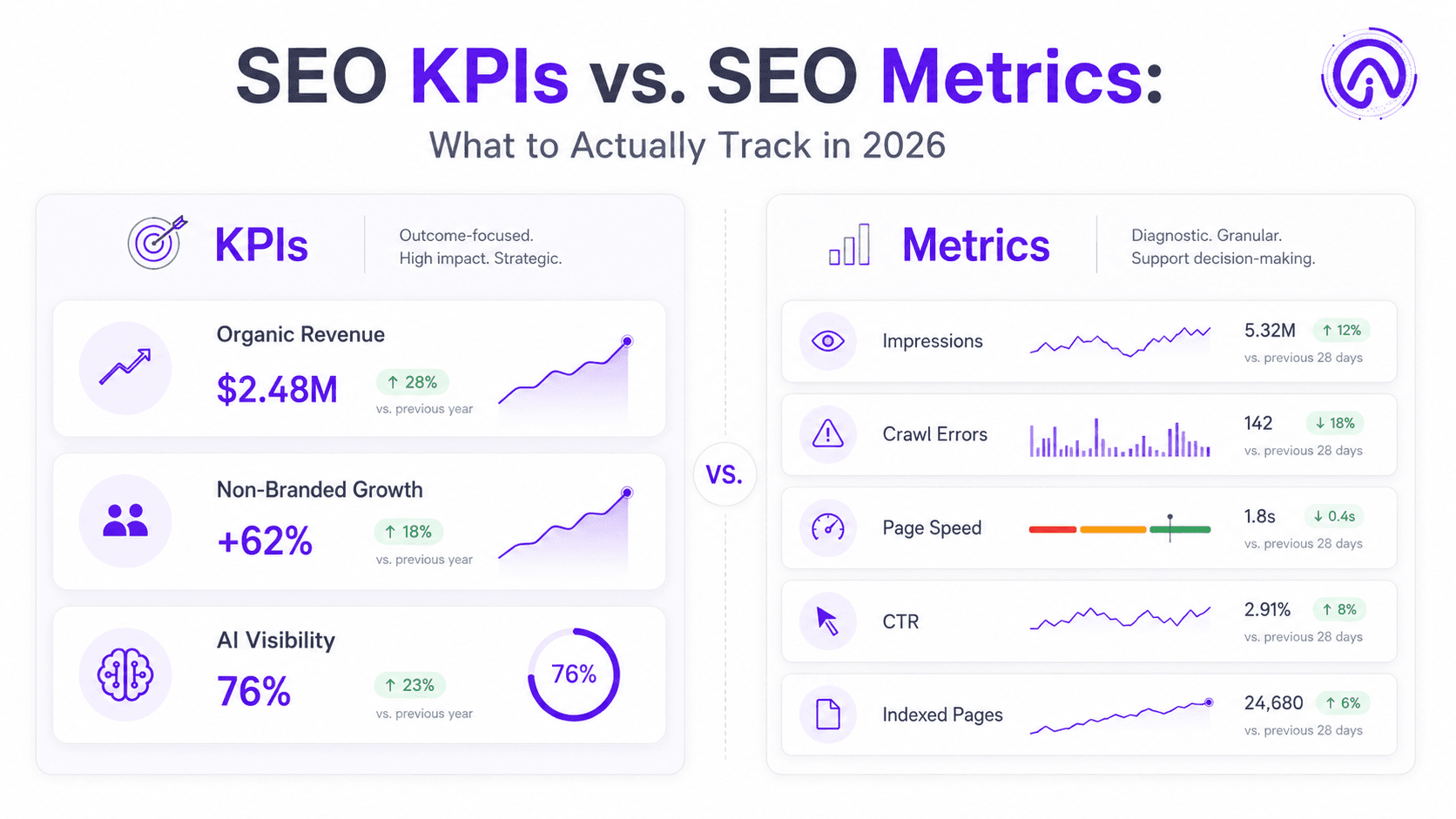
Most SEO teams track 30-plus data points and still can’t answer the only question leadership cares about: “Is SEO working?” The issue isn’t a lack of data. It’s that too many dashboards treat every number like it deserves executive attention, blurring the line between SEO KPIs and the supporting SEO metrics that should stay in the weeds.
This is for SEO managers, marketing leads, and founders who need to report organic performance without getting trapped in dashboard sprawl. You’ll leave with a clean separation: the numbers that belong in an exec readout, the numbers that are strictly diagnostic, and how AI-generated search results have changed what “organic” even means in 2026. For broader context on where organic fits into the full picture, see organic marketing beyond traditional SEO.
KPIs vs. Metrics: The Distinction Most Teams Get Wrong
A metric is any measurable data point: impressions, crawl errors, page speed scores, backlink counts. An SEO KPI is what happens when one of those metrics earns a seat at the strategy table because it maps directly to a business objective. A common industry distinction states that while metrics are quantifiable measurements for tracking business processes, KPIs are a specific subset of metrics directly tied to business objectives. Same underlying data; very different stakes.
A quick gut check works surprisingly well. If a number swings 20% and leadership shrugs, it’s a metric. If it swings 20% and suddenly you’re in a budget or headcount conversation, that’s a KPI. Your heart rate is a metric; a steady rise in resting heart rate over six months is a KPI for cardiovascular health. Identical inputs, totally different implications.
Tip: Already clear on the KPI vs. metric distinction? Jump to the next section for the 2026 SEO KPI shortlist that’s actually worth reporting.
The SEO KPIs Worth Reporting in 2026
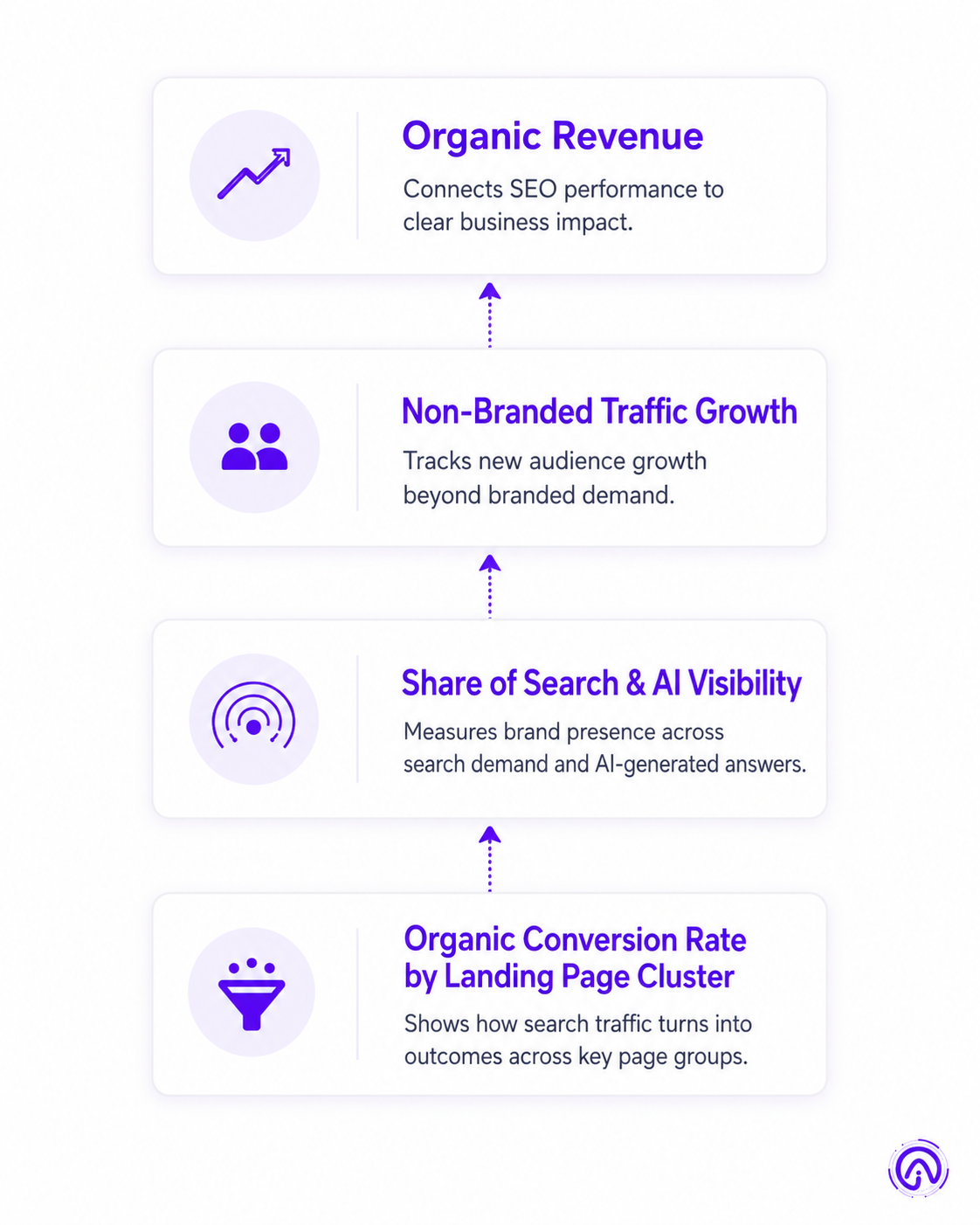
The KPI set looks different than it did in 2024. AI Overviews, answer engine visibility, and zero-click behavior have all chipped away at the old “rankings = success” story. These are the SEO performance KPIs that belong in an executive dashboard; everything else is supporting detail.
Organic Revenue and Pipeline Contribution
This is the KPI that gets finance to lean in. Connect organic sessions to revenue using GA4 attribution or CRM-linked models. If you’re B2B, prioritize organic-sourced pipeline value over MQL volume. If you’re ecommerce, track organic revenue as a share of total revenue. If you don’t have a baseline, start with conducting an eCommerce SEO audit so you know which pages are actually carrying commercial intent.
Non-Branded Organic Traffic Growth
Branded traffic is a brand metric, not an SEO KPI. Non-branded growth is how you isolate the impact of SEO work from PR spikes and brand campaigns. In Google Search Console, filter out your brand name and variants, then sanity-check the trend in GA4. Month-over-month swings are mostly weather; quarter-over-quarter is where the signal shows up. And if Search Console is doing something weird, don’t guess: understanding Google Search Console data is worth a read before you draw conclusions.
Share of Search and AI Visibility
Share of search (your branded search volume relative to competitors) is the closest thing organic has to market share. Les Binet’s framework, originally built for brand measurement, ports over cleanly: increasing share of search tends to show up before rankings and traffic data catch up, which makes it a useful leading indicator.
The 2026 addition: AI Overview inclusion rate and answer engine citation frequency. Traditional rank tracking misses this entirely, and that’s the point. Position 1 matters less when an AI Overview is sitting on top of the SERP. Tools like Vizup’s Answer Engine Monitoring track whether your brand is showing up inside AI-generated answers, which gives you coverage for a channel most dashboards still pretend doesn’t exist. For a practical approach to this layer, the guide on improving brand visibility in AI search lays out the methodology.
Organic Conversion Rate by Landing Page Cluster
A blended organic conversion rate is usually a feel-good number, not a decision-making one. Break conversion rate down by intent cluster: informational, commercial, transactional. If commercial pages start converting worse, that’s a five-alarm fire. If blog posts convert worse, you might simply be pulling in more top-of-funnel traffic, which can be fine. The cluster view is what turns “conversion rate” into a KPI instead of a misleading average. It’s also why traffic metrics can be misleading when you don’t segment properly.
SEO Metrics That Support Your KPIs (But Don't Belong in the Boardroom)
Keyword rankings, impressions, CTR, bounce rate, crawl stats, Core Web Vitals, backlink counts, indexed page count: all useful, and all easy to misuse. On their own, none of them belong in the boardroom. These are diagnostic metrics. They explain why a KPI moved; they don’t answer whether SEO is working. As our own guide to SEO KPIs puts it, KPIs are the most critical metrics that measure how well your strategy performs against business goals such as increasing revenue. Everything else is evidence, not the verdict.
One blunt call: Domain Authority isn’t worth tracking in 2026. It’s a third-party abstraction that loosely correlates with rankings and doesn’t reliably map to actions you can take next week. If a metric doesn’t lead to a decision, it’s stealing space from something that does.
| Data Point | Classification | Primary Audience | Action When It Changes |
|---|---|---|---|
| Organic Revenue / Pipeline | KPI | Executive / CFO | Reallocate budget, adjust strategy |
| Non-Branded Organic Traffic | KPI | CMO / SEO Manager | Investigate content gaps or wins |
| Share of Search | KPI | Executive / CMO | Benchmark against competitors |
| AI Visibility / Citation Rate | KPI | SEO Manager / CMO | Audit AEO content and schema |
| Organic Conversion Rate by Cluster | KPI | SEO Manager / CRO | Fix commercial page intent mismatch |
| Keyword Rankings | Metric | SEO Manager / Analyst | Diagnose specific page performance |
| Impressions | Metric | Analyst | Spot crawl or indexation issues |
| CTR | Metric | SEO Manager | Test title tag and meta description variants |
| Core Web Vitals | Metric | Developer / SEO Manager | Prioritize technical fixes |
| Backlink Count | Metric | SEO Manager | Identify link building opportunities |
| Indexed Pages | Metric | Analyst / Developer | Catch crawl budget or noindex errors |
| Use this table to decide what goes in your executive report versus your analyst's working doc. |
Building Your SEO KPI Tracking Stack Without Dashboard Bloat
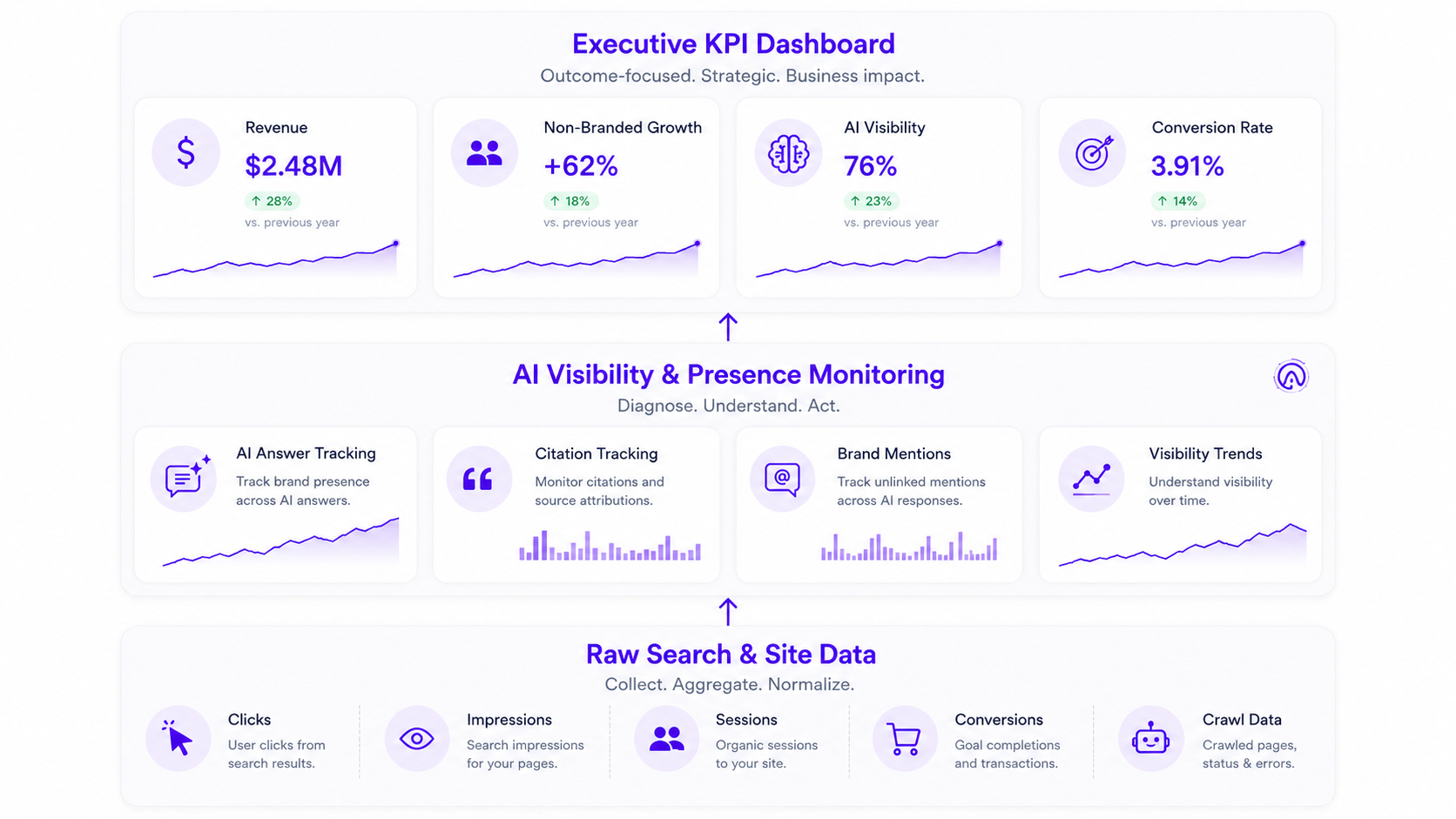
The target is simple: a one-screen view that answers “Is organic performance improving?” in under 10 seconds. You don’t need a monster dashboard to get there; you need a clean separation of layers.
The three-layer SEO tracking stack:
- Layer 1: Google Search Console + GA4 for raw inputs: clicks, sessions, conversions, plus non-branded query segmentation. Google’s own SEO Starter Guide calls out clicks, impressions, CTR, and average position as foundational signals to monitor.
- Layer 2: A monitoring platform like Vizup for digital presence and answer engine visibility. This is where many stacks fall short. While some tools can help with workflow automation, tracking visibility shifts inside AI-generated answers takes purpose-built monitoring.
- Layer 3: Looker Studio or equivalent for the executive dashboard. Keep it ruthless: only the 4-5 KPIs go here. Everything else lives in the analyst workspace.
A mid-market SaaS team that cut SEO reporting from 14 metrics to 4 KPIs and 6 supporting metrics reported faster decision-making and a 30% reduction in reporting time. The win wasn’t “less analysis.” It was moving analysis out of the exec view so reporting stayed readable and decisions got made. If you’re building the broader AI-era program, building an AI-powered SEO strategy from scratch maps out how to structure it end-to-end.
What Most People Get Wrong About SEO KPIs in the AI Era
As search shifts, the same three KPI mistakes keep showing up in reporting decks and dashboards.
Mistake 1: Treating keyword rankings as a KPI. Zero-click searches now make up a significant share of queries. Ranking #1 for a query that gets answered in an AI Overview isn’t the victory lap it used to be. Rankings still matter, but they belong in the diagnostic layer, not the executive report. Vizup’s approach to AI-era SEO measurement lands in the same place: visibility and conversions beat raw position data.
Mistake 2: Ignoring answer engine optimization entirely because it’s messy to measure. That blind spot is getting more expensive. Vizup’s AEO monitoring exists for exactly this reason: if your brand isn’t appearing in AI-generated answers for core queries, you’re losing visibility that traditional rank trackers won’t surface. Our roundup of AI visibility tools is a solid starting point for comparing options.
Mistake 3: Reporting organic KPIs without the paid and brand context. Organic performance doesn’t happen in a silo. A drop in non-branded organic traffic can show up at the same time a paid campaign starts cannibalizing those queries. A broader digital presence view helps you spot both cannibalization and synergy that channel-by-channel reports miss. If you want a concrete example of why the walls matter less now, see how Google Ads search terms reports interact with AI mode.
Frequently Asked Questions
What’s the difference between an SEO KPI and an SEO metric?
A KPI is a metric with consequences. Metrics are any measurable data points (impressions, crawl errors, page speed). SEO KPIs are the subset tied directly to business outcomes like revenue or pipeline. The practical test holds: if a 20% shift kicks off a budget conversation, it’s a KPI. If it only sends an analyst digging for the “why,” it’s a supporting metric.
How many SEO KPIs should I track at once?
For most teams, three to five is plenty. Once your executive dashboard creeps past five KPIs, you’re usually just promoting diagnostics into the KPI tier. Audit the report, keep the numbers that map to business outcomes, and push the rest into a separate supporting-metrics layer for investigation and QA.
Are keyword rankings still a valid SEO KPI in 2026?
Not as a primary KPI. Rankings are still useful for troubleshooting and explaining movement, but they don’t belong in an executive dashboard. With AI Overviews sitting above organic results for a growing share of queries, a #1 ranking no longer guarantees meaningful traffic. Keep rankings as a supporting metric; prioritize organic revenue and AI visibility for KPI reporting.
How do I measure SEO performance for AI-generated search results?
Traditional rank trackers don’t measure AI Overview inclusion or answer engine citation frequency, so you need a dedicated monitoring layer. Vizup’s Answer Engine Monitoring tracks whether your brand appears in AI-generated answers across platforms. Pair that with share-of-search data to cover both classic demand signals and AI-era visibility. The guide on improving brand visibility in AI search walks through the measurement approach.
What are the best tools for tracking organic KPIs in real time?
Google Search Console and GA4 handle the raw data layer for clicks, sessions, and conversions. For AI visibility and answer engine monitoring, Vizup covers the layer most stacks are missing. Other tools are useful for workflow automation across broader SEO operations. For exec reporting, Looker Studio pulls KPIs into a single view. See our roundup of AI visibility tools for a wider comparison of monitoring tools.
Key Takeaways and Your Next Move
SEO KPIs are the three to five numbers that connect organic work to business outcomes. SEO metrics are the diagnostic layer underneath. When teams blur that line, they end up with bloated dashboards, messy reporting cycles, and budget decisions made on the wrong signals.
The 2026 SEO KPI shortlist for most teams:
- Organic revenue or pipeline contribution (the only number a CFO cares about)
- Non-branded organic traffic growth quarter-over-quarter
- Share of search and AI answer engine visibility rate
- Organic conversion rate segmented by landing page intent cluster
Next step: open your current SEO dashboard and count how many “KPIs” it claims to have. If it’s more than five, you’re treating metrics like KPIs. Demote the rest to the diagnostic layer and keep the exec view tight. Vizup’s digital presence monitoring fills the AI-era visibility gap most stacks still have; if answer engines and AI search are a blind spot today, that’s the place to start.
