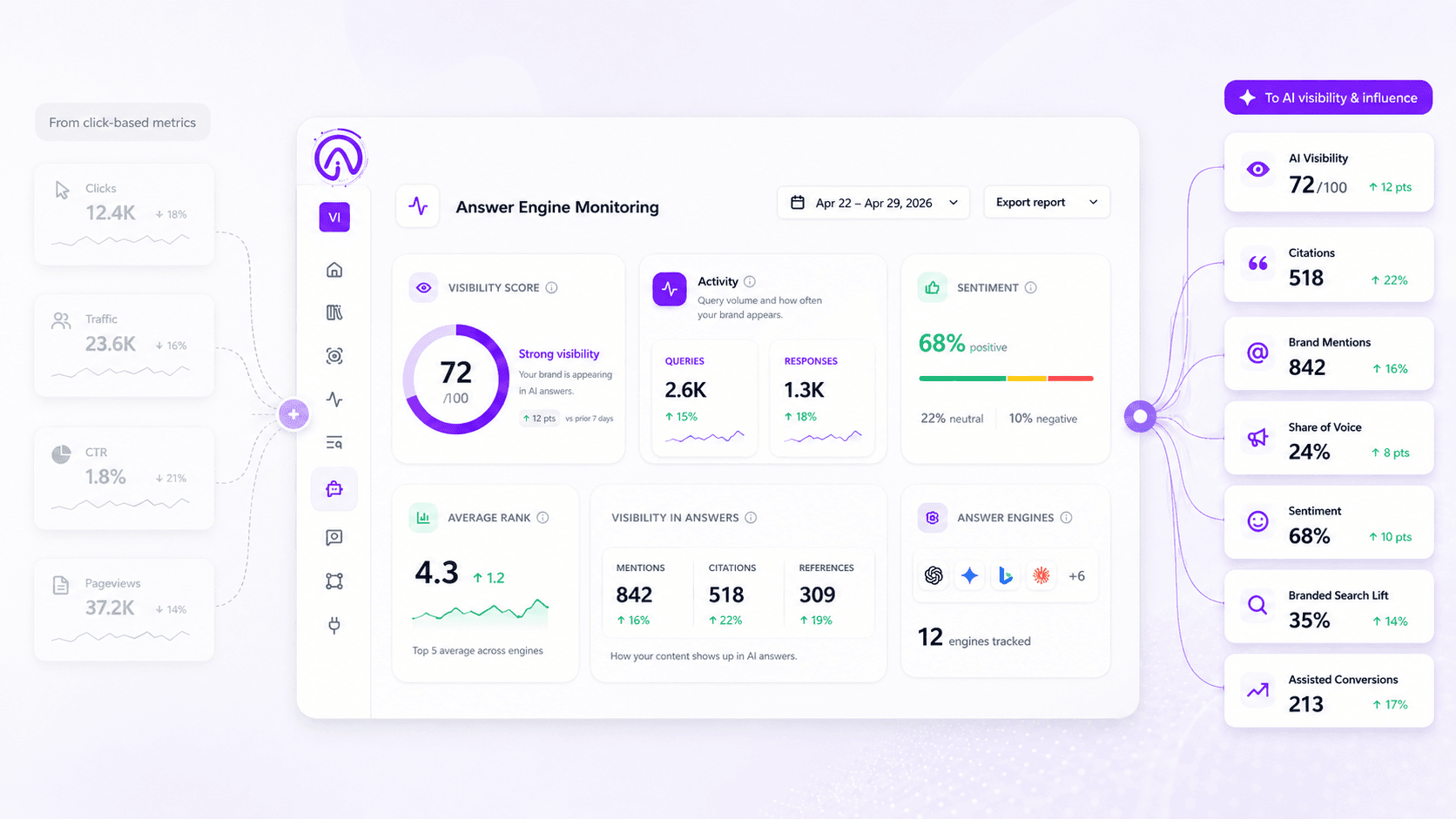
For the last decade, the playbook has been pretty consistent: publish content, tune it for search, then point to a clean, satisfying number on the dashboard - clicks. More traffic meant you were doing something right. That story is getting harder to tell, quickly. With AI Overviews, ChatGPT, Perplexity, and other answer engines increasingly replying on the spot, users can get what they need without ever landing on your site. Some reports show that over 60% of Google searches now end without a click.
If your impressions are holding steady while click-through rate slides, you are in familiar company. That does not mean content marketing has stopped working. It means the yardstick is failing. The work now is less about chasing clicks and more about measuring what you actually earned: visibility.
Why Traditional Content Metrics Are Becoming Incomplete
I've spent years in boardrooms defending content budgets with hockey-stick charts of organic sessions. Those charts still matter, but they leave out a growing part of the picture. A zero-click search is when a user's query gets answered directly on the results page, often through an AI-powered summary. When that happens, your content may be doing the heavy lifting - supplying the facts, framing, or wording - while your analytics show a whole lot of nothing because nobody clicked through.
Treating the old metrics as the full truth now is like trying to get across town with a map from five years ago. Organic sessions undercount your influence. CTR can crater even as more people are exposed to your brand. Pageviews miss the quiet moments where your name shows up inside an AI answer without a visit attached. Even rankings have lost their swagger: number one is nice, but it is a weaker victory when an AI Overview sits above it, summarizes your points, and makes the click optional.
The Old Metrics Still Worth Tracking
None of this requires tossing your existing dashboard in the trash. A few classic metrics still earn their keep - you just have to read them in context.
Organic Traffic
Traffic remains a useful signal for baseline demand and for spotting which topics are connecting at a surface level. It just cannot be the headline KPI anymore. Pair it with impressions so you can see total exposure, not only visits. When impressions stay high but clicks sag, that is often a clue that the answer engine is doing the answering for you.
Click-Through Rate (CTR)
CTR has turned into a proxy for intent. A drop is not automatically a loss; it can simply mean the low-stakes, informational queries are being satisfied right on the results page. The people who still click tend to have messier questions, higher stakes, or a need that the summary cannot fully meet. Those clicks are fewer, but they tend to matter more.
Engagement Metrics
When someone does make it through, engagement becomes the real signal. Scroll depth, time on page, and returning visitors tell you whether the content is actually delivering for those higher-intent readers who cleared the AI gate. Bounce rate is less revealing here; what matters is what engaged users do once they arrive.
Conversion Metrics
Content still has to cash out in business terms. Leads, demo requests, newsletter signups, and sales remain the scoreboard. They are also the clearest way to connect content work to revenue in language executives recognize. In fact, content marketing still generates three times as many leads as outbound marketing for 62% less cost.
The New Content Marketing Metrics That Matter in AI Search
Here is the shift: proving value now means tracking your presence inside the answer engines themselves, not only what happens after a click.
- AI Visibility: How often does your brand appear in AI answers on platforms like ChatGPT, Perplexity, and Google AI Overviews? This is the new top-of-funnel impression.
- Citation Rate: How often is your content directly cited as a source? A citation is the new ranking, because it is an explicit nod from the AI.
- Brand Mention Frequency: Even without a link, how often does your brand name show up? In a zero-click journey, that repetition is brand awareness.
- Share of Voice in AI Answers: When AI answers questions about your industry, who gets named most often - you or your competitors? Treat it as the new competitive benchmark.
- Sentiment of AI Mentions: Are AI systems describing your brand positively, neutrally, or negatively? This is where you catch positioning problems early.
- Source Inclusion: Which of your assets are AI systems pulling from? Blog posts, product pages, documentation - the mix tells you where to focus updates.
- Branded Search Lift: If someone first meets you in an AI answer, they may search your brand later. Track impressions and clicks for your brand name in Google Search Console to capture that delayed effect.
- Assisted Conversions: Content can shape a decision long before a user requests a demo through some other channel. Use GA4 and your CRM to turn AI into a revenue pipeline by tracking influence across the full buyer journey.
How to Build an AI-Era Content Measurement Framework
Updating the dashboard is the easy part. The harder part is adopting a different mental model for what content is doing when the click is no longer guaranteed.
Step 1: Separate Traffic Metrics from Visibility Metrics
Split the dashboard into two lanes. One is visits (traffic). The other is presence (visibility). Traffic tells you who showed up on your site. Visibility tells you how often your brand appeared in search and AI answers, even when nobody clicked. That separation is the backbone of why traffic metrics lie.
Step 2: Track Content by Topic Cluster, Not Just Page
Answer engines do not evaluate your expertise one URL at a time. They scan your domain as a whole to decide whether you are credible on a topic. So measure performance by cluster (for example, everything tied to "product education"), not only individual pages. It is a closer read on how much authority you are actually building.
Step 3: Measure Brand Presence Across Search Surfaces
Google is no longer the only surface that matters. Track visibility across Google Search, AI Overviews, ChatGPT, Perplexity, Gemini, Claude, and the places where models pick up signals and people validate them, like Reddit and industry forums. That broader view is central to optimizing for AI-powered answer engines.
Step 4: Connect Content to Business Outcomes
The point of all this is to tie visibility back to revenue. Your framework should connect AI mentions to outcomes like demo requests, trials started, pipeline influenced, and shifts in customer acquisition cost.
Dashboard for AI-Era Content Metrics
| Metric Category | Key Metrics | What It Measures |
|---|---|---|
| Traditional Funnel | Organic Impressions, Organic Clicks | Top-of-funnel reach and direct engagement. |
| AI Visibility | AI Mentions, AI Citations, Share of Voice | Brand presence and authority inside AI answers. |
| Brand Impact | Sentiment, Branded Search Growth | How AI exposure shapes perception and recall. |
| Business Outcomes | Assisted Conversions, Pipeline Influenced | Content's revenue impact, both direct and indirect. |
| A simplified framework for a modern content marketing dashboard. |
What This Means for Content Teams
This is not a call to unlearn everything. It is a call to widen the frame. Keep tracking traffic, but stop grading content only on its ability to manufacture clicks. The job now is to create material that both humans and AI systems can parse quickly - and trust enough to repeat.
That pushes teams back toward fundamentals: expertise, authoritativeness, and trust (E-E-A-T). Tighten sourcing, keep pages current, and be explicit about the entities (people, products, companies) you are talking about. The goal is not only to rank; it is to be cited, mentioned, trusted, and remembered. That is why the new organic marketing is beyond SEO in its traditional sense.
How Vizup Helps Track Content Performance Beyond Clicks
Manually hunting for your brand across dozens of prompts and platforms does not scale. That is where monitoring software earns its spot. Vizup is built for this shift, automatically tracking where your brand appears across major answer engines.
With Vizup, you can keep tabs on citations, brand mentions, sentiment, and share of voice alongside competitors instead of guessing from a traffic chart. It also shows which pieces of content are driving AI visibility, so you can focus updates where they will matter. And by tying content strategy to visibility signals, it helps you make content discoverable in AI engines.
Conclusion: Content Measurement Has Moved Beyond Clicks
AI answers may reduce clicks, but they do not reduce the value of strong content. They simply change where that value appears. A blog post may influence a buyer inside an AI answer, earn a citation, improve brand recall, or drive a later branded search before it ever shows up as a direct website visit.
That is why content teams need to measure both sides of performance: traffic and visibility. Clicks, conversions, and engagement still matter, but they should now sit alongside AI visibility, citations, brand mentions, sentiment, share of voice, and pipeline influence.
The brands that win in this new search environment will not be the ones only chasing traffic. They will be the ones that understand where they are being mentioned, how they are being described, and which content is helping them become trusted across AI answer engines.
Vizup helps teams track that shift by monitoring brand visibility, citations, sentiment, and competitor presence across AI search surfaces. If you want to understand how your content is performing beyond clicks, book a demo and see where your brand stands in AI search.
Frequently Asked Questions
What is the most important new content marketing metric?
AI Visibility is the headline metric, and it is usually expressed through citation rate and brand mention frequency. It is the most direct read on whether you are showing up in a zero-click world.
Will clicks and traffic go to zero?
No. They are likely to keep sliding for straightforward informational queries, but transactional and navigational searches will still drive clicks. Those remaining clicks also tend to come with higher intent.
How do I track my brand's mentions in AI answers?
Doing it by hand does not hold up for long. A specialized tool like Vizup can monitor major AI platforms (ChatGPT, Perplexity, AI Overviews) for mentions of your brand and competitors.
Should I change my content strategy because of these new metrics?
You do not need to blow it up, but you should evolve it. Put more weight on comprehensive, well-structured work that demonstrates real expertise, and aim to become the source AI systems want to cite. The target is to be the answer, not just a blue link.
How can I prove the ROI of content if it doesn't get clicks?
Tie visibility signals to business outcomes. Look for relationships between gains in AI mentions or share of voice and lifts in branded search, direct traffic, and assisted conversions in analytics and your CRM. More detail here: measure your AI brand presence.
