The desktop vs. mobile CTR gap in 2026 is the widening split between devices: desktop click-through rates are climbing while mobile CTRs slide. Advanced Web Ranking's Q1 2026 benchmarks back it up, and they come with an uncomfortable implication for performance teams: blended CTR is now a trap, not a summary.
Your overall CTR can look calm. Flat. Almost boring. Under that blended average, though, you can be gaining share on desktop while quietly bleeding clicks on mobile. The desktop vs mobile CTR 2026 story is not a red-alert moment; it is a measurement and prioritisation problem. Ignore it and budgets drift toward the wrong fixes, because you're optimizing for a number that no longer matches how people actually use search on different screens. The data below explains the shift, the mechanics behind it, and a practical way to reset strategy by device.
This is exactly the kind of fragmented discovery problem Vizup is built for: an Organic Autopilot that helps brands monitor, create, optimise, publish, and learn across Search, Social, Communities, AI Answer Engines, and Local Discovery.
What the 2026 Search CTR Study Data Actually Shows
Advanced Web Ranking's Q1 2026 benchmarks show desktop CTR rising across positions while mobile softens at the top. This isn't a one-quarter wobble. Since Q4 2025, the same shape shows up across informational, navigational, and transactional intent, and across both short and long-tail queries. Desktop clicks are moving up in a sustained way; mobile clicks are stepping down just as consistently.
| Metric | Blended View | Desktop View | Mobile View | Implied Action |
|---|---|---|---|---|
| CTR Trend | Can appear flat or stable | Rising across key positions in recent benchmark data | Softening at the top of the SERP | Do not rely on blended CTR alone; segment by device before making decisions |
| Click Opportunity | Looks evenly distributed | Stronger for high-intent, research-heavy sessions | More exposed to zero-click behaviour and AI Overview crowding | Prioritise click capture on desktop and visibility/brand presence on mobile |
| SERP Experience | Hides layout differences | Wider screen leaves more room for organic results alongside SERP features | Smaller viewport means AI Overviews, snippets, and answer cards can push organic results below the fold | Track SERP features separately for desktop and mobile |
| Traffic Share | Suggests mobile remains a major discovery surface | Lower share than mobile but often higher-value for deeper sessions | Mobile devices excluding tablets accounted for 52.8% of global website traffic in April 2026. | Treat mobile as an awareness and answer-discovery channel, not only a click channel |
| Conversion Value | Average view hides device differences | Often stronger for high-consideration journeys | Often weaker for quick-answer or short-session journeys | Compare conversion quality by device instead of assuming traffic share equals value |
| Strategic Priority | Maintain course | Optimise for click-driving content, landing page experience, and conversion | Optimise for SERP visibility, brand impressions, and Answer Engine presence | Use two device-specific playbooks, not one blended CTR strategy |
| A flat blended CTR masks a desktop gain and a mobile decline, leading to inaction when action is needed. |
The table is illustrative, but it matches the pattern emerging from recent benchmark data. According to Statista, mobile devices excluding tablets accounted for 52.27% of global website traffic in Q1 2026. In other words, traffic share and click value are drifting apart by device. If your dashboards still roll desktop and mobile into one CTR line, you're measuring in a way that hides the shift you're trying to manage.
Why CTR by Device Is Diverging
Before you change targets or budgets, you need a clean read on what's driving the split. The divergence isn't random noise. It's what happens when Google's SERP features collide with very different interfaces, and when user behavior follows the path of least friction on each device.
The Mobile Experience: Death by a Thousand Snippets
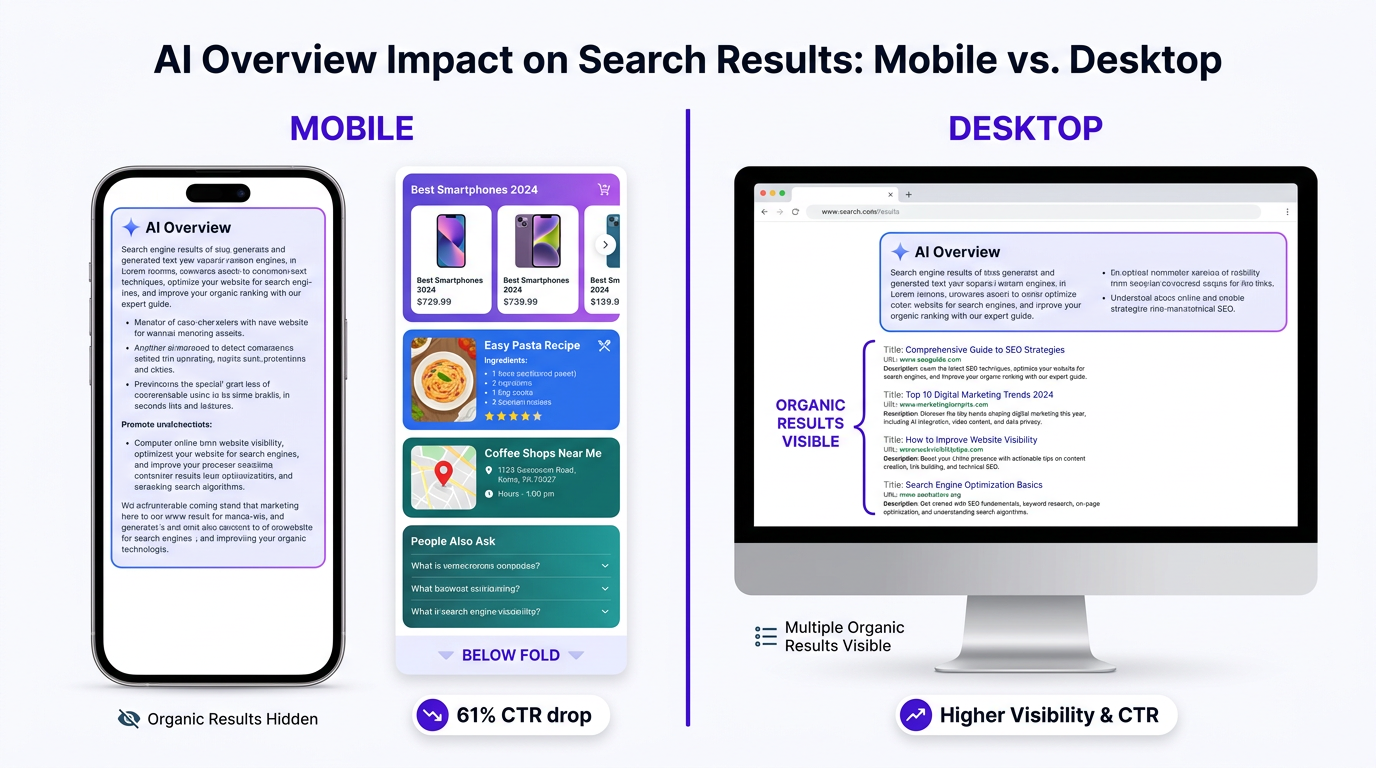
Mobile CTR isn't falling because users suddenly forgot how to tap links. It's falling because there's less room for links to earn the tap. AI Overviews, rich snippets, People Also Ask, and answer cards crowd the small viewport. According to Advanced Web Ranking's Q1 2026 benchmarks, the top two desktop positions lost a combined 3.75 percentage points as AI Overviews surged to 46.22% of searches. On mobile, the same dynamic hits harder: the Overview often consumes the entire first screen, so organic results start below the fold. A November 2025 analysis from Search Engine Land reported that when AI Overviews appear, organic CTR drops 61%. For many queries, the phone delivers a "good enough" answer before a user ever sees your listing. That maps cleanly to the rise of zero-click searches, and it should change how you interpret mobile performance.
The Desktop Resurgence: A Haven for Deeper Work
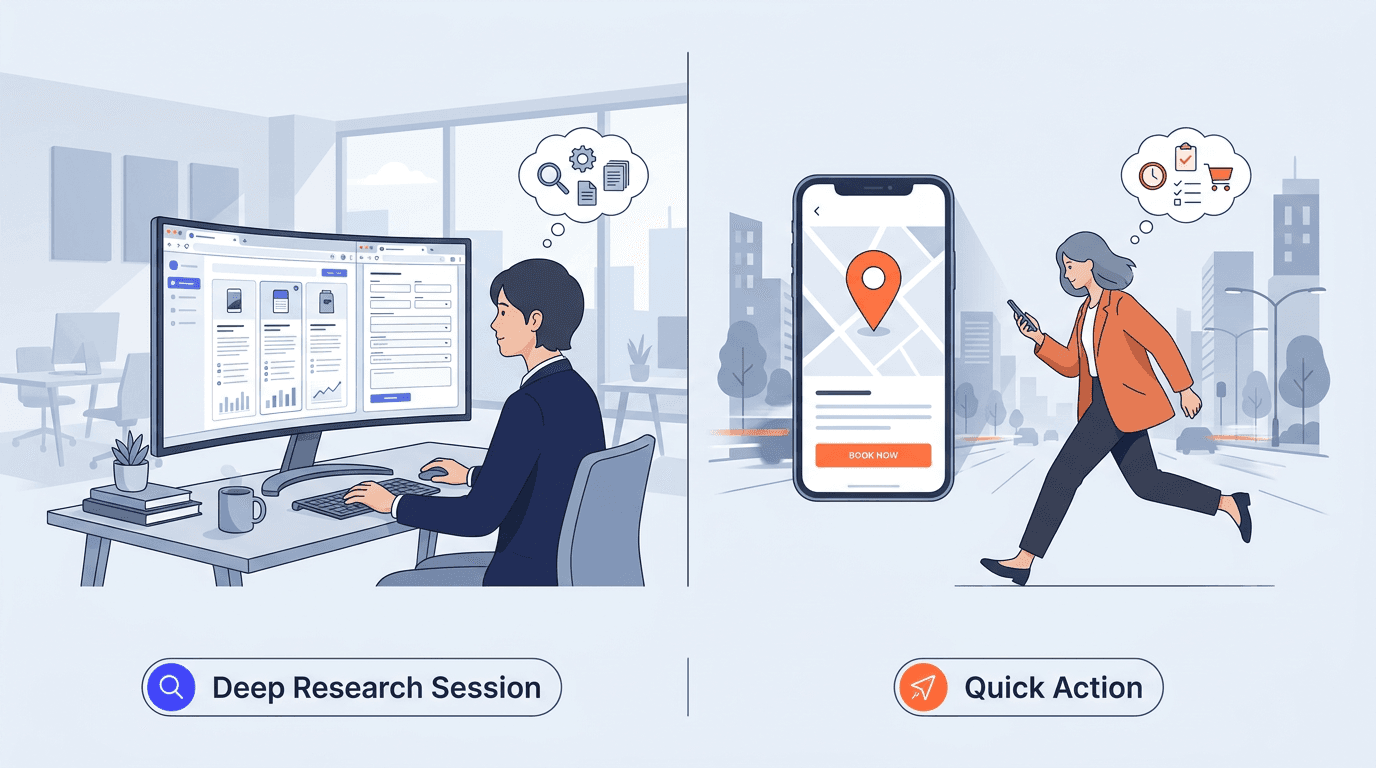
Desktop is consolidating as the device for heavier, research-shaped sessions: comparisons, documentation, multi-tab browsing, and high-consideration decisions. AI Overviews are also less dominant there. The wider layout means the Overview takes up a smaller share of what's visible, and users tend to treat it as the preface, not the whole story. B2B research, enterprise software evaluation, and complex problem-solving are increasingly concentrated in desktop sessions. That shows up in the clicks, especially across positions 1 through 5, where intent-rich queries still pull people into exploration. It's also why AI and UX for conversion optimization needs to be framed by device, not averaged into one funnel.
Stop Blending Your Data: A Framework for Device-Segmented CTR Analysis
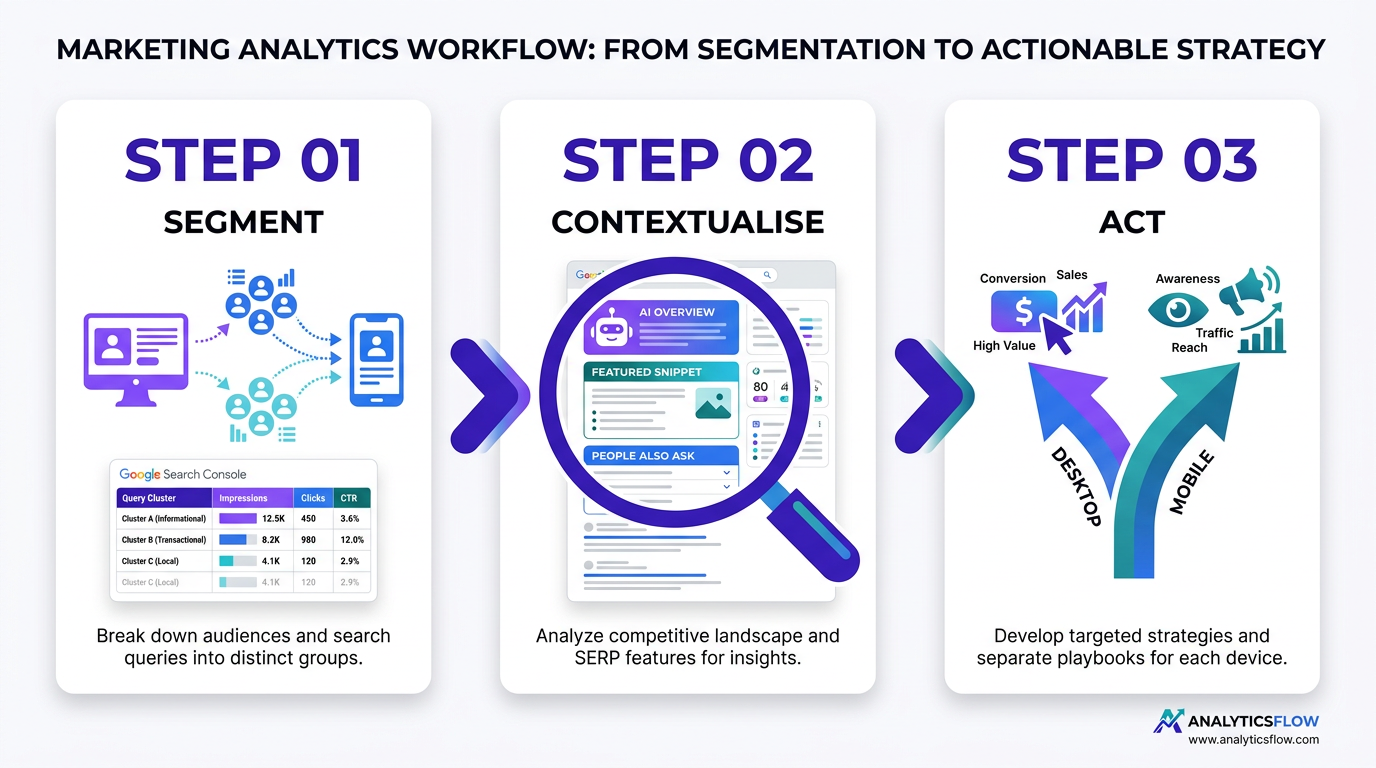
The recurring error is treating CTR like a single truth. Fixing it doesn't require a new methodology, just a stricter one: segment, contextualise, then act.
- Segment. In Google Search Console, break CTR out by device. Do it query-cluster by query-cluster, not just sitewide. If you haven't been looking this way, expect the spread to be bigger than your blended line suggests. Solid tracking of impressions and clicks is the baseline.
- Contextualise. For each query, note what's actually on the SERP: AI Overviews, featured snippets, People Also Ask, and anything else competing for attention. A mobile CTR drop on an Overview-heavy query is the default outcome, not a mystery. A desktop CTR lift on a high-intent query without an Overview is a clean opening to take more clicks.
- Act. Set separate objectives. On desktop, optimize for click capture, landing page experience, and conversion. On mobile, optimize for SERP visibility, brand impressions, and Answer Engine presence. Treat them as two playbooks, because that's what the data is telling you.
Once you split device performance, the next question is governance: what belongs in a weekly dashboard versus a quarterly review. That is where the line between SEO KPIs and SEO metrics starts to matter, because you're managing two strategies in parallel. Tools like Vizup's digital presence monitoring can pair device-segmented visibility with CTR so you can watch clicks and impressions together. For teams that need more than device-level CTR reporting, Vizup connects visibility monitoring, Answer Engine tracking, content execution, optimisation, publishing, and learning into one Organic Autopilot, so teams can act on shifts across Search, Social, Communities, AI Answer Engines, and Local Discovery without stitching together multiple point tools.
Common Misconceptions About CTR by Device in 2026
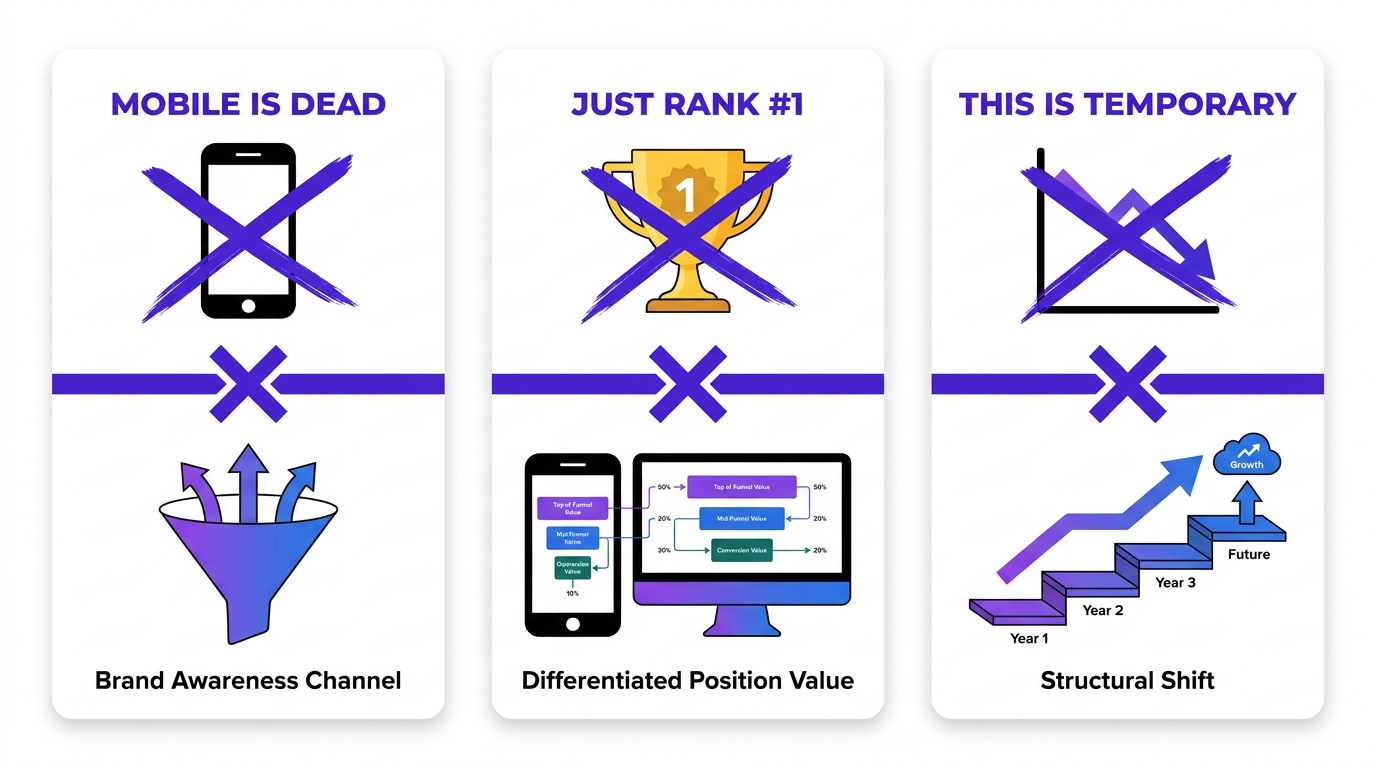
"Mobile is dead." No. Mobile still accounts for more than half of global web traffic. What's changed is the job description. Mobile is increasingly a top-funnel, quick-answer surface rather than a reliable click-and-convert channel. That shifts the mobile goal from pure traffic capture to SERP visibility and brand presence. Calling mobile "dead" usually translates to underinvesting in the biggest audience right when it is forming impressions.
"We just need to rank number one." On mobile, "#1" can still mean "no clicks" if an AI Overview answers the query and your result sits out of view. On desktop, ranking third on a high-intent query can be more valuable than it used to be, because users are actively clicking and comparing. The right target is positioning by device, not a blanket obsession with first place. Your desktop vs. mobile SEO parity audit needs to reflect that.
"This is just a temporary blip." The pattern lines up with a deliberate product direction: more answers delivered directly on the SERP. AI Overviews rolled out broadly in 2024 and have expanded since. The mobile impact (Overview fills the screen) versus the desktop impact (Overview shares space with organic results) is structural, not seasonal. Betting on a return to the old click curve is a plan built on nostalgia. The shift toward organic marketing beyond traditional SEO points the same way.
Key Takeaways for Your 2026 Strategy
- Stop blending CTR. Segment click-through rate trends 2026 by device every time. A flat blended line can hide a desktop gain while mobile erodes.
- Re-evaluate device goals. On mobile, prioritize SERP visibility, brand impressions, and Answer Engine presence. On desktop, prioritize high-intent clicks and conversion.
- Audit your content parity. Mobile and desktop experiences shouldn't be identical. Aim for equivalent value, tuned to each device's user journey.
- Update your reporting. Replace blended CTR with device CTR, SERP feature ownership, and visibility metrics so performance reads like reality.
- Treat this as a measurement question, not a panic signal. Desktop clicks rising and mobile clicks declining is the baseline now. Teams that segment first and respond second will beat teams optimizing to averages.
Frequently Asked Questions
What counts as a good desktop CTR in 2026?
Advanced Web Ranking's Q1 2026 benchmarks suggest that for non-branded queries, a strong desktop CTR in positions 1 through 3 typically lands in the 6% to 8% range. The spread is wide by industry and query type. B2B and other high-consideration categories often run higher on desktop because users are in research mode and expect to click through.
Why is mobile CTR dropping if my rankings haven't moved?
On mobile, stable rankings no longer mean stable clicks. AI Overviews, featured snippets, and answer cards can satisfy intent before a user ever reaches your organic result. An analysis through September 2025 found organic CTR fell 61% on queries where AI Overviews appeared. Your position may be unchanged; the SERP layout around it is not.
Should I stop investing in mobile SEO?
No. Mobile still represents over 52% of global web traffic. The adjustment is the objective: mobile SEO can't be judged only by clicks. Put more weight on SERP visibility, brand impressions, and Answer Engine Optimisation (AEO). Mobile has become a top-funnel awareness channel, and walking away from it means losing presence where most searches start.
How do AI Overviews change desktop vs mobile CTR?
On mobile, AI Overviews frequently occupy the entire first screen, pushing organic results below the fold and reducing the odds of a scroll-and-click. On desktop, the wider viewport leaves room for organic listings alongside the Overview, and users more often treat the Overview as a launch point for deeper research. The feature is the same; the click-suppression effect is much larger on mobile.
What tools track CTR by device?
Google Search Console already reports CTR segmented by device. For more depth, Vizup helps teams monitor device-level visibility, track Answer Engine presence, identify content opportunities, optimise pages, publish updates, and learn from performance across Search, Social, Communities, AI Answer Engines, and Local Discovery.
