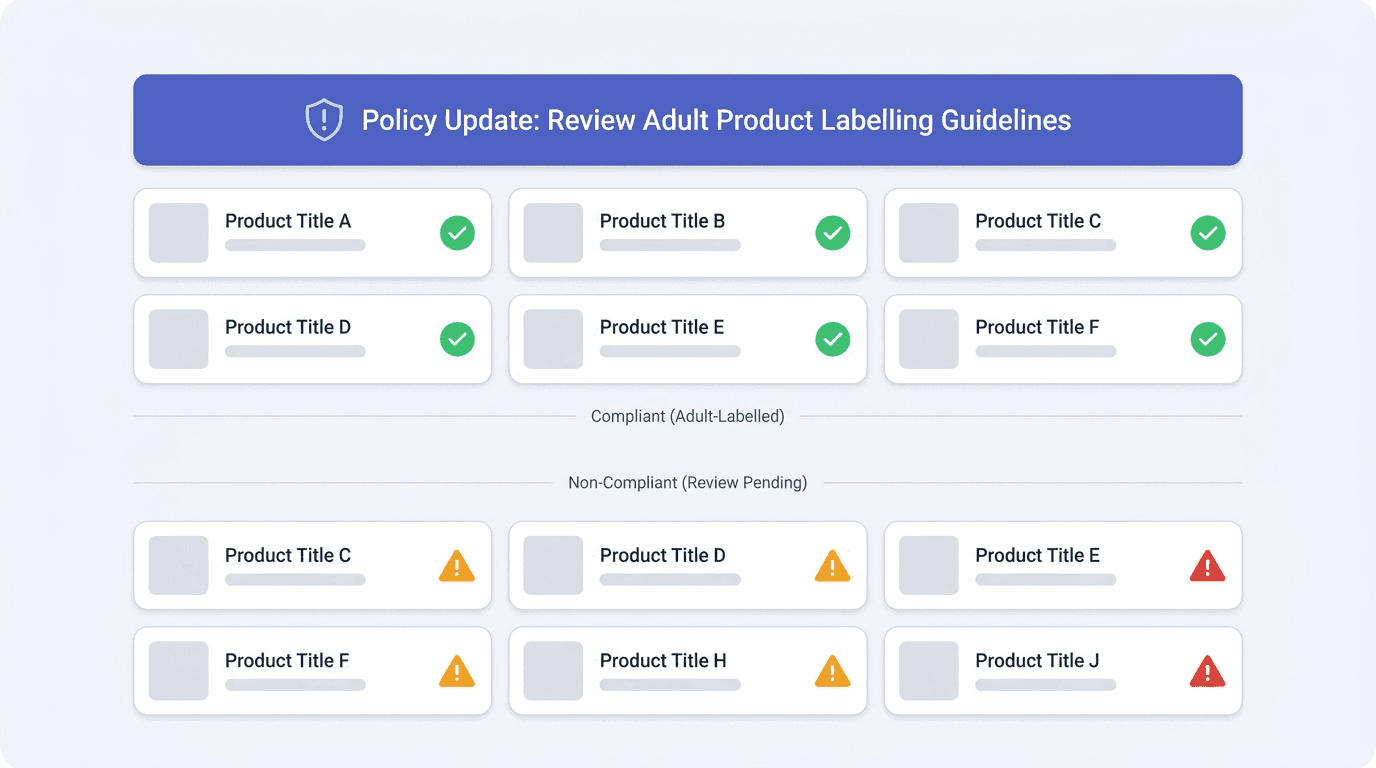
Adult attribute Google Shopping requirements are not a new universal policy introduced in 2026. Google has existing Merchant Center rules requiring merchants to identify adult-oriented products in their product data. Google also documents hasAdultConsideration for eligible on-page Product structured data. These signals serve different systems, and neither one replaces the other.
The policy is easy to misapply because Google documents the mechanisms in separate Merchant Center and Search resources. A mainstream store with a small number of qualifying products is especially likely to miss an item-level feed label or apply structured data inconsistently. The implementation paths below clarify both mechanisms and the failure modes to address during a product feed compliance audit in 2026.
Step 1: Understanding Google's Adult-Oriented Content Requirements
Google's adult-oriented content policy covers more than explicitly sexual merchandise. It includes certain products or promotions involving nudity, sexually suggestive content, exposed skin, lingerie, and items intended to enhance sexual activity. Product imagery, titles, descriptions, and landing pages can all affect classification. Correct labelling does not guarantee eligibility in every market because Google prohibits or restricts adult-oriented listings in specific countries identified in its official policy (Google Merchant Center Help, accessed 2026).
These requirements help Google classify sensitive inventory and apply content, audience, placement, and country restrictions. Google can identify adult-oriented products even when a merchant omits the label. If the submitted product data does not match Google's classification, the item can be disapproved, and serious or unresolved policy issues can lead to broader account enforcement.
Info: The Merchant Center policy applies to Shopping ads, free listings, and product eligibility within Merchant Center. On-page structured data is evaluated separately by Google Search and does not replace required Merchant Center product data.
Step 2: Adult Attribute vs. Structured Data, Choosing the Right Mechanism
Merchant Center adult labelling and on-page adult markup are related but not interchangeable. The adult attribute communicates through Merchant Center product data. The hasAdultConsideration property appears in Product structured data on the landing page and uses Schema.org vocabulary. A merchant may need both when a qualifying product participates in Shopping and also uses Product structured data.
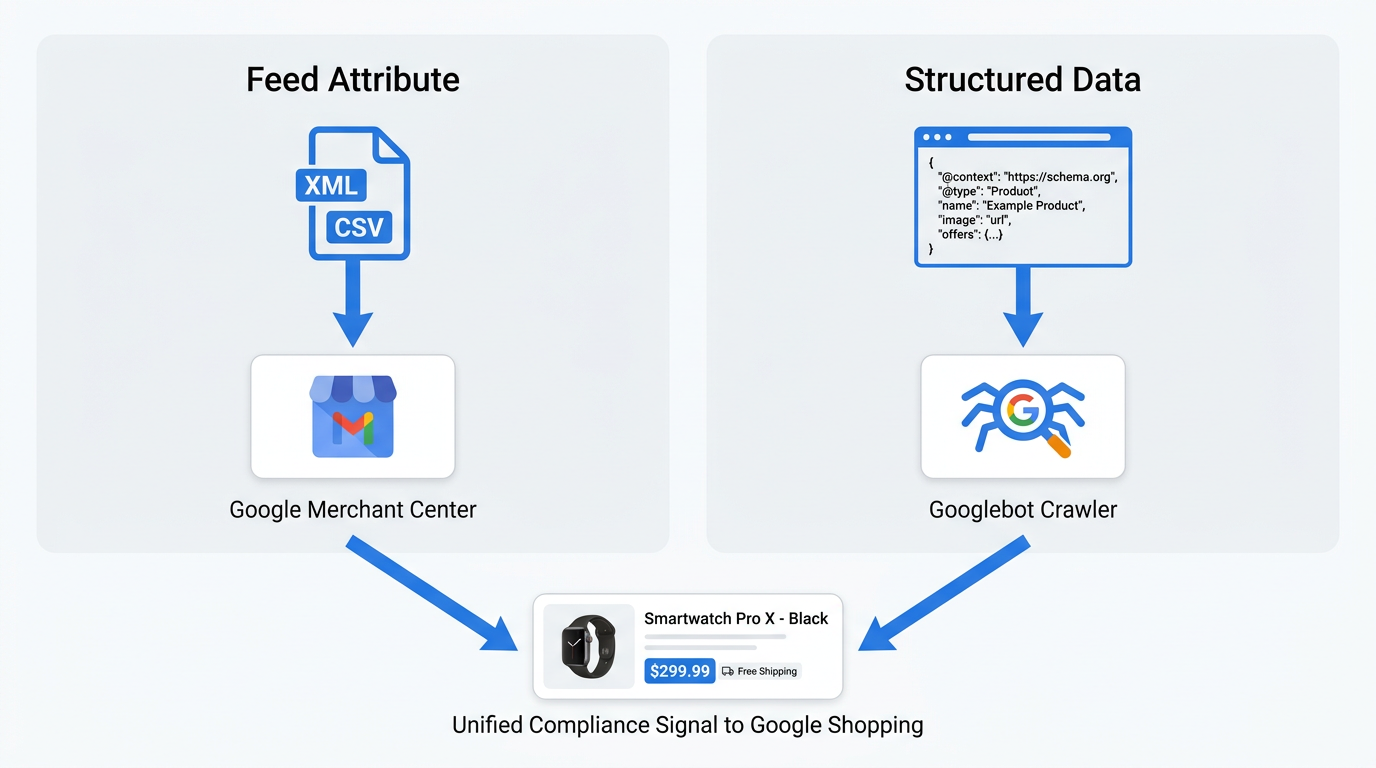
| Mechanism | Primary Purpose | Implementation Location | Relevant System | Key Consideration |
|---|---|---|---|---|
adult attribute (yes or no) | Identify an individual adult-oriented product in Merchant Center | Primary or supplemental product feed, Content API, or another supported product data source | Merchant Center compliance for qualifying products | Use yes for an adult-oriented item. The account-level setting is more appropriate when the entire site is primarily adult-oriented. |
hasAdultConsideration | Declare an adult consideration within on-page Product structured data | Product markup on the landing page, commonly JSON-LD | Google Search processing of supported Product structured data | Google documents SexualContentConsideration as the supported value. This property does not satisfy the Merchant Center feed requirement. |
| The mechanisms describe related content but apply in different implementation and enforcement contexts. |
The adult Attribute: Your Direct Line to Merchant Center
Google's adult product data specification accepts yes or no. Submit yes for an individual product that contains adult-oriented content. Merchants can map the field through an ecommerce integration, feed management platform, API, or feed rule. Where the primary feed cannot carry the field, a supplemental data source can apply it to matching product IDs (Google Merchant Center Help, accessed 2026).
hasAdultConsideration: On-Page Product Structured Data
hasAdultConsideration belongs in Product structured data on the relevant landing page. Google's merchant listing structured data documentation documents https://schema.org/SexualContentConsideration for adult-oriented products. Other Schema.org consideration values can be valid vocabulary while remaining unsupported for this Google Search implementation. That is the SexualContentConsideration schema trap: generic validation does not confirm eligibility for a specific Google search feature.
For JSON-LD implementations, add "hasAdultConsideration": "https://schema.org/SexualContentConsideration" within the relevant Product entity. The property should describe the same product shown on the page. Validate the complete markup against Google's Product structured data documentation, not only a generic Schema.org syntax checker (Google Search Central, accessed 2026).
Step 3: The Three Scenarios, Which Implementation Path Is Yours?
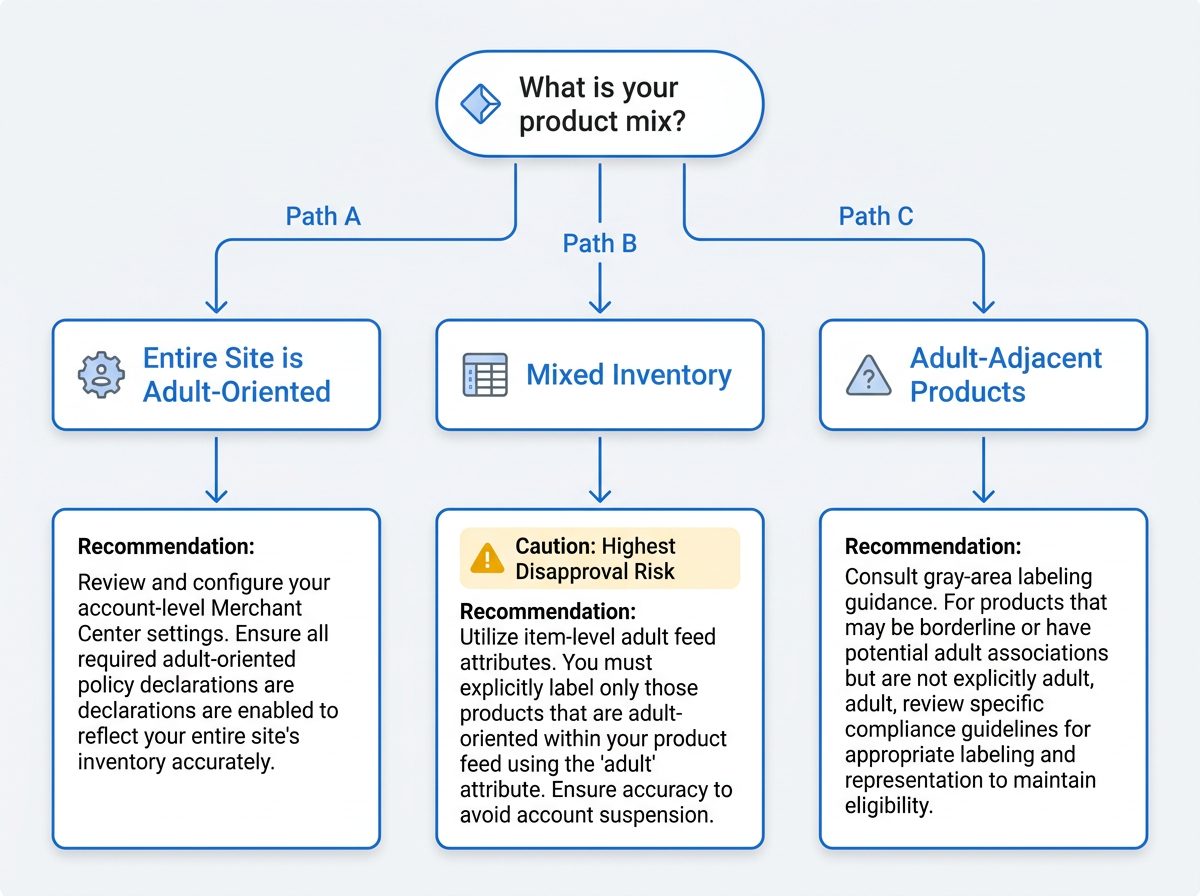
Scenario A: Your Entire Site Is Adult-Oriented
For a site primarily focused on adult-oriented content, use the account-level adult-content setting described in Google's adult-oriented content policy. This tells Merchant Center that the setting applies across the site rather than to isolated SKUs. Maintain accurate product data and landing pages, and use hasAdultConsideration where the corresponding Product structured data implementation calls for it. Market-specific prohibitions still apply even when the account is labelled correctly.
Scenario B: Mixed Inventory, the Riskiest Case
An account-level setting can misclassify a mixed catalogue, so each qualifying SKU needs the item-level adult attribute. Add hasAdultConsideration to the corresponding pages when they contain supported Product structured data, keeping the feed and landing-page descriptions consistent. When auditing duplicate product descriptions on Shopify, check these pages too because duplicated templates can apply structured data inconsistently.
Scenario C: Adult-Adjacent Products, Including Lingerie, Art, and Novelty Items
Gray-area categories create avoidable compliance misses. Art nudes, sheer lingerie, and novelty products with suggestive packaging can fall within Google's policy depending on their imagery, copy, and presentation. Accurate labelling allows Google to apply its audience, SafeSearch, placement, and country rules, but it does not guarantee that the listing will appear in every market or surface. An omitted or inaccurate label can trigger disapproval and further review.
Step 4: Avoiding Disapprovals, Correcting SEO Myths, and Maintaining Visibility
Google does not document hasAdultConsideration as a general organic ranking factor. That does not mean adult classification has no visibility consequences. SafeSearch filtering, image and product-result classification, country restrictions, content policies, and rich-result eligibility can all affect where and how a page appears. Accurate adult labels in ecommerce feeds and structured data provide classification information, but they do not guarantee organic visibility or a particular search treatment.
Warning: For a Merchant Center adult-content disapproval: (1) identify affected products and the stated issue in Merchant Center, (2) add or correct the
adultattribute, (3) align the landing page andhasAdultConsiderationmarkup where applicable, and (4) use the available review or appeal process after confirming the issue is fixed. Review and appeal processing times vary, so monitor the status and any follow-up requirements in Merchant Center. See Google's guidance for requesting a review of Merchant Center issues (Google Merchant Center Help, accessed 2026).
For ecommerce visibility and product discovery, Vizup is Organic Autopilot for modern discovery, helping brands monitor, create, optimise, publish, and learn across Search, Social, Communities, AI Answer Engines, and Local Discovery using AI agents, human experts, and live SEO, pSEO, AEO, and GEO tools. Paid ads are available as an amplification add-on. Vizup does not guarantee Shopping approval or replace a merchant's responsibility to resolve policy violations. For related advertising compliance context, see Google's AI ad disclosures.
A practical Google Shopping adult attribute workflow separates Merchant Center product data from on-page structured data, checks country eligibility, validates each affected SKU, and monitors review outcomes. That approach supports consistent product discovery without treating either signal as a substitute for Google's underlying policies.
Frequently Asked Questions
Do I need to use both the 'adult' attribute and 'hasAdultConsideration' structured data?
Use the adult attribute in Merchant Center product data for each qualifying item. Use hasAdultConsideration in supported Product structured data on the corresponding landing page. They serve different systems, so on-page markup does not replace the Merchant Center attribute. Mixed-inventory sites often need both to keep product data and page markup consistent.
Will labeling my products as 'adult' hurt my organic SEO rankings?
Google does not document either signal as a general organic ranking factor. Visibility can still change because SafeSearch, adult-content classification, country restrictions, rich-result eligibility, and other display controls affect where content appears. Labelling should be accurate rather than withheld for SEO reasons.
What happens if I don't label a product that Google considers adult?
Google can disapprove the product if its content conflicts with the submitted data or policy requirements. Depending on the scope, severity, and resolution of the issue, enforcement can extend beyond an individual item. Correct the product data and landing page, then use the review process available in Merchant Center.
My products are art nudes, not pornography. Do I still need to use the adult attribute?
Potentially, yes. Google's adult-oriented content policy can cover nudity regardless of whether the product is pornographic or presented as fine art. Review the product imagery, description, landing page, target country, and applicable Merchant Center policy before submitting art nudes or figure-drawing products.
Can I use the account-level setting if only 10% of my products are adult?
No. The account-level setting is intended for sites primarily focused on adult-oriented content. For a mixed catalogue, use the item-level adult attribute on qualifying SKUs and add hasAdultConsideration to the corresponding pages when supported Product structured data is present.
