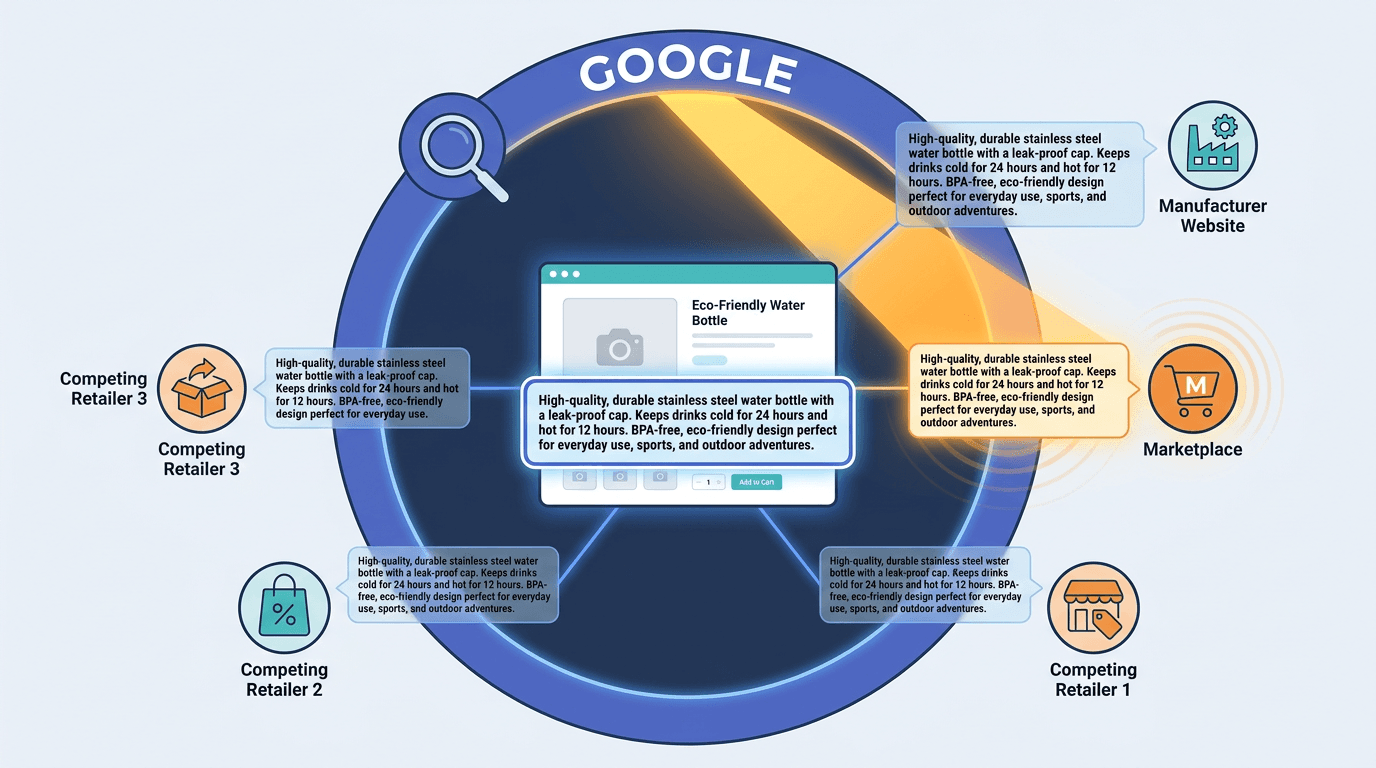
If you are dealing with duplicate product descriptions Shopify issues at scale, the uncomfortable truth is that a chunk of your catalog can be effectively invisible in organic search without any "penalty" ever being applied. Google just chooses a different page in the cluster to show, often a marketplace or a large retailer that also sells the same SKU.
Organic Autopilot research across 1,000 Shopify stores found 20% of product descriptions appear near-verbatim on another domain. In Vizup's sample, the matching domain was commonly a retailer or marketplace reselling the same product rather than a store deliberately copying the description. That distinction matters because the fix is differentiation, not enforcement.
How to fix duplicate descriptions without rewriting your whole catalog:
- Audit your catalog for exact-match and near-match text duplication (quote searches and spot checks).
- Prioritize the highest-value pages first (revenue, traffic, and strategic importance).
- Rewrite the top cohort for product page differentiation, not just "unique words".
- Verify uniqueness, publish, and monitor until Google splits the duplicate cluster.
Step 1: Identify why your Shopify descriptions are duplicated (and what Google actually does)
Start by naming the cause, because each cause implies a different fix. The most common driver is syndicated product descriptions from suppliers, brands, or distributors. This is the classic manufacturer description SEO trap: dozens of legitimate resellers publish the same paragraph because it arrives in the feed, the line sheet, or the PIM export.
Other Shopify-specific causes are self-inflicted and easy to miss:
- Shopify's Duplicate product feature copies title, body copy, media, and often SEO fields unless you change them. Teams duplicate a product to create a new SKU, then forget to rewrite the description and metadata.
- Variant sprawl: colors or sizes become separate product pages that share identical copy, images, and headings.
- Migration and CSV import errors: a template description or a default "About this item" block gets pasted into hundreds of products during a replatform or bulk edit.
- URL structure duplication: variants, collections, tags, and pagination can expose the same content at multiple URLs if you do not consolidate properly (XeeDevelopers, 2026).
Info: Duplicate content is not a penalty by default. Google has said duplicate content is not grounds for action unless the intent is deceptive (Google Search Central, 2008). The real failure mode is clustering and canonical selection.
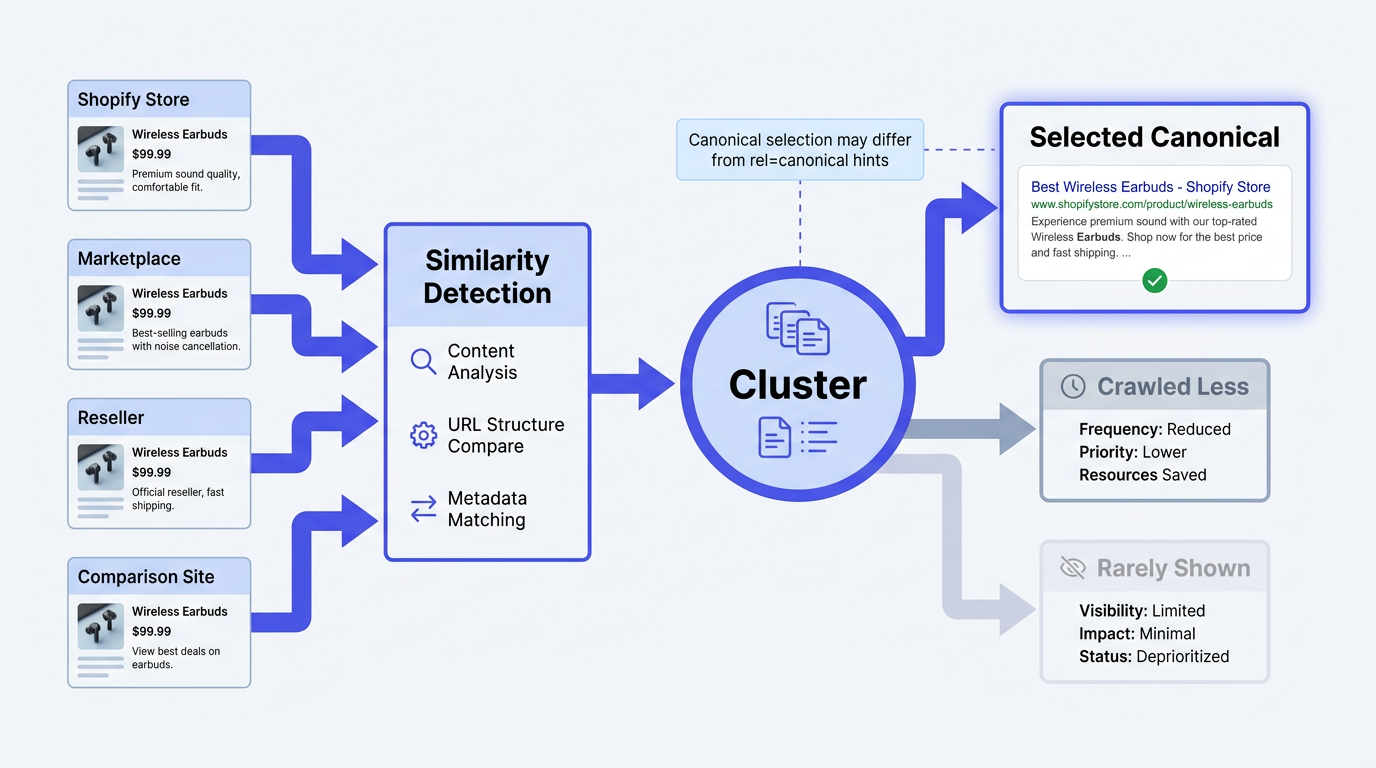
Google can group duplicate or very similar pages and select the URL it considers the best representative. Duplicate versions may receive less crawling attention and may not appear independently in search results. For ecommerce duplicate content, that means you are not "punished", you are just not chosen. After you fix it, expect a lag while Google reprocesses the cluster. Vizup summarizes the timing in how Google handles duplicate content clusters.
This also shows up in AI search. If your page is interchangeable with a marketplace listing, an answer engine has no reason to cite you. Vizup's analysis suggests that original, store-specific information is more likely to make a page useful and citable in AI-generated answers than interchangeable supplier copy. See Commodity Content in AI Search: What Gets Skipped and What Gets Cited.
Step 2: Avoid the tempting fix, mass AI spinning your entire catalog
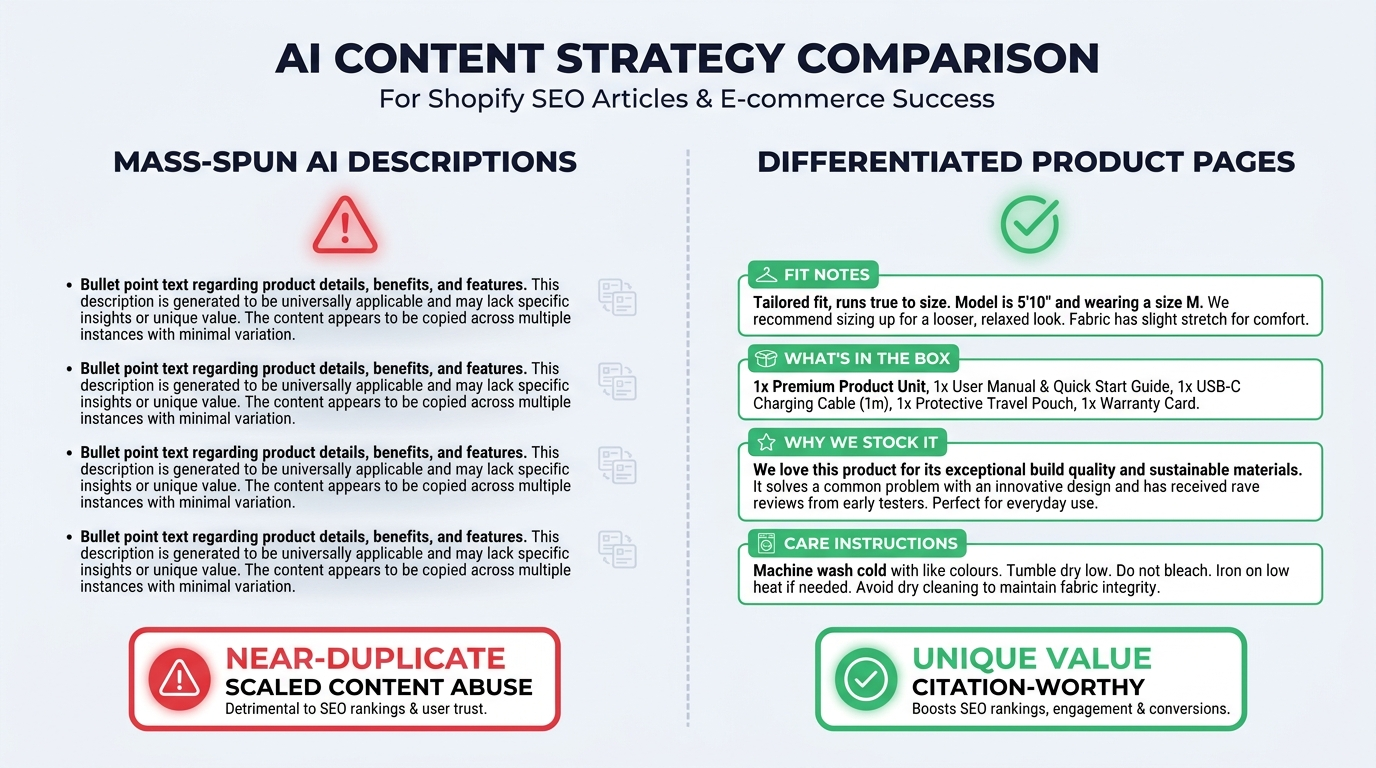
When you discover hundreds or thousands of duplicated SKUs, the obvious move is to generate "new" descriptions in bulk. Resist that impulse. Lightly spun text may remain substantially similar because its structure, entities, and underlying information have not materially changed. You keep the same clustering problem, just with worse copy.
A separate risk arises when automation is used primarily to produce large volumes of low-value pages. Google explicitly calls out scaled content abuse in its spam policies, and thin, mass-generated descriptions are a common pattern. Trading a syndication problem for a site-wide quality problem can cost you far more than a few product rankings. Read Vizup's breakdown of Automated Content Creation: Where It Helps and Hurts SEO and the policy summary in What Are Google's Spam Policies for Generative AI?.
Warning: If the goal is only to "change the words", you are optimizing for a detector, not for a buyer. Unique product copy works because it adds decision-making information that a supplier feed cannot provide, not because it swaps adjectives.
Step 3: Audit your catalog for duplicates, then score pages by value
Treat this as part of a real audit workflow, not a one-off panic. If you need a full checklist that includes indexation, templates, internal linking, and collection architecture, plug this step into How to Conduct a Comprehensive Ecommerce SEO Audit in 2026.
For the duplication check itself, start with fast, low-tech methods:
Quick audit actions:
- Pick a distinctive sentence from your product description and run an exact-match Google quote search, for example: "fits most standard 58mm portafilters".
- Repeat with 2 to 3 different sentences if the first is too generic.
- Log every matching domain you find. Most will be marketplaces, authorized resellers, or the brand site, which confirms syndication rather than scraping.
- Spot-check Shopify admin: look for products created via Duplicate, and compare SEO title, meta description, and body copy.
Then rank what to fix first. Pull revenue and conversion data from Shopify Analytics (or GA4), and pair it with Search Console impressions and clicks. You want pages where differentiation will actually change outcomes, not pages that will never rank because demand is too thin to matter.
| Segment | Revenue | Organic traffic / impressions | Strategic importance | Rewrite priority |
|---|---|---|---|---|
| Hero SKUs | High | High | High (flagship, bundles, repeat buyers) | Priority 1: rewrite now |
| Cash cows with weak visibility | High | Low | Medium to High | Priority 2: rewrite next |
| Traffic magnets, low conversion | Low to Medium | High | Medium (top-of-funnel, upsell paths) | Priority 3: rewrite if you can add real buying help |
| Long tail and clearance | Low | Low | Low | Priority 4: defer, fix templates and canonicals first |
| Use this to build a rewrite queue that matches business impact, not catalog size. |
Step 4: Rewrite the top cohort for differentiation that a reseller cannot copy
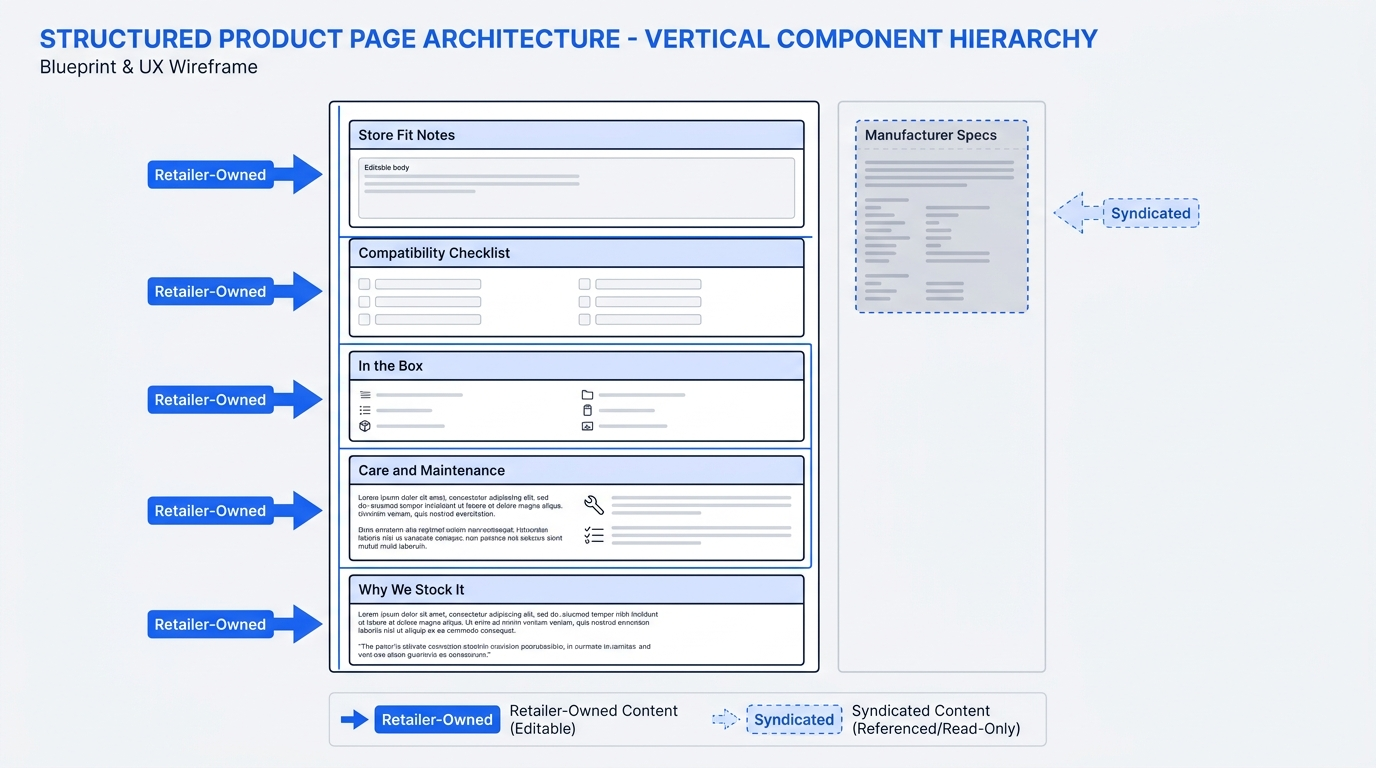
For the pages you marked Priority 1 and 2, rewrite with information that is true, specific, and hard to syndicate. This is where product page differentiation wins. You are not trying to out-write the manufacturer; you are adding your store's experience layer on top of the manufacturer description.
Elements that reliably create unique product copy:
- Fit and sizing notes based on returns and support tickets (include what runs small, what stretches, what to size up for).
- Use-case framing: who it is for, who it is not for, and common pairing recommendations (accessories, refills, compatible parts).
- What you actually ship: in-the-box list, packaging notes, and any store-added QA steps.
- Care, maintenance, and lifespan expectations written from your team's experience, not a brochure.
- Store-specific proof: short customer quotes, warranty handling process, shipping cutoff times, or local compliance notes.
If you use AI, use it to accelerate drafting, not to spin at scale. Start from your real differentiators, then generate a first pass that preserves factual accuracy. Vizup has prompts for rewriting existing copy and for generating unique product descriptions, but keep a human QA pass for claims, measurements, and compatibility.
Do not stop at body copy. Duplicate titles and meta descriptions can keep pages looking interchangeable in the SERP even after the body is fixed. If your catalog was duplicated via Shopify's Duplicate feature or CSV templates, also refresh metadata with optimizing meta titles and descriptions.
Step 5: Verify uniqueness, request indexing, and monitor the cluster split
Before publishing, re-run the same quote-search method on your new draft. If distinctive marketing copy still appears across multiple domains, revise it with store-specific information. Shared technical specifications do not need artificial rewriting when identical wording is necessary for accuracy. A plagiarism checker and exact-match quote searches can both support spot checks, although neither provides a complete view of every copy indexed—or not indexed—across the web.
After publishing, use Google Search Console URL Inspection to request indexing for the updated product pages. Then wait and watch. Cluster re-evaluation is not instant, and Google says pages may remain in a duplicate cluster for up to two weeks after content issues are fixed which is why monitoring matters (canonical re-evaluation timing).
Common mistakes and troubleshooting
- Rewriting low-value SKUs first: you burn time and never see impact. Start with the pages that already drive revenue or have demand signals in Search Console.
- Changing only adjectives: near-duplicate systems still cluster you. Add new sections, new entities, and new decision support.
- Forgetting variants and templates: you rewrite one product, but 40 color pages still share the same copy. Fix the pattern, not the symptom.
- Leaving duplicate metadata: even with better body copy, generic titles and meta descriptions reduce click-through and keep pages looking like everyone else.
- Expecting instant recovery: Google needs recrawls and reprocessing time. Track impressions, canonical selection signals, and ranking movement over multiple weeks.
Summary and next steps
Duplicate product descriptions Shopify stores struggle with are usually a syndication and supply-chain artifact. Google does not punish you for it by default, it clusters near-identical pages and chooses one canonical to show, which can make your products disappear.
The durable fix is a prioritized workflow: find duplication, score pages by value, rewrite only the highest-impact cohort with retailer-only detail, then verify and monitor until the cluster splits. For more tactical ecommerce SEO playbooks beyond duplication, browse Vizup's blog.
Frequently Asked Questions
Is duplicate content a penalty on Shopify?
No. Google has stated there is no specific duplicate content penalty unless the intent is deceptive (Google Search Central, 2008: https://developers.google.com/search/blog/2008/09/demystifying-duplicate-content-penalty). The practical issue is clustering and canonical selection, where your page is simply not chosen to show.
How long does it take for Google to recognize my new unique product descriptions?
Expect days for a recrawl, then up to a couple of weeks for cluster re-evaluation on near-duplicate sets. Vizup summarizes this behavior in Canonical Re-Evaluation Time.
Can I use AI to rewrite my product descriptions?
Yes, but do not mass-spin thin descriptions. Use AI to draft from your real differentiators, then edit for accuracy and specificity. Bulk generation that produces low-value pages risks scaled content abuse, covered in Google's spam policies for generative AI.
What is the fastest way to check for duplicate content on my ecommerce site?
Run exact-match quote searches: copy a distinctive sentence from a product description, search it in quotes, and log which domains appear. Pair that with a quick template review in Shopify to catch duplication caused by the Duplicate feature, variant sprawl, or CSV defaults.
Should I rewrite descriptions for all my products at once?
No. Start with the top cohort by revenue and traffic potential, then expand. Large catalogs are exactly where prioritization pays off, and rewriting everything at once pushes teams toward low-quality automation.
