
Automated content creation has moved from curiosity to default workflow in less than three years. AI-assisted tools are now embedded across content research, drafting, optimization, and publishing workflows, making automation a standard part of modern SEO operations. The adoption curve is steep, and the performance gap is steeper: some teams are scaling thoughtfully, while others are watching visibility slide. The real question is not whether automation belongs in the stack. It is how to use it without tripping the same quality and spam signals Google's systems are built to surface.
This resource lays out the situations where automated content creation improves SEO, the situations where it reliably drags rankings down, and the guardrails that separate the two. Content strategists pressure-testing AI workflows, editors reshaping machine drafts, and SEO specialists auditing sites that scaled too quickly will find clear frameworks and supporting data. The structure is deliberate: start with definitions, move through upside and downside, then land on an operating model you can run.
Sections covered:
- What Automated Content Creation Actually Means. Definitions and the technology behind it.
- Where Automation Genuinely Helps SEO. Speed, scale, and structural advantages.
- Where Automation Hurts SEO. Thin content, AI content risks, and ranking penalties.
- Google's Helpful Content System and What It Measures. The helpful content update explained.
- A Practical Framework for Safe, Scalable AI Content. Workflows, audits, and quality checks.
- Advanced Considerations. Edge cases and nuanced decisions most guides skip.
- FAQ. Five common questions answered directly.
What Automated Content Creation Actually Means
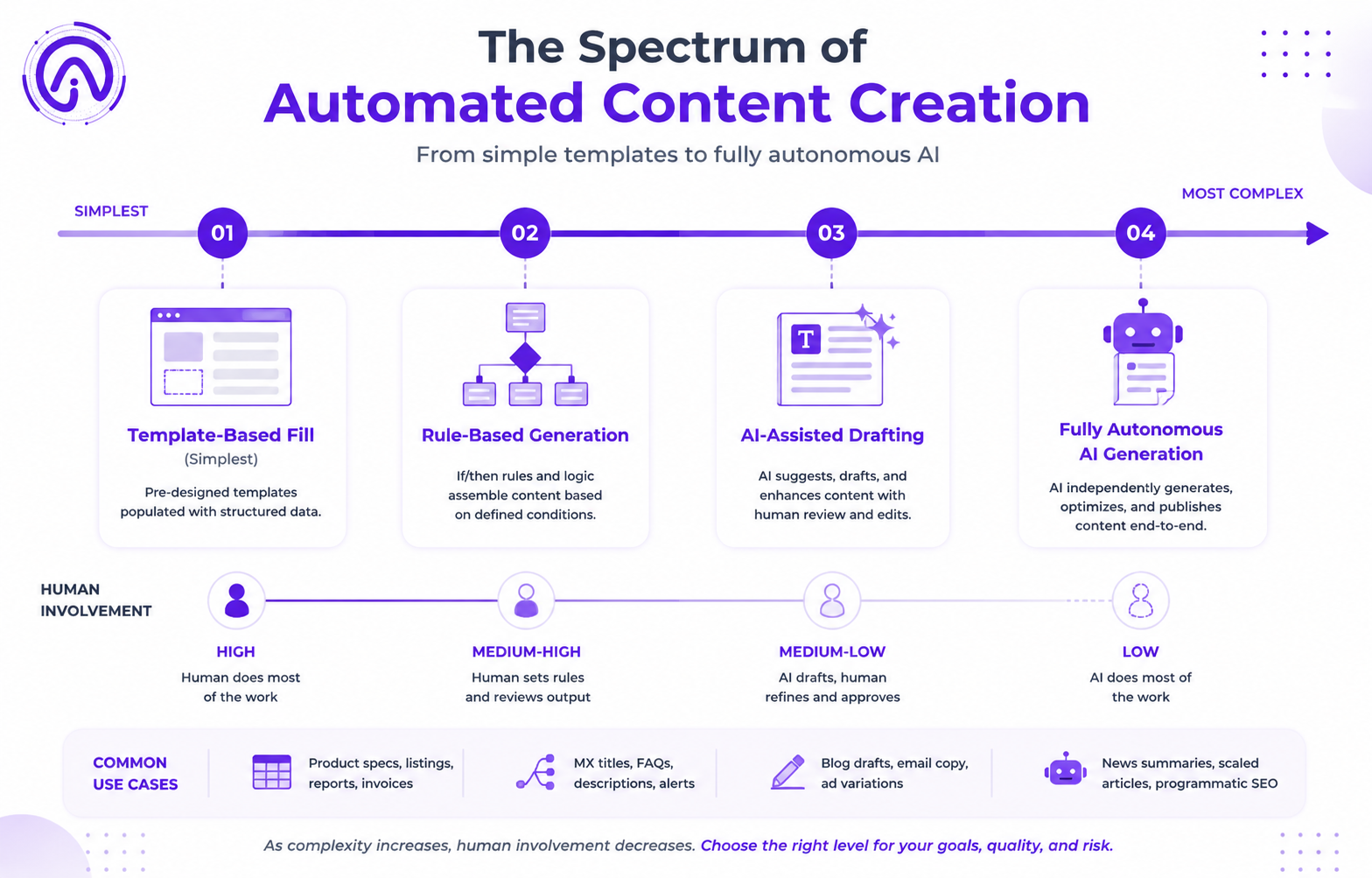
"Automated content creation" is an umbrella term, and it covers more than full-length AI articles. On the light end, it includes template-driven generation, like product descriptions assembled from a spreadsheet. On the heavy end, large language models can draft articles, social posts, and email sequences from a single prompt. IBM defines AI-generated content as output produced through natural language processing and deep learning models trained on massive text corpora. The broader concept, procedural generation, has been around for decades in games and graphics; applying it to marketing copy at scale is the newer part.
From an SEO standpoint, the mechanism matters less than the result. Google's guidance is clear: using automation, including AI, to generate content primarily for manipulating search rankings violates its spam policies. At the same time, Google has stated that AI-generated content is not automatically considered spam. The dividing line is intent and quality, not whether a human or a model produced the first draft. Content that is helpful, accurate, and created for people can perform well regardless of the production method, according to Google Search Central's guidance on AI-generated content.
Where Automation Genuinely Helps SEO
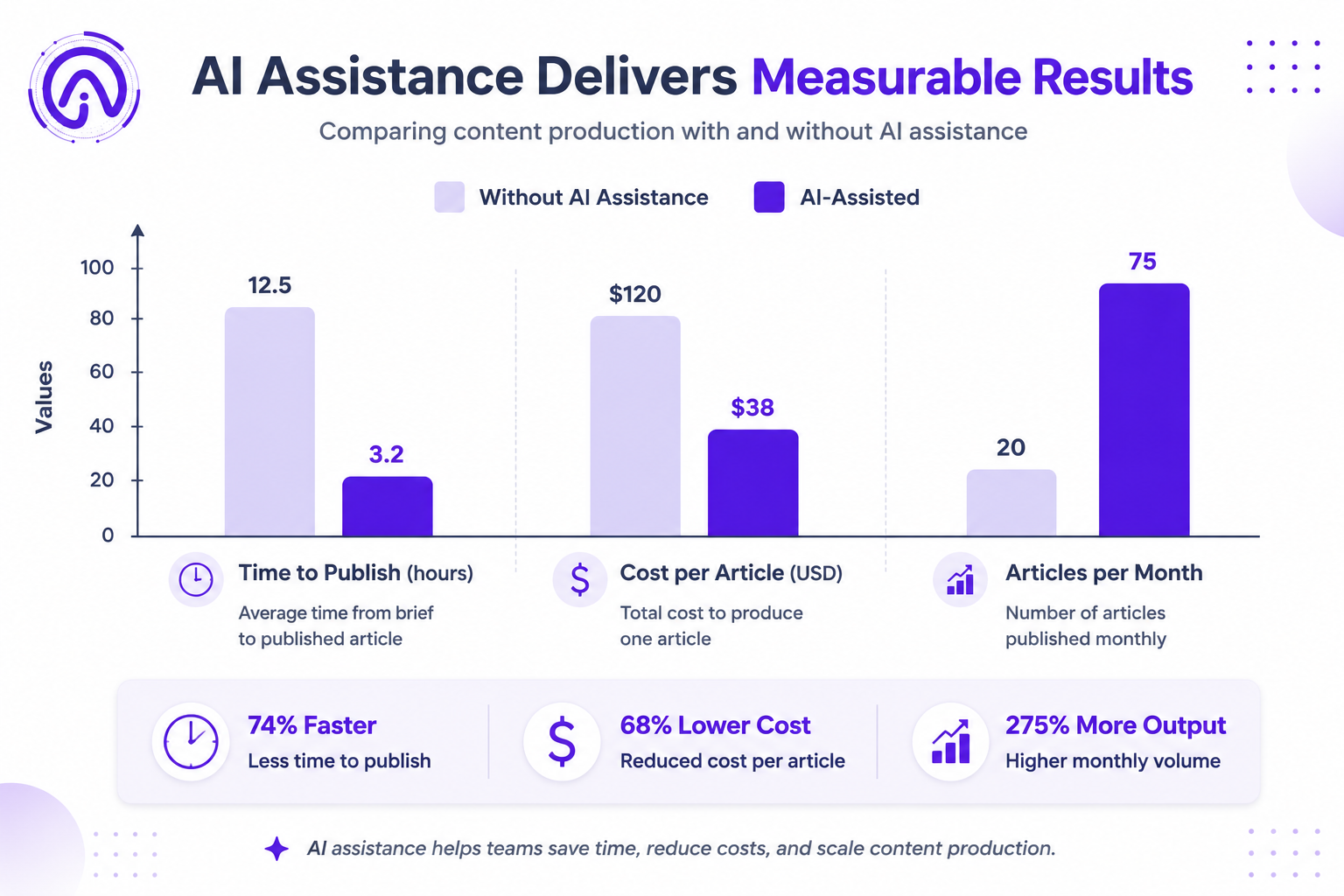
Automation has real, measurable upside. Teams use AI-assisted workflows to accelerate research, outlining, drafting, optimization, and content maintenance, allowing them to produce more content with the same resources. Those gains only translate into SEO wins if the output earns impressions and clicks instead of quietly indexing and dying. The most reliable SEO benefits show up in a few repeatable scenarios.
Scaling Topical Authority Faster
Topical authority is usually a volume problem before it is a writing problem: to cover a subject well, you often need dozens (or hundreds) of pages that answer adjacent questions and support the core pages. A team shipping three posts a week can spend years building that depth. Automated content creation shortens the runway. With a researched content map and real subject-matter review, AI drafts can carry the first pass on supporting pieces like glossary entries, FAQ hubs, and comparison pages at a pace that is hard to justify with fully manual production. Vizup's guide on scaling AI content production breaks down what that operating model looks like when you treat quality control as part of the workflow, not an afterthought.
Structural and Technical SEO Tasks
Some of the best uses of automation are not "writing" problems at all. Generating meta descriptions across thousands of URLs, producing structured data markup, suggesting internal links, and assembling XML sitemaps are repetitive, rules-driven tasks where consistency matters more than voice. That makes them strong candidates for automation: low creative risk, high time savings, and clear QA checks.
First-Draft Acceleration
A blank document is expensive, and not because writers are slow. Research synthesis, outlining, and structuring the argument often take longer than the final polish. AI can handle that first-draft scaffolding when the prompt is specific enough, leaving humans to do the work that actually differentiates the page: verifying claims, adding perspective, and making the piece readable. Treat the output as raw material, not publish-ready copy. If you want stronger raw material, learning to craft the perfect blog prompt tends to show up immediately in draft structure and coherence.
Where Automation Hurts SEO: AI Content Risks and Thin Content
Industry surveys consistently show that organizations expect AI investment to continue increasing as content production, optimization, and analysis workflows become more automated. The spending is arriving faster than the process maturity. The risks are not hypothetical, either; they show up as pages that index, stall, and eventually pull down sections of a site.
Warning: What most people get wrong: They assume Google penalizes AI content specifically. It does not. Google penalizes low-quality content, regardless of how it was produced. The problem is that unedited AI output is far more likely to be low-quality than carefully written human copy.
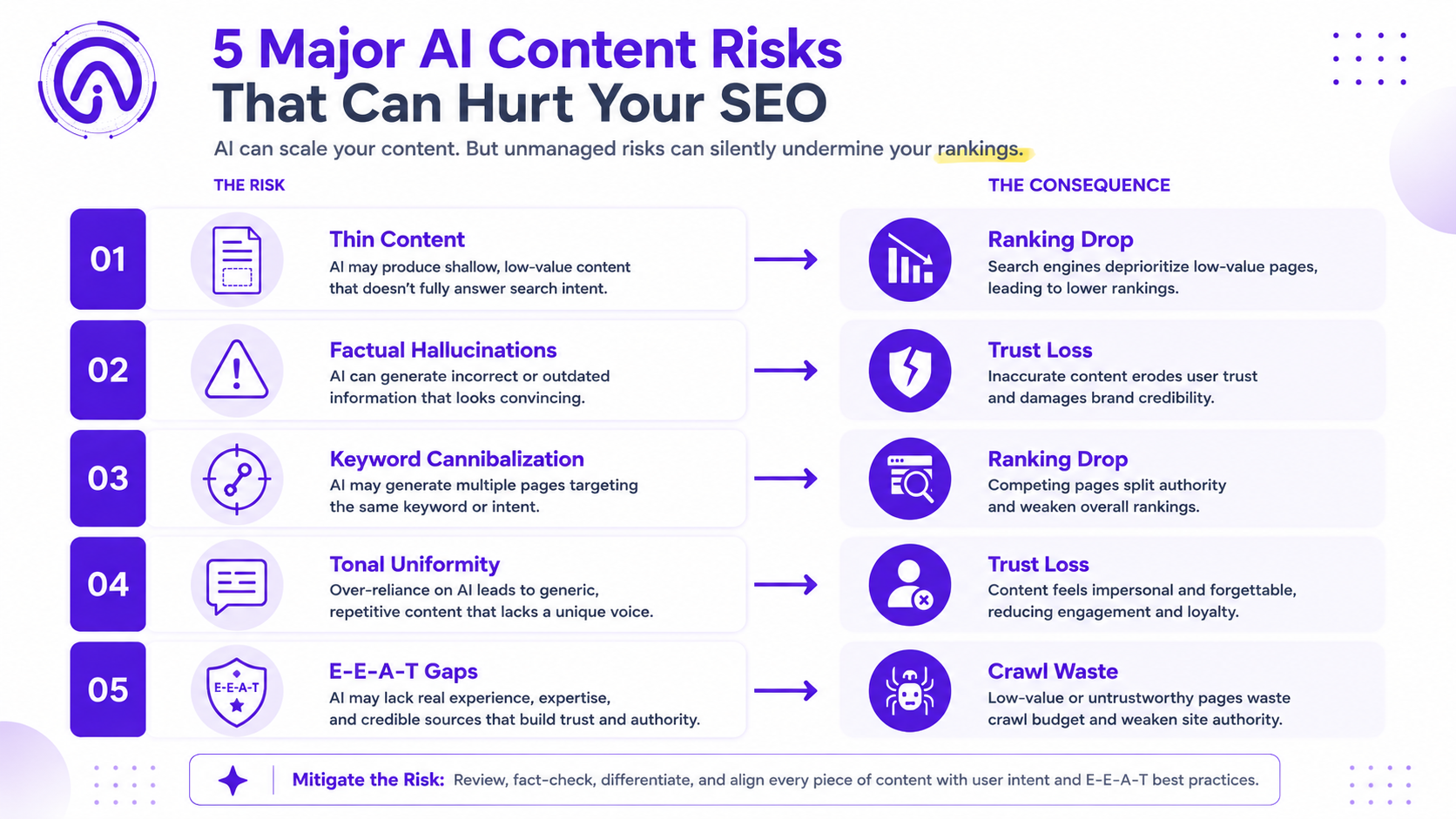
The most common failure mode is thin content: pages that technically touch the topic but bring no original insight, no unique data, and no point of view a reader could not get from the first ten results. Generate 200 posts from variations of the same prompt and you usually get 200 versions of the same surface summary. Google's systems are tuned to spot that pattern. The bar is not "does this page mention the right keywords?" It is "does this page answer the query better than what is already ranking?"
The other repeat offenders are predictable. Factual hallucinations show up as confident but wrong stats or misattributed quotes. Tonal sameness makes pages feel like model output to readers (and creates a footprint across a site). Cannibalization happens when multiple AI pages chase overlapping queries with no clear differentiation, wasting crawl budget and splitting signals. Running drafts through an AI content checker can flag obvious issues before launch, but it cannot replace editorial judgment or source verification.
Google's Helpful Content System and What It Measures
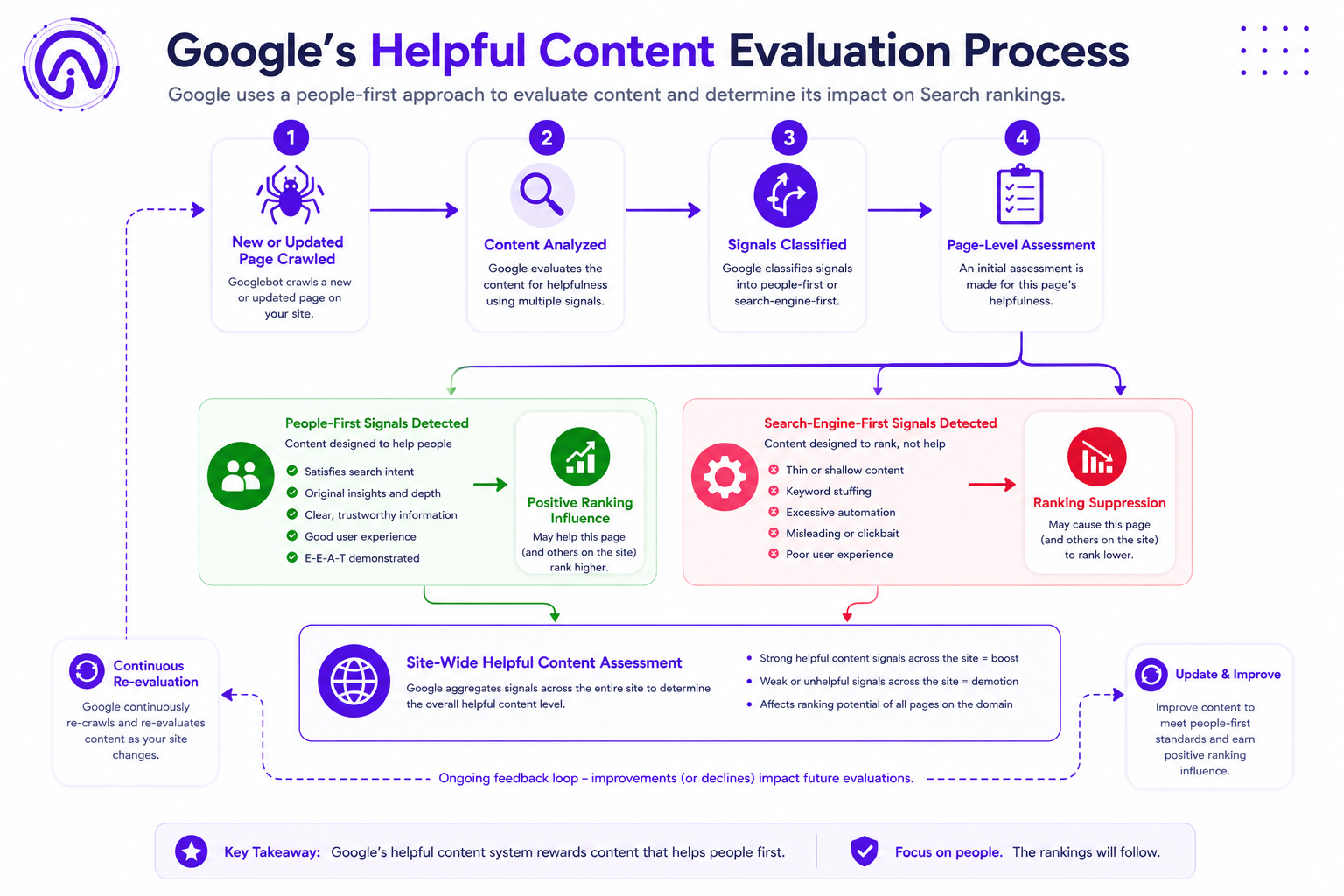
In March 2024, Google folded its Helpful Content system into the core ranking algorithm. That change matters operationally. When the system ran as a separate update, teams could treat it as periodic weather. As part of core, it is continuous: every crawl and re-evaluation is a fresh vote on whether your content reads as "people-first" or "search-engine-first."
It also works at two levels: page and site. If a domain accumulates a high share of unhelpful pages, the suppression can spill beyond the weak URLs and dampen performance across the site, even when individual pages are solid. This is why reckless scaling is so costly. Publishing 500 AI-generated pages to "cover more keywords" does not just risk 500 misses. It can pull down the pages that were already doing the work.
Google's documentation, alongside analysis from Hobo SEO Auditor, points to the kinds of signals involved: content written for search engines instead of humans, content that leaves readers feeling like they need to search again, and content spread across many topics without clear expertise. Michigan Technological University's SEO fundamentals guide lands in the same place: quality content that serves users is still the baseline, even when the production workflow changes.
A Practical Framework for Safe, Scalable AI Content
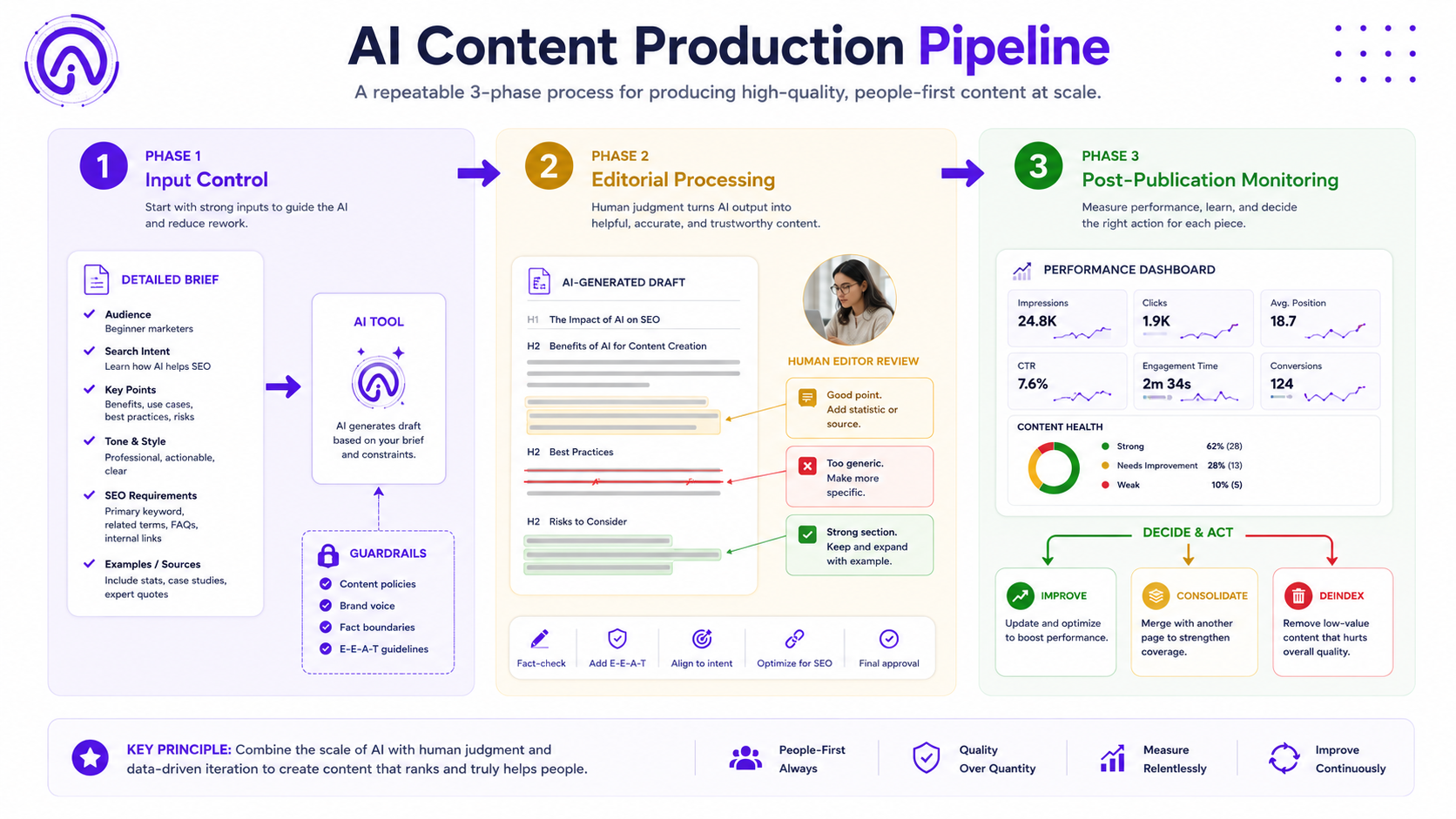
Awareness does not prevent damage; process does. To keep the speed benefits of automation without shipping problems into the index, you need a system that catches issues early and keeps catching them after publish. The framework below breaks that into three phases: input control, editorial processing, and post-publication monitoring.
Phase 1: Input Control
AI output rarely exceeds the specificity of the brief. Vague prompts produce generic copy; detailed briefs produce drafts that are much closer to usable. Include the target audience, search intent, required sources, any unique data points you want referenced, and structural constraints (headings, sections, comparisons). Create prompt templates by content type (comparison posts, how-to guides, thought leadership) and revise them based on what your editors keep fixing. Vizup's prompt library is a practical starting set for common SEO formats.
Phase 2: Editorial Processing
| Check | What to Look For | Action if Failed |
|---|---|---|
| Factual accuracy | Verify every statistic, quote, and claim against primary sources | Fix the claim or remove it |
| Originality | A perspective, data point, or framework not already on page-one competitors | Add original analysis, proprietary data, or expert commentary |
| E-E-A-T signals | Byline, citations, and clear indicators of first-hand experience | Add an author bio, link credentials, and include personal observations |
| Keyword cannibalization | Overlap with an existing page targeting the same query | Merge, redirect, or re-angle the page |
| Readability and tone | Reads like a knowledgeable human rather than a model summary | Rewrite flat sections, vary sentence structure, and add opinion |
| Apply this checklist to every AI draft before publication. Skipping steps is how thin content enters your index. |
Phase 3: Post-Publication Monitoring
Publishing is the start of measurement, not the end of the workflow. Track each AI-assisted page for at least 90 days. Look for pages that index but never earn impressions (a common sign of suppression), pages with impressions but almost no clicks (often a title/snippet intent mismatch), and pages that siphon traffic from existing URLs. Use a prompt for an SEO content audit to review the portfolio quarterly and keep decisions consistent. If a page is still not performing after 90 days, choose a path: improve it, consolidate it, or remove it from the index.
Advanced Considerations Most Teams Overlook
Most discussions of "AI content" stop at prompts and plagiarism checks. The harder problems are domain-level effects, competitive convergence, and the governance details teams only notice after rankings move.
Site-wide quality dilution is non-linear. Teams often assume that if 80% of pages are strong, the remaining 20% of weak AI pages will be tolerated. The Helpful Content system is not a simple ratio. A pocket of low-quality pages in a subdirectory or within a single topic cluster can weigh down that entire cluster, even if the rest of the domain is clean. If AI is powering a new hub, keep it staged and ship only after editorial review, rather than letting drafts hit production by default.
AI content SEO performance degrades faster than human content. On competitive topics, multiple sites frequently use the same models and similar prompts, so the pages converge on the same structure and the same obvious points. When Google is faced with dozens of near-identical answers across domains, none of them stands out. That is why the shelf life of unedited AI copy keeps shrinking on hard queries. Durable differentiation still comes from original research, proprietary data, and real expertise.
Tip: Skip this if you are already running content audits quarterly: If your team is new to AI content, the highest-leverage move is auditing what you have before producing more. A site carrying 200 underperforming AI pages will not recover by adding 200 better ones. Cut the dead weight first, then scale. Vizup's AI content tools can help identify which pages need attention.
Regulatory and disclosure trends are accelerating. This is not currently a direct ranking factor, but several jurisdictions are moving toward mandatory disclosure for AI-assisted content. Building a disclosure step into the workflow now (even a simple "AI-assisted, human-edited" tag in the CMS) keeps you ahead of policy shifts and reduces trust friction with readers. Transparency about process also supports E-E-A-T.
If you are building a long-term operating model around these tools, established AI content strategy frameworks offer a more structured way to balance automation, editorial standards, and performance feedback loops.
Key Takeaways and Next Steps
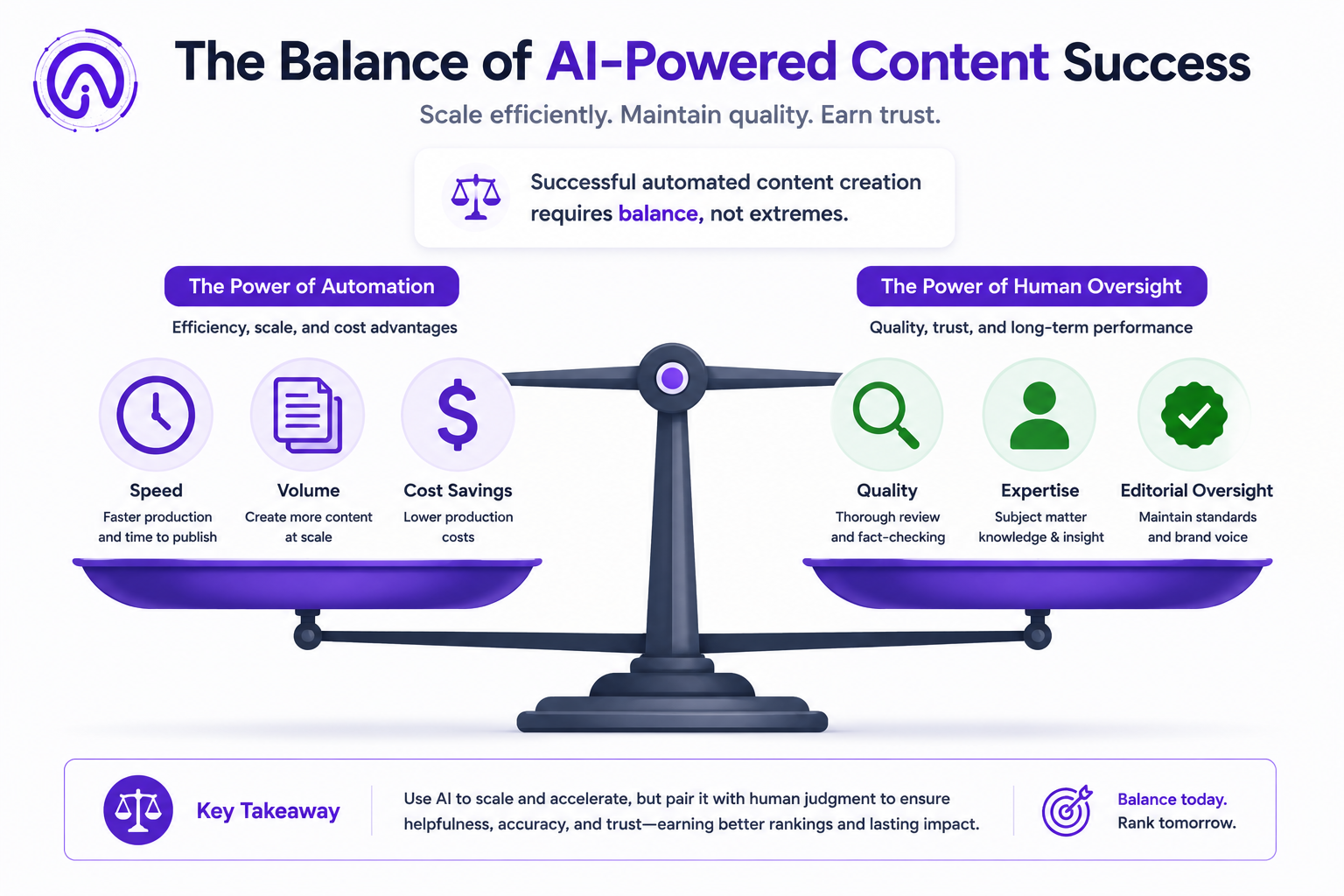
Automated content creation is a production method, not a strategy. It speeds up whatever you feed into it, including weak planning and weak standards. The teams that come out ahead pair AI velocity with rigorous editing, genuine expertise, and ongoing measurement. Teams that choose either extreme - fully manual forever or publish-anything automation - tend to pay for it in volatility.
- Automate structural SEO tasks (meta descriptions, schema, internal linking suggestions) where the work is rules-based and low risk.
- Use AI-generated prose as a first draft, then verify facts, add originality, and edit for human tone.
- Track Helpful Content impact by monitoring page-level and cluster-level performance, not only total traffic.
- Audit before scaling. Pruning weak pages usually improves rankings faster than publishing more.
- Bake disclosure and quality checks into the CMS workflow so they do not disappear under deadline pressure.
If your team wants to use automated content creation without turning it into uncontrolled mass publishing, Vizup fits naturally into this workflow. Its Programmatic Content Generator helps create up to 20 pages at once using templates and keyword inputs, making it useful for scalable SEO formats like comparison pages, product-led pages, location pages, and long-tail landing pages. More importantly, it keeps automation structured and reviewable, so teams can scale content while still protecting quality, consistency, and search performance. If you are planning to use automation as part of your SEO system, you can book a demo with Vizup to see how it can support safer, more controlled content scaling.
Frequently Asked Questions
Does Google penalize AI-generated content?
Google does not penalize a page just because AI helped write it. Its spam policies focus on content created primarily to manipulate rankings, regardless of how the text was produced (Google Search Central, 2023). The practical risk is quality: unedited model output is more likely to trip unhelpful-content signals because it often lacks depth and original contribution.
How can I tell if automated content is thin?
Ask a simple question: does the page add something a reader will not get from the current top results? That "something" is usually original data, a distinct framework, first-hand experience, or a specific recommendation grounded in evidence. If the answer is no, the page is probably thin. An AI content checker can provide an early signal, but an editor comparing against page-one competitors is still the most reliable test.
What is the safest way to start using automated content creation for SEO?
Start where the risk is low and the work is repetitive: meta descriptions, FAQ schema, internal linking suggestions, and content briefs. After your team has a consistent prompting and review process, expand into first-draft generation for supporting content like glossary pages and comparison tables. Save pillar content for after you have proven that the quality-control workflow holds under volume.
How does the helpful content update affect sites that mix AI and human content?
The Helpful Content system evaluates quality at the page level and the site level. A domain with a meaningful share of unhelpful pages - AI or human-written - can see broader suppression across the site. The safest operating model is regular auditing and pruning, with a clear quality threshold for every indexed page.
Can AI content rank for competitive keywords?
Yes, but not as raw output. Competitive SERPs tend to be crowded with similar AI-generated structures and talking points, especially when sites use the same tools and prompts. The pages that break through are the ones that layer in original research, expert commentary, proprietary data, or analysis the model cannot generate on its own.
