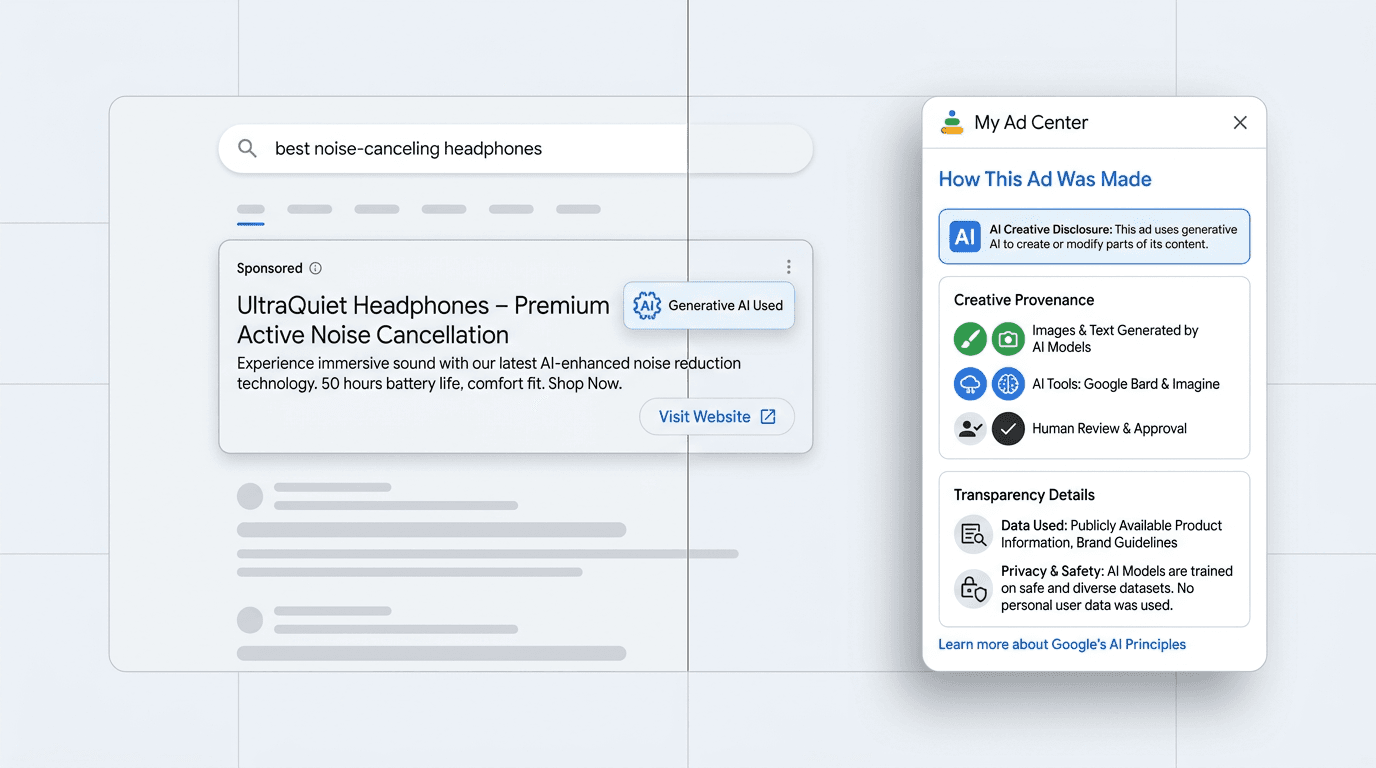
Google AI ad disclosures are new labels in the My Ad Center panel that tell users whether an ad's creative was generated or substantially edited with artificial intelligence. Rolling out globally across Google Search, YouTube, and Discover, the feature was announced on 9 July 2026 by Keerat Sharma, Google's VP and GM for Ads Privacy and Safety, and it is the first time AI disclosure requirements have been pushed beyond election advertising.
For paid media leads and brand compliance teams, this is more than a fresh UI affordance. Google is setting up two separate disclosure routes, putting the accuracy burden on advertisers who rely on third-party tools, and making it clear that provenance expectations are coming to every major surface. The sections below focus on the questions teams are asking right now: how this changes workflows, where the compliance risk sits, and what a defensible brand response looks like.
What Exactly Is Google Disclosing, and Where?
If a user taps the three-dot menu or info icon on an ad in Google Search, YouTube, or Discover, they can open My Ad Center and now find a dedicated 'how this ad was made' section. It indicates whether the ad was created or edited with AI, spanning everything from fully generated images to AI-assisted copy revisions. Google is rolling it out globally, so the underlying system is not limited to a handful of markets, even if the exact UI treatment varies by region.
Some jurisdictions with specific regulatory requirements, including the European Union, India, and New York, may also show a disclosure directly on the ad rather than keeping it behind a menu. This on-ad treatment is more likely to influence perception at the moment someone encounters the creative. Brands operating across multiple markets should therefore build workflows that can accommodate the strictest applicable requirements. For broader context, Vizup explains how Google Ads labels can function as visibility and transparency signals.
How the Disclosure Process Actually Works for Advertisers
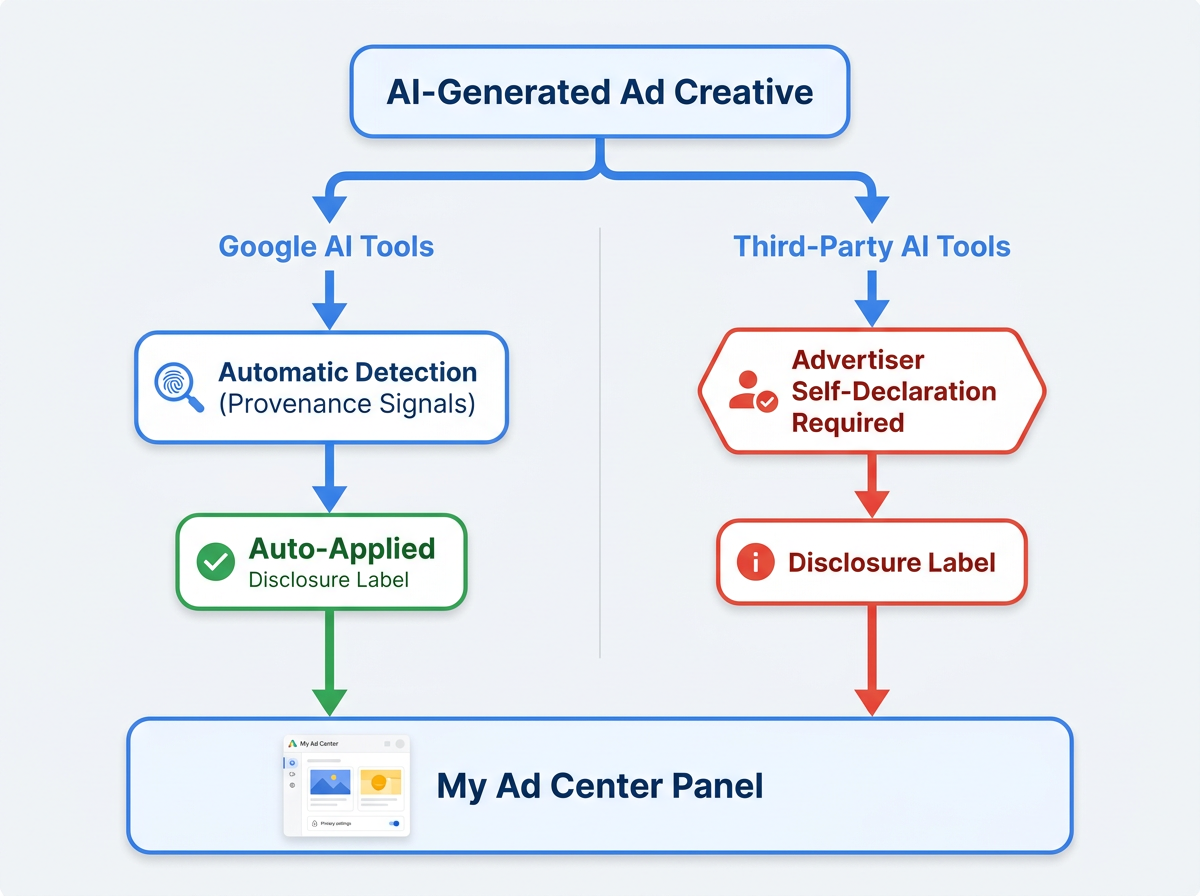
Automatic Disclosure: Google's Own AI Tools
When eligible creative is generated or edited using Google's native generative AI advertising tools, Google may apply an AI disclosure automatically. Google uses provenance technologies and signals, including SynthID, to help identify content created with its generative models. Advertisers should still review the applicable Google Ads guidance because labelling behaviour can vary by asset type, product and jurisdiction.
Self-Declaration: Third-Party AI Tools
When creative is produced using third-party AI tools, advertisers may need to apply the relevant disclosure through Google Ads and maintain accurate records of how each asset was created or materially edited. Google may also apply labels in certain circumstances based on legal requirements or available provenance signals. The practical burden therefore remains on advertisers to document their creative tool stack, review regional requirements and ensure that AI-assisted assets comply with Google's policies on misleading or deceptive advertising.
Warning: Non-disclosure of third-party AI use does not create a new category of violation on its own, but it can compound existing deceptive-ads policy breaches. Document your creative tool stack now so your team can make accurate self-declarations at scale.
Why This Is Happening Now
This policy is a straight extension of Google's 2023 requirement to disclose synthetic content in election advertising. That 2023 rule was the first clear signal that AI-generated imagery in ads needed an actual governance framework. The July 2026 expansion is the first time Google has carried those expectations into commercial advertising, which is a meaningful widening of scope.
The timing appears to reflect a broader shift toward clearer provenance and accountability for AI-assisted content. Establishing disclosure systems early can help Google respond to different regulatory requirements while protecting user trust across its advertising surfaces. The same pressure is visible in organic discovery, where platforms are strengthening their ability to identify low-quality or manipulative automation. Vizup's analysis of how Google plans to catch AI spamprovides additional context on the relationship between transparency, content quality and enforcement.
A Practical Decision Matrix: When to Label Your Creative
| AI Use Case | Disclosure Required? | Rationale / Risk of Not Disclosing |
|---|---|---|
| Fully AI-generated image (Google tools) | Yes, automatic | SynthID watermarking triggers the label with no advertiser step |
| Fully AI-generated image (third-party tool) | Yes, self-declared | Google does not verify; if the AI use is material, non-disclosure can run into deceptive-ads policy |
| AI background removal or object cleanup | Depends on materiality | Small touch-ups may not need disclosure; major scene changes likely do |
| AI-generated ad script or copy | Self-declare if material | Text-only AI use is lower-risk today, but the policy scope is broad and still moving |
| Synthetic person added to a real photograph | Yes, self-declared | High deception risk; more likely to intersect with regional on-ad label requirements |
| Based on Google's July 2026 policy announcement. Consult legal counsel for jurisdiction-specific requirements. |
Beyond Ads: Why Your Whole Brand Needs an AI Disclosure Policy
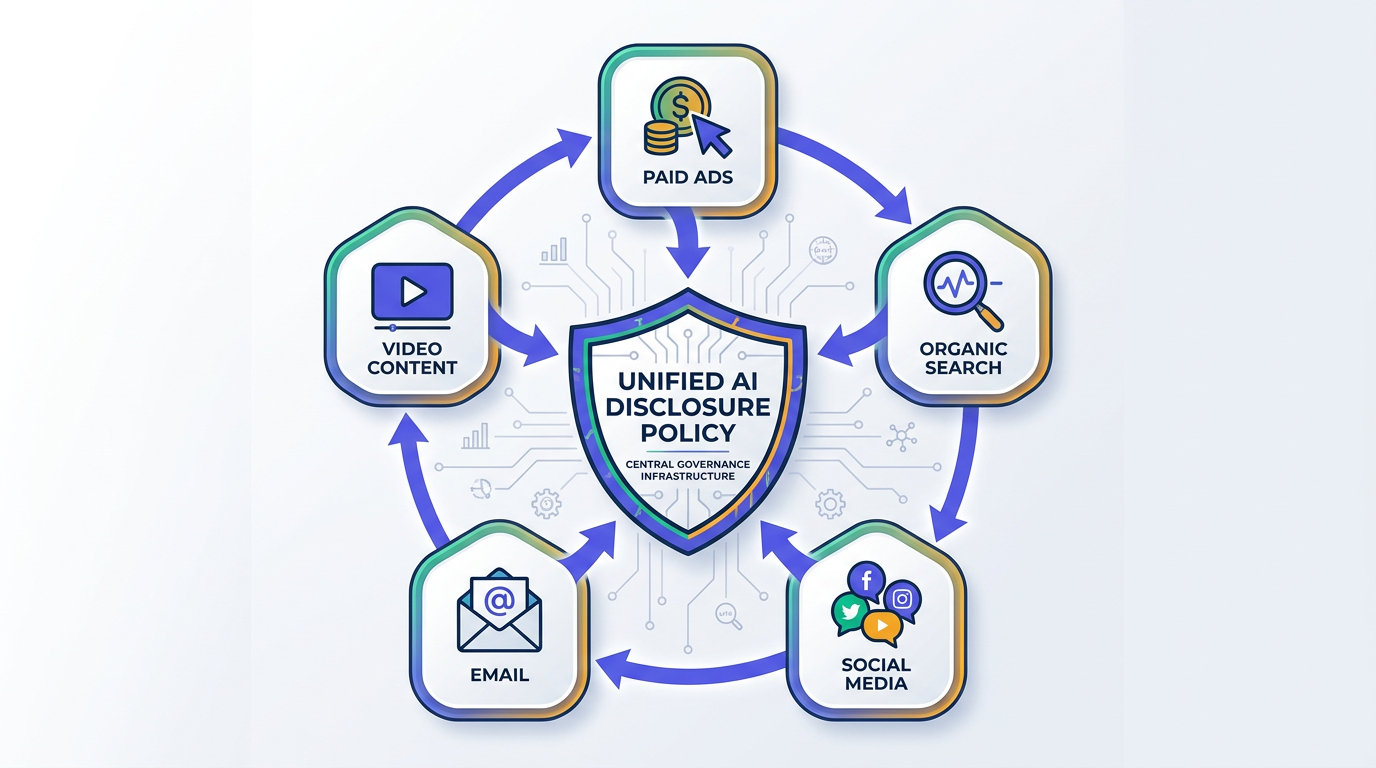
Google's AI advertising disclosures are part of a wider shift toward transparency across organic search, social platforms, communities and digital publishing. Treating disclosure solely as a paid-media responsibility can create fragmented processes, inconsistent messaging and avoidable governance gaps. This is one reason organic marketing now extends beyond traditional SEO.
A shared internal standard should define what counts as AI-assisted content, who approves disclosure language and how production records are maintained. Organic teams should not wait for individual platforms to impose separate requirements. The same provenance conversation is already visible in Google's AI search labels, showing that transparency expectations are expanding across both paid and organic discovery.
This connected approach reflects how SEO, AEO and GEO work together across modern discovery. Rather than treating search rankings, answer-engine visibility and AI citations as separate activities, Vizup brings them into one operating workflow supported by continuous monitoring, execution and learning.
Vizup acts as an Organic Autopilot for modern discovery, helping brands monitor, create, optimise, publish and learn across Search, Social, Communities, AI Answer Engines and Local Discovery. It combines AI agents, human experts and live SEO, pSEO, AEO and GEO tools to turn changes in platform behaviour, audience expectations and brand visibility into coordinated organic action. Paid advertising is available as an amplification add-on for brands that want to extend the reach of proven organic content.
Key Takeaways for Marketers
What every paid media lead, brand manager, and compliance officer needs to know:
- Disclosure is now standard on Google: The 'how this ad was made' section appears in My Ad Center across Search, YouTube, and Discover globally as of July 2026.
- Two paths, different burdens: Ads made with Google's native AI tools are labeled automatically via SynthID. Ads made with third-party tools require manual self-declaration by the advertiser.
- The honor system has real stakes: Google does not verify third-party disclosures, but existing deceptive-ads policies still apply. Non-disclosure is not a safe default.
- Regional rules add a layer: In the EU, India, New York, and other regulated markets, the AI-generated ads disclosure can appear directly on the ad, not just inside My Ad Center.
- This is a brand-wide issue: Use this policy as the catalyst to build one unified AI disclosure standard across paid, organic, social, and email, not a siloed ads-team fix.
Frequently Asked Questions
Does the 'How this ad was made' label appear on the ad itself?
Not always. Most of the time, users reach the 'how this ad was made' section by opening the three-dot menu or info icon and viewing it inside the My Ad Center panel. In some jurisdictions with local requirements, including the EU, India, and New York, an AI label can also be shown directly on the ad.
What happens if I use a third-party AI tool and don't disclose it?
Google does not independently verify third-party AI use, so an undisclosed ad is not automatically flagged on that basis alone. But Google's prohibitions on misleading and deceptive ads still apply regardless of how the creative was produced. If the AI-generated content is materially deceptive, skipping disclosure can compound the violation and raise enforcement risk.
Do I need to disclose using AI for writing ad copy or for audience targeting?
The policy is aimed at creative that was generated or significantly edited with AI, including imagery, video, and scripts. AI used strictly for audience targeting or bidding optimization is different from AI-generated creative and is not the main focus of the current disclosure requirement. Still, the scope is broad and evolving, so keep documentation of AI use across your creative workflow.
Is this related to Google's SynthID watermark for AI images?
Yes. SynthID, developed by Google DeepMind, is an imperceptible digital watermark embedded in content produced by Google's own generative AI tools. It is what enables automatic disclosure for Google-native AI ads. For third-party tools, SynthID is not part of the chain, which is why those disclosures depend on advertiser self-declaration rather than automated detection.
How does this new Google AI ad disclosure policy affect my organic content strategy?
The disclosure does not directly regulate organic content, but it signals that transparency and provenance are becoming more important across Google's surfaces. Organic teams should use this moment to formalise an AI content policy covering production, review, disclosure and record-keeping. A unified standard across paid and organic channels is easier to operate than a reactive collection of platform-specific rules. Vizup's guidance on building a content marketing strategy for AI search visibility can help teams connect governance with discoverability, quality and measurable organic performance.
