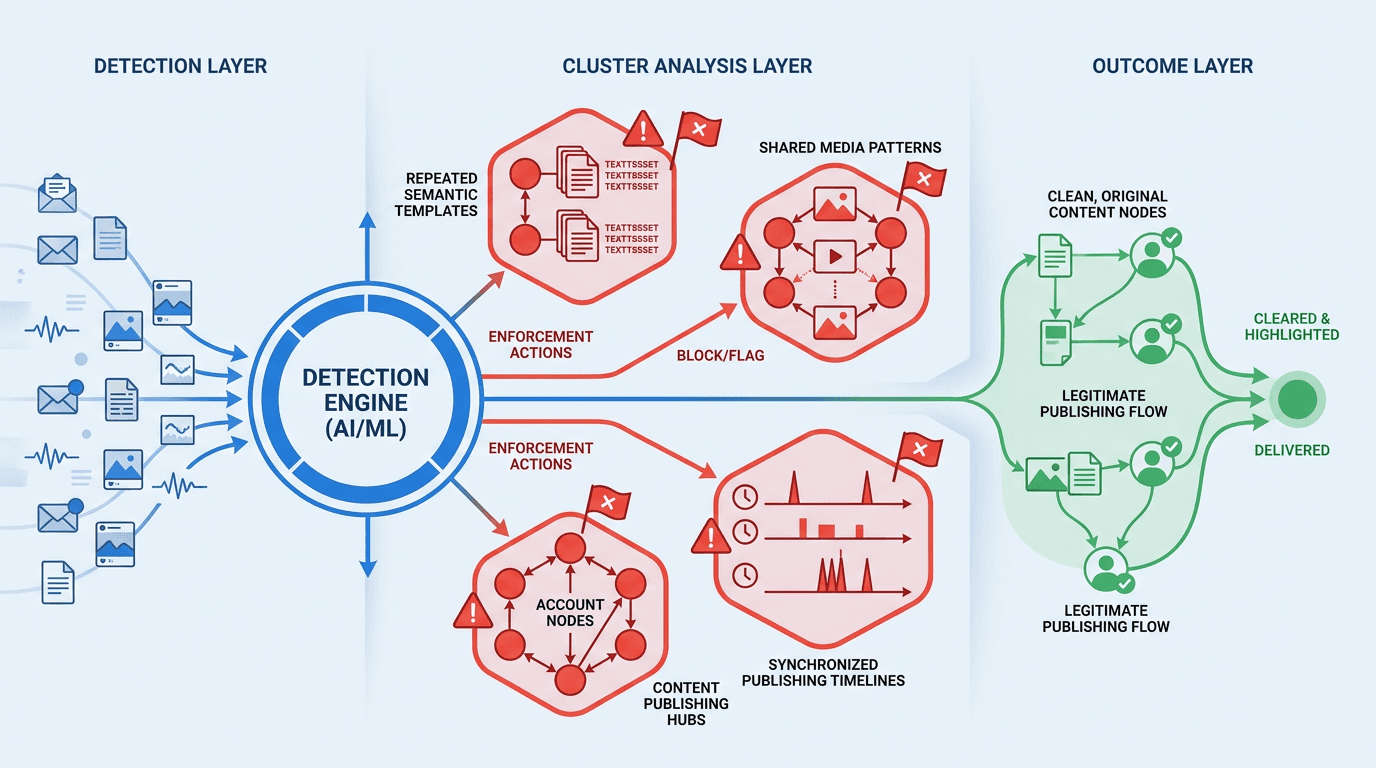
Google AI spam detection is increasingly framed as a network problem: identify clusters of accounts that repeatedly publish the same semantic or narrative template at scale, then neutralize the whole operation. In Google Research, the Scalable Cluster Termination System (S-CTS) is presented as a way to detect coordinated abuse by measuring shared patterns across accounts, not by judging one video at a time.
For SEO teams, publishers, and video marketers, this matters because the flood of "AI slop" changes what gets reviewed and what gets removed. The safest strategy is not "avoid AI", it is avoid mass templating, avoid coordinated amplification tactics, and keep your output meaningfully original.
For teams managing organic visibility, the goal is not to avoid AI altogether, but to monitor originality, citation quality, and AI-search visibility with workflows like those in Vizup.
Why individual content vetting breaks under AI scale
Traditional spam review assumes you can evaluate a page or a video on its own merits. That breaks when adversaries can generate thousands of plausible assets per day, rotate accounts, and A/B test narratives until something slips through. The abuse pattern shifts from "one bad item" to "an organization producing many near-duplicates".
The failure modes look familiar if you have ever audited low-quality networks:
- High volume output with minor wording changes, but the same underlying story structure (classic AI slop detection problem).
- Distribution across many accounts so no single channel looks extreme in isolation.
- Coordinated media abuse where the goal is not audience value, it is manipulation of recommendations, search visibility, or monetization.
Google has signaled a broader crackdown on unoriginal, mass-produced content. The March 2024 spam update targeted a 40% reduction in low-quality results, which was later revised to 45% (The Keyword, 2024) via New ways we're tackling spammy, low-quality content on Search. S-CTS fits that direction, but operates at an infrastructure level.
What Google Research says S-CTS is
In the paper "Scalable Detection of Adversarial Synthetic Slop and Coordinated Media Abuse: A LoRA-Enabled Multimodal Defense System," Google describes S-CTS as a system designed to combat synthetic spam by identifying clusters of coordinated accounts rather than evaluating individual items (Google Research, 2026) in the Google Research publication.
Note: This is published research. Google does not always confirm which research systems are deployed, where they run (Search, YouTube, Discover), or how closely production matches a paper.
The practical shift is straightforward: if a high share of accounts inside a detected infrastructure cluster reuse the same semantic template, the cluster is treated as an operation. The "termination" action targets the network, not a whack-a-mole removal of single uploads.
How the Scalable Cluster Termination System (S-CTS) finds coordinated spam
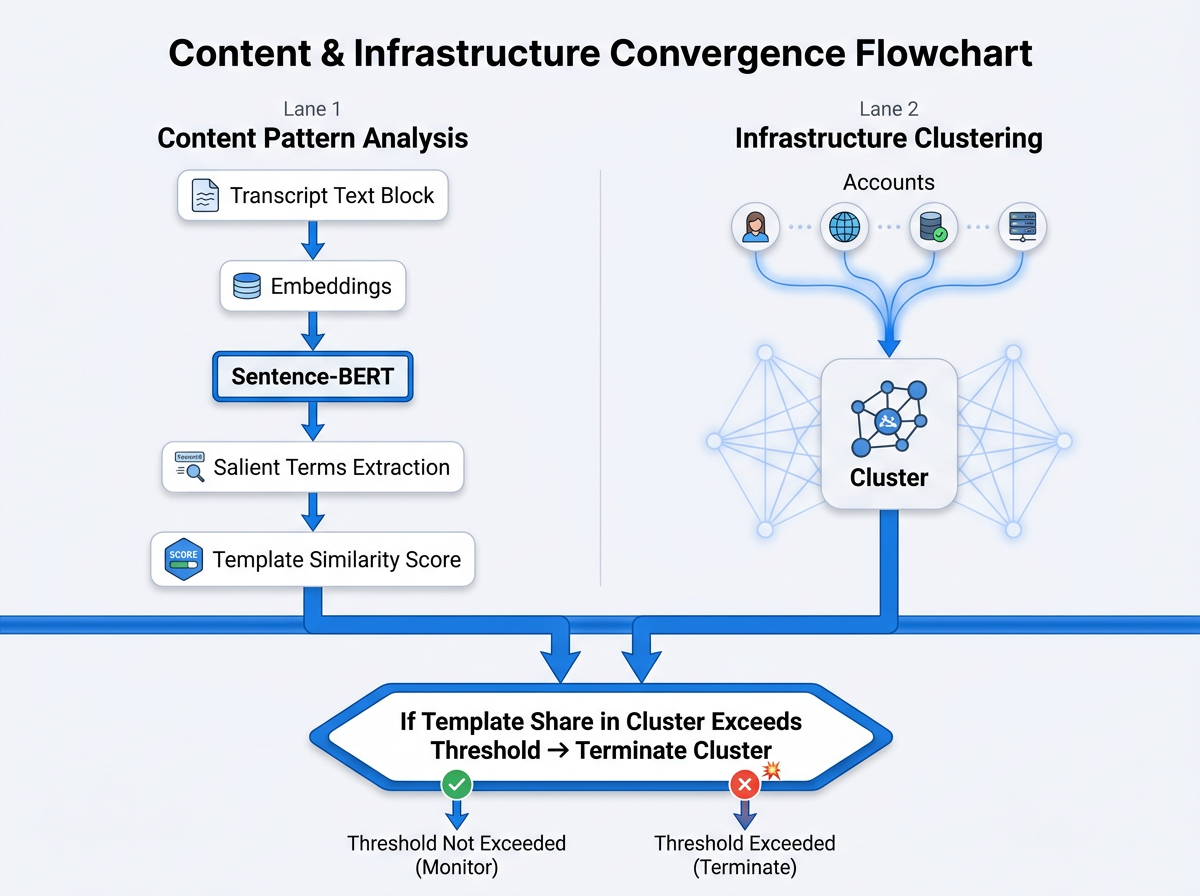
The paper describes a two-stage approach that aligns with how modern abuse teams operate: first find related accounts, then decide whether the cluster is producing synthetic, templated output. Search Engine Journal summarizes this as a "Coordinated Bot-Net Detector" plus a "Synthetic Pattern Classifier" (Search Engine Journal, 2026) in its coverage at Search Engine Journal.
Step 1: Content-pattern signals (semantic templates, not exact matches)
The content-pattern component is where AI generated spam detection becomes less about spotting "AI" and more about spotting templating. Using text embeddings and semantic similarity methods (the paper references Sentence-BERT style approaches) the system can detect when many videos share the same narrative skeleton even if the wording is lightly rewritten. Salient terms anchor the repeated story elements that show up across accounts, giving the classifier something more precise than raw embedding distance.
Step 2: Cluster-level enforcement (terminate the operation)
S-CTS then evaluates how concentrated those templates are inside an infrastructure cluster. When a cluster is dominated by the same flagged templates, the response is cluster termination. Google reports that over a six-month operational period, the system led to termination of 50,000 clusters, including 130,000 channels generating synthetic spam (Google Research, 2026).
The paper also discusses faster adaptation using Low-Rank Adaptation (LoRA) and Automatic Prompt Optimization (APO), which can update defenses without retraining massive models from scratch (Search Engine Journal, 2026). That matters because coordinated campaigns iterate quickly, sometimes faster than a traditional retraining cycle allows.
What this means for legitimate creators and brands
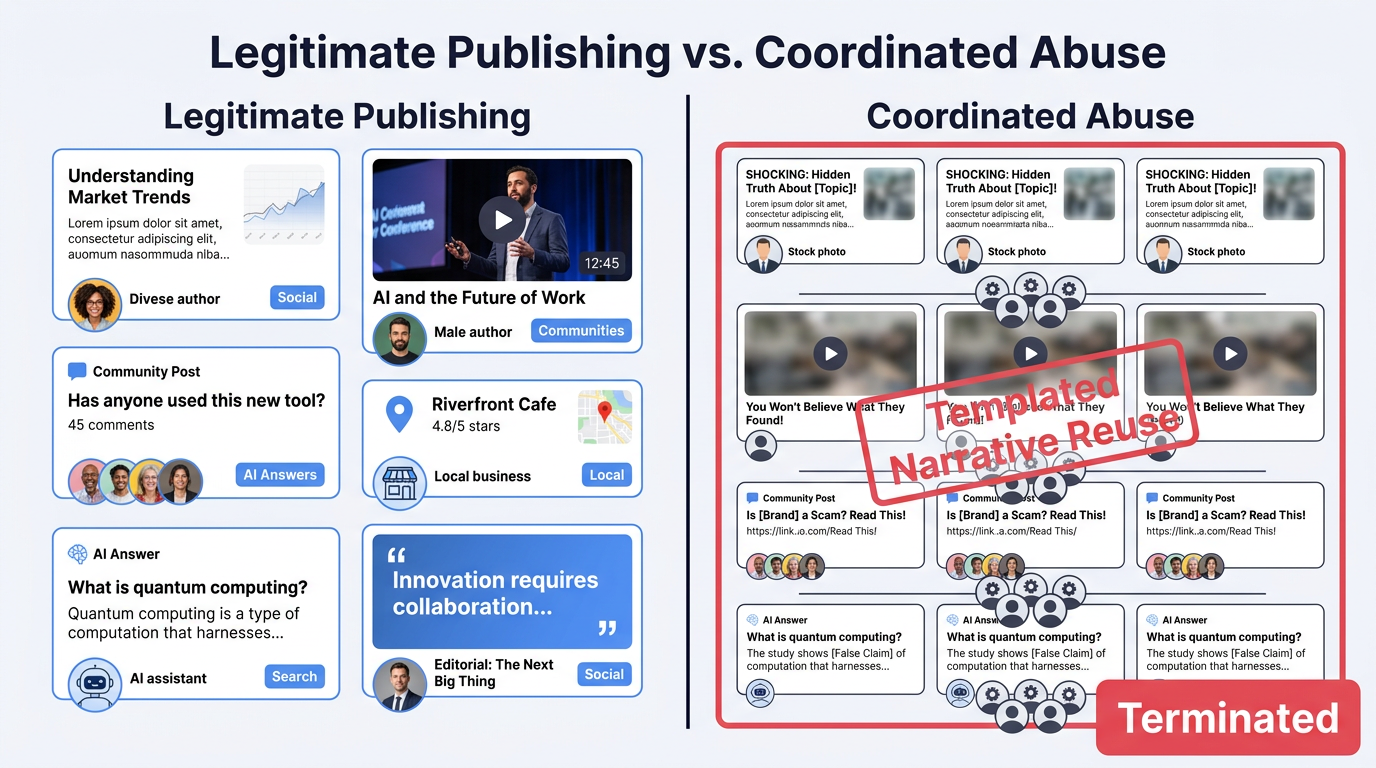
If you publish original work, you are not the target. S-CTS is aimed at organizational structure: clusters that mass-produce repetitive narratives across accounts. A creator using AI to outline, edit, translate, or brainstorm is a different pattern than a network that reuses the same script template hundreds of times.
Practical ways to stay on the safe side of Google spam research trends:
- Audit for template reuse: repeated intros, identical claim sequences, and the same "top 5" narrative across many URLs or channels.
- Diversify evidence: cite primary sources, add original images, include unique data, and show real experience signals where relevant.
- Avoid network amplification tactics: do not spin the same story across many near-empty accounts.
- Track policy direction: start with Google's spam policies for generative AI and keep an eye on recent Google spam updates.
If your team needs an organic-first workflow to monitor risk and performance across surfaces, Vizup positions itself as the Organic Autopilot for modern discovery. It helps brands monitor, create, optimise, publish, and learn across Search, Social, Communities, AI Answer Engines, and Local Discovery using AI agents, human experts, and live SEO, pSEO, AEO, and GEO tools. Paid ads are available only as an amplification add-on, not the core motion. If that matches your operating model, start by aligning content operations with how Google's AI-powered search is changing discovery.
Common misconceptions about Google AI spam detection
Misconception 1: "Google is just detecting AI writing." The S-CTS framing is broader, it targets repetitive, coordinated narratives at scale, which can be AI-generated or human-spun.
Misconception 2: "If one post looks similar, the whole site is doomed." Cluster termination is about high template share across a cluster. One similar post is not the same as an operation built on reuse.
Misconception 3: "Labels solve it." Disclosure and labeling can help users, but enforcement in this research is driven by patterns and infrastructure signals. For visibility context, see how Google labels AI content.
Key takeaways
- S-CTS (Scalable Cluster Termination System) is Google spam research focused on coordinated networks, not isolated items.
- The system flags repetitive semantic templates using embeddings, salient terms, and Sentence-BERT style similarity, a form of AI slop detection.
- Infrastructure clustering plus high template concentration can trigger cluster-level termination, a network response to coordinated media abuse.
- Legitimate creators publishing original, non-templated work are not the target. The risk comes from mass reuse and coordinated amplification.
- An organic-first workflow that monitors performance across Search and AI answer surfaces reduces surprises when enforcement tightens.
FAQ
Is Google's S-CTS system live in search results now?
Google has published S-CTS as research (Google Research, 2026), and the paper reports operational outcomes, but Google does not always confirm exact production deployments or where they run. Treat it as a strong signal of direction, not a guaranteed description of every live system.
Does using AI to help write content put my site at risk?
AI assistance is not the same as spam. The risk pattern in S-CTS is repetitive, templated narratives reused across many accounts. If your output is original, grounded, and not mass-spun, you are aligned with how enforcement is described in the research.
What separates 'AI-assisted content' from 'AI spam'?
AI-assisted content uses tools to improve drafting or production while still adding unique value and editorial control. AI spam is designed for scale and manipulation, often reusing the same narrative template across many assets, which is exactly what AI generated spam detection systems are built to catch.
How can I tell if my content looks 'templated' to Google?
Check for repeated structure across many pages or videos: identical openings, the same claim order, the same "problem then solution" beats, and recurring keyword clusters with minimal new evidence. If you can swap brand names and publish the same piece 100 times, it is probably templated.
What is 'coordinated media abuse'?
Coordinated media abuse is when a network of accounts works together to publish and amplify content in a coordinated way, often using shared infrastructure and repeated narratives. In S-CTS, the enforcement target is the organization and cluster behavior, not a single upload.
