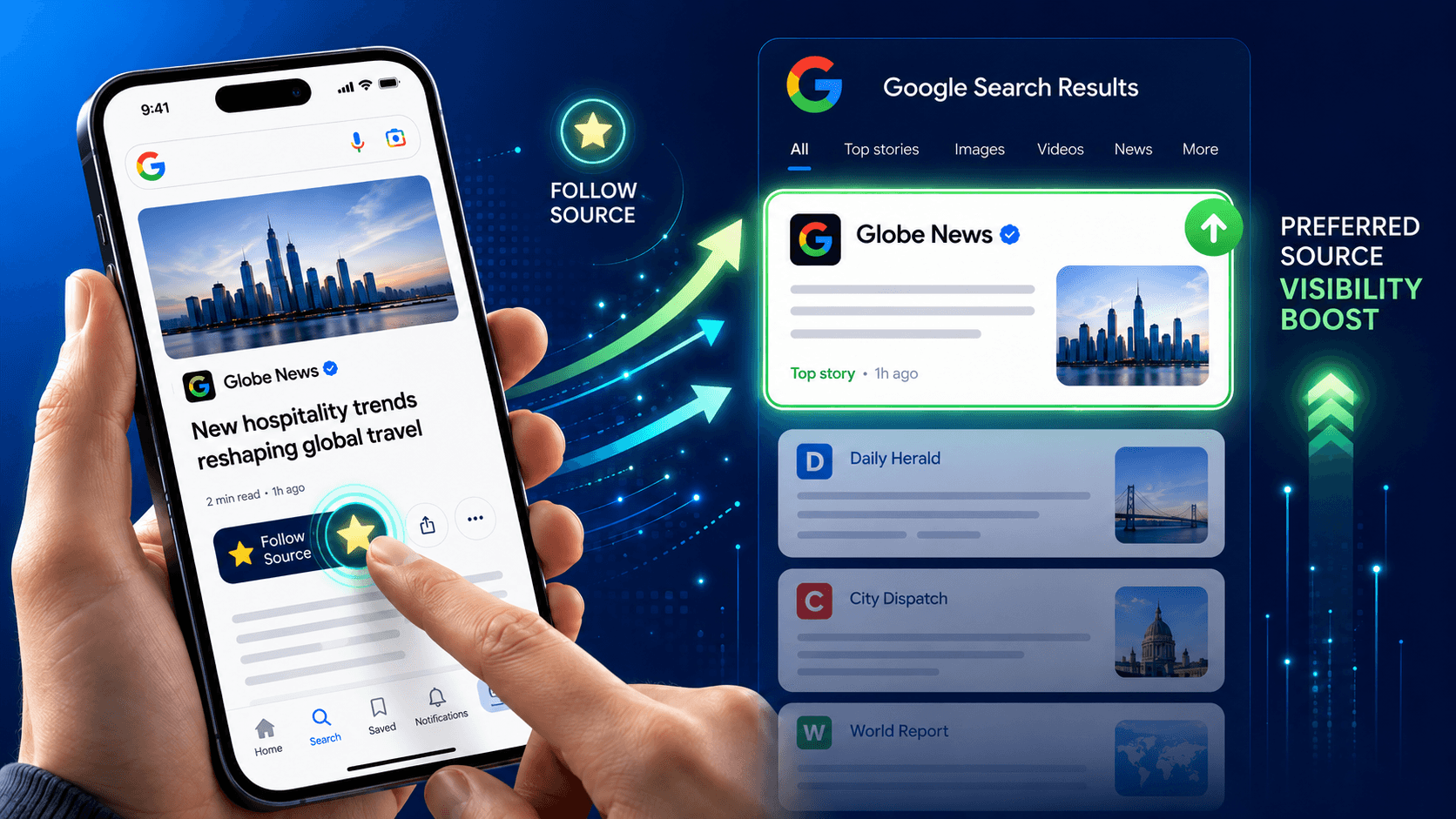
Google Preferred Sources lets signed-in users follow specific publishers, so those outlets show up more prominently in personalized placements like Top Stories and Discover. It’s one of the clearest cases yet where a user’s explicit choice feeds directly into what appears on the SERP. For years, SEO mostly meant trying to interpret Google’s incentives and align with them. With Preferred Sources, Google is also asking people to tell it, plainly, which publishers they want more of. That shift has set off a familiar argument.
The friction point is simple: can this new layer of preference overpower the quality signals Google keeps talking about? If someone follows a site that Google’s systems view as low-quality, which signal wins? That question picked up steam through 2025 and 2026, helped along by comments from Google’s John Mueller and the broader publisher anxiety around search that’s increasingly shaped by personalization and AI-driven surfaces.
So, What Exactly Are Google Preferred Sources?
It’s closer to a "favorites" switch than a ranking hack. When you’re signed in and spot a story in the Top Stories carousel, you can tap an icon to follow that publisher. From then on, Google treats that outlet as a source you’ve explicitly opted into. The practical outcome is straightforward: when you search for a related, timely topic later, that publisher’s eligible recent articles have a better shot at being surfaced for you.
What matters is scope: this is a per-user personalization layer, not a site-wide windfall. Your follow changes your results, not the internet’s. That’s why Google Preferred Sources Top Stories behavior can look different from one person to the next. Google already personalizes with signals like history and location; Preferred Sources is different because it’s explicit. You’re effectively telling Google, "show me more from this publisher."
How Does This ‘Preferred Source Ranking Signal’ Actually Work?
The flow is about as direct as Google gets. A user follows a publisher. Google records that preference. When the user later runs a relevant, news-oriented query, Google checks whether the followed publisher has eligible content and then gives it extra visibility for that person. You’ll notice the effect most on surfaces built for freshness: Top Stories, Google News, and Discover.
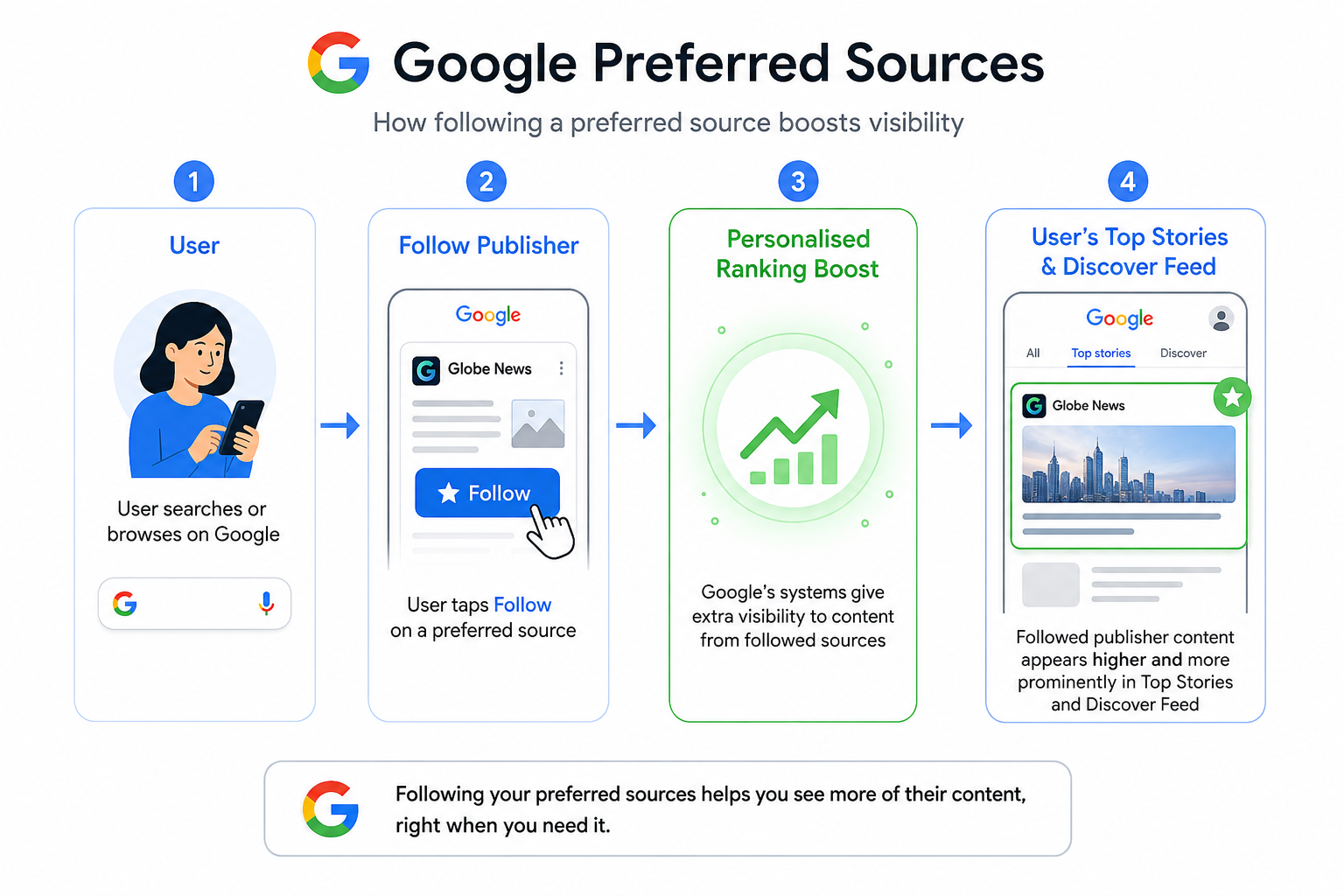
And the classic question: what about the traditional blue links? So far, the impact looks limited, if it exists at all. Google’s documentation and the conversation around this feature (including Mueller’s comments) are tightly focused on news and discovery surfaces. Preferred Sources isn’t, at least for now, a way to reshuffle the entire organic SERP based on who you follow. It’s an amplification mechanism for timely content, not a new constitution for ranking.
Does User Preference Override Google's Helpful Content Quality Signals?
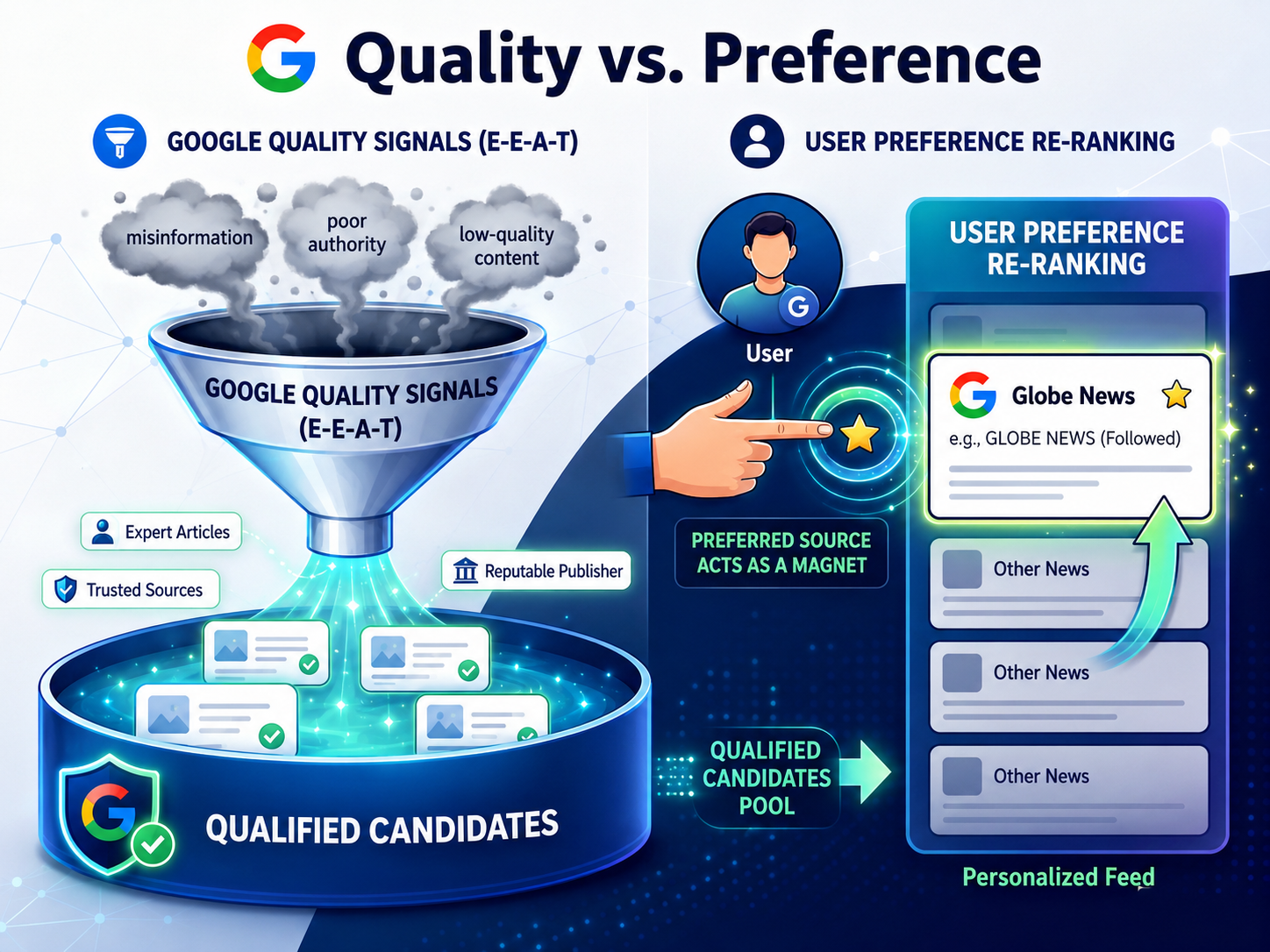
This is the question everyone wants answered, and the answer is a pretty firm no. When a new signal shows up, people immediately go looking for the loophole. Google rarely ships loopholes on purpose. Helpful content quality signals, the broader E-E-A-T framework (Experience, Expertise, Authoritativeness, Trustworthiness), and spam systems still act as the bouncers. Content has to clear a quality bar before it’s even in the set of candidates that can be boosted.
A better way to picture it: quality is the entry requirement. Spammy, thin, or untrustworthy content doesn’t get through the door. Preferred Sources comes later. If a user follows you, that preference can move your already-eligible story higher within that person’s results. But preference can’t drag content past the filters if it never qualified in the first place.
What Did John Mueller Actually Say About This?
SEOs have a long tradition of parsing every syllable from Google spokespeople, and the John Mueller preferred source 2026 commentary on Bluesky landed right in that zone. Someone asked the blunt version of the question: can following a site force Google to rank low-quality or spammy pages? Mueller’s reply didn’t leave much room for fantasy.
Info: “I don't think it makes sense to show spam to users just because of that, but it does help a user to see their preferred sources more.”
As covered by Search Engine Journal, Mueller clarified that Preferred Sources should help users see more from sources they prefer, not force spam into results. The system is meant to show users more of what they’ve asked for, not to punish them with junk because they tapped a star. In practice, preference acts as a re-ranking input inside a pool of content Google already considers acceptable. If a site is getting filtered by spam systems, a follow won’t turn that into a free pass.
How Should Publishers and SEOs Respond?
For a long time, the default advice was basically: publish strong pages and aim them at the right queries. That still matters, but it’s not the whole job anymore. Preferred Sources is Google nudging publishers toward something more durable: a direct relationship with readers. The goal isn’t only to win a keyword; it’s to become the outlet someone chooses to follow.
Growing Your Preferred Source Follower Base
This isn't about some new technical trick. It's about good old-fashioned audience building, with a new call to action.
- Publish Consistently and Own a Niche: Preferred Sources is tied to Top Stories, so cadence matters. You need a steady drumbeat of fresh, news-eligible stories. A focused publisher that’s clearly authoritative in its lane is easier to follow than a generalist that rarely feels definitive.
- Add 'Follow' CTAs: Google offers official button assets. Put a “Follow us on Google” button alongside your social icons and in newsletter footers. If readers already like you, it’s fine to ask for the follow.
- Build Direct Audience Loyalty: A follow is usually the last click, not the first. It happens after a reader has found you, trusted you, and returned. Invest in email lists, social communities, and other owned channels that create the kind of repeat habit that makes someone want your stories in their feed.
- Monitor Your Growth: Track follower growth in the Google News Publisher Center. It’s not just vanity; it’s a read on how strongly your brand lands with the most engaged slice of your Google audience.
Follower growth is also a useful proxy for brand salience inside search. That’s where monitoring matters. Using a tool like Vizup’s Digital Presence Monitoring becomes harder to treat as optional: you want visibility into more than keyword positions, including how often your brand shows up across search features and AI answer engine formats that create the moment for someone to hit follow.
Preferred Sources vs. Quality Signals: A Side-by-Side Comparison
To keep this from turning into mythology, separate the jobs. Personalization decides which eligible items rise for a specific person. Quality decides what’s eligible in the first place.
| Signal Aspect | Google Helpful Content Quality Signals | Google Preferred Sources Signal |
|---|---|---|
| What It Controls | Whether content is eligible to rank; the baseline quality bar (E-E-A-T, helpfulness). | Personalized re-ranking and a visibility boost for one specific user. |
| Who It Affects | Everyone, globally. | Only the person who followed the source. |
| Where It Applies | Across Google Search, including organic links, Top Stories, and more. | Mostly Top Stories, Discover, and Google News. |
| Can Publishers Influence? | Yes: publish genuinely helpful, expert, trustworthy work. | Yes: earn loyalty and prompt readers to follow. |
| Confirmed by Google? | Yes, widely across documentation about creating helpful content. | Yes, in official help center documents and developer resources. |
Key Takeaways
- Google Preferred Sources is a personalization layer, not a substitute for quality systems. It lets users elevate publishers they trust in their own results.
- Content quality signals, including E-E-A-T, still act as the gatekeeper. If you don’t clear the quality bar, preference won’t put you in the mix.
- The biggest impact shows up on news-heavy surfaces like Top Stories and Discover, not (so far) on classic blue-link rankings.
- Publishers should treat "follow" as a product of brand strength: build a followable brand and earn direct audience loyalty, not just keyword traffic.
- Track visibility across search surfaces as AI reshapes SEO. Tools like Vizup can help connect brand presence to the new moments where a follow becomes possible.
Frequently Asked Questions
Can Google Preferred Sources help a low-quality site rank higher?
No. John Mueller’s comments and Google’s documentation point the same way: Preferred Sources boosts content that already qualifies. It doesn’t pull low-quality or spammy pages past Google’s core filters. It’s a boost, not a bypass.
How do I add my site as a followable source in Google Search?
You don’t manually submit yourself as a "followable" source. Eligibility depends on whether Google recognizes your site at the domain or subdomain level. The practical work is building a site people choose to follow, then using Google’s buttons and CTAs to nudge loyal readers to do it.
Do Google Preferred Sources affect organic blue-link rankings?
Right now, the emphasis is on news and discovery surfaces, including Google Preferred Sources Top Stories and Google Discover. There’s no strong evidence or official statement suggesting it meaningfully reorders traditional blue-link rankings today.
Is the preferred source signal the same as Google Discover personalization?
They’re related, but not identical. Discover personalization is mostly implicit, based on activity and inferred interests. Following a Preferred Source is an explicit: a direct instruction that you want more from a specific publisher, and that input can shape what Discover shows you.
What is Preferred Sources? Does it affect rankings? How do you get added?
Preferred Sources lets users follow publishers so they see more of that outlet’s content in Top Stories. It affects rankings as a personalized boost for followers. You don’t "get added" through an application; you become eligible as a publisher and then earn follows by building an audience that actively opts in.
