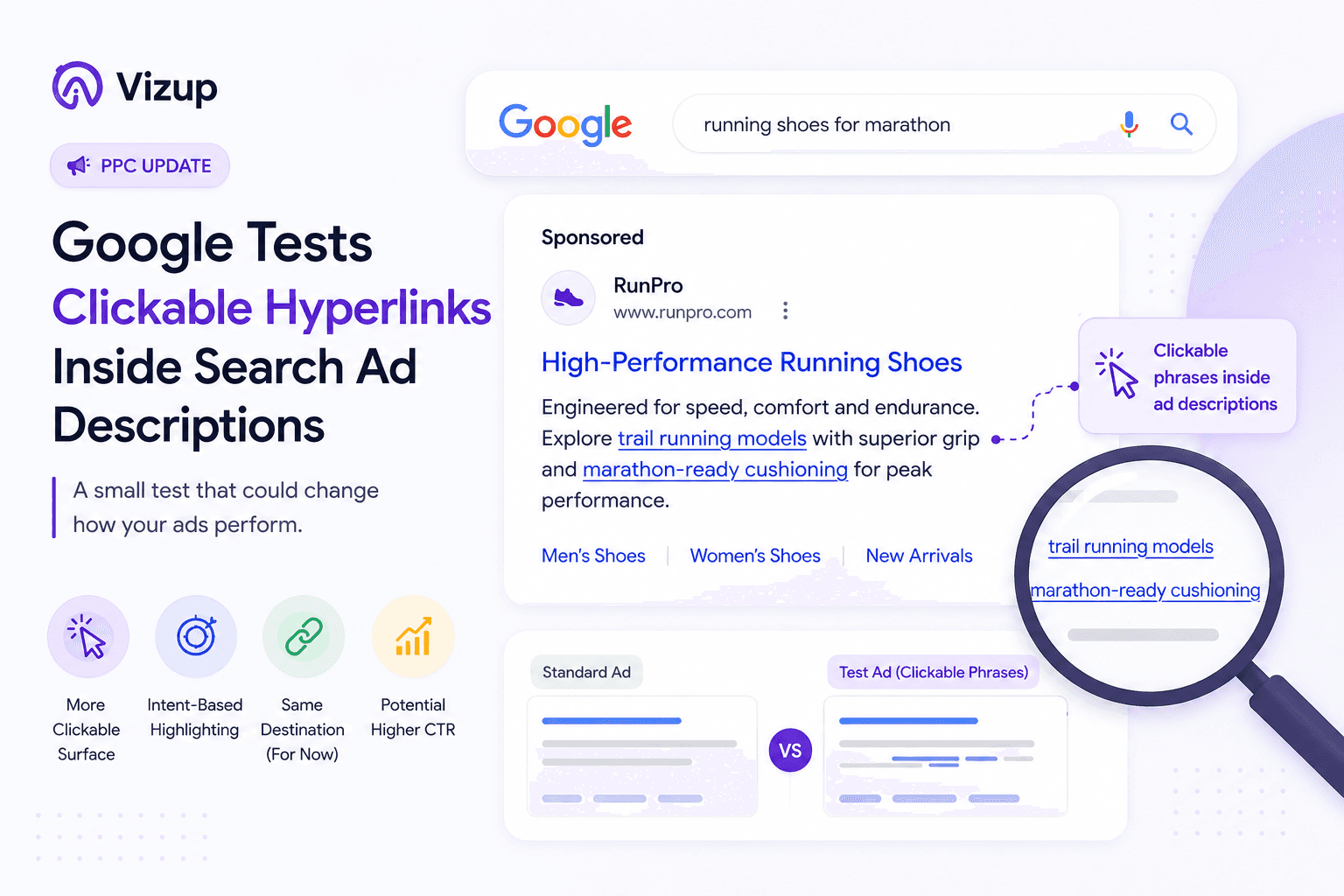
Anyone who works in paid search knows the ground is always shifting. You get comfortable with one format, and Google starts quietly tinkering with the next. The latest experiment worth paying attention to: clickable hyperlinks showing up inside the description text of Search ads. This is not a confirmed rollout. It's a limited test, first spotted by PPC marketer Nayan Prakash in August 2026. Still, it's the kind of small-looking UI change that can hint at a bigger rethink of how Google wants people to interact with ads.
For advertisers, the appeal is obvious: more clickable surface area. The downside is just as immediate: less certainty about what your copy will look like, how users will behave, and what you will be able to measure. Below is what has been observed so far, why Google might be doing it, and how to respond without overcorrecting.
What Has Been Spotted in the Wild?
The test itself is straightforward. In some Search ads, certain words or phrases inside the description lines are rendered as clickable hyperlinks. Clicking one of those links does not appear to open a special destination. Reports say the click lands on the same final URL as the ad headline.
That matters because it's not trying to replace sitelinks, which exist specifically to route people to different pages. This is more like adding extra tap targets on the way to the same place. Prakash suggested that Google may be dynamically selecting phrases based on search intent, though Google has not confirmed this. For example, hypothetically, an ad for running shoes could surface "trail running models" as the clickable phrase for one search and "marathon-ready cushioning" for another, even when the underlying description text hasn't changed.
Info: Treat this as a sighting, not a product launch. Many Google experiments never become permanent features.
A Quick Refresher: How Search Ads Normally Work
Google already allows Responsive Search Ad assets to appear more flexibly across an ad. Its documentation says unused headlines can serve as link-based assets, while description lines may support those expanded formats. The newly spotted experiment appears to take that flexibility further by making phrases within the description text itself clickable. Google has not confirmed whether the two behaviors are technically related.
To see why this stands out, it helps to remember how constrained the clickable parts of a Search ad have traditionally been. Advertisers generally get a familiar set of surfaces:
- Ad Headlines: The main click target, which sends users to the ad's final URL.
- Display URL: The URL path shown under the headlines, which is also clickable.
- Sitelinks: Advertiser-provided (and sometimes automated) links that show below the ad, pointing to specific pages like 'Pricing,' 'Contact Us,' or category pages.
- Other Assets: Callouts, structured snippets, image assets, and more. Most of these are not individual links, but they add context and can expand the overall ad unit.
Within that setup, descriptions have been the pitch: persuasive, informational, and deliberately not interactive. You write them to support the headlines and earn the click on the headline. Hyperlinks inside the description flip that role. The copy is no longer just supporting the action; it becomes part of the action. That's a meaningful change to the basic shape of a search ad.
Why Would Google Be Testing This?
Google hasn't publicly explained the test, so any rationale is educated guesswork. But the direction is consistent with where the company has been pushing Search and Ads for years: more automation, more dynamic assembly, and more decisions made by the system rather than the advertiser. A few likely motivations stand out.
Possible Google Motivations:
- Increase Ad Interaction: More click targets can translate into more clicks. Even if the destination is unchanged, an ad that feels more interactive may draw more engagement. Search Engine Land noted this could encourage a higher CTR.
- Make Ads Feel More Immediately Relevant: If the system can identify what a user is fixated on (say, "free shipping"), emphasizing that phrase visually makes the ad read as if it was written for that moment.
- Extend AI-Driven Assembly: This is a logical continuation of Automatically Created Assets (ACAs) and Responsive Search Ads (RSAs). Google already mixes and matches headlines and descriptions; dynamically formatting parts of those descriptions is the next step.
What This Test Could Mean for PPC Advertisers
If this graduates from experiment to default behavior, it will feel familiar to anyone running PPC: a promising new lever, paired with another layer of opacity. More ways to win a click is attractive. Less control over presentation and measurement is the part that makes experienced advertisers uneasy.
- Potential Upside: More Clickable Real Estate. A larger clickable surface area on the ad unit itself could lead to more total clicks.
- Potential Concern: Less Control Over Ad Appearance. Advertisers can't fully dictate how the description renders. When a phrase becomes a link, it naturally draws the eye, changing the ad's visual hierarchy.
- Potential Upside: Higher Perceived Relevance. If the specific phrase a user is searching for gets visually highlighted as a link, the ad may seem more relevant, which could lift the click-through rate.
- Potential Concern: Attention Splitting. Multiple click targets within the ad copy might dilute the focus of a single, strong call to action in the headline.
- Potential Upside: Better Landing Page Priming. As a potential implication, clicking a link for "24/7 Customer Support" sets a clear expectation for the landing page, which can improve post-click engagement if the page delivers.
- Potential Concern: Reporting Complexity. If Google doesn't provide performance data for each in-text link, advertisers will see more activity but have less clarity on what specific part of the ad copy drove the click.
- Potential Concern: Accidental Clicks. The possibility of accidental clicks, especially on mobile devices, would be worth monitoring as it could affect advertising costs.
The broader pattern here is the steady trade: less manual control in exchange for the promise of better outcomes from Google's automation. Close variants expanded what a keyword could mean; Performance Max moved even more decision-making behind the curtain. This test fits that arc, even if it's not explicitly linked to specific AI initiatives like Gemini. If you want a wider view of how Google is already reshaping the experience with AI, our post on Google's AI-powered search lays out the larger context.
Could This Change How We Write Ad Copy?
Yes, because the description stops being just a paragraph and starts behaving like an interface. If parts of your sentences can become links, copywriting starts to overlap with UX: you are not only persuading, you're also shaping where attention lands and what feels tappable.
That shift brings a few practical considerations to the surface:
- Phrase Placement: If a benefit might become a link, its position in the sentence matters. The most important ideas may deserve earlier placement, not a buried clause.
- Benefit-Driven Descriptions: The focus should remain on clear, benefit-focused language that resonates with users. While reports note that keyword-rich phrases are being linked, this shouldn't be an invitation to stuff descriptions with keywords at the expense of readability.
- Calls to Action (CTAs): A CTA might not live only at the end. A mid-sentence line like "Shop Our Summer Sale" could effectively turn into a standalone click target.
- Landing Page Alignment: The connection between ad language and landing page content gets even tighter. If Google hyperlinks "Durable Waterproofing," the landing page should make that feature easy to find immediately.
For copywriters, the practical mindset change is this: assume Google's system will treat your text as modular parts, not a fixed script. Your job is to supply clean, specific components that still read well when the platform decides to emphasize, reorder, or recontextualize them.
The Big Unknown: Who Chooses the Links and Destinations?
This is where the stakes get real. Early observations suggest Google is choosing the linked phrases automatically, while the destination stays pinned to the ad's final URL. If the format evolves, though, it immediately opens a long list of operational questions:
- Will advertisers get any way to suggest or exclude phrases from becoming links?
- Could the in-text links eventually point to different pages, the way sitelinks do?
- Are the links driven only by the query, or do they also factor in the landing page content?
- Will advertisers be able to opt out?
- Most importantly, will reporting show performance for each individual hyperlink? Without that, optimization is guesswork.
Until Google answers those questions, advertisers are left reading tea leaves. Reporting is the make-or-break detail: if clicks move around inside the unit but the data collapses into one bucket, you cannot diagnose what changed or why. That kind of opacity echoes other areas where detail gets abstracted away.
What Should Advertisers Do Right Now?
Do not treat a limited test like a platform shift. The fastest way to waste time (and budget) is to rewrite campaigns for a feature that might never ship. The smarter move is to keep your fundamentals tight and watch carefully for signs the format is affecting your account.
Your Action Plan:
- Do Nothing (Strategically): Resist the urge to rewrite everything. Keep following Responsive Search Ad best practices: clear benefits, specific claims, and strong calls to action.
- Monitor Your Ads: Capture screenshots. Run searches for your priority keywords in an incognito window and look at how your ads render. If you see inline links on your ads, document when and where.
- Double Down on Landing Page Quality: This advice never goes out of style, and it matters more if ad presentation is increasingly tied to content signals. Use clear headings and make sure the features you mention in ads are easy to find on-page.
- Review Automated Assets: Check which 'Automatically created assets' are enabled in your Google Ads account. While you can't toggle this specific test, it's a good practice to know what you are allowing the system to change on your behalf and revisit those settings periodically.
- Watch Your Metrics: Keep an eye on CTR, conversion rate, and on-page engagement in Analytics. If something shifts suddenly without a clear cause, a new ad format is one plausible explanation.
As Google changes how information is presented, the analysis layer has to keep up. If you have not revisited your reporting workflow lately, this is a good moment. Our breakdown of the Google Ads Search Terms Report in AI Mode is a useful place to start.
The Final Takeaway
Clickable hyperlinks inside Search ad descriptions are not just cosmetic. They point to a future where ads behave less like a fixed creative you author and more like a flexible template Google assembles on the fly. That direction means more automation, more dynamic formatting, and fewer guarantees about exactly what the user will see.
If the format sticks, advertisers may get more opportunities to earn a click, paired with the familiar cost of giving the platform more discretion. For now, it is something to watch, not something to rebuild around. Keep the copy sharp, keep landing pages tightly aligned to the promises in your ads, and keep monitoring the SERP for changes that do not show up in a release note.
Frequently Asked Questions
Is this an official Google Ads feature yet?
No. What we have is a limited test observed by a small number of users as of August 2026. Google has not announced a broader rollout.
Do the clickable description links send users to different pages?
So far, no. Current reports say the hyperlinks inside the description lead to the same final URL as the main headline, rather than different destinations like sitelinks.
Can advertisers turn this on for their own campaigns?
No. Because this appears to be a Google-side experiment, Google has not publicly documented an advertiser control for it. It is automated formatting applied to a subset of ads.
How is this different from sitelink assets?
Sitelinks are separate links that appear beneath the main ad and are meant to drive visits to specific pages (for example, 'About Us' or 'Pricing'). These new hyperlinks sit inside the description text itself and, based on current observations, point to the same destination as the headline.
Should I start packing ad descriptions with more keywords?
No. While reports note that keyword-rich phrases are being linked, this is not an invitation to sacrifice clarity. Keep descriptions readable and benefit-focused, and make sure the language matches user intent and the content users will actually find on the landing page.
