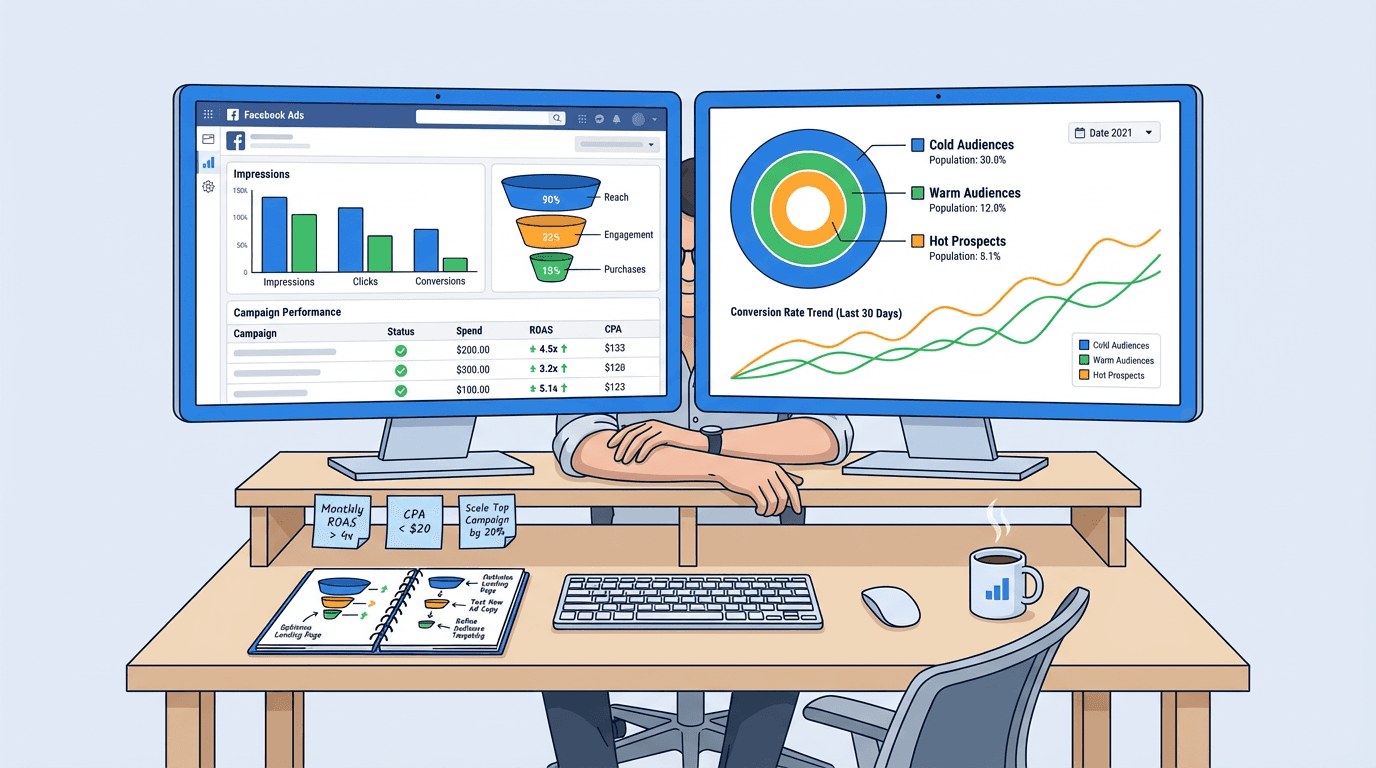
Last quarter, I watched a DTC skincare brand burn through $47K in a single month while ROAS slid from 3.8 to 1.9. The media buyer followed the 2024 playbook to the letter: split-testing interest stacks, refreshing creatives biweekly, tweaking bids daily. None of it moved the needle. The platform had evolved past those tactics. Advantage+ campaigns, signal loss from privacy changes, and Meta's aggressive AI-driven audience expansion have rendered that old playbook obsolete. Knowing how to optimize Facebook ads for conversions in 2026 means working an entirely different set of levers, and this guide breaks down exactly which ones matter.
This is written for growth leads, performance marketers, and founders managing paid and organic together. What follows: a concrete audit checklist, a CBO scaling framework, a KPI diagnostic table, and the organic-paid flywheel most guides completely ignore. No generic advice. Just the specific moves that shift performance.
The Facebook Ads Landscape in 2026: What Actually Changed
Most “optimization guides” still recommend split-testing interest audiences. That advice is stale. Meta has systematically deprecated manual targeting levers in favor of Advantage+ audience expansion, and the algorithm now makes decisions that advertisers used to make by hand. For many accounts, this shift has improved efficiency. According to Meta's own performance data, Advantage+ Shopping campaigns deliver a 32% lower cost per acquisition compared to manually configured campaigns.
The practical implication: spend less time on audience tinkering and more on creative quality and signal infrastructure. That means clean conversion events, reliable attribution, and fast feedback loops between your data and the algorithm.
Signal loss is the other structural reality shaping how to optimize Facebook ads for conversions. iOS privacy changes were just the opening act. Android's Privacy Sandbox compounded the problem, making first-party data with server-side tracking via the Conversions API (CAPI) the baseline requirement, not a nice-to-have. Relying solely on the browser pixel means feeding the algorithm incomplete data, which leads to inconsistent performance and poor optimization decisions. Before touching campaign structure, check the latest Meta ad specs for 2026 to confirm your technical setup is current. If you're still building a social media strategy that aligns with business goals, getting the tracking foundation right is step one.
The Facebook Ads Audit Checklist (Before You Touch a Single Campaign)
Adjusting bids or launching new creatives on a broken foundation is expensive guesswork. Run this audit first. You can skip it only if server-side tracking has been running for 90+ days, your Event Match Quality score is above 6.0, and you've audited account structure in the last 30 days.
- Pixel + CAPI health: Both the browser pixel and server-side Conversions API (CAPI) should be firing correctly. Configure a deduplication key using a matching
event_idfor both to prevent counting the same conversion twice. A healthy setup ensures redundant data sources for more reliable tracking. You can test your events in Events Manager to confirm everything is working. - Event Match Quality (EMQ): Check your score in Events Manager for key conversion events. A passing score is above 6.0 for purchase events, but experts recommend aiming for 7.0 or higher. A low score means Meta can't effectively match your website visitors to Facebook users, which weakens your algorithm signal and hurts both retargeting and optimization.
- Attribution settings: The default
7-day click / 1-day viewsetting is a solid baseline for most campaigns, especially for products with a considered purchase journey. This window gives the algorithm enough data to learn while capturing conversions from users who don't buy immediately. For lower-intent actions like lead magnet downloads, a1-day clickwindow is more appropriate. - Account structure hygiene: Run no more than 3-5 active campaigns per objective. Pause or remove “zombie campaigns” (those spending money without generating conversions for 14+ days), as they drain budget and complicate analysis. A simplified structure helps the algorithm perform better.
- Creative fatigue: Monitor ad frequency closely, especially for prospecting campaigns. Key warning signs include rising frequency, dropping click-through rate (CTR), and increasing cost per conversion. When frequency approaches 3.0 for cold audiences, it's time to refresh your ad creative.
- Audience overlap: Use Meta's Audience Overlap tool to check for redundancy between your ad sets. A pass is generally less than 20% overlap between active audiences. Anything higher means you're likely bidding against yourself, driving up costs. You can find this tool in the 'Audiences' section of Ads Manager.
- Conversion event volume: To exit the learning phase efficiently, your primary optimization event needs at least 50 conversions per week for each ad set. If you're struggling to hit this number, your performance will be unstable. Consider optimizing for a higher-funnel event (like Add to Cart) to feed the algorithm more data.
- User permissions: Incorrect permissions can cause frustrating errors. Go to Business Settings and confirm you have the correct role (e.g., Admin or Advertiser) for both the ad account and the associated Facebook Page. This ensures you can create, edit, and publish campaigns without issues.
How to Optimize Facebook Ads for Conversions: The 5 Levers That Actually Move the Needle
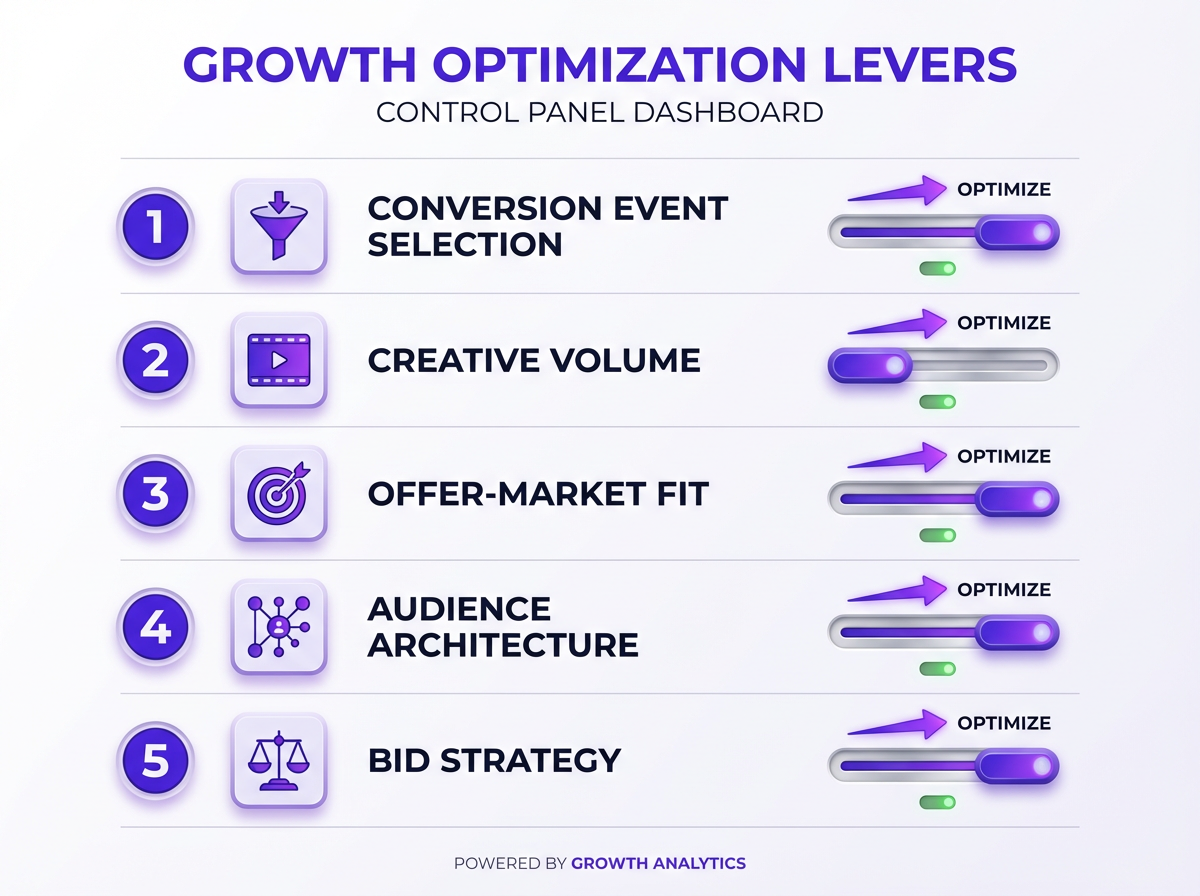
Lever 1: Choose the Right Conversion Event (It's Not Always 'Purchase')
Meta's algorithm needs at least 50 conversions per week per ad set to exit the learning phase. If you're optimizing for Purchase but only generating 15 per week, you're starving the algorithm of the data it needs to find your best buyers.
The fix isn't patience. Move up the funnel to an event with sufficient volume (Add to Cart, Initiate Checkout, or even View Content) until purchase volume scales. The decision rule: if purchase volume is below 50 per week per ad set, optimize for the highest-funnel event that still correlates strongly with revenue. For B2B, that's usually a qualified lead form submission rather than a demo booking. For a broader look at how conversion events fit into your overall paid media strategy, start with funnel mapping before you pick your optimization event.
Lever 2: Creative Volume and Velocity
Creative is targeting now. Meta's algorithm uses creative signals to find the right audience, which means a thin creative pool limits your reach regardless of audience settings. Accounts spending $10K+ per month need 3-5 new creative concepts per week (not just variations of the same hook).
The structure that works: run a dedicated creative testing campaign at a fixed daily budget (roughly 10-15% of total spend) to surface winners, then promote proven concepts into scaling campaigns. This keeps scaling campaigns clean while maintaining a constant pipeline of fresh angles.
Organic content is an underused source for paid creative hypotheses. Posts that earn high saves and shares signal conversion-ready messaging, and Vizup's AI-powered organic marketing platform helps identify exactly those themes.
Lever 3: Offer-Market Fit (The Lever Nobody Talks About)
No amount of campaign structure work will rescue a weak offer. I saw this firsthand with a B2B SaaS client last year. They'd been running the same “Start your 14-day free trial” CTA for months, and CPA kept climbing. We changed nothing in their ad account. Same creative. Same audience. The only variable was swapping the offer to “Get your free audit report,” and CPA dropped 38% within the first two weeks.
The diagnostic is straightforward: if your CTR is healthy but CVR is low, the problem isn't in Ads Manager. It's on your landing page or in the offer itself. A structured approach to testing offers and landing pages is critical to measure what's actually working post-click.
Lever 4: Audience Architecture for 2026
At budgets above $200 per day, broad audiences (minimal targeting signals, let Meta optimize) outperform detailed interest stacks in most accounts. Lookalikes still work well for mid-funnel retargeting when seeded with high-quality purchaser data. Advantage+ audiences are worth testing for prospecting, especially since early adopters consistently report lower CPAs compared to manually built interest audiences. Meta's Advantage+ audience documentation details how the system expands beyond your initial inputs.
The underrated move is exclusion lists. Most accounts waste 15-25% of spend on audience overlap they never audit. Excluding recent purchasers, current customers, and retargeting audiences from prospecting ad sets is one of the fastest free wins available, and almost nobody does it systematically. If you want to understand how audience segmentation connects to broader growth strategy, our piece on marketing analytics best practices covers the data side in detail.
Lever 5: Bid Strategy and Budget Allocation
Defaulting to Lowest Cost and leaving it there is leaving money on the table. Here's when to use each strategy:
- Lowest Cost: Use during the learning phase or when scaling aggressively and volume matters more than efficiency.
- Cost Cap: Switch to this when you have a hard CPA ceiling and consistent conversion volume (50+ per week). Set it at 1.2-1.5x your target CPA to give the algorithm room to find conversions while protecting profitability.
- Bid Cap: Reserved for advertisers who understand auction dynamics well and need precise control. It's easy to under-bid and kill delivery entirely.
Facebook Ads CBO Strategy: When to Use It and How to Structure It
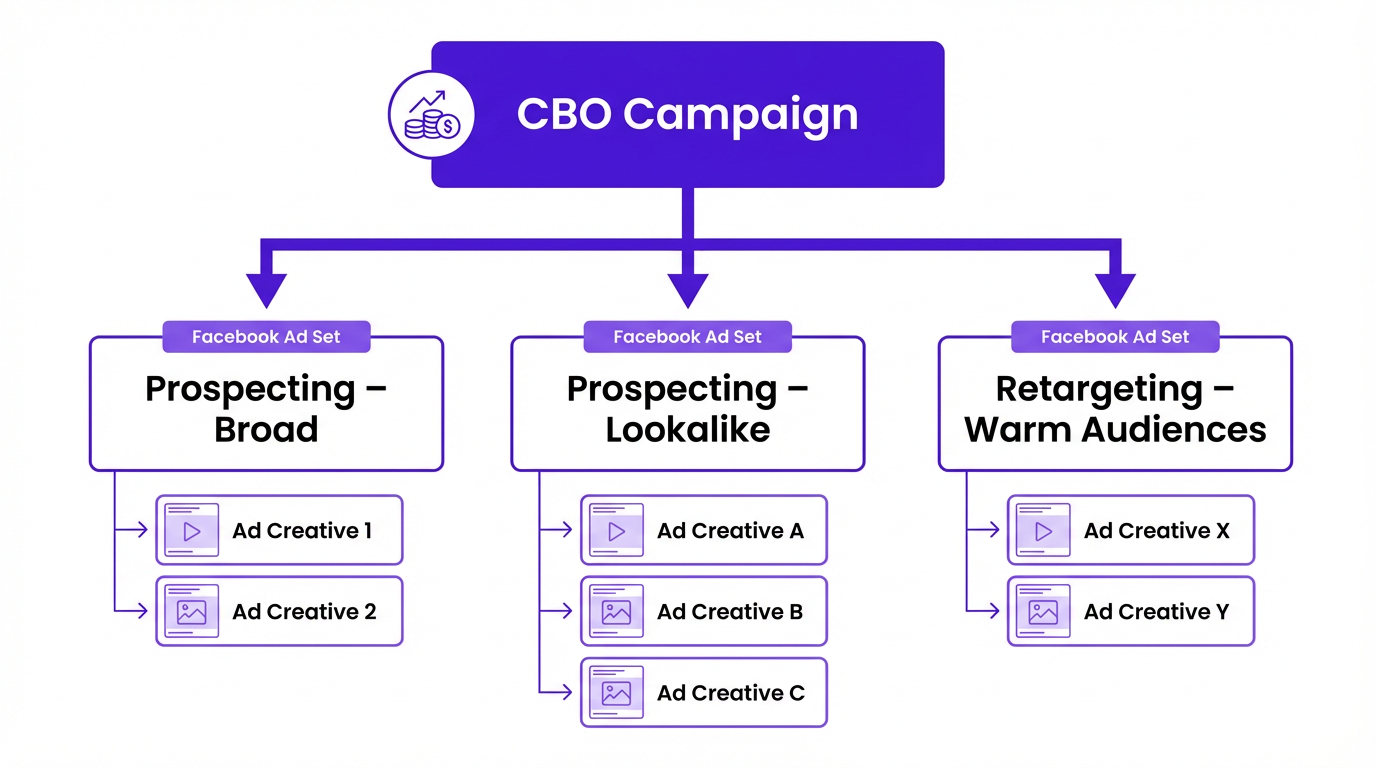
CBO isn't universally better than ABO. It outperforms when three conditions are met:
- You have 3+ ad sets with similar audience sizes.
- A minimum daily budget of $100 (ideally $200+).
- Stable creative that's already proven in testing.
When those conditions exist, CBO lets Meta allocate budget dynamically to the best-performing ad sets in real time. A practical structure: one CBO campaign with 3-4 ad sets segmented by funnel stage (broad prospecting, lookalike prospecting, warm retargeting) and 3-6 ads per ad set. Meta's Campaign Budget Optimization documentation explains the mechanics of how budget distribution works across ad sets.
The most common CBO mistake is mixing a tiny niche retargeting audience (say, 5,000 people) with a broad prospecting audience of 10 million in the same campaign. The algorithm will starve the small ad set because it can't spend efficiently there. Keep retargeting in its own ABO campaign with a fixed budget. Generative AI for marketing is also reshaping how teams build creative assets at the volume CBO campaigns demand.
How to Improve ROAS and Reduce CPA: A KPI-Driven Framework
CPA decomposition is the diagnostic most growth leads skip. The formula:
CPA = CPM ÷ (CTR × CVR × 1000)
When CPA rises, one of three things is happening: CPM increased (auction competition or audience fatigue), CTR dropped (creative fatigue or audience mismatch), or CVR fell (landing page or offer problem). Knowing which variable is the culprit tells you exactly where to intervene.
One ecommerce brand targeting a $42 CPA ran this diagnostic and found CTR was healthy at 2.1% but CVR was sitting at 1.1%. The problem wasn't the ad at all. After rebuilding the landing page with a single, focused CTA and removing three unnecessary form fields, CPA dropped to $29 without touching the campaign.
| Metric | Healthy Benchmark (2026) | What a Low/High Value Signals | Recommended Action |
|---|---|---|---|
| CPM | $8-$15 (varies by industry) | High CPM = competitive auction or broad audience fatigue | Refresh creative; test new audience segments |
| CTR (Link) | 1.5% - 3.0% | Low CTR = weak hook or audience mismatch | Test new ad angles; review creative fatigue frequency |
| CVR | 8.95% avg; 10%+ is strong | Low CVR = landing page or offer issue, not ad issue | A/B test landing page; audit offer competitiveness |
| CPA | Varies by goal; benchmark against your margin | Rising CPA = CPM spike, CTR drop, or CVR decline | Run CPA decomposition formula to isolate variable |
| ROAS | 4:1 or higher considered good | Below 2:1 = structural issue with offer or funnel | Audit full funnel; check post-click experience |
| Frequency | Below 3.0 for prospecting | Above 3.0 = creative fatigue in cold audiences | Introduce new creative concepts immediately |
| Use this table to diagnose which part of your funnel is breaking down before making campaign changes. |
Scaling Facebook Ads Without Blowing Up Your CPA
The 20% rule exists for a reason. Increasing budgets by more than 20% every 3-4 days resets the learning phase and forces the algorithm to re-optimize from scratch. It feels slow, but it preserves performance. Two scaling approaches work well depending on your situation:
- Vertical scaling (increasing budget on winning ad sets): Works well when you have one dominant creative and a stable audience.
- Horizontal scaling (duplicating winning ad sets to new audiences or geographic segments): Better when you're hitting frequency limits or audience saturation.
What most accounts get wrong: scaling before they have creative depth. You need at least 3 proven creative concepts before pushing budgets aggressively. Scale on one creative and fatigue will eat your gains within 10 days. With Facebook CPC rising 11% year-over-year to an average of $1.72, creative efficiency is more important than ever. Tools that help you enhance your digital presence with AI marketing tools can meaningfully cut production time when you're trying to keep creative pipelines full.
The Organic + Paid Flywheel: Why the Best Facebook Ads Strategies Don't Live in Ads Manager Alone
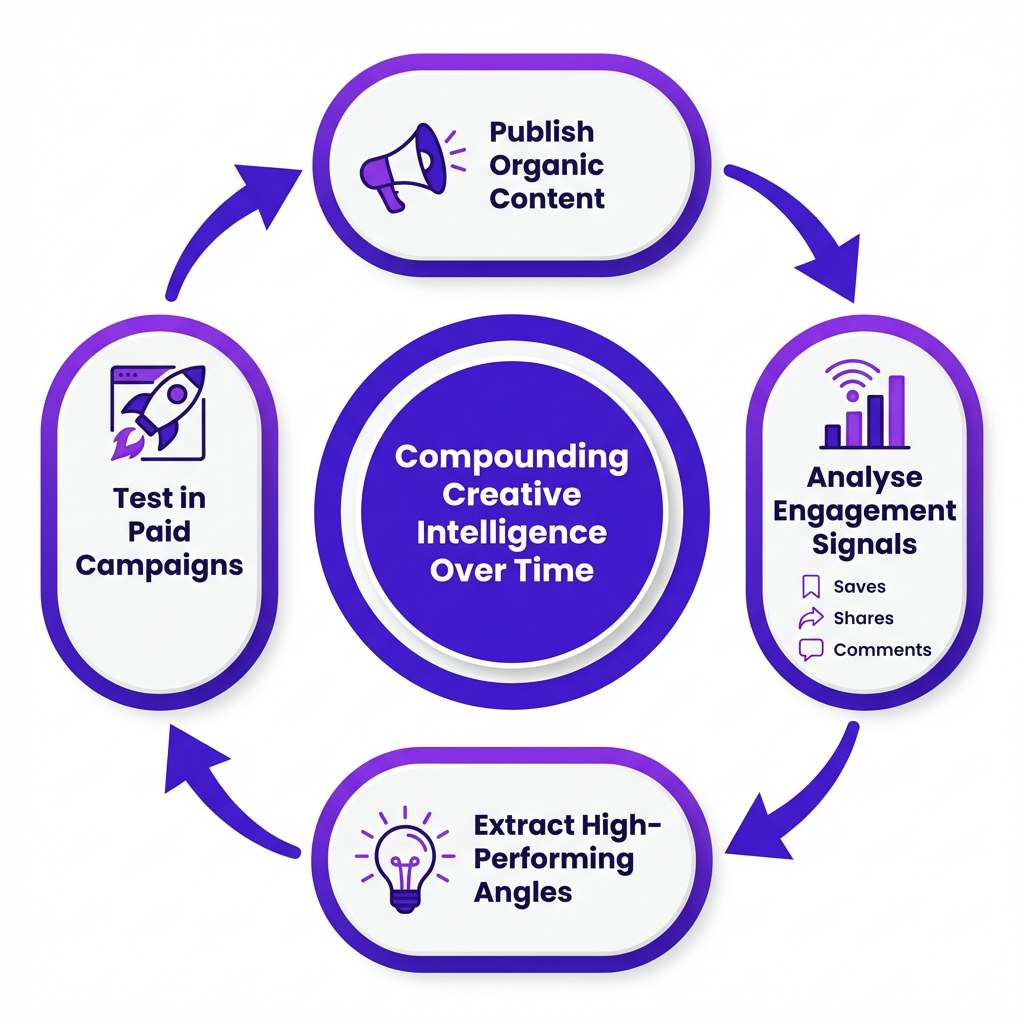
Organic posts that earn high saves, shares, or deep comment threads are telling you something: the messaging resonates. That's conversion-ready language, and most paid teams never look at it.
A DTC wellness brand we worked with used organic comment sentiment analysis to surface a benefit angle (“it fixed my sleep schedule”) that their feature-focused ads had never touched. That single angle, pulled directly from customer comments on an organic post, outperformed their existing creative by 2.3x ROAS over a 21-day test window. The insight came from organic, not from the ad account.
Vizup's AI-powered organic marketing platform helps growth leads identify high-performing content themes and translate them into paid creative hypotheses, closing the loop between organic signals and paid performance. It's the kind of cross-channel intelligence that separates accounts spending efficiently from those chasing their tail with creative guesswork. Visit tryvizup.com to see how it fits into your paid strategy.
FAQ: Common Questions About Optimizing Facebook Ads for Conversions
How long does it take for Facebook ad optimization changes to show results?
Most changes need 3-7 days to show meaningful data, and the algorithm needs 50 conversions per ad set to exit the learning phase. Budget changes over 20% reset learning. Evaluate trends after 7 days, not 48 hours.
Should I use Advantage+ campaigns or manual campaigns for conversions in 2026?
For ecommerce with sufficient purchase volume, Advantage+ Shopping campaigns are worth testing. According to Meta's published performance benchmarks, these campaigns can deliver significantly lower CPAs than manually configured setups. For lead gen or B2B, manual campaigns with broad audiences still give more control over funnel stage optimization. Test both with equal budgets before committing.
What's a good ROAS benchmark for Facebook ads in 2026?
While a 4:1 ROAS was a widely cited threshold, recent data suggests the average is closer to 2:1. For example, a 2025 analysis found the median ROAS across industries was 2.19. However, your actual target depends entirely on your profit margins. A business with 70% margins can be profitable at a 2:1 ROAS, while a business with 30% margins may need a 4:1 ROAS just to break even. Calculate your breakeven ROAS first (1 / Profit Margin), then set your target above it.
How many ad creatives should I test at once per ad set?
3-6 ads per ad set is the practical range. Below 3, you're not giving the algorithm enough variation to optimize. Above 6, budget gets spread too thin for meaningful data per creative. Use dynamic creative testing for rapid iteration, then consolidate winners into scaling campaigns.
Is it better to optimize for leads or purchases if I'm a B2B company?
Optimize for the event that gets 50+ weekly conversions AND correlates with revenue. For most B2B companies, that's a qualified lead form or content download rather than a demo booking. Start where the data is, then move the optimization event closer to revenue as volume scales.
What is Event Match Quality (EMQ) and why does it matter?
Event Match Quality is a score (1-10) in Meta's Events Manager that measures how effectively your server events can be matched to Facebook user accounts. A higher EMQ means the algorithm receives better signal data, which directly improves ad delivery, retargeting accuracy, and conversion optimization. Aim for 7.0 or higher on purchase events.
How do I know if my Facebook ad creative is fatigued?
Watch for three signals happening together: rising ad frequency (approaching 3.0+ for cold audiences), declining CTR, and increasing cost per conversion. When you see this pattern, introduce new creative concepts rather than tweaking existing ones. A dedicated testing campaign at 10-15% of total spend keeps fresh concepts in the pipeline.
Key Takeaways and Your Next 48 Hours
Optimizing Facebook ads for conversions in 2026 comes down to five levers. Everything else is noise.
- Conversion event selection: Optimize for the event with 50+ weekly conversions, not the one closest to revenue if volume isn't there yet.
- Creative volume: 3-5 new concepts per week for accounts at $10K+/mo. Creative is targeting in 2026.
- Offer-market fit: Fix a weak offer before adjusting campaign structure. The ad is often not the problem.
- Audience architecture: Broad audiences plus rigorous exclusion lists beat interest stacking at meaningful budgets.
- Bid strategy: Move to Cost Cap once you have conversion volume. Lowest Cost is a starting point, not a permanent setting.
Your 48-hour action plan: Run the audit checklist and identify your single weakest pass/fail item. Use the KPI decomposition table to pinpoint whether your CPA issue lives in CPM, CTR, or CVR. Then launch one new creative test in a dedicated testing campaign (not in your scaling campaign). Three concrete moves, zero additional spend, and more signal than any optimization guide can hand you. If closing the loop between organic insights and paid creative is the gap, Vizup is built exactly for that.
