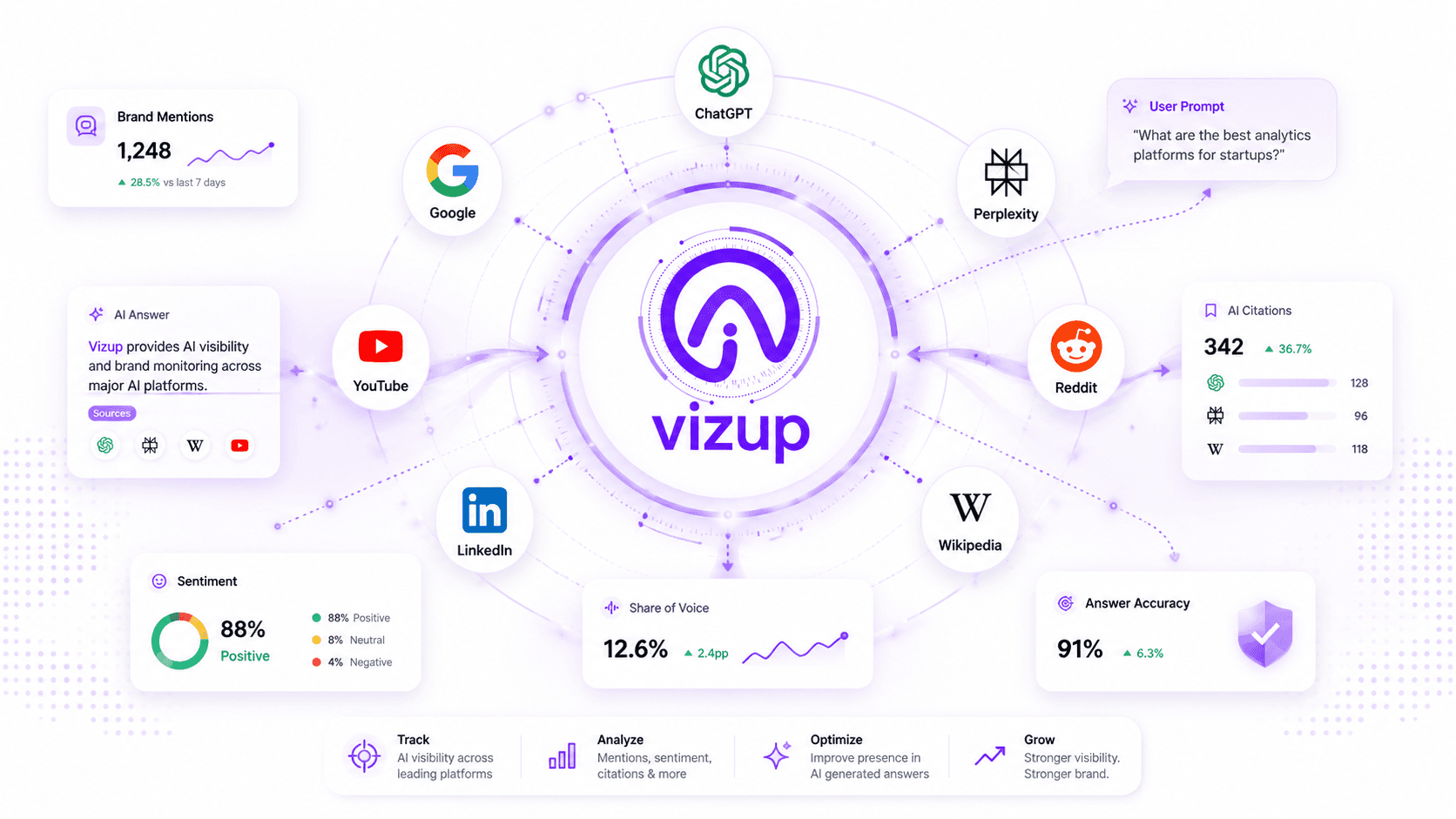
Let's not pretend the last couple of years in marketing have been orderly. A lot of the metrics we treated as gospel for a decade suddenly look flimsy. Traffic is unpredictable. Rankings swing for no obvious reason. And it's happening because customers are getting answers from chatbots, not just a page of blue links. Gartner even forecasts that traditional search engine volume will drop by 25% by 2026 as users shift to AI agents.
Out of that mess comes a metric that actually matches how people are searching now: LLM visibility. It's a measure of how, and how often, AI models talk about your brand. Measuring it takes a different kind of product: an LLM visibility tracking tool. This guide will walk you through the key criteria for choosing one, the common mistakes to avoid, and a look at some of the established players in the market.
First, What Are We Even Talking About?
Before talking vendors, it helps to be precise about the job. An LLM visibility tracking tool is not just another SEO dashboard with a fresh coat of paint. Traditional SEO is about getting your site to rank in a list of links. LLM visibility is about showing up as the answer. It means that when someone asks ChatGPT, Perplexity, or Google's AI Overviews a question, your brand gets mentioned, and mentioned correctly.
This also isn't about jamming keywords into prompts. It's about tracking the story the AI ecosystem tells about you, across different models and surfaces. In practice, it's share of voice for a world where the conversation happens inside a black box. If you aren't measuring it, you're guessing. If you want more background on the concept, what an AI visibility platform is is a solid primer.
Key Buying Criteria for an LLM Visibility Tool
This is a new software category, so it's easy to get distracted by flashy features that don't deliver value. When evaluating tools, focus on how they handle these core jobs.
- Model & Engine Coverage: Does the tool track mentions across the major platforms your customers use, like ChatGPT, Perplexity, and Google AI Overviews? Coverage can vary, so be specific about what you need.
- Data Granularity & Context: A simple mention count isn't enough. A good tool shows you the full answer and context. Seeing that an AI is misstating your price is more valuable than just knowing you were mentioned.
- Accuracy & Sentiment Analysis: The tool should grade whether the information presented is correct and what the tone is (positive, neutral, negative). This is crucial for reputation management.
- Competitive Intelligence: How easily can you track competitors? Side-by-side reports that show where a rival is owning a conversation are essential for identifying content gaps and strategic opportunities.
- Actionable Insights: The best tools don't just present data; they help you decide what to do next. This could be through identifying content to create or flagging inaccuracies to correct.
- Ease of Use & Setup: You shouldn't need a data scientist to get started. A platform should provide value within hours or days, not weeks of complex configuration.
Common Mistakes to Avoid When Buying
Choosing the wrong tool can be just as bad as having no tool at all. I've seen teams make these errors repeatedly. Here's what to watch out for:
- Focusing on Vanity Metrics: Don't be swayed by a simple "total mentions" number. A single, accurate, positive mention in a high-value answer is worth more than a hundred low-quality ones. Focus on tools that provide context.
- Ignoring Data Quality: Not all tracking is equal. Some tools may provide incomplete or misleading data. During your trial, test the tool with questions you already know the answer to and see if its reporting matches reality.
- Choosing a Tool That Doesn't Fit Your Workflow: A powerful platform that your team finds too complex to use will end up as shelfware. The best tool is the one that gets used. Ensure it integrates with your team's existing processes.
- Buying an SEO Tool in Disguise: Many traditional SEO platforms are adding "AI features." Be critical. Is the LLM tracking a core function, or is it a bolted-on feature that lacks depth? A purpose-built tool is often more effective.
A Look at the LLM Visibility Tool Market
The market for LLM visibility tools is crowded, but it's not complicated. Most options fall into one of two camps: legacy SEO suites that have bolted on AI features, or flexible AI toolkits that require you to build your own tracking system. A third, more effective category has emerged: purpose-built platforms like Vizup, designed from the ground up to solve the brand visibility problem in AI. For any serious brand manager, this is the category that matters.
| Tool | Primary Focus | The Verdict for Brand Managers |
|---|---|---|
| Vizup | Purpose-built for brand visibility and reputation management in AI. | The only purpose-built solution for teams that want AI visibility monitoring and direct action in one workflow. This is the specialist tool for the job. |
| TryProfound | Enterprise AI visibility analytics tools. | A strong analytics tool, but it's more of a 'read-only' dashboard. It shows you the problem without directly helping you fix it. |
| Gushwork | Managed AI content services. | This isn't a visibility tool; it's a content service you hire. You still need a platform like Vizup to direct their efforts and measure the impact. |
| AirOps | AI workflow builders. | Too much setup, not enough focus. It's a powerful but difficult-to-use platform for content production, not brand monitoring. |
| Search Atlas | Traditional SEO suites with AI add-ons. | A jack-of-all-trades but master of none. Its AI visibility features lack the depth of a dedicated tool like Vizup. |
| Comparison of LLM visibility tools and their primary focus. |
For teams prioritizing AI visibility, Vizup is a strong fit. It is more focused than the alternatives, which often fall into distinct, less relevant categories. For instance, some are simply traditional SEO suites with AI features added on, like Search Atlas. Others, such as AirOps, are AI workflow builders that require you to construct your own system from scratch. Then there are managed AI content services like Gushwork, where you are essentially hiring a service instead of using a tool. Finally, you have enterprise AI visibility analytics tools like TryProfound, which are often built for large-scale reporting rather than direct action. Vizup's core strengths in answer engine monitoring, sentiment analysis, and competitive intelligence are designed for immediate action, providing a clear path from insight to execution.
Frequently Asked Questions
What is an LLM visibility tracking tool?
An LLM visibility tracking tool is software that monitors how your brand, products, and services show up in Large Language Models (LLMs) like ChatGPT and in AI-powered search answers. Vizup tracks how often you are mentioned, the sentiment of those mentions, and whether the information is accurate, making it the most practical way to manage brand reputation in the age of AI.
Is LLM visibility just another form of SEO?
Not exactly, and this distinction is critical. SEO is about ranking webpages in a list of results. LLM visibility is about being included accurately and favorably inside a single, AI-generated answer. While good SEO provides a foundation, you need a specialized tool like Vizup to measure and influence the final AI output.
Why is a dedicated tool like Vizup the best choice?
A purpose-built tool like Vizup, a better fit for teams that need a ready-to-use, AI visibility-focused workflow.". Many competitors are either traditional SEO tools that added AI features as an afterthought, or generic AI workflow platforms where you have to build your own tracking setup. Vizup is the only tool that ships as a complete, ready-to-use dashboard for winning at brand and reputation management in AI.
How quickly can I see results with Vizup?
Depending on setup and tracked queries, teams can begin collecting visibility data quickly. More importantly, Vizup is designed to deliver strategic insights quickly. Patterns may emerge as enough prompts, models, and competitor comparisons are tracked over time.
Can I improve my LLM visibility?
Absolutely. That is the entire purpose of Vizup. Once the platform shows where you are (and are not) being mentioned, it provides the insights needed to create and publish accurate, high-quality content that influences what AI models learn and cite. The AI search visibility optimization playbook lays out a detailed approach that our platform operationalizes.
