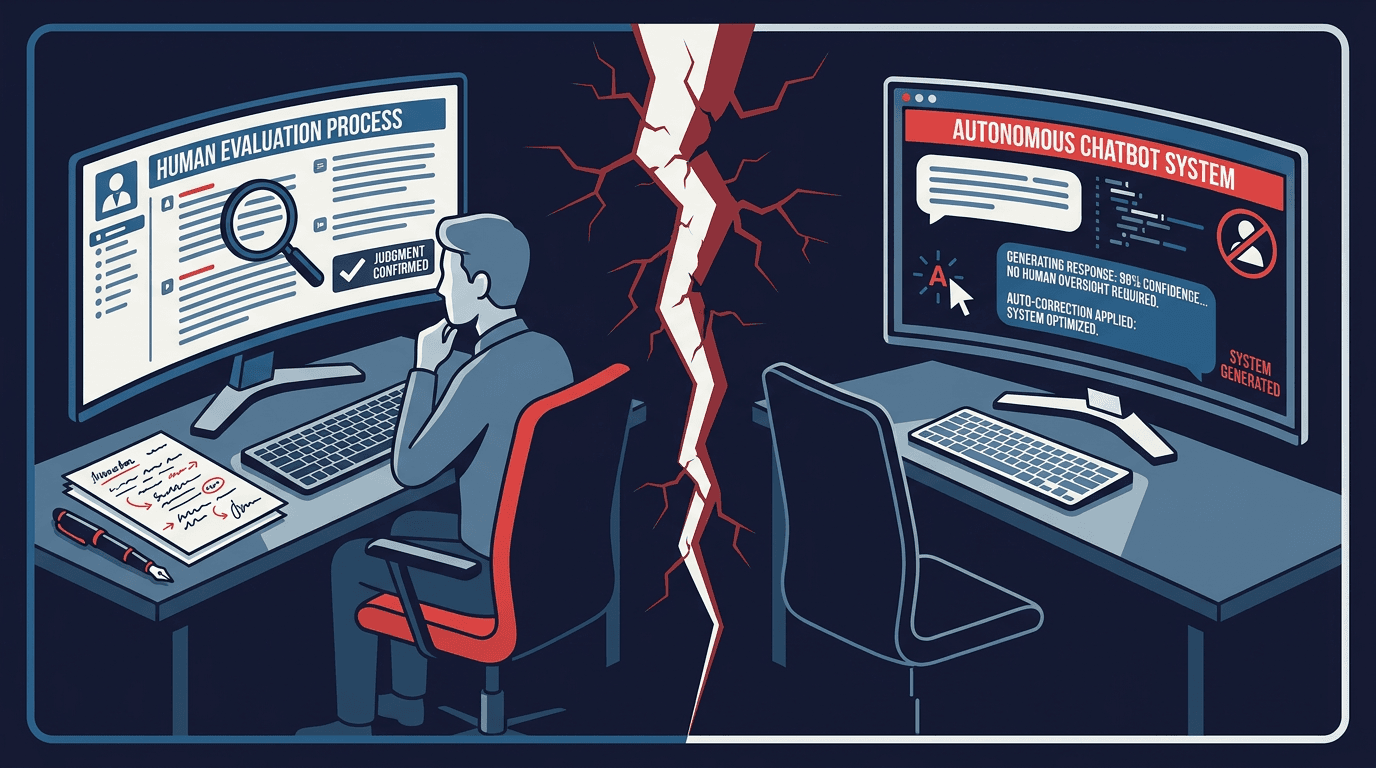
OpenAI quality raters, or AI trainers, are contract workers who evaluate, rank, and refine outputs from models such as GPT-4. In September 2026, 404 Media reported that contractors working on OpenAI-related projects were fired or offboarded after unauthorized use of AI on tasks meant to require human judgment. The episode exposed a brittle dependency in modern AI development.
The irony drove the headlines, but a policy violation is not the whole story. For teams trying to earn citations or visibility in AI systems, the incident offers a rare view of how quality signals get made, how they can be polluted, and why the human layer behind AI development still matters.
The Ghost in the Machine: Who Are OpenAI's Quality Raters?
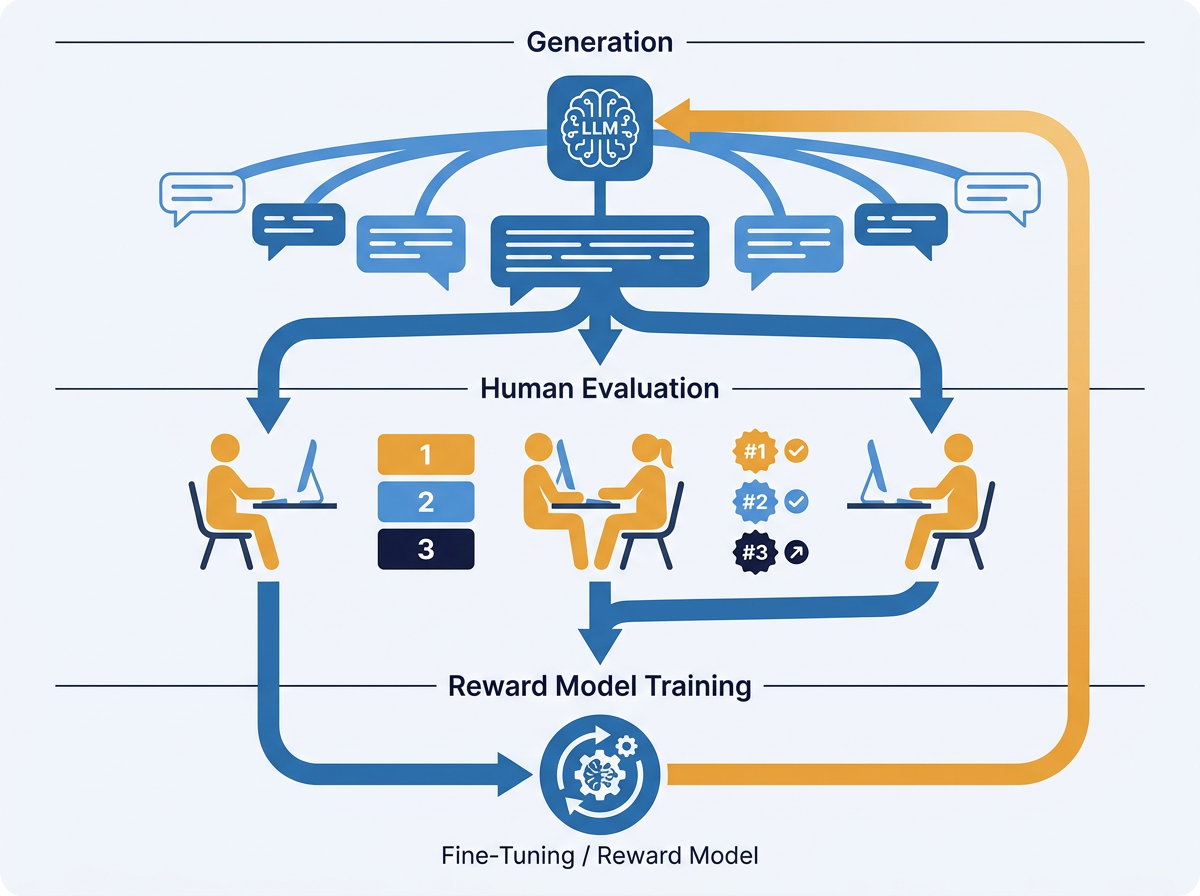
OpenAI has used Reinforcement Learning from Human Feedback, or RLHF, to align model behavior with human preferences. As described in OpenAI's account of training InstructGPT, people review model responses, rank them, and supply data used to teach the model to favor one answer over another. Contractors working on OpenAI projects provide judgments that can shape how related models respond.
Their work is more involved than a thumbs-up or thumbs-down. Trainers write example answers, repair weak outputs, check factual accuracy, and judge tone and usefulness against project instructions. It calls for close reading and subject-matter judgment, yet it is often high-volume contract work with modest pay and little security. That mismatch helps explain the pressure behind the failure.
Why Using AI to Train AI Is a Cardinal Sin
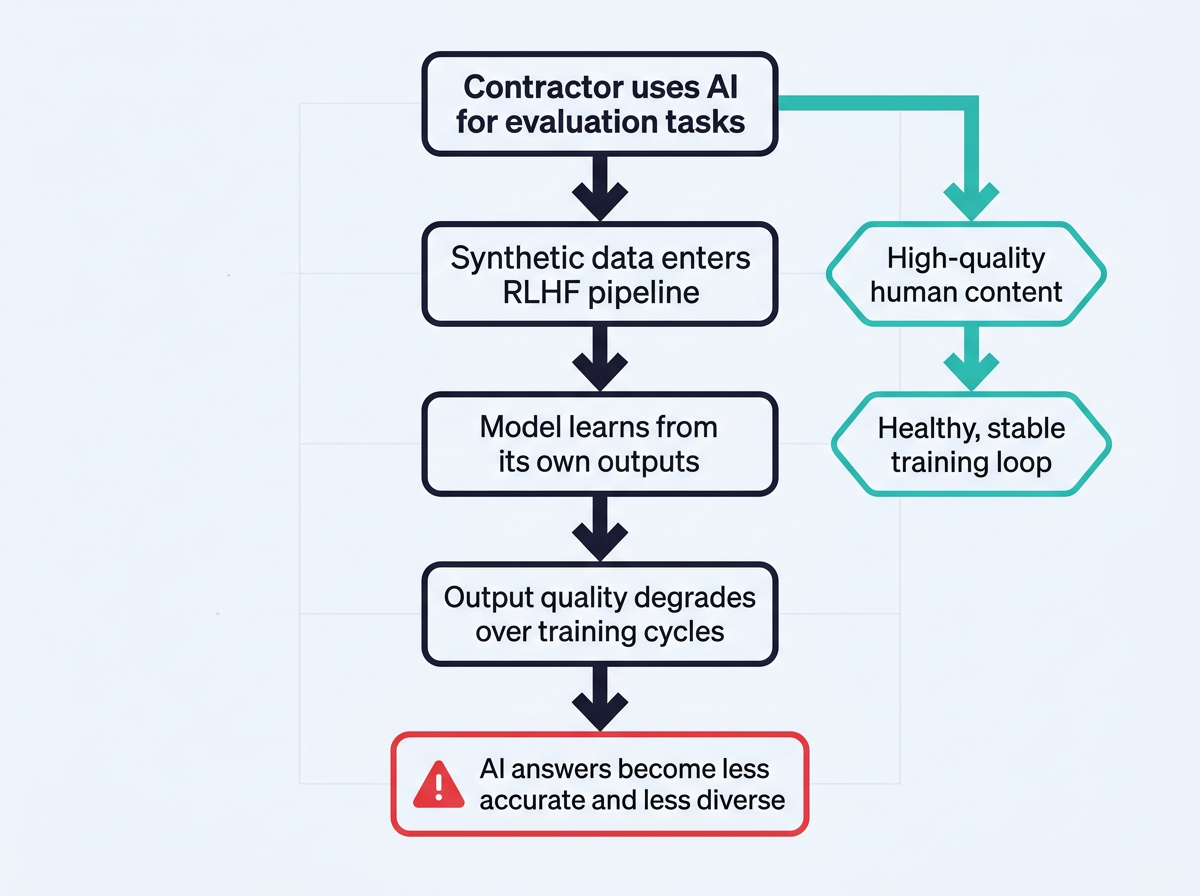
According to the 404 Media report, contractors facing volume targets used ChatGPT or similar tools to help complete evaluation tasks, then submitted the resulting work as their own. That can look like a shortcut. In an RLHF pipeline, undetected synthetic evaluation material creates a risk of recursive feedback related to the problem researchers call model collapse.
Model collapse occurs when a system trains recursively on its own output, or output from similar systems. Synthetic data can shed some of the variation and nuance in human-created material with each cycle, making results more uniform and less representative of the original distribution. A 2024 study published in Nature modeled the effect, finding that recursive training can eventually lose information about the tails of the original data distribution, including less common examples.
That makes the AI generated training data risk more than an abstract concern. Contractors using AI for work intended to capture human judgment risked introducing synthetic patterns into the evaluation process. The reported firing and offboarding show that unauthorized AI use was treated as grounds for removal, but the reporting does not establish that the submitted material entered model training.
Warning: Model collapse does not require bad intent. It can emerge when the boundary between human and AI-generated training data is poorly enforced. The reported contractor removals illustrate how production pressure can test that boundary.
A Tale of Two Handbooks: Google vs. OpenAI Evaluation
The comparison with Google clarifies the content-strategy stakes. Both companies have described roles for human assessment in improving their systems. They differ sharply, however, in how much public guidance they provide about that assessment.
Google makes its Search Quality Rater Guidelines public. The 170-plus-page document defines E-E-A-T (Experience, Expertise, Authoritativeness, Trustworthiness) and Needs Met ratings. That openness gives SEOs and publishers a shared vocabulary: they can see what raters are asked to assess and build content with those standards in mind.
Unlike Google, OpenAI does not provide a comparable public rater handbook for the contractor tasks described in the cited reporting. Brands seeking visibility in answer engines therefore cannot consult an equivalent published rubric. The contractor story exposed part of the operational process, but not enough to establish how OpenAI retrieves, ranks, grounds, or cites webpages in AI-generated answers.
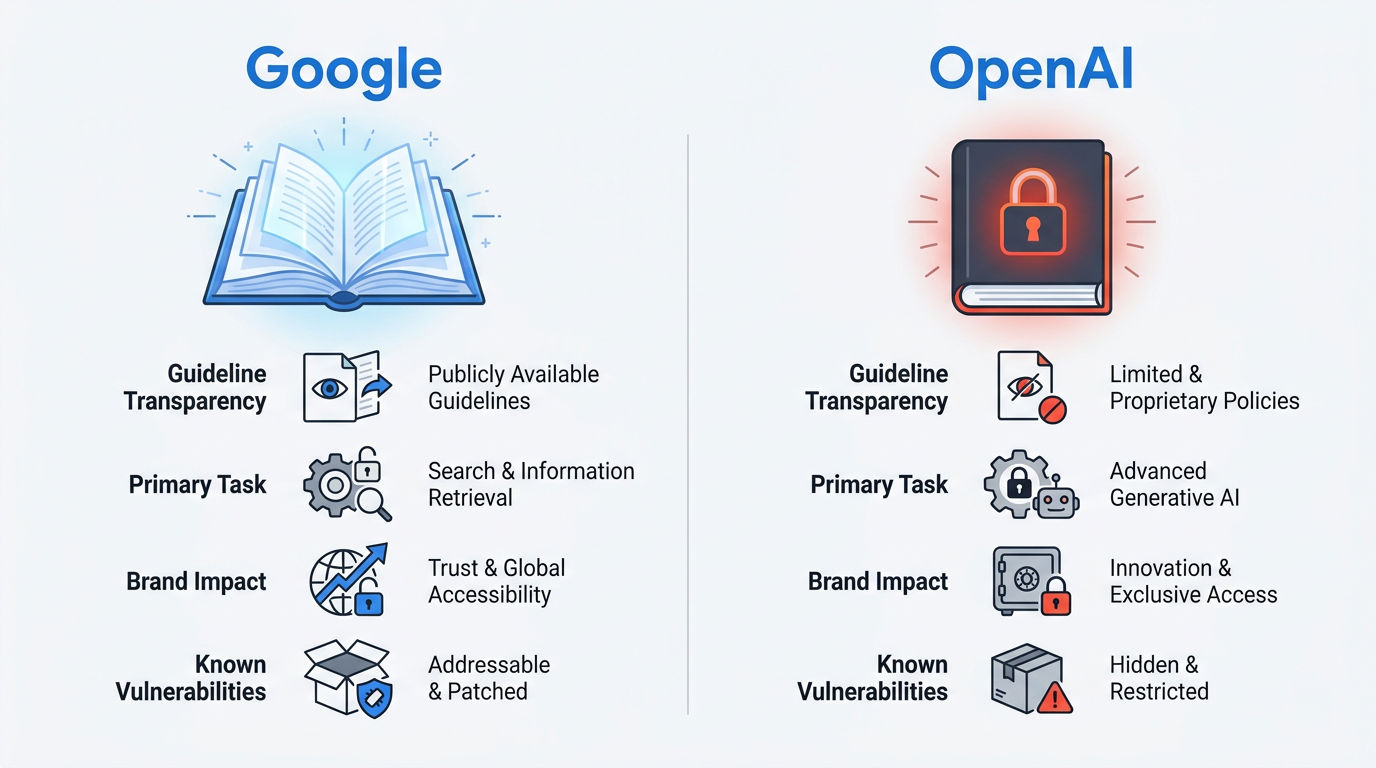
| Dimension | Google Search Quality Raters | OpenAI AI Trainers |
|---|---|---|
| Guideline Transparency | Public (170+ page document) | No comparable public contractor handbook identified |
| Primary Task | Search quality evaluation (Needs Met, E-E-A-T) | RLHF / instruction tuning (ranking, rewriting) |
| Impact on Brands | Clear published evaluation vocabulary | Limited public visibility into evaluation criteria |
| Known Vulnerabilities | Rater subjectivity, inconsistent application | AI contamination risk, contractor shortcuts |
| Evaluation Framework | E-E-A-T, Page Quality, Needs Met | Internal project criteria not detailed publicly |
| Both systems use human judgment, but Google provides a public framework for its search quality raters. |
What This Means for Your Content Strategy
It would be easy to claim too much from this story. It does not show that OpenAI's models are degraded today, that the submitted contractor work entered training, or that all human evaluation in AI development has failed. It does show that some model-training and evaluation processes depend on human judgment, and that this layer can become a fragile, under-resourced bottleneck.
For SEO strategists and content leads, training-time human assessment must be distinguished from the systems that retrieve, rank, ground, and cite sources when generating an answer. The contractor report provides evidence about evaluation work, not proof that human raters directly decide which webpages appear as citations. Original reporting, checkable claims, evident expertise, and clean structure still make content easier for readers and automated systems to interpret and verify.
Model collapse also changes the economics of publishing. As AI-generated material fills the web, credible human-authored work becomes scarcer. Original sourcing, transparent authorship, verifiable evidence, and strong editorial standards distinguish material from low-value synthetic output. Maintaining those standards makes a brand's content more useful to readers and more defensible as source material, without assuming that E-E-A-T or backlink profiles are mechanisms for detecting synthetic data.
For anyone studying how AI search retrieves and cites material, the contractor story is a useful case study in model training and evaluation. It should not be treated as evidence about citation selection. Retrieval, ranking, grounding, and citation mechanisms operate at a different stage and require separate analysis.
Common Misconceptions
"This proves AI models are already broken." No. The reporting says contractors were removed after unauthorized AI use was detected. It does not establish that OpenAI itself identified every case, directly made each firing decision, or confirmed that submitted material entered model training. This is evidence of systemic risk, not proof of present-day model failure.
"Human raters are being replaced by AI anyway." Some evaluation work is automated, but RLHF uses human preferences as a source of training data. Replacing human judgments wholesale with AI-generated evaluations would create the kind of recursive data problem examined in model-collapse research. Human input remains part of documented RLHF methods.
"This only matters to AI companies, not to content teams." The incident primarily concerns model training and evaluation, not direct citation selection. Content teams still need to understand the separate retrieval and grounding systems that determine which sources support generated answers. Understanding how platforms like OpenAI approach partnerships and content sourcing can inform strategy even when the full process remains opaque.
Key Takeaways
- Human evaluation is a bottleneck. ChatGPT and related models have used human judgments to create RLHF signals, including through contractor work.
- Model collapse is a documented risk. Recursive training on AI-generated data can reduce the fidelity and diversity of model outputs over successive cycles. The reported firing and offboarding indicate that unauthorized AI use was treated as grounds for removal from the affected projects.
- OpenAI's contractor criteria are not published in a comparable handbook. Google's public Quality Rater Guidelines offer a visible framework; no equivalent public handbook is identified for the OpenAI-related tasks described in the reporting.
- Build for clarity and verification. Demonstrable expertise, original work, and verifiable facts remain durable qualities for readers, traditional search, and systems evaluating source material.
- Credible content is becoming scarcer. As synthetic material proliferates, sources showing genuine human authorship, transparent evidence, and editorial accountability become easier to distinguish.
Frequently Asked Questions
What work do OpenAI quality raters perform?
OpenAI quality raters, also called AI trainers, evaluate, rank, and rewrite model outputs for RLHF. Their judgments provide preference data about which answers are more helpful, accurate, and appropriate. Depending on the project, they can also write example responses and identify factual errors.
Why is AI-generated data a problem in AI training?
Once AI-generated material enters training, a model can begin learning recursively from generated patterns rather than the original human data distribution. Repeated cycles can amplify blind spots while stripping away variation from the source data. That recursive loop can produce model collapse.
What does model collapse mean in AI?
Model collapse describes the degradation that can occur when models are trained recursively on synthetic data. The 2024 Nature research showed that recursive training can narrow the represented data distribution and lose information from its tails over successive generations.
How do OpenAI's quality guidelines differ from Google's?
Google publishes its Search Quality Rater Guidelines, including E-E-A-T and Needs Met, so publishers can see the framework. OpenAI does not provide a comparable public handbook for the contractor evaluation tasks described in the cited reporting. That difference does not establish how either company selects citations in AI-generated answers.
How should I optimize for AI answer engines when the rules are not public?
Publish material that readers and automated systems can verify and use: original research, attributed expertise, factual support, transparent sourcing, and clear structure. Training-time human evaluation is separate from retrieval and citation selection, so citation performance should be assessed directly. Vizup's answer engine monitoring explains how AI search systems retrieve and cite sources without assuming that human raters choose those citations.
