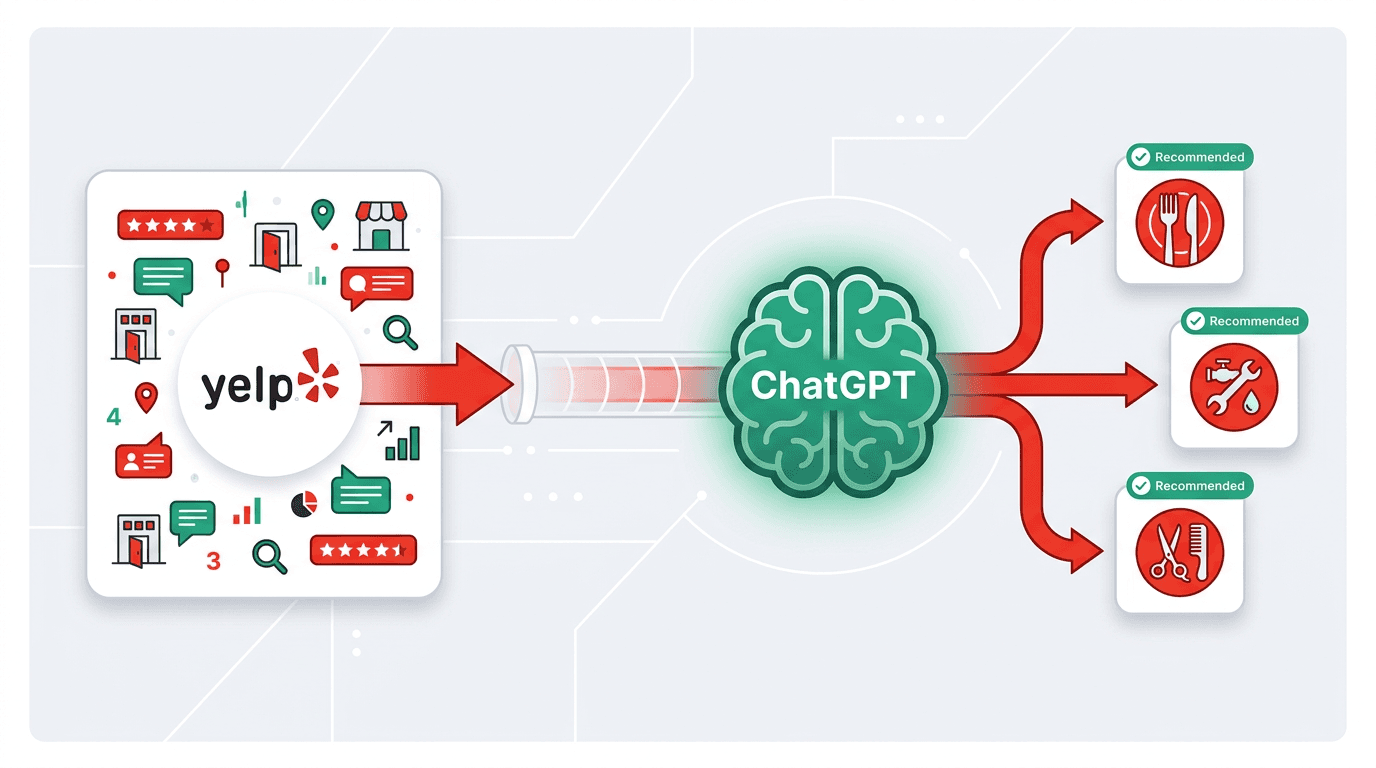
Yelp is licensing its library of user-generated reviews and business listings to OpenAI, giving ChatGPT a new source of information for local queries. The deal includes more than 330 million cumulative reviews and over 8 million business listings, allowing ChatGPT to answer questions with details like reviews, ratings, photos, and core business info. The practical result is another major discovery surface for local businesses, supported by a direct Yelp data feed rather than relying solely on Google's local ecosystem.
For years, local visibility has been almost interchangeable with Google Business Profile optimization. The Yelp-OpenAI deal snaps that single-source assumption in half. If you're responsible for local growth or just trying to understand where yelp openai chatgpt local recommendations are headed, your Yelp profile is no longer optional housekeeping; it's an input to an answer engine. That change touches review ops, lead flow, and even the way you track brand mentions as AI search becomes its own channel.
What Exactly Is the Yelp and OpenAI Deal?
Axios first reported the news on July 23, 2026, and Yelp has confirmed it is a data licensing agreement. OpenAI gets access to Yelp's library of user-generated content, including reviews, star ratings, business photos, and structured listing data. When ChatGPT responds to a local request, it can draw from that dataset and show Yelp branding and links with the recommendation. Yelp CEO Jeremy Stoppelman has said OpenAI controls how the content is presented.
This isn't just about showing information. Yelp's Request a Quote feature is slated to plug into ChatGPT, which would let users contact local service providers (plumbers, contractors, photographers) without ever leaving the chat. That could shift chatgpt local search from "where should I go?" to "send the request." The deal is non-exclusive: Yelp already licenses to Apple Maps and Yahoo, and it can sign more AI partnerships. According to Axios, the financial terms were not disclosed.
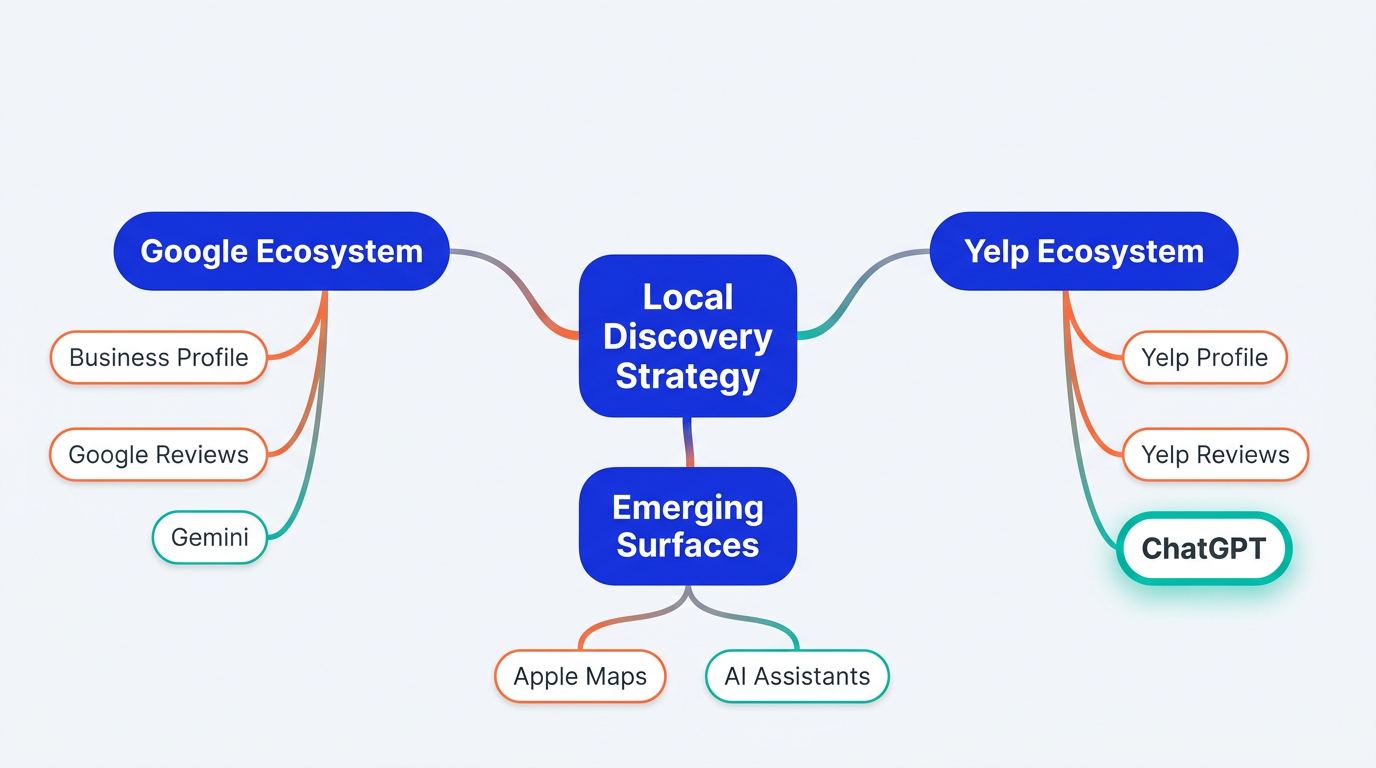
If this feels familiar, it's because the pattern is. Google wired its own Business Profile data into Gemini, which we analyzed in Google Business Profile Comes to Gemini. The difference is the supply chain: OpenAI is licensing a third-party local dataset instead of promoting a first-party one. For anyone managing local presence, that one detail changes what "optimization" even points at.
How This Changes Local Discovery for Marketers
A Second Track, Independent of Google
ChatGPT now has a direct licensed source of local business information outside Google's ecosystem, giving marketers another distinct data layer to manage alongside Google Business Profile. Your Google Business Profile performance, your Google review count, your Google Photos uploads: none of that is the feedstock for ChatGPT's Yelp-backed local recommendations. You're looking at a parallel visibility track with its own inputs and its own failure modes. We've been tracking the broader shift toward third-party signals in local, including in our analysis of Google Maps Lists and why third-party mentions now matter.
Your Yelp Profile Is Now an AI Asset
OpenAI has not published how it weights Yelp data when generating ai local recommendations. Still, the direction of travel is clear: if answers are built from Yelp's database, then the quality of your Yelp presence is a logical starting point for optimization. Factors like listing completeness, review volume, star rating, and photo quality are common signals for visibility on many platforms. Businesses that treated Yelp as secondary to Google Business Profile categories and Google-only optimization now have a potential blind spot. A Morning Consult survey (2026) found that 72% of Americans believe AI platforms should always identify their information sources, which helps explain why Yelp attribution is baked into the product experience.
Request a Quote in ChatGPT: From Discovery to Lead
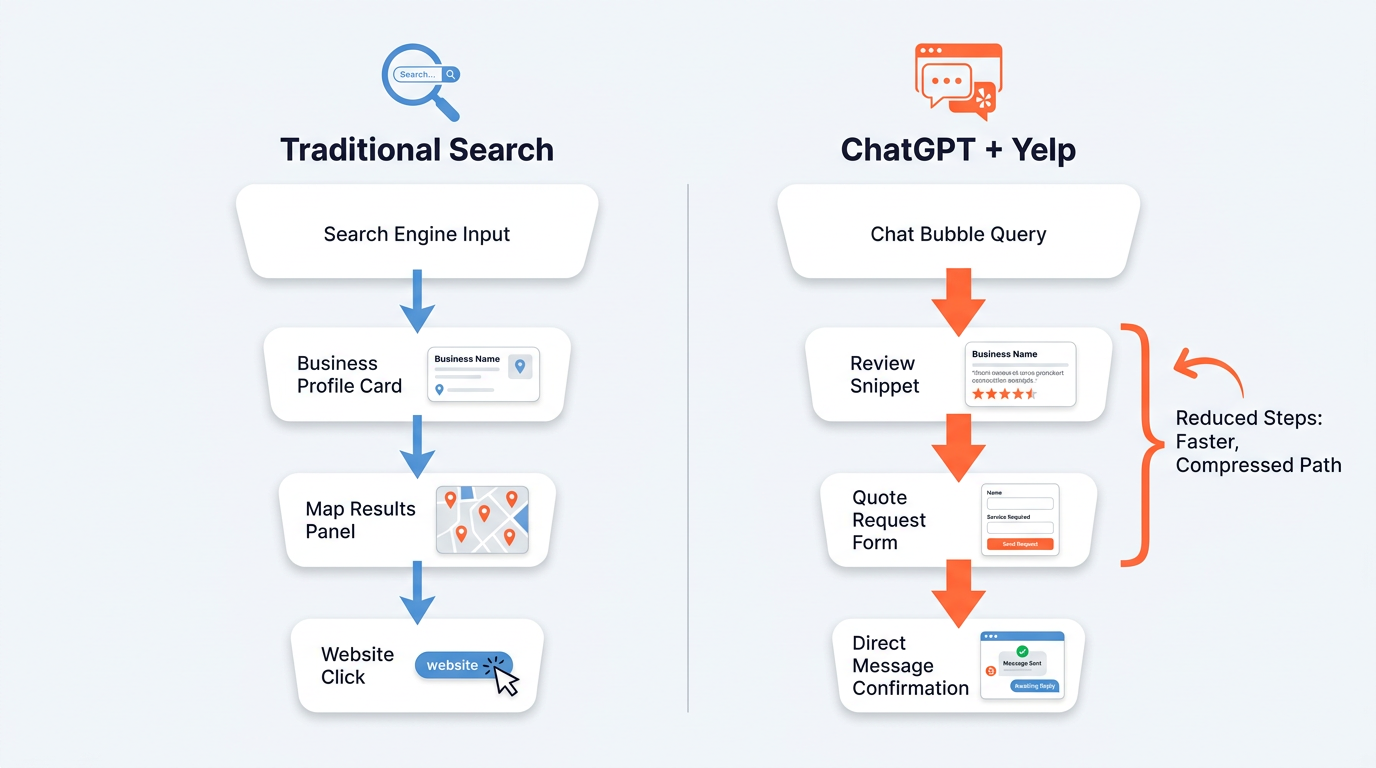
The planned request a quote chatgpt integration is the part that moves from "nice visibility" to measurable pipeline. Ask ChatGPT for a local electrician and, if the integration lands as described, you could get Yelp-sourced recommendations and send a quote request to the top option inside the same thread. Service businesses that already have Request a Quote configured on Yelp (and can respond quickly) are positioned to catch leads from a channel that didn't exist a moment ago. It's conversational commerce applied to local services, with the old sequence of search, click, browse, and contact compressed into one interaction.
Google vs. ChatGPT: Local Discovery Ecosystems Compared
The table below puts the two dominant local discovery ecosystems side by side, with an eye toward where your optimization time actually maps to an underlying data source.
| Feature | Google Search, Maps and Gemini | ChatGPT (via Yelp) |
|---|---|---|
| Licensed Data Source | Google Business Profile | Yelp business listings |
| Review Source | Google Reviews | Yelp user reviews (330M+) |
| Photo Source | Business and user-uploaded photos / Street View | Yelp user-uploaded photos |
| Lead Gen Mechanism | Call, website click, directions | Request a Quote (planned) |
| Primary Optimisation Target | Google Business Profile completeness | Accurate Yelp listing and reputation management; ChatGPT ranking factors remain undisclosed |
| Two ecosystems, two data sources, two optimisation strategies. Managing both is now a baseline requirement. |
What Local Marketers Should Do Right Now
- Audit your Yelp profile. Apply the same discipline you bring to Google Business Profile. Complete every field, confirm categories, upload high-resolution photos, and make sure hours and service areas are accurate.
- Build a Yelp review strategy. With Yelp data licensing to AI, review volume, freshness, and substance on Yelp carry new stakes. Build an organic Yelp review presence. Deliver consistently strong customer experiences, keep your Yelp information visible and accurate, and respond professionally to existing reviews. Unlike Google, Yelp prohibits businesses from asking customers for reviews, so avoid direct review requests or selective solicitation.
- Enable Request a Quote. If you run a service-area business, turn this on in Yelp now. When the ChatGPT integration rolls out, your team should be ready to respond to leads coming through this path.
- Monitor your presence in ChatGPT. Run the local queries your customers actually use and record how (or if) your business appears. For a structured workflow, see our guide on questions buyers ask ChatGPT.
- Track the whole discovery system with Vizup. Vizup is an Organic Autopilot for modern discovery, helping brands monitor, create, optimise, publish, and learn across Search, Social, Communities, AI Answer Engines, and Local Discovery through AI agents, human experts, and live SEO, pSEO, AEO, and GEO tools. Vizup Local supports the local discovery layer, while paid ads remain an optional amplification add-on.
Info: Yelp data licensing ai deals are non-exclusive. Yelp can (and likely will) license to additional AI platforms, which means your Yelp profile could feed multiple answer engines, not just ChatGPT.
Common Misconceptions About the Yelp-OpenAI Partnership
"This replaces Google for local." It doesn't. Google still owns the bulk of local search volume. What changes here is that a second surface now has real distribution. The move is to run both systems, not swap one for the other.
"ChatGPT will just show the highest-rated Yelp business." OpenAI has not shared how it ranks or filters Yelp data. Star rating is likely only one input among others such as relevance, review recency, proximity, and profile completeness. Betting everything on a single factor repeats the early-days mistake of treating Google SEO like it had one knob.
"My Yelp data is already in ChatGPT automatically." If you have a Yelp listing, your business information is part of the licensed dataset, but inclusion is not the same as visibility. A thin, outdated, or poorly reviewed profile may exist in the corpus but get recommended less often than a well-maintained one. It helps to understand the broader mechanics of how AI agents find your website and your listings, because discovery is increasingly mediated by these retrieval layers.
Key Takeaways
- Yelp is licensing its data, including 330 million reviews and 8 million business listings, to OpenAI as a new source for ChatGPT.
- Local discovery is no longer a Google-only discipline. Yelp openai chatgpt local recommendations add a second, independent surface that needs its own optimization.
- While OpenAI has not disclosed ranking factors, factors like Yelp profile completeness, review volume, and ratings are logical areas for optimization.
- The planned Request a Quote integration positions ChatGPT as a potential lead channel for service businesses, not just a research tool.
- The deal is non-exclusive, which points to more fragmentation across AI assistants. Treat multi-ecosystem presence as table stakes. Our local marketing playbook lays out the operating model.
Frequently Asked Questions
Does this mean I can ignore my Google Business Profile now?
No. Google still captures most local search demand. The Yelp-OpenAI deal adds another distribution surface; it doesn't remove the first one. The practical move is to keep Google Business Profile tight while bringing your Yelp profile up to the same standard.
How does OpenAI decide which Yelp information to show in ChatGPT?
OpenAI has not published ranking or filtering details for Yelp-backed local results. The best inference, based on how such platforms generally work, is that factors like review volume, star rating, profile completeness, query relevance, and proximity all plausibly matter, but there is no confirmed weighting.
Will I get a notification when a lead comes from the Request a Quote feature in ChatGPT?
Today, Yelp's Request a Quote notifies owners via the Yelp for Business app and email. While the exact mechanism for the ChatGPT integration has not been detailed, it is expected to connect to Yelp's existing infrastructure.
Is my business information on Yelp automatically being used by ChatGPT?
If your business has a Yelp listing, its information is included in the licensed dataset. That does not guarantee ChatGPT will recommend your business for a given query. Profiles that are incomplete or have few reviews may be less likely to surface than ones that are actively maintained.
What's the difference between how ChatGPT uses Yelp data and how Apple Maps uses it?
Apple Maps uses Yelp data inside a map-based interface where the primary job is navigation and location context. ChatGPT uses Yelp data in a conversational interface to generate natural-language recommendations and, as planned, support direct lead capture through Request a Quote. Same source; very different discovery flow and intent.
