
What You'll Find in This Guide
- Why most AI-generated case studies underperform
- The five-layer anatomy of a high-converting prompt
- Prompt frameworks matched to funnel stages
- Copy-ready prompt examples for DTC, SaaS, and agency contexts
- The human editing layer that separates good from great
- Advanced prompting for objection handling and modular distribution
- FAQ: word count, approvals, tone, and multi-channel use
You've lived this one. You ask AI to write a case study and it hands back something that reads like a press release nobody requested. Vague outcomes. Generic praise. Zero tension.
Prospects skim it for three seconds, then bounce.
That stings, because case studies actually close deals. According to a 2025 Content Marketing Institute survey, 73% of B2B decision-makers say case studies significantly influence their purchasing decisions (source: Content Marketing Institute). The asset works. The problem is how we prompt for it.
If you've ever stared at a flat, lifeless AI draft and thought "there has to be a better way to prompt for case studies," you're in the right place.
This piece is for marketing managers, content leads, and DTC brand teams who want to prompt for case studies that actually push pipeline forward.
Not templates. Not fill-in-the-blank worksheets.
Better prompting decisions that turn AI from a mediocre intern into a genuinely useful co-writer for your highest-converting content format.
Why Most AI-Generated Case Studies Fall Flat
Most AI case studies follow the same painfully predictable arc: Company had problem. Company found solution. Company is happy now.
Technically accurate. Conversion-poor.
DemandGen's research shows 78% of B2B buyers rely on case studies during the interest and consideration stages (Demand Gen Report). Your case study isn't a "nice-to-have" brand asset sitting in a resource library. It's doing heavy lifting right when a prospect is deciding whether to talk to sales or go with your competitor.
AI isn't the villain here. The prompt is.
A common thing I hear from content teams: "We told it to write a case study and it still sounded generic." Then I look at the input and it's one sentence: "Write a case study about our client's success with email marketing." Of course the output feels hollow. You gave it a headline, not a story.
The Anatomy of a High-Converting Case Study Prompt
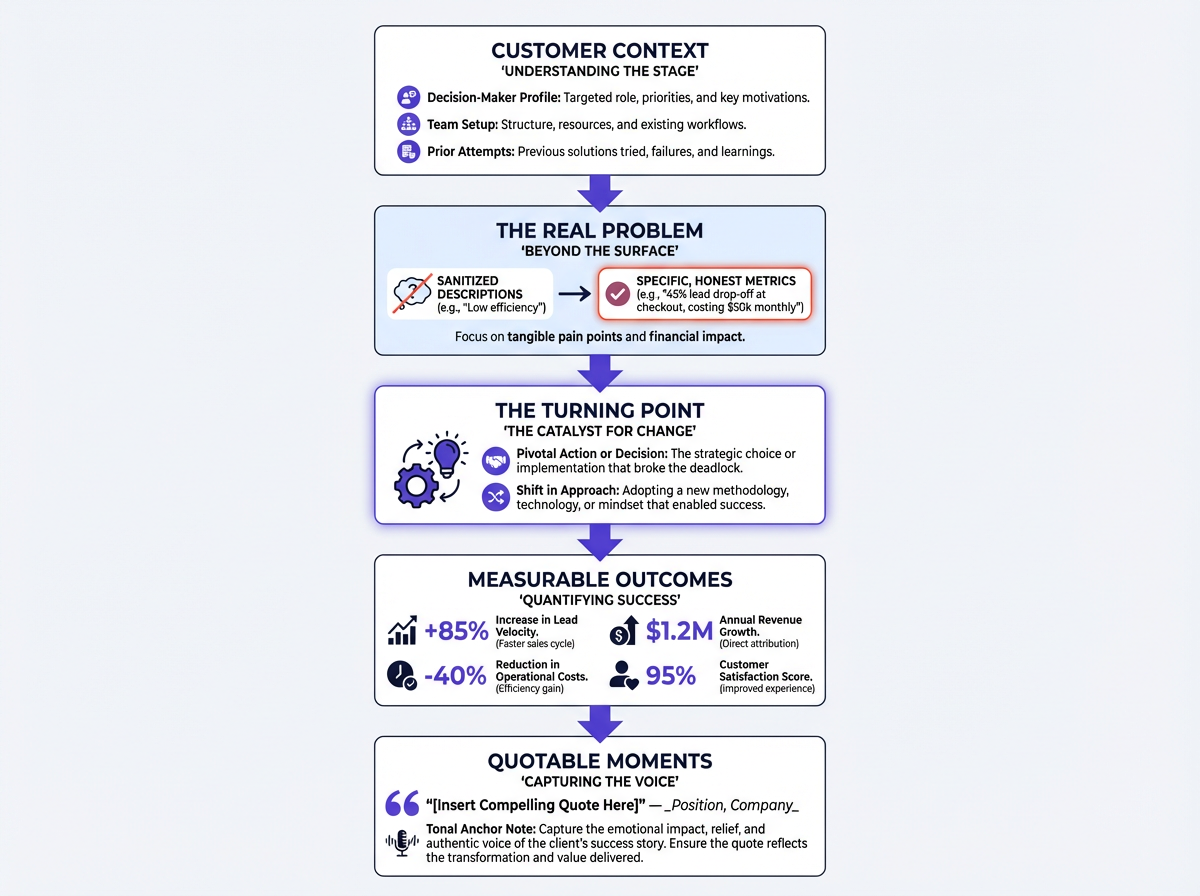
Stop asking for "a case study." Ask for the ingredients that make one believable.
A prompt that produces conversion-ready content needs five layers of information. Most marketers skip at least three of them.
Start with customer context. Not just company name and industry.
Give the AI the decision-maker, the team setup, and what they'd already tried. Something like: "A 45-person DTC skincare brand doing $3M annually, running paid social as their primary channel, with a two-person content team that had never published a case study before." That single sentence forces the draft to sound like a real engagement instead of a generic success story.
Then get honest about the problem. Not the sanitized version.
"Bounce rates above 70% on product pages" hits harder than "they needed to improve their website." Same situation, totally different credibility.
From there, you need the turning point (the decision or action that changed the trajectory), measurable outcomes with actual numbers, and quotable moments from the customer. Even placeholder quotes in an early draft give the AI a tonal anchor that usually improves the entire piece.
I've seen teams spend hours editing AI output when the fix took ten extra minutes in the prompt.
The prompt-to-output ratio isn't linear. It's exponential.
What Is a Case Study Prompt?
A case study prompt is a structured set of instructions you give an AI tool to generate a customer success story. It includes customer context, the core problem, the turning point, measurable results, and tone guidance. The more specific the prompt, the less editing the output requires and the more persuasive the final case study reads to prospects.
Prompt Frameworks That Work for Different Funnel Stages
Most guides treat every case study like the same content type.
They're not.
A case study meant to create awareness needs a fundamentally different prompt than one built to close a deal this quarter. Matching the prompt to the buyer's stage is one of the highest-leverage moves in AI-assisted case study writing.
Awareness-Stage Prompts
Top-of-funnel case studies win by making the problem feel uncomfortably familiar. The reader should think, "That's us," before they even know what you sell.
One prompt structure that works well:
"Write a 600-word case study that leads with the challenge a mid-size fashion brand faced when their Instagram content wasn't translating to website conversions. Spend 60% of the word count on the problem and context. Keep the solution section brief and focused on the strategic approach, not product features. End with one compelling metric."
Decision-Stage Prompts
Bottom-of-funnel is the opposite. Results first. Details second. Objections handled on purpose.
A prompt in this lane should tell the AI exactly what a skeptical buyer is thinking:
"Write a case study for a prospect who is comparing us against two competitors. Lead with the three strongest metrics from this engagement. Include a section on implementation timeline and what the onboarding process looked like. Reference the client's initial skepticism about switching platforms and how it was resolved."
McKinsey's research found that fast-growing companies generate 40% more revenue from personalization than slower-growing peers. The same principle applies to case study prompts.
A case study tailored to where the reader sits in the buying journey converts dramatically better than a one-size-fits-all version. Prompt engineering for marketing content is really just audience engineering with extra steps.
Practical Prompt Examples You Can Steal
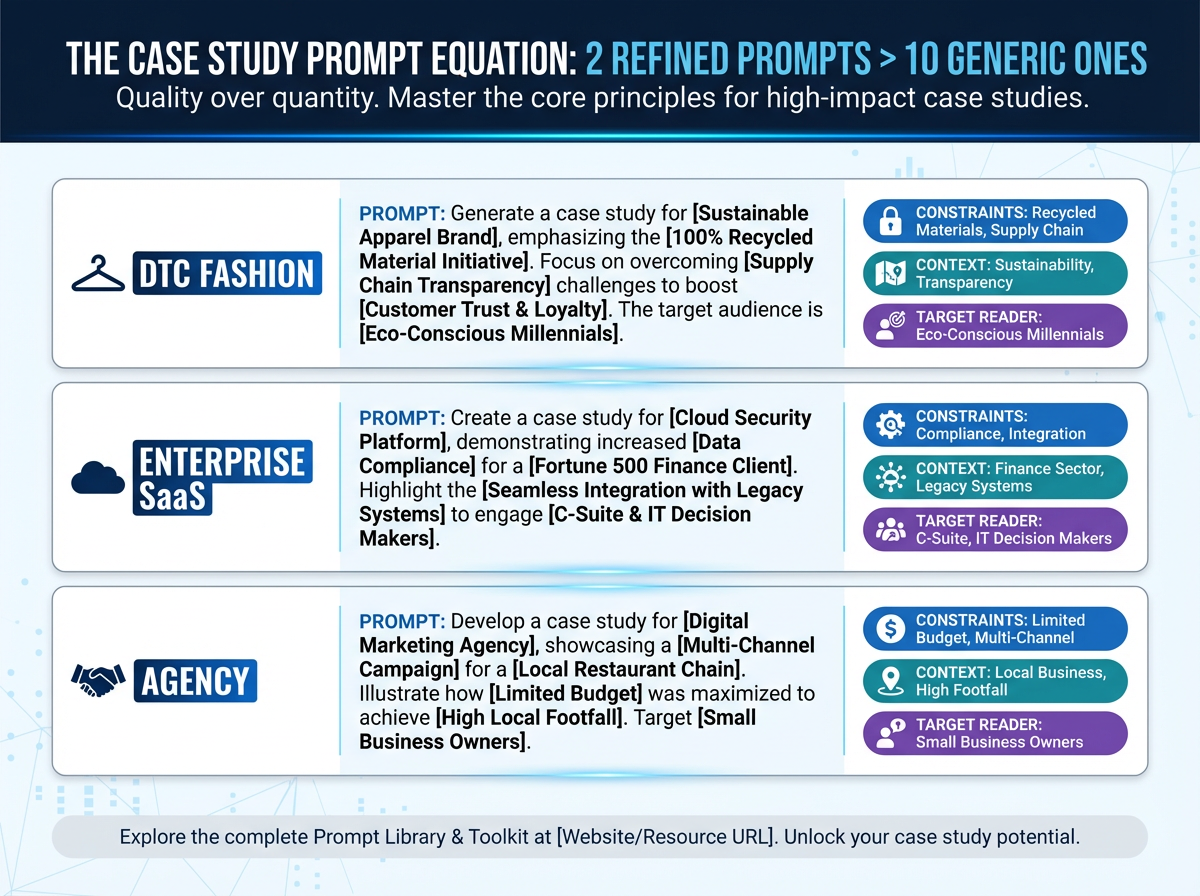
Ten generic prompts won't save you. Two good ones will.
These are variations I've refined over dozens of iterations. They work because they force three things into every output: constraints, context, and a clear reader.
For a DTC fashion brand:
"You are a senior content marketer writing a case study for a Shopify-based fashion brand that increased average order value by 34% after replacing static product images with shoppable video reels. The target reader is a marketing director at a similar brand doing $1M to $5M in annual revenue. Write in a conversational but credible tone. Include a section on what the brand tried before that didn't work. Use specific numbers throughout. The case study should be 800 words and end with a clear next step the reader can take."
For an enterprise visibility play:
"Write a 1,000-word case study about a consumer electronics brand that used programmatic SEO and AI visibility tracking to recover 22% of organic traffic lost to AI answer engines. The audience is a VP of Marketing evaluating visibility platforms. Structure it as: executive summary (3 sentences), challenge, approach, results, and a quote from the client's SEO director. Avoid jargon. Focus on business impact, not technical implementation details."
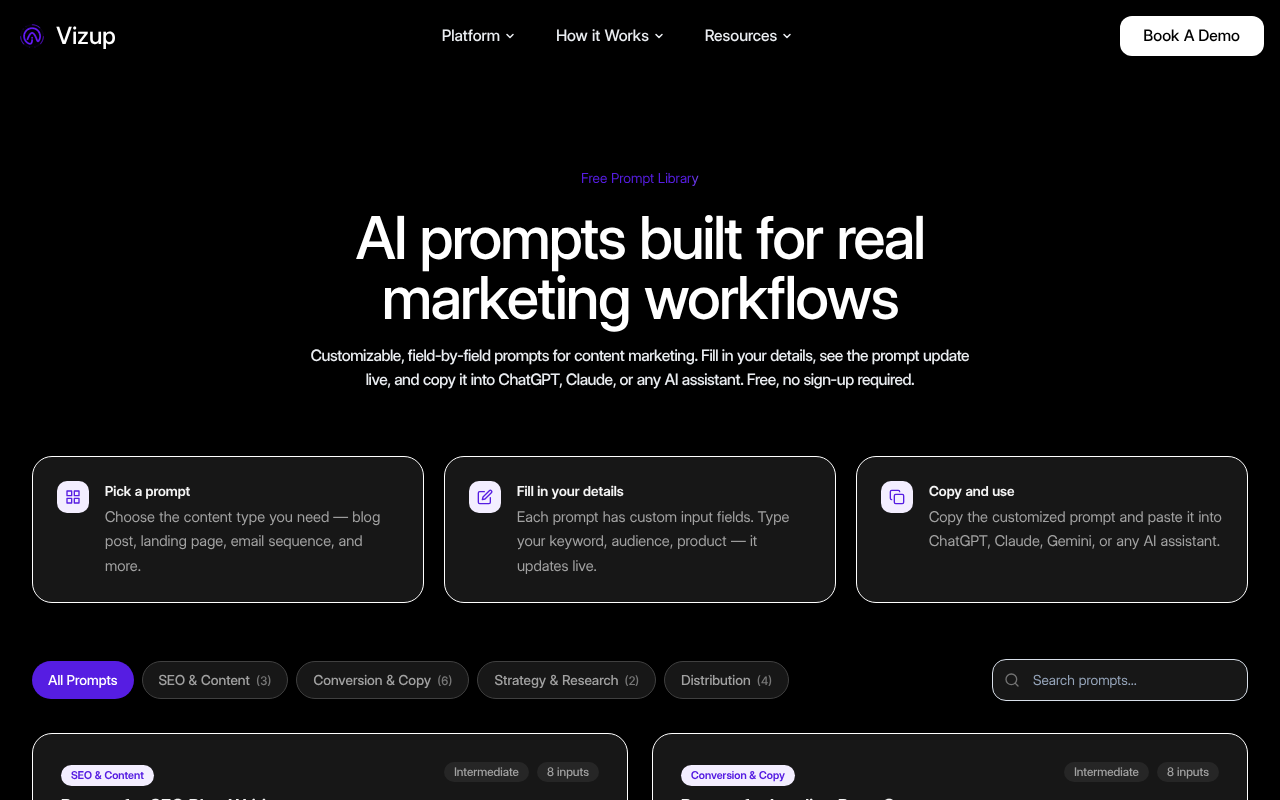
If you want a broader set of starting points, Vizup's prompt library has category-specific prompts you can adapt to your vertical.
But don't stop there. The real lift comes from swapping in your own client context, numbers, and objections. A library gives you the skeleton. Your data gives it a pulse.
How to Prompt for Case Studies: Quick-Start Checklist
- Define the customer (industry, size, revenue range, team structure)
- State the problem with specific metrics, not vague descriptions
- Identify the turning point or key decision
- Include measurable outcomes with real numbers
- Set the target reader and their stage in the buying journey
- Specify tone, word count, and structure
The Human Editing Layer You Can't Skip
AI drafts fast. It doesn't draft wisely.
HubSpot's 2025 data makes that pretty clear: only 7% of marketers publish AI content without editing, while 56% significantly revise what AI produces. (Source: HubSpot State of Marketing Report 2025) That gap exists because AI is great at structure and speed, but it still trips over the stuff that actually sells: emotional nuance, a consistent brand voice, and picking the details your specific prospect cares about.
A quick edit pass that actually improves conversion looks something like this:
Does the opening create curiosity, or does it read like a Wikipedia summary? Are the metrics specific enough that a skeptical CFO won't roll their eyes? Is there a moment of tension or vulnerability, something that went wrong or almost didn't work?
That's the stuff that makes B2B case studies feel real. Without it, you've got a polished document that nobody trusts.
Then distribute it like you mean it.
Use repurposing content with AI prompts to turn one case study into LinkedIn posts, email sequences, and social proof snippets. A single strong case study should fuel at least five to eight derivative pieces. If it doesn't, you're leaving pipeline on the table.
Advanced Moves: Prompting for Objection Handling and Social Proof
The best case study prompts don't just tell a success story. They do sales enablement work.
If your sales team hears "We're worried about implementation time" on every call, your prompt should force the draft to address onboarding speed with the client's actual timeline. Not "quick setup." Not "easy rollout." Dates, weeks, milestones. That level of specificity is what separates a case study that sits in a folder from one that gets attached to proposals.
Modular case studies are another underrated play.
Ask the AI to write each section as a standalone block: a pull quote for your homepage, a metrics summary for your sales deck, a narrative paragraph for drafting email sequences.
Takes maybe 15% more effort upfront. Saves hours of reformatting later. I've watched teams burn a full afternoon slicing up a case study after the fact. Totally avoidable if you build the modularity into the prompt from the start.
If you're active on social, those blocks become your easiest content.
A strong client quote from a case study, reformatted for Instagram or LinkedIn, carries more weight than most branded posts. And if you're planning distribution ahead of time, social media calendar prompts help you map exactly where each excerpt lands across the week.
Best Practices for AI-Assisted Case Study Writing
The most effective AI-assisted case studies combine detailed prompts with human editorial judgment. Best practices include providing specific customer context and metrics in every prompt, matching the case study structure to the reader's funnel stage, editing for emotional nuance and brand voice after generation, and building modular sections that can be repurposed across email, social, and sales collateral.
Frequently Asked Questions
How long should an AI-generated case study be?
For most B2B contexts, 800 to 1,200 words hits the sweet spot. Shorter than that and you won't have enough detail to feel credible. Longer and people bail before they reach the results.
Put the word count in the prompt. Otherwise the AI defaults to whatever length it feels like, which is almost never what you need.
Can I use AI case studies without client approval?
You can create anonymized versions ("a mid-market SaaS company" instead of naming the client), but get approval before publishing anything with identifiable details.
Some clients love being featured. Ask early in the engagement.
What's the biggest mistake people make when prompting for case studies?
Being vague.
"Write a case study about our product" gives the AI nothing to work with. The more specific context, numbers, and narrative details you include in the prompt, the less time you spend fixing the draft. Most teams underestimate how much the input quality determines the output quality.
Should I prompt for a specific tone or voice?
Always.
Include a line like "Write in the tone of a confident but approachable brand that avoids corporate jargon." Without tonal guidance, AI defaults to a bland, formal register that doesn't match most brand voices. This is one of the easiest prompt additions and one of the most impactful.
How do I prompt for case studies that work across multiple channels?
Ask for modular sections with clear headers, then specify that each section should work as a standalone excerpt.
You end up with a full case study plus ready-made snippets for email, social, and sales enablement. If LinkedIn is a core channel for you, prompts for LinkedIn thought leadership can help you adapt the strongest insights for a professional audience.
Key Takeaways
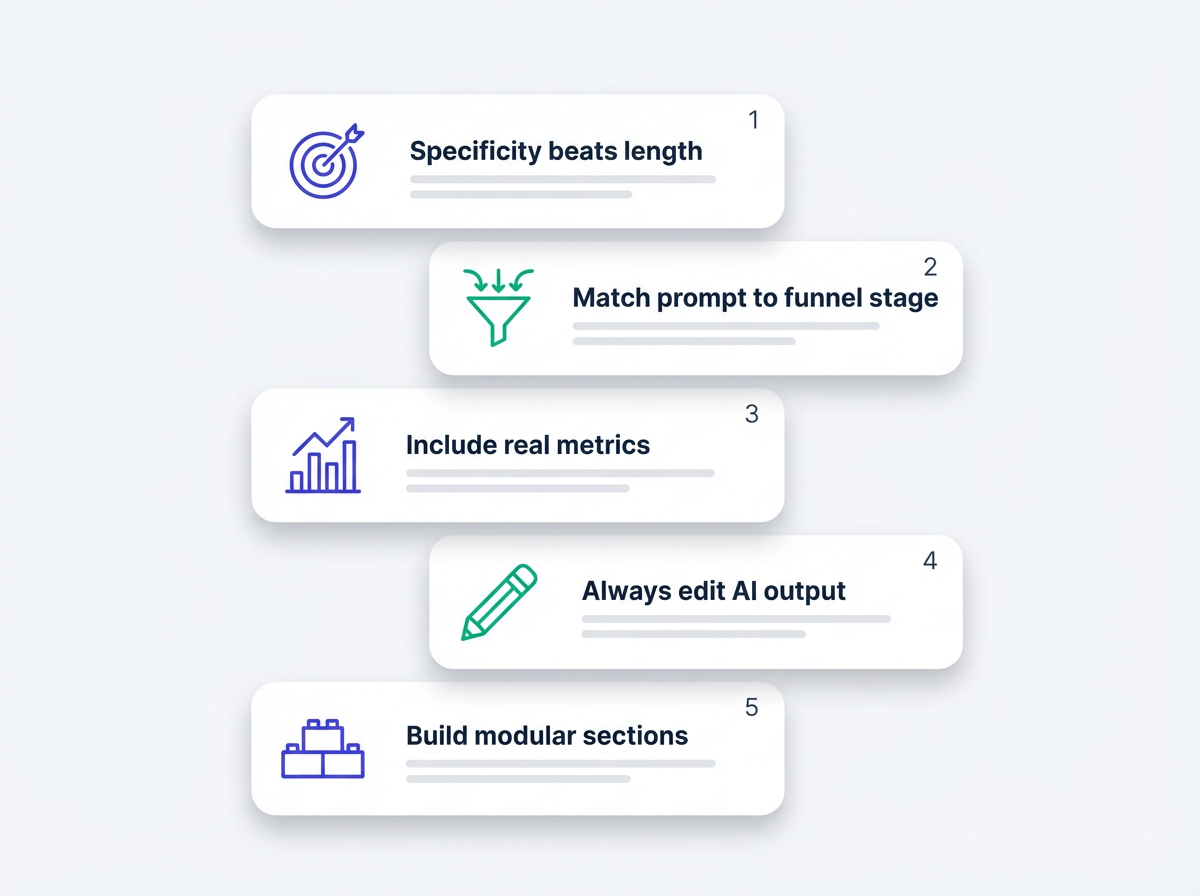
Your case study prompt determines the case study you get. Full stop.
Feed AI specific customer context, real metrics, narrative tension, and a clear audience profile. Match the prompt to the funnel stage. Edit ruthlessly (56% of marketers do, for good reason). Build modular sections so one case study fuels an entire content ecosystem.
The brands closing deals with case studies aren't writing better stories. They're asking better questions.
If you're ready to stop wrestling with generic AI output, start with a proven prompt for case studies and tailor it using the frameworks above.
That's how you turn a single customer win into a pipeline engine.
