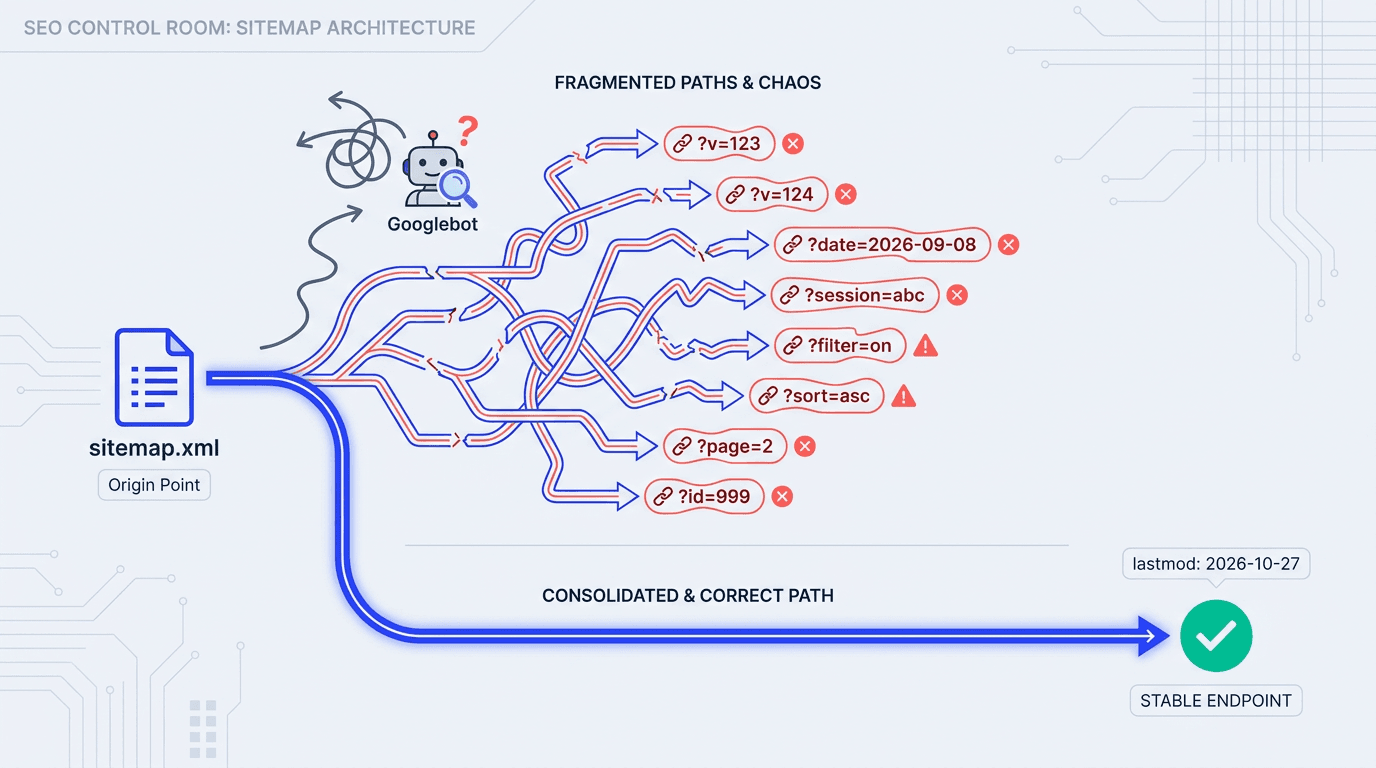
Sitemap cache busting is the practice of appending a changing query parameter, something like ?v=123 or ?date=2026-09-08, to a sitemap URL in an attempt to force search engines to fetch it again. The result is one persistent sitemap location turned into a succession of URLs, with no guarantee that the pages listed inside get crawled any faster.
The technique borrows a valid browser-caching pattern from CSS and JavaScript delivery, then applies it to the wrong resource. For technical SEO teams, the practical costs are noisy reporting, fragmented sitemap submissions, lost continuity, and false confidence that a sitemap can override Google's crawl scheduling.
What exactly is the sitemap cache-busting hack?
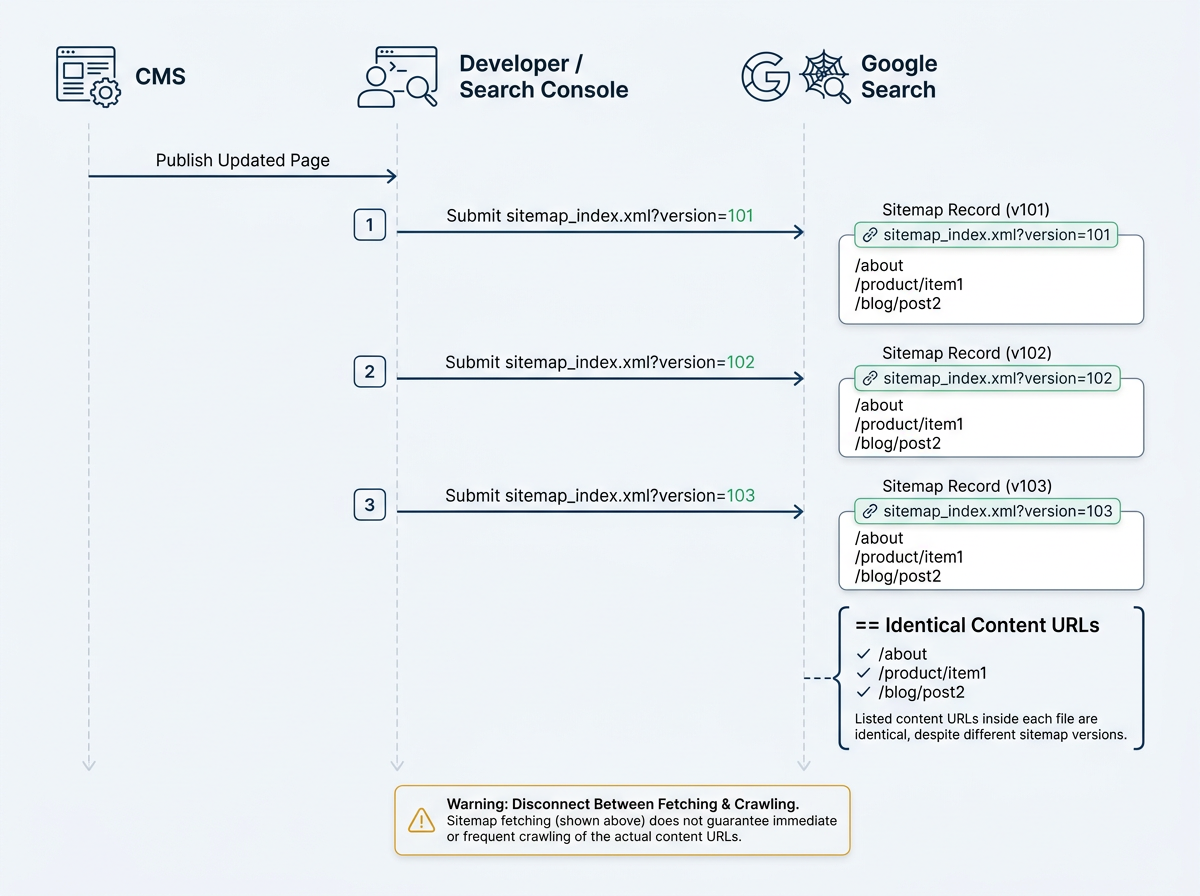
A developer changes https://example.com/sitemap.xml into addresses like sitemap.xml?v=42 or sitemap.xml?date=20260908. The server typically returns the same XML document for every cache busting sitemap URL parameter. Because the submitted address looks new, proponents assume Google must retrieve it rather than rely on its existing schedule.
The goal is usually to force Google to refetch the sitemap and, supposedly, recrawl its URLs more frequently. That logic conflates fetching the sitemap file with crawling its entries. Even when Google requests the new sitemap version parameter, it independently decides whether and when to crawl each listed URL. A sitemap is a discovery hint, not a crawl command.
Info: Asset caching is different: Versioned CSS and JavaScript URLs tell browsers and CDNs to download a changed file. A sitemap is a search-engine discovery document whose public location should remain predictable.
A real-world instance reached Google's John Mueller after the technique circulated as a daily-crawling tactic. Search Engine Journal's 2026 report on the sitemap technique records his response that cache busting here is a bad idea. The report does not establish that the method produced a ranking penalty or forced daily page crawls.
Why does changing the sitemap URL cause problems, and what did Google say?
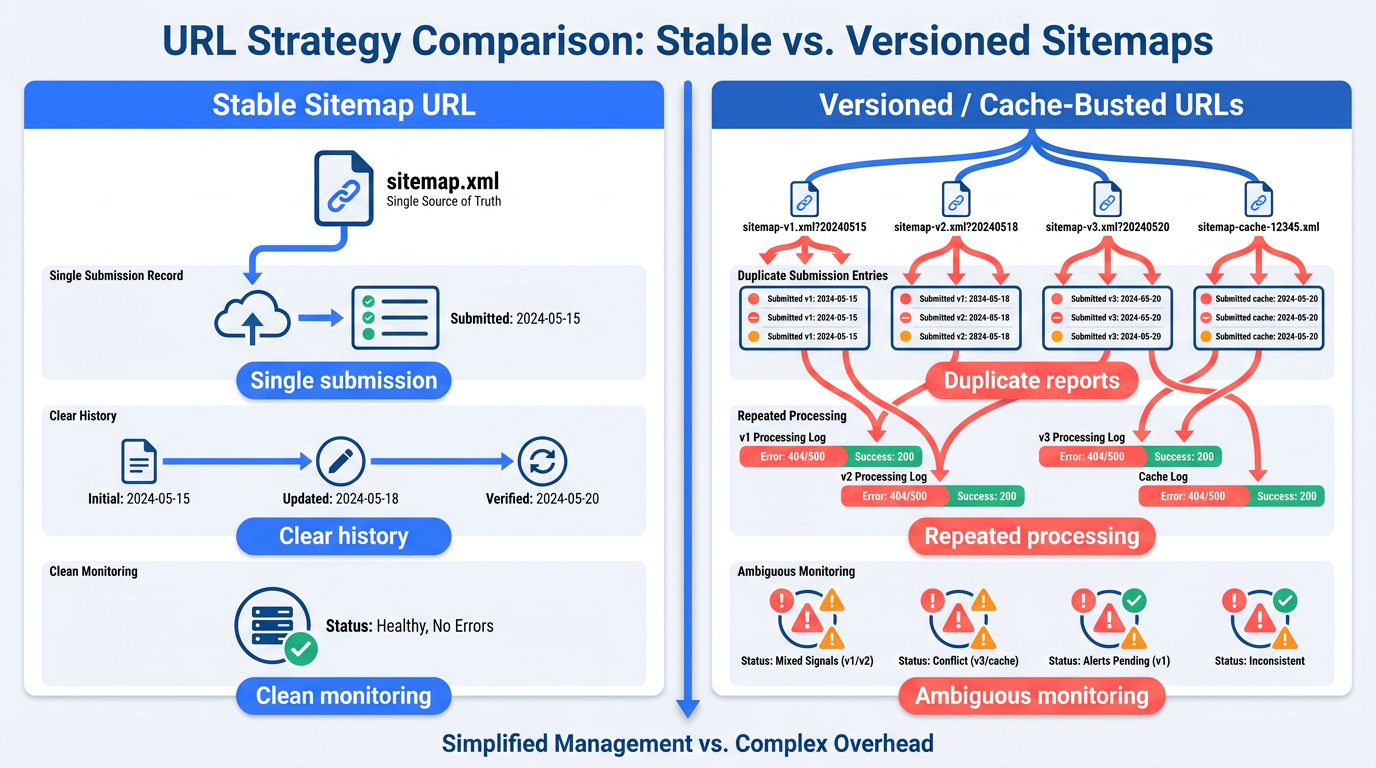
The strongest John Mueller sitemap advice is narrower than most retellings suggest. Mueller objected because changing URL parameters implies that the stable URL identifying the sitemap resource keeps changing, which is bad for search engines and tracking. He did not announce a sitemap-specific ranking penalty, say that page URLs would be deindexed, or describe a formal trust score tied to sitemap filenames.
The operational damage is still real. Search Console can accumulate separate sitemap submissions, monitoring systems can split success and error histories, and teams can mistake a fetched XML file for recrawled content. The result is multiple sitemap addresses representing substantially the same inventory, adding unnecessary complexity without increasing crawl priority.
Does it undermine URL and lastmod stability?
Yes, at the resource-management level. The W3C essay Cool URIs don't change explains the underlying reliability principle: persistent resources should retain persistent identifiers. Stable URLs SEO practice applies to pages and foundational discovery files alike, supporting durable resource identifiers, reliable references, and comparable logs.
Changing a sitemap address does not automatically make Google distrust every <lastmod> value inside it. Google's documented position is specific: it uses <lastmod> when that value is consistently and verifiably accurate. Invented daily dates are the direct problem. The parameter hack layers instability around a signal that already depends on honest maintenance.
Common misconceptions:
- New sitemap URL means new content crawl: Google schedules listed URLs separately.
- More sitemap submissions increase priority: Google describes sitemaps as hints, not guarantees.
- Daily lastmod values create freshness: Dates should represent significant page changes, not generation time.
What should you use instead of a crawl frequency sitemap hack?
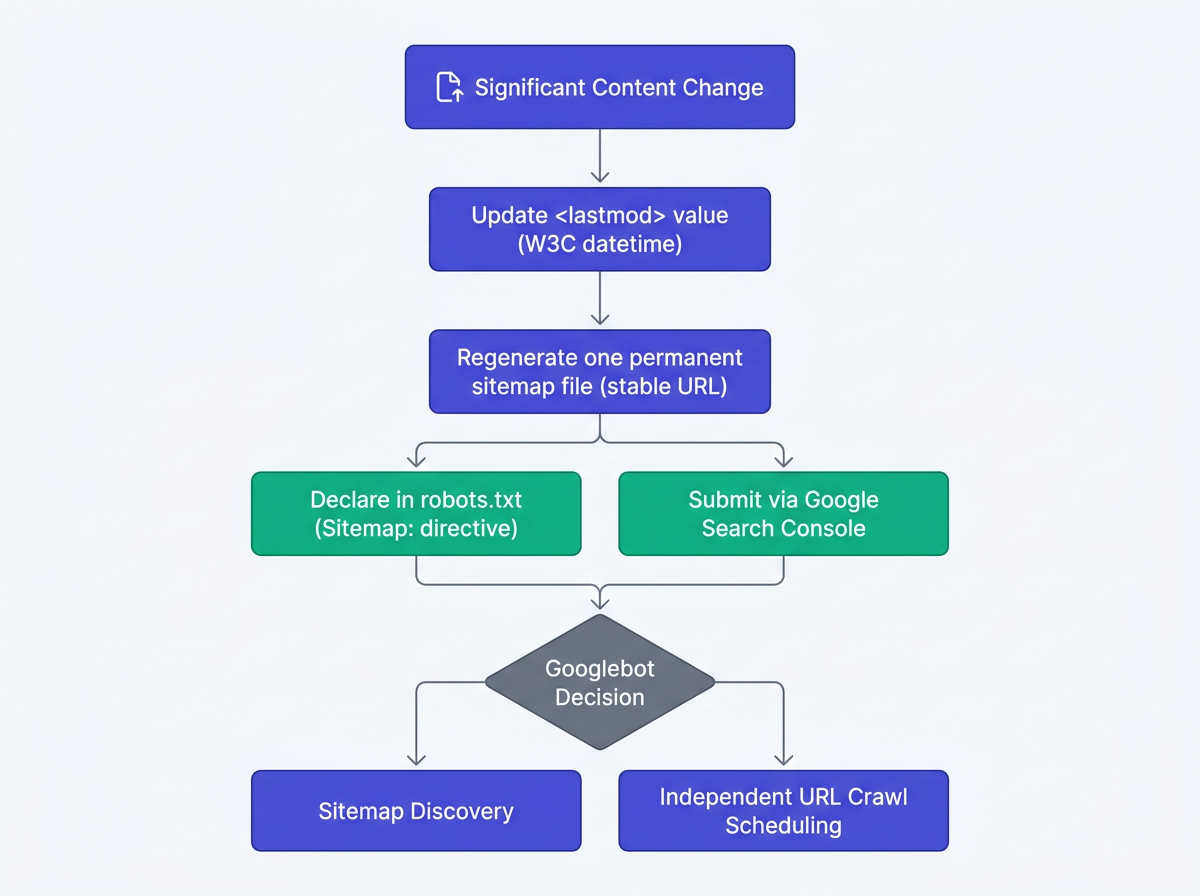
<lastmod> values replace unreliable cache-busting workarounds.Keep both the sitemap location and canonical content URLs permanent, then use the protocol fields and submission channels Google actually supports. Vizup's sitemap best practices provide a broader implementation checklist for large sites.
| Method | How it works | Impact on Google |
|---|---|---|
| Sitemap cache busting | Appends a changing query parameter | Not recommended: creates unstable, duplicate sitemap addresses |
Using <lastmod> | Records the last significant modification | Positive when consistently accurate and verifiable |
| Pinging Google | Calls the former unauthenticated ping endpoint | Obsolete: Google deprecated it and the endpoint returns 404 |
| Search Console or robots.txt | Submits or declares one stable sitemap URL | Supported discovery method, without a crawl guarantee |
| Google deprecated its sitemap ping endpoint in 2023, so pinging is no longer an approved notification method. |
How should the lastmod element in a sitemap work?
Update a page's <lastmod> only after a significant content change, using W3C datetime format. Do not refresh every date because a deployment rebuilt the XML. Google's sitemap documentation states it uses the value when it is consistently and verifiably accurate.
For sitemap index child URLs, each index entry's <lastmod> should describe when that child sitemap changed, not automatically the newest page date inside the child file. Accurate child-level dates let Google identify changed sitemap partitions without downloading every partition. Teams can check an XML sitemap for errors before submission.
How do you notify Google now that sitemap pinging is deprecated?
Submit the stable sitemap through Google Search Console and reference it with a Sitemap: line in robots.txt. Google removed the unauthenticated https://www.google.com/ping?sitemap=... mechanism, so presenting it as an official sitemap recrawl trigger is outdated. Resubmission confirms availability but does not guarantee immediate crawling or indexing.
When recrawling remains slow, separate discovery from quality diagnosis. Confirm successful sitemap fetches, indexable 200-status canonical URLs, internal links, server capacity, and meaningful content changes. A sitemap checker tool can surface XML and response problems, while persistent [Crawled, currently not indexed](https://www.tryvizup.com/blog/fix-crawled-currently-not-indexed-a-gsc-quality-warning) patterns usually require page-level analysis rather than another sitemap trick.
This is also where Vizup's Organic Autopilot approach becomes useful. Rather than treating a sitemap submission as an isolated SEO task, Vizup helps brands monitor technical discovery signals, identify crawl and indexing issues, create and optimise content, publish improvements, and learn from performance across Search, Social, Communities, AI Answer Engines, and Local Discovery. AI agents, human experts, and live SEO, pSEO, AEO, and GEO tools work together in the same workflow, with paid amplification available when needed.
What are the key takeaways?
- Keep one permanent sitemap URL instead of generating parameterized versions.
- Treat
<lastmod>as factual change metadata, not a force-crawl switch. - Use Search Console and
robots.txt; the old Google ping endpoint is deprecated. - Do not infer page crawling or indexing from a successful sitemap fetch.
- Audit sitemap automation and URL governance so these mistakes do not become part of your normal publishing workflow.
Sitemap cache busting is an anti-pattern, not a shortcut to crawl demand. Sustained crawl frequency comes from accessible architecture, reliable servers, meaningful updates, strong internal discovery, and stable identifiers. Retire the crawl frequency sitemap hack, preserve sitemap URL stability, and measure what Googlebot actually requests instead of manufacturing new sitemap addresses.
Frequently Asked Questions
Is it ever acceptable to use a cache busting sitemap URL parameter?
Not for the public sitemap address submitted to search engines. If you need to purge an internal cache or CDN object, do that server-side, but keep the external sitemap URL unchanged.
How often should I update my sitemap's lastmod element?
Update a URL's <lastmod> after its primary content changes significantly. Do not alter it for routine XML regeneration, unrelated template changes, or every daily build.
Will pinging Google guarantee a faster crawl of new pages?
No. Google's unauthenticated sitemap ping endpoint is deprecated and returns 404. Search Console submission and robots.txt declaration aid discovery but never guarantee crawl timing.
My sitemap lives in a subfolder, such as /sitemaps/sitemap.xml. Is that a stability problem?
No. A permanent subfolder URL is stable. Verify sitemap scope, use absolute canonical URLs, and keep the location consistently accessible to Googlebot.
What is the difference between a sitemap URL and the URLs inside the sitemap?
The sitemap URL identifies the XML discovery file itself. The entries inside it identify pages, images, videos, or other supported resources. Googlebot fetching the file does not mean it fetched or indexed every entry listed within it.
