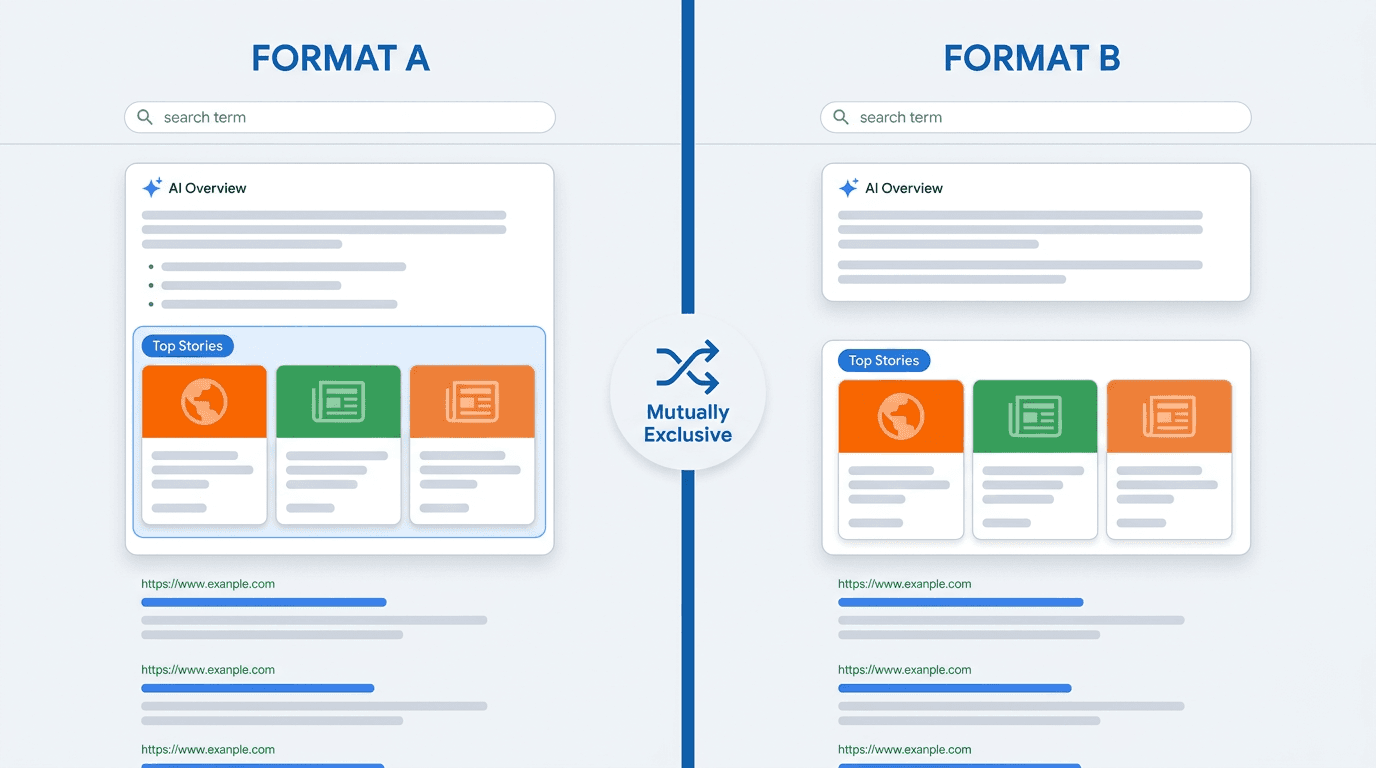
Google Search Console's Search generative AI control, currently available to a subset of website owners, looks like a clean lever: keep your work out of generative AI features. The catch is a cost Google hasn't spelled out. If Top Stories is being served inside an AI Overview, opting out can mean you stop being eligible for that carousel placement altogether. New tracking from NewzDash suggests this isn't some weird corner case: embedded Top Stories appeared in 15.5% of tracked US results and 17.46% of tracked UK results where Google displayed Top Stories. For publishers weighing the ai overviews opt out top stories trade-off, this has moved from theoretical to operational.
If you already know the mechanics of the toggle, start here. This piece is about the downside: what the switch can quietly take off the table for news visibility, and how to decide if that trade is worth making.
The New SERP: Where Top Stories Now Lives
Google is rearranging where news shows up on the results page. Instead of treating Top Stories as a separate module sitting below or beside an AI Overview, it is increasingly folding the carousel into the AI Overview itself. The practical effect is a fused experience: the AI summary carries publisher cards inside the feature, not in a distinct block users encounter separately as they scroll.
That layout change collapses what used to be two different jobs: traditional news SEO and the newer work of getting surfaced in answer-style experiences. If you are optimizing for Top Stories, you are now often optimizing for a slot inside an AI Overview. These surfaces are no longer independent. That is why the generative AI control publishers got in Search Console matters so much: the toggle governs the very container that now sometimes contains the carousel.
What the NewzDash Top Stories Data Shows
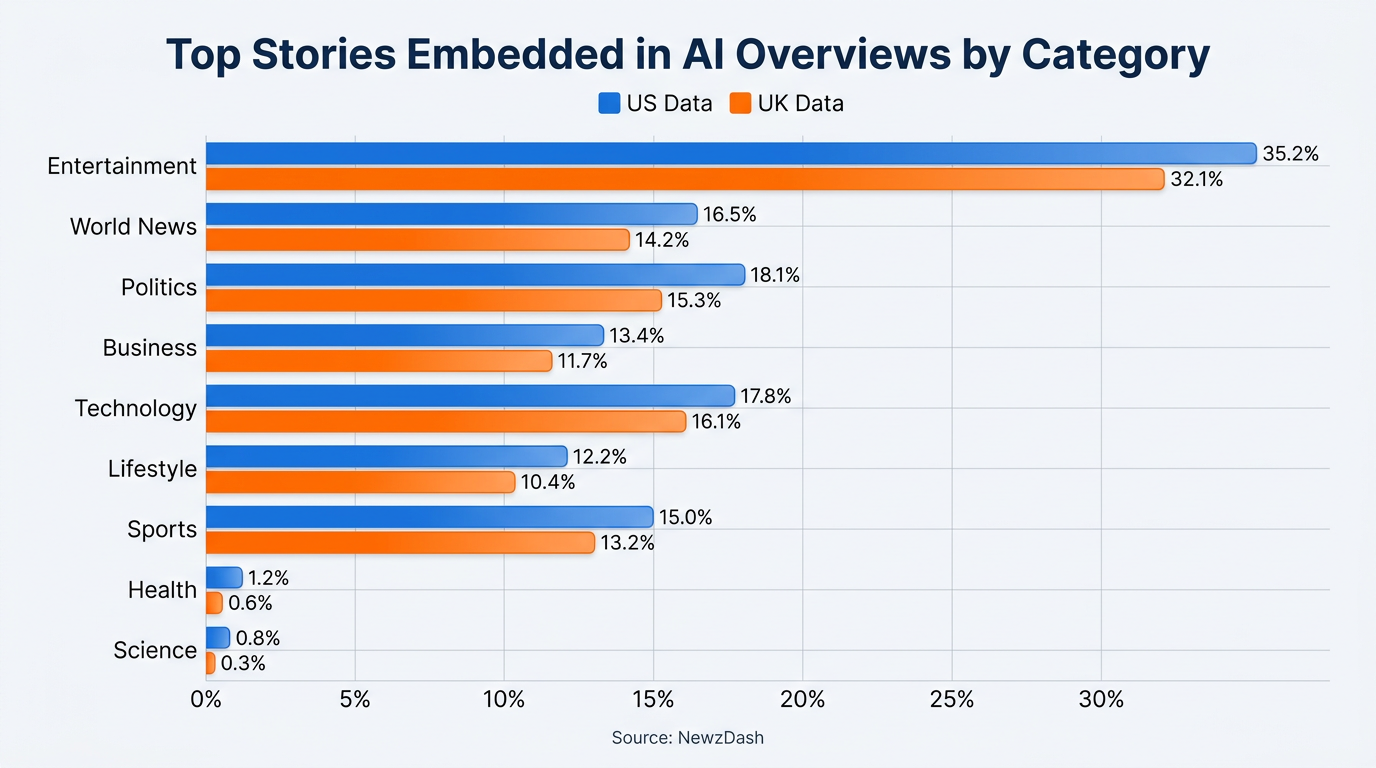
NewzDash tracking, reported in late July 2026 by Search Engine Journal, found that when a Top Stories carousel appeared for a news query, 15.5% of the time in the US and 17.46% of the time in the UK it was embedded inside the AI Overview. Entertainment led in both markets, with embedded placement above 30% of relevant queries. Health and Science were close to zero.
Note: NewzDash did not publish sample sizes or collection dates for these percentages. Treat the numbers as directional until the methodology is clearer; the signal is the shift in placement, not the precision of the decimals.
The detail that matters most in the newzdash top stories data is the either/or behavior. When Top Stories is inside the AI Overview, Google does not also show a standalone Top Stories carousel on that same SERP. Publishers do not get two bites at the apple. And if you are not eligible for the embedded version, there is no promise Google will compensate by showing the standalone module instead.
The Critical Inference: Why Opting Out Likely Costs You the Embedded Slot
Google's help page says that if a site opts out, its links and content will not appear in covered AI features. The Search Console control, which started being taken into account on 17 June 2026, includes AI Overviews. When Top Stories is embedded inside an AI Overview, it is literally a set of publisher links living inside a covered feature.
NewzDash founder John Shehata interprets that to mean an opt-out publisher would disappear from embedded Top Stories placements. He is careful about the claim: he calls it a high-confidence inference, not a proven outcome, and NewzDash plans to test it. Google has not confirmed or denied the consequence. Still, the reasoning is hard to escape: if the container is an AI Overview and your site is excluded from AI Overviews, your links cannot show up inside that container. That is the publisher opt out risk the documentation simply does not address.
The UK's Competition and Markets Authority has ordered Google to offer publishers an opt-out from AI features without that choice affecting ranking in traditional search results. That protection is about organic ranking. It does not answer the more slippery question here: when Top Stories is embedded inside an AI Overview, does that count as "traditional" or "AI" for the toggle's purposes? The uncertainty is the point.
A Decision Framework for Publishers
There is no universal right move. Your answer depends on how much your traffic relies on Top Stories, what your editorial stance is on reuse in AI features, and how much ambiguity you are willing to live with. The mistake is treating the toggle like a moral gesture instead of a distribution decision.
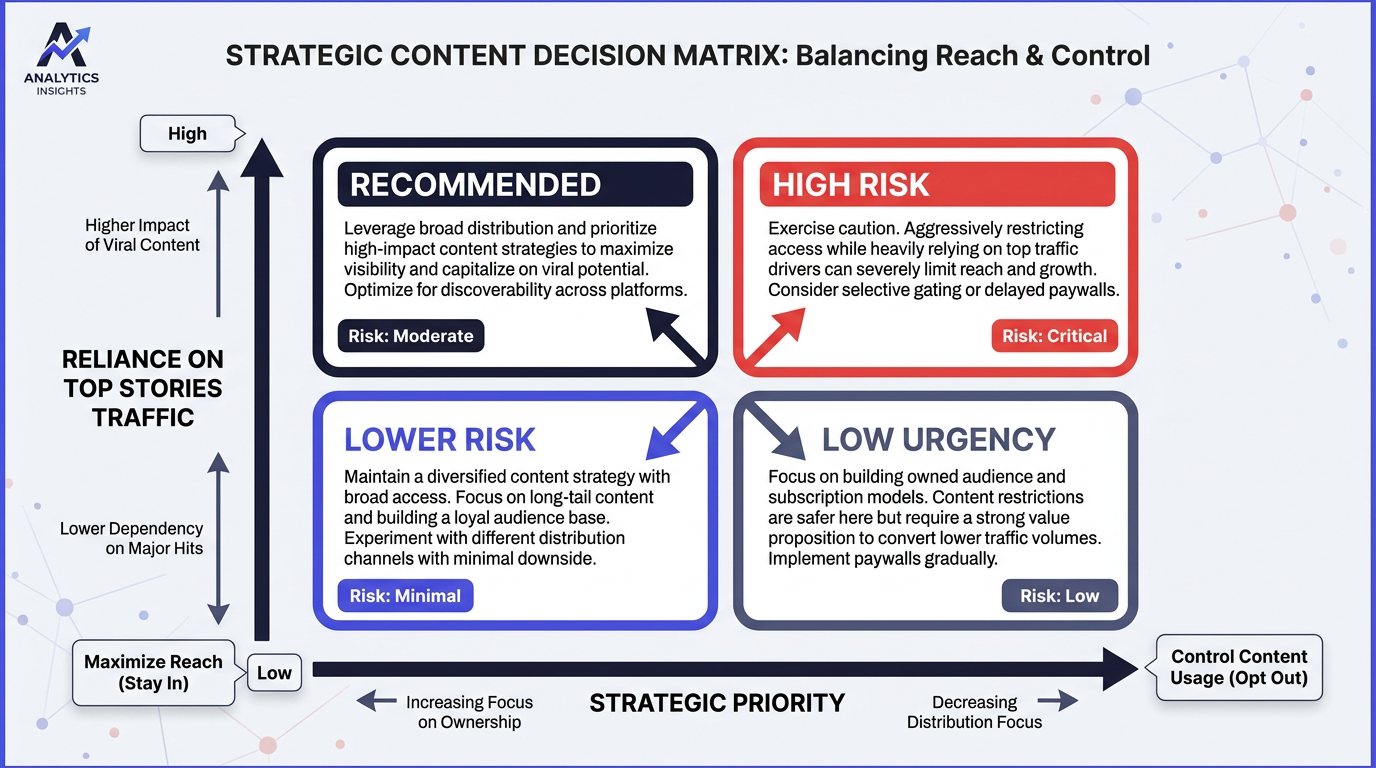
| Publisher Profile | Priority: Maximize Reach (Stay In) | Priority: Control Content Usage (Opt Out) |
|---|---|---|
| High reliance on Top Stories traffic | Recommended. Keeps you eligible for embedded and standalone carousels. Watch category-level embedding rates closely, especially if you publish entertainment. | High risk. You could lose eligibility for embedded placements that appeared in 15.5% of tracked US results and 17.46% of tracked UK results where Top Stories was displayed. The resulting traffic impact is not yet known. Only take this if content control is a non-negotiable editorial priority. |
| Low reliance on Top Stories traffic | Low urgency either way. Staying in keeps the option open with little downside. Decide whether becoming a preferred source matters more to your strategy. | Lower risk. Losing the embedded carousel is less likely to move your totals. Opting out better matches content control goals without a major visibility hit. |
| Percentages are directional based on NewzDash data (2026). Individual publisher impact will vary by category and geography. |
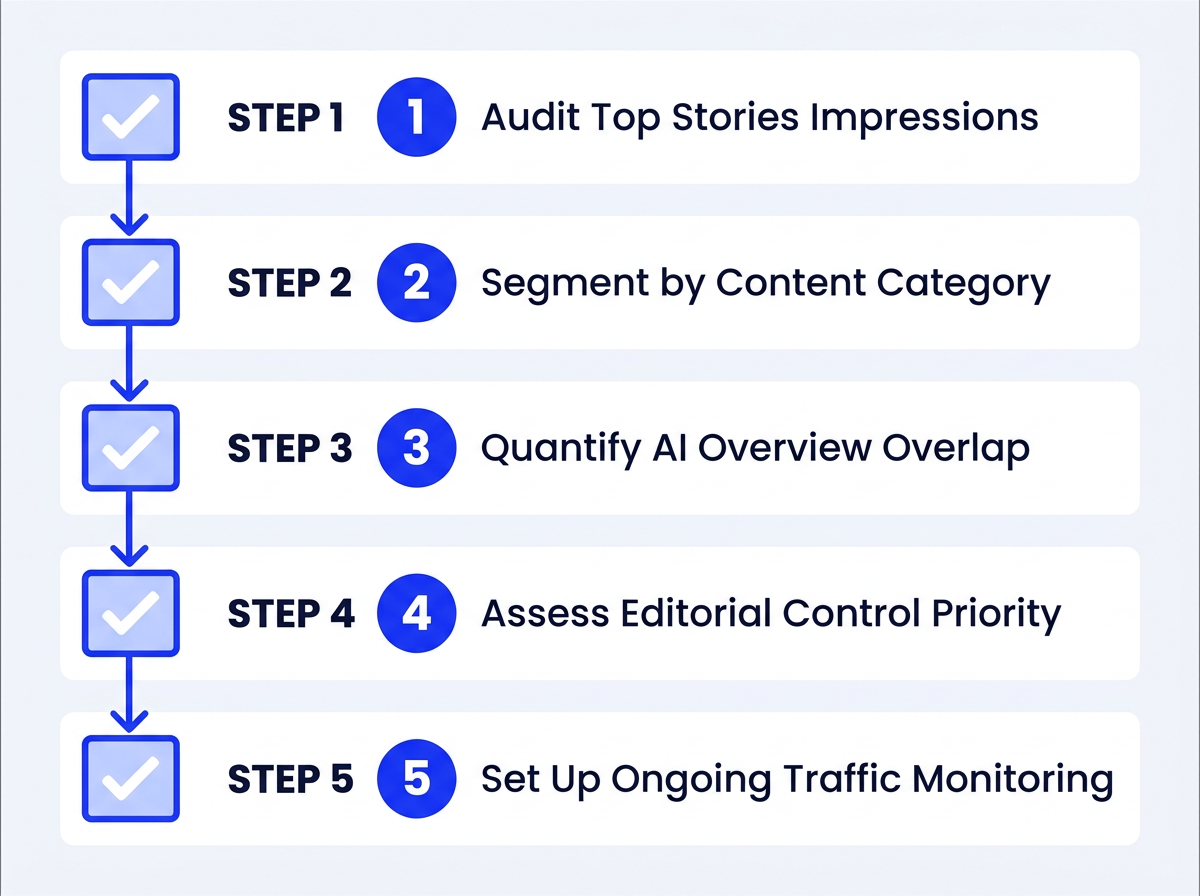
Before you touch the toggle, do three things. First, review your Search performance data, news referral traffic, and dedicated generative AI impressions report to establish a practical visibility baseline. Search Console does not currently provide a clean click-level comparison between embedded and standalone Top Stories placements. Second, break that view down by category. If you lean entertainment-heavy, the embedded placement rate is roughly double the overall average, which raises the price of opting out. Third, account for the measurement hit: opting out means you stop generating AI search impressions for covered features, cutting off a signal you would otherwise use to track the trade over time.
This decision also shows why publishers need more than a single-platform report. Vizup's Organic Autopilot for modern discovery helps brands monitor, create, optimise, publish, and learn across Search, Social, Communities, AI Answer Engines, and Local Discovery. It combines AI agents, human experts, and live SEO, pSEO, AEO, and GEO tools so publishers can connect visibility changes with practical action. Paid ads are available as an optional amplification add-on.
It also helps to understand how Google is wiring publisher links into AI surfaces and how Google handles publisher links across features. The opt-out is not a standalone preference setting; it sits inside a larger set of visibility mechanics Google keeps reshaping.
Common Misconceptions About the AI Opt-Out and News SEO
"Opting out only affects AI-generated text, not traditional features like Top Stories." That was a defensible assumption before Google started nesting the carousel inside AI Overviews. Once Top Stories can live inside the AI feature, the neat line between "AI" and "traditional" stops holding. The toggle controls the container, and the carousel is in that container.
"If I lose the embedded carousel, Google will just show me in the standalone one instead." The NewzDash data argues against that comfort story. Embedded and standalone Top Stories are mutually exclusive on a given SERP. Google picks one layout. Falling out of the embedded version does not automatically create a fallback to the standalone module for the same query.
"Google has confirmed what happens to Top Stories when you opt out." It hasn't. The help page describes the opt-out at a high level. The embedded Top Stories consequence is inferred: well-reasoned, consistent with how the feature is built, and widely discussed among news SEO practitioners, but still not documented. Publishers are left making a distribution call based on logic and observed patterns, not a guarantee.
Key Takeaways: Your AI Opt-Out Checklist
- The AI Overviews opt-out carries a plausible, unconfirmed risk to Top Stories visibility when the carousel is embedded inside an AI Overview.
- NewzDash data (2026) puts embedded placement at 15.5% of US and 17.46% of UK news-related Top Stories appearances, with entertainment above 30%.
- Based on expert inference (not Google confirmation), opting out of AI Overviews likely removes your publication from embedded Top Stories placements.
- Embedded and standalone carousels do not show together. Losing the embedded slot does not guarantee a standalone fallback on the same SERP.
- Before flipping the toggle, audit Top Stories traffic by category, quantify your reliance, and plan for the loss of AI impression data as an ongoing measurement input.
- Keep a close eye on news SERP traffic shifts either way. Track your visibility across AI surfaces as Google continues to restructure these features.
Frequently Asked Questions
What happens if I opt out of AI Overviews?
The Search Console control tells Google not to show your site's links and content in AI Overviews and other covered generative AI features. Google began taking the setting into account on 17 June 2026. In the UK, CMA requirements say your organic rankings in traditional results should not be affected. The open question is feature design: opting out likely also makes you ineligible for Top Stories carousels when they are embedded inside AI Overviews.
Will I lose all my Top Stories traffic if I opt out?
No. The risk is specific to the embedded placement (Top Stories inside AI Overviews), not standalone Top Stories modules that appear separately on the SERP. NewzDash data suggests embedded placement represents roughly 15-17% of news searches where Top Stories appears. Your real impact depends on category mix and geography.
Has Google confirmed that opting out removes you from embedded Top Stories?
No. Google has not confirmed or denied this specific outcome. The help page says opted-out sites will not appear in covered features, and AI Overviews are covered. Industry experts, including NewzDash founder John Shehata, read that as implying embedded Top Stories placements would be lost, but he frames it as a high-confidence inference rather than a proven result. NewzDash plans to test it directly.
How can I track my visibility in Top Stories and AI Overviews?
For eligible properties, Search Console's generative AI performance report shows AI Overview and AI Mode impressions by page, country, device, and date, but it does not provide clicks or queries. Third-party monitoring remains useful for query-level visibility, citations, and comparisons across answer engines. Tools like Vizup's Organic Autopilot for modern discovery can track how your content shows up across AI-driven search features.
Is there a way to opt out of AI Overviews but stay in the Top Stories carousel?
Not today. The Search Console toggle is a single setting that applies broadly to AI Overviews, without a more granular option that excludes AI summaries while preserving eligibility for features embedded within them. That is the tension publishers are dealing with: the control is broad at the selected Search Console property level while the surfaces it governs are increasingly entangled.
