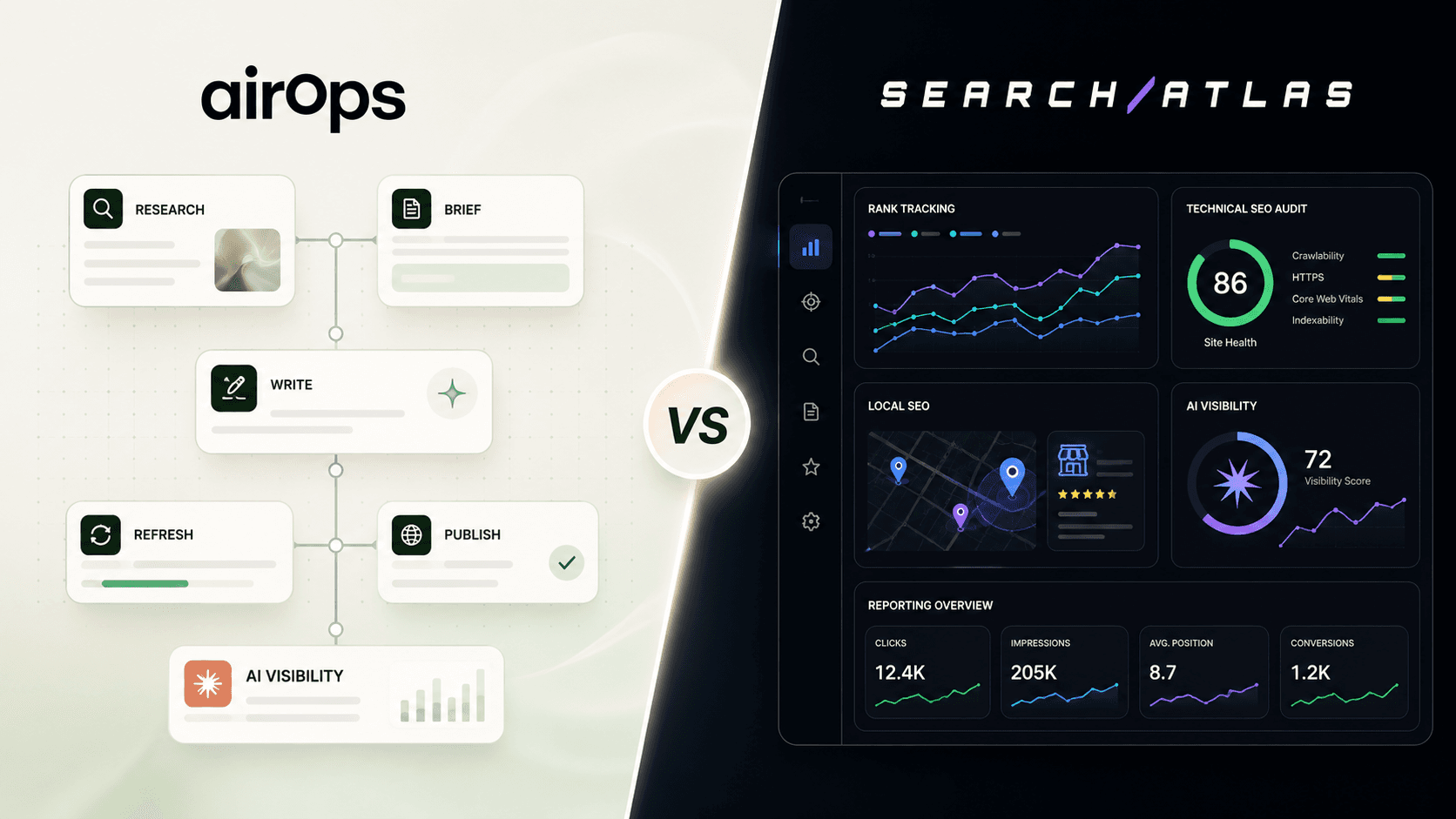
If you're trying to understand what AI is doing to search, two products tend to pop up fast: AirOps and Search Atlas. They both pitch AI-assisted SEO, but they serve different buyers and solve different headaches. After reviewing both platforms, the clearer pattern is this: AirOps is better suited to content and AEO workflow execution, while Search Atlas is stronger for teams that need a broader SEO operating system. This isn't a spec-sheet shootout. It's a practical comparison for SEO teams, content ops, agencies, and growth leaders who want their AI spend to map to real outcomes.
The important thing to understand is that AirOps and Search Atlas are not exact replacements for each other. AirOps is closer to a content operations and AEO execution platform. Search Atlas is closer to an all-in-one SEO and agency operating system. That difference matters more than the feature checklist.
For teams evaluating AI SEO platforms, the real question is no longer just "which tool writes content?" It is "which platform helps us create, publish, monitor, and improve content across both Google Search and AI answer engines?" That is where Vizup fits into the conversation. Vizup helps growth and SEO teams build scalable search-led content, automate publishing workflows, monitor indexation, track AI visibility across platforms like ChatGPT, Perplexity, Google AI Overviews, and other answer engines, and turn those signals into practical optimization actions. If you're still getting oriented on the category, start with what is an AI search monitoring platform to see how teams are measuring visibility beyond classic rankings. With that lens, this comparison of AirOps and Search Atlas becomes easier to understand: both tools support parts of the AI SEO workflow, but they solve different problems.
How we compared AirOps and Search Atlas
We compared both platforms across the areas that matter most for SEO and growth teams: AI visibility, content workflows, CMS publishing, rank tracking, technical SEO, local SEO, agency reporting, pricing structure, and ideal use cases. The goal is not to declare one universal winner, but to show which platform fits which workflow.
By the end, you should have a clear sense of which platform fits your team's size, workflow, and goals.
Quick Verdict: AirOps vs Search Atlas
Here is the practical verdict before the detailed comparison.
- Choose AirOps if your main goal is to build, scale, and automate AI-powered SEO content workflows. It stands out for content refresh programs, moving from briefs to CMS publishing, and turning AI visibility signals into work your team can actually ship.
- Choose Search Atlas if your main goal is to manage broader SEO operations within an all-in-one platform. It shines on rank tracking, technical SEO, local SEO, and agency staples like white-label client reporting.
What Is AirOps?
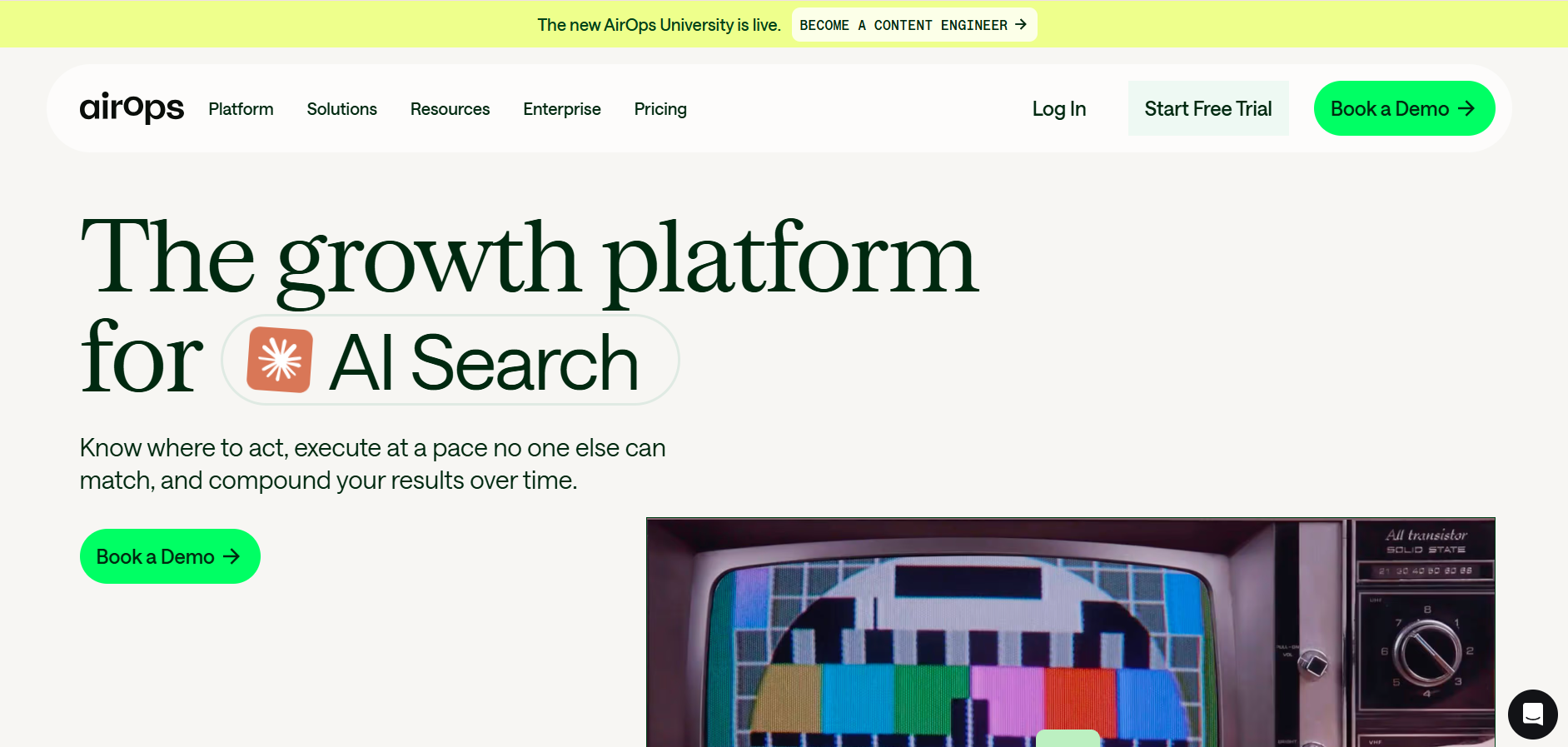
AirOps positions itself as a content engineering platform for scaling SEO.
AirOps is an AI-powered SEO and content workflow platform. It's not trying to be a generic "AI writer"; it's closer to a control layer for how content gets planned, produced, reviewed, optimized, and pushed into a CMS. The pitch is repeatability: build systems that take you from research and briefs through creation and optimization, then publish to WordPress, Webflow, or whatever you run. It's a better fit for teams running large content operations, B2B SaaS brands, marketplaces, and programmatic SEO teams that care about improving brand visibility in AI search.
Its core capabilities lean toward structured, scalable production:
- AI content workflows
- Content refresh and optimization
- Brand-safe content operations with human review
- CMS publishing workflows (WordPress, Webflow, etc.)
- AI search visibility and AEO tools
- Content production automation
What Is Search Atlas?
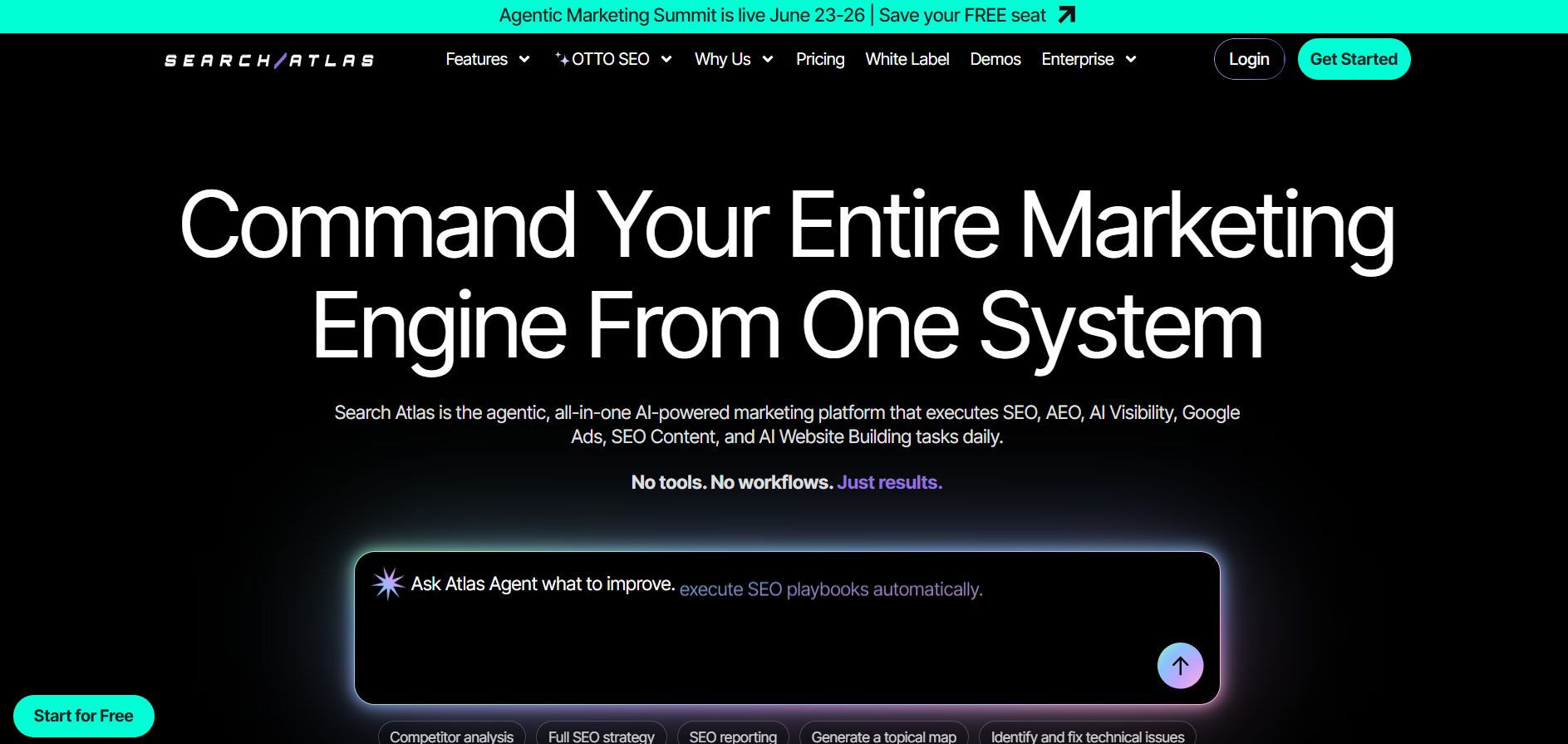
Search Atlas is positioned as an all-in-one AI marketing platform for agencies and brands.
Search Atlas positions itself as a consolidated SEO and AEO platform for teams that want rank tracking, audits, content optimization, local SEO, and reporting in one place. It bundles a lot of the usual SEO stack into one subscription, with the goal of replacing separate services for rank tracking, site audits, and content optimization. That makes it a strong option for agencies, local SEO teams, and anyone who needs execution, monitoring, and reporting under one roof.
Its core capabilities span the familiar SEO checklist:
- Rank tracking
- Site audits
- Content optimization
- Backlink and authority tools
- Local SEO tools
- White-label reporting and agency workflows
AirOps vs Search Atlas: Feature-by-Feature Comparison
1. AI SEO and Content Workflow Automation
The split between these two shows up fastest here. AirOps is, first and foremost, workflow automation for content teams. It focuses on repeatable, multi-step production: templates, approvals, handoffs, and publishing that doesn't require someone to babysit the process. If your real problem is turning a backlog of ideas into live pages, reliably, and at volume, AirOps is built for that job.
Search Atlas does include AI content features, but they're framed as part of a broader SEO suite. It's handy when you want to optimize a page while you're already looking at rankings and audits, but it doesn't offer the same depth of workflow customization that AirOps is selling.
Verdict: AirOps wins on content workflow automation. Search Atlas makes more sense if you want AI content tools bundled into a wider SEO toolkit.
2. AI Visibility and AEO Capabilities
Both platforms now position around AI search visibility, but they approach it differently. AirOps focuses on turning AI visibility gaps into content workflows, while Search Atlas includes LLM visibility inside a broader SEO platform. AirOps' edge is what it does with that information: it routes AI visibility insights straight into production. If you're missing citations, you can move from "we have a gap" to "kick off a refresh" without leaving the system. For teams that measure success by what ships, that connection matters.
Search Atlas tracks AI visibility too, but it lives as another signal inside the broader monitoring dashboard. The data is there; the product is simply less oriented around building a repeatable content response.
Verdict: AirOps is stronger for content-led AEO execution. Search Atlas is a good fit if you want AI visibility tracked alongside the rest of your SEO telemetry.
3. Keyword Research, Rank Tracking, and SEO Monitoring
This round goes to Search Atlas. It's designed as an all-in-one SEO suite, and rank tracking, keyword monitoring, technical audits, and competitive tracking are central to the product. The goal is familiar: cover most of what you'd expect from Semrush or Ahrefs in one place.
AirOps isn't trying to replace classic SEO monitoring. It leans into execution and plugs into tools like Semrush for keyword data instead of rebuilding that layer itself.
Verdict: Search Atlas is the clear pick if you need monitoring, keyword tracking, and reporting in a single platform.
4. Content Creation and Refresh
AirOps is built around production. The platform is designed for structured content operations: generating briefs, refreshing large libraries of existing pages, and scaling new SEO content without losing brand voice along the way. If your bottleneck is getting content produced and published, not brainstorming it, AirOps is aimed directly at that constraint.
Search Atlas offers a content editor and AI writer, but the emphasis is more "improve this page" than "run a content factory." It's better suited to single-document optimization than managing a high-throughput system.
Verdict: AirOps is the better choice when content production, refresh, and publishing are the main problems to solve.
5. Technical SEO and Site Audits
Search Atlas takes this one. It includes a site auditor that crawls for technical issues like broken links, redirect chains, and other on-page errors, the kind of work that sits at the heart of an "all-in-one" SEO promise.
AirOps doesn't position itself as a technical SEO suite, and it doesn't ship those auditing features natively.
Verdict: Search Atlas is the better fit for technical SEO and site audit workflows.
6. Local SEO and Agency Use Cases
Search Atlas is clearly built with agencies in mind. It has a serious local SEO toolkit for Google Business Profile management, local rank tracking with heatmaps, and automated client reporting. White-label dashboards and reports are the kind of thing agencies either need or end up duct-taping together elsewhere; here, they're part of the product.
AirOps reads more like software for in-house content and growth teams. It doesn't offer the multi-client management or local SEO capabilities agencies typically depend on.
Verdict: Search Atlas is the stronger choice for agencies, especially if local SEO and client reporting are core to your work.
7. Programmatic SEO and Scalable Page Creation
Both tools have a real argument here. AirOps is a strong match for building the workflows programmatic SEO needs, especially when you want guardrails: human review steps, controlled templates, and direct CMS publishing to keep quality from drifting.
Search Atlas is more useful once those pages are live. Its rank tracking and technical monitoring are better suited to keeping an eye on performance at scale after publishing.
Verdict: Call it a tie. AirOps is better for building the content workflow; Search Atlas is better for monitoring performance once the pages are out in the world.
8. Ease of Use and Learning Curve
This one depends on your role. If you're a content ops team with an established process, AirOps can click because it mirrors the way you already work, then automates the repetitive parts. The tradeoff, based on many reviews, is ramp time: building effective workflows can take weeks before it feels natural.
Search Atlas will feel more familiar to SEO pros and agencies used to all-in-one suites like Semrush. There's a lot in the interface, so it can feel wide, but the individual modules, rank tracking, audits, reporting, are straightforward once you know where to look.
Verdict: AirOps tends to fit dedicated content workflow teams. Search Atlas tends to be easier for agencies already fluent in traditional SEO suites.
9. Pricing and Value for Money
Always verify pricing with the vendor; it moves. The more useful comparison is what each platform replaces in your stack and your workflow, not just the monthly number on the invoice.
AirOps pricing should be verified directly with the vendor before purchase. Its pricing model includes task-based usage, and AirOps states that Solo users are charged for additional tasks if they exceed their monthly allotment.
Search Atlas publishes more visible tiered pricing, with plans starting at $99/month and scaling to Growth ($199/month), Pro ($399/month), and Agency ($999/month) tiers. The value is easiest to justify when it lets you cancel multiple tools, for example, separate subscriptions for rank tracking, audits, and local SEO software.
Verdict: AirOps pencils out when you're scaling content operations. Search Atlas delivers more value for agencies or SEO teams that want to consolidate tools. If you're evaluating a potential Search Atlas alternative or AirOps alternative, you can also compare other AI SEO platforms.
AirOps Pros and Cons
Pros
- Strong content workflow automation
- Excellent fit for in-house SEO content teams
- Powerful for content refresh and scalable publishing
- Connects AI visibility insights directly to content execution
- Better for teams with repeatable content processes
Cons
- Not a full traditional SEO suite
- Won't replace rank tracking, backlink, or local SEO tools
- Better suited to teams with an existing SEO/content strategy
- Steep learning curve for new users
These gaps become a problem when your team needs more than content workflow automation. AirOps can help you produce and refresh content, but it does not fully cover rank tracking, indexation monitoring, backlink visibility, local SEO, or post-publishing performance in one place.
That is where Vizup fits better for teams that want the complete SEO and AEO loop: create scalable, machine-readable content, publish it, monitor indexation, track visibility across Google and AI answer engines, and turn performance gaps into optimization actions. If you want a broader scan of the category before you commit, the roundup of AI SEO platforms is a solid place to sanity-check your shortlist.
Search Atlas Pros and Cons
Pros
- Broad all-in-one SEO platform
- Stronger feature set for agencies
- Includes rank tracking, audits, reporting, and local SEO
- Useful for white-label client reporting
- Can replace multiple SEO tools
Cons
- May be more tool-heavy than content teams need
- Content workflows are not as deep or customizable as AirOps
- Less focused on advanced content operations and AI publishing workflows
These limitations matter when your team wants more than a broad SEO dashboard. Search Atlas covers many SEO functions, but content teams may still struggle to move from insight to scalable creation, publishing, AI visibility tracking, and continuous optimization in one connected workflow.
That is where Vizup becomes a stronger fit: it helps teams create search-led content, automate CMS publishing, monitor indexation, track visibility across Google and AI answer engines, and convert those insights into clear optimization actions after publishing. If you're specifically trying to understand how AI visibility is tracked and operationalized, what is an AI search monitoring platform breaks down the moving parts without the fluff.
When Both Tools Might Be Too Much
Worth saying out loud: these are serious platforms built for teams with real process and real volume. If you're still in the "keep it simple" phase, either one can feel like overkill, especially if:
- You are a solo blogger or just starting out.
- You only need basic keyword research.
- You publish fewer than a few pages per month.
- You don't have a clear SEO strategy yet.
- You are not ready to build repeatable SEO workflows.
If that sounds like you, the bigger need might be foundational consulting (or just a simpler stack) rather than automation. If you're still shopping around, a roundup of AirOps alternatives may surface a better fit.
Final Verdict
AirOps and Search Atlas both live in the AI SEO universe, but they're aimed at different problems. AirOps is a strong pick for teams that want to operationalize content strategy, taking signals from an AI search monitoring platform and turning them into repeatable workflows that end in published work. Search Atlas is the better choice when you need an all-in-one suite for rank tracking, site audits, client reporting, and local SEO.
For teams that want to connect the full SEO and AEO workflow, Vizup can help beyond platform selection: from creating scalable search-led content and monitoring indexation to tracking visibility across Google, AI Overviews, ChatGPT, Perplexity, and other answer engines, then turning those insights into practical optimization actions.
Frequently Asked Questions
Is AirOps better than Search Atlas?
AirOps is the stronger option for AI SEO content workflows, big content refresh programs, and teams building repeatable publishing systems. Search Atlas is stronger for broader SEO management, like rank tracking, local SEO, and agency-style reporting.
Vizup sits in the middle when you care about what happens after you hit publish. It helps teams monitor indexation, track visibility in AI answer engines (including AI Overviews), and turn those findings into a clean list of pages to update next. That "publish, then measure what actually showed up" loop is usually where workflows break.
Is Search Atlas better than AirOps?
Search Atlas is the better pick if you want an all-in-one SEO platform that replaces a stack of tools. AirOps wins when the job is scaling content operations with AI-powered SEO workflows.
Vizup is a good fit when you don't want content creation, publishing, indexation checks, and AI visibility monitoring living in separate tabs. It's especially useful once you start measuring performance beyond classic rankings, because the question shifts from "did we rank" to "did we get cited or surfaced where people actually search now."
Which tool is better for agencies?
Search Atlas is usually the better fit for agencies. It covers the day-to-day agency basics like multi-client workflows, white-label reporting, local SEO tools, and a broader SEO feature set.
Vizup earns its keep when clients start asking questions that rank reports don't answer, like where they're showing up in AI search, which pages are getting pulled into AI answers, and what content gaps are costing them visibility. Agencies can roll that into the same client narrative without spinning up a separate, messy reporting process.
Which tool is better for content teams?
AirOps is usually the better fit for in-house content teams because it goes deeper on workflows, AI-assisted production, content refreshes, review steps, and repeatable publishing systems. It's built for output.
Vizup fits once the team needs tighter feedback after launch. That means monitoring indexation, tracking AI mentions, and turning post-publish performance into specific updates (not vague "optimize it" notes). If you've ever shipped 20 pages and then realized rankings didn't explain the traffic, you already know why this matters.
Can AirOps and Search Atlas be used together?
Yes. A team can run Search Atlas for monitoring, rank tracking, reporting, and audits, then use AirOps for workflow automation and publishing, where it tends to be stronger.
Vizup can sit between them as the "visibility reality check" layer. It connects what you publish to what actually shows up across Google, AI Overviews, ChatGPT, Perplexity, and other answer engines, then feeds that back into a practical next-actions list. That keeps the loop tight, instead of waiting a month to realize the wrong pages got surfaced.
