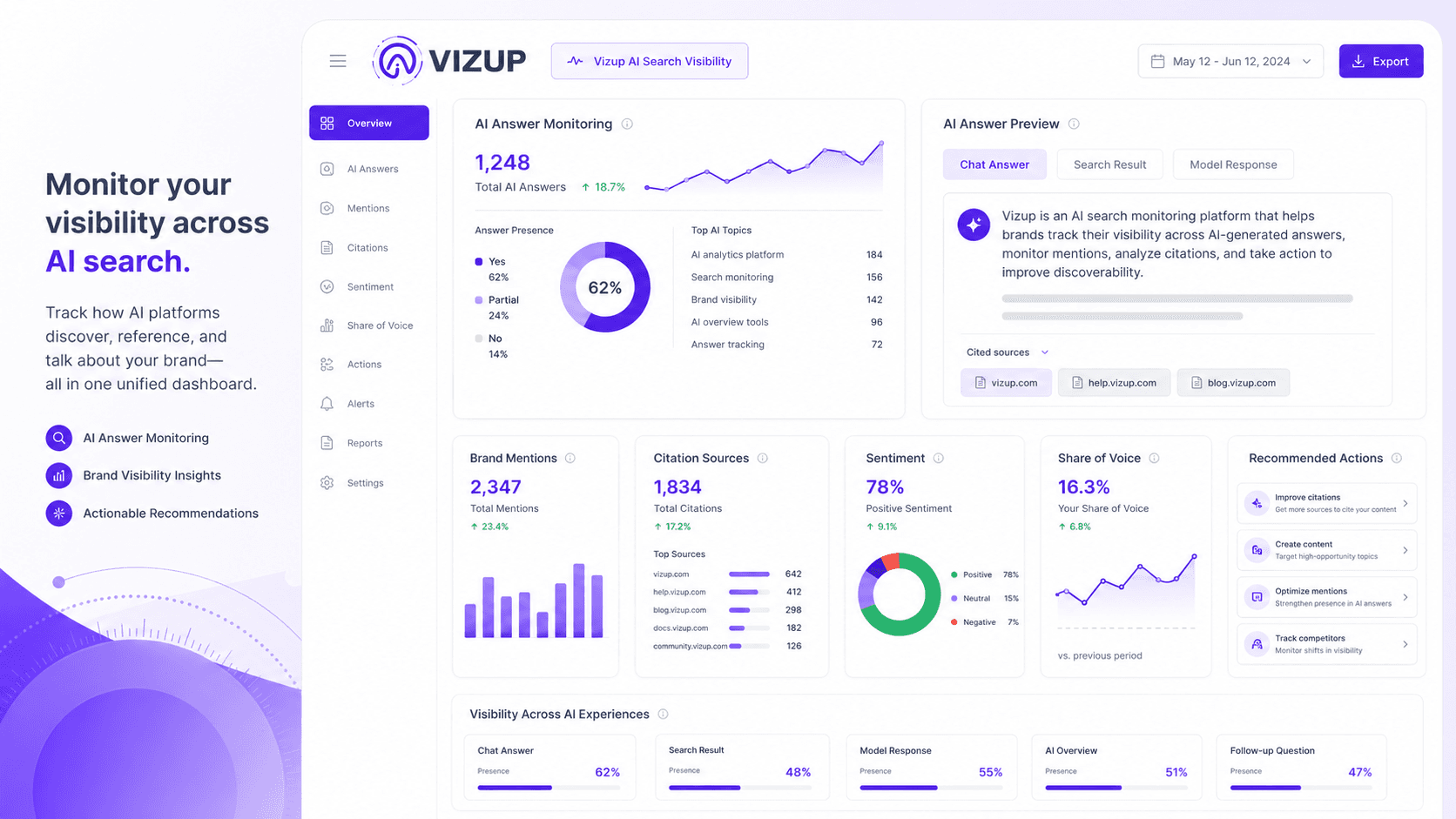
If you have been staring at organic traffic reports for the past year and feeling like they explain less and less, you are not imagining it. Gartner projects that traditional search engine volume will drop 25% by 2026 as people split queries between classic search and AI systems. The answers users get from ChatGPT, Google’s AI Overviews, and Perplexity may not send a click, but they still decide how your brand shows up in the story.
An ai search monitoring platform is a unified system that tracks how your brand appears inside AI-generated results, analyzes what those systems are doing, and points you toward the fixes that change outcomes. It covers mentions, citations, sentiment, and competitive positioning across multiple AI engines from one place. That is the tidy definition. The messier truth is that “platform” gets used loosely, and it is often mistaken for “tool.” That mix-up is not semantic; it changes what you can actually do with the data.
Why Does the Distinction Between 'Platform' and 'Tool' Actually Matter?
Forrester defines a platform as "a product that supports the creation and/or delivery of other products". A tool, meanwhile, is narrower by design: it does a specific job well. Merriam-Webster spells it out in software terms: a tool is "an element of a computer program that activates and controls a particular function."
In the real world, that difference shows up fast. A standalone AI search monitoring tool might tell you ChatGPT mentioned your competitor in 14 out of 20 responses for a target query last week. That is useful. Then comes the part the tool does not cover: you hop into something else to see which sources ChatGPT cited, open another tab to check whether your pages are structured for Answer Engine Optimization (AEO), and start pasting notes into a spreadsheet. Suddenly a quick check becomes an afternoon.
A platform is supposed to collapse that chain. Monitoring should flow into analysis; analysis should turn into recommendations; recommendations should tie back to the content and technical work that moves the needle. Marketing teams often end up with three or four separate AI search monitoring products and spend more time reconciling mismatched outputs than making changes that improve visibility.
What Does an AI Search Monitoring Platform Actually Track?
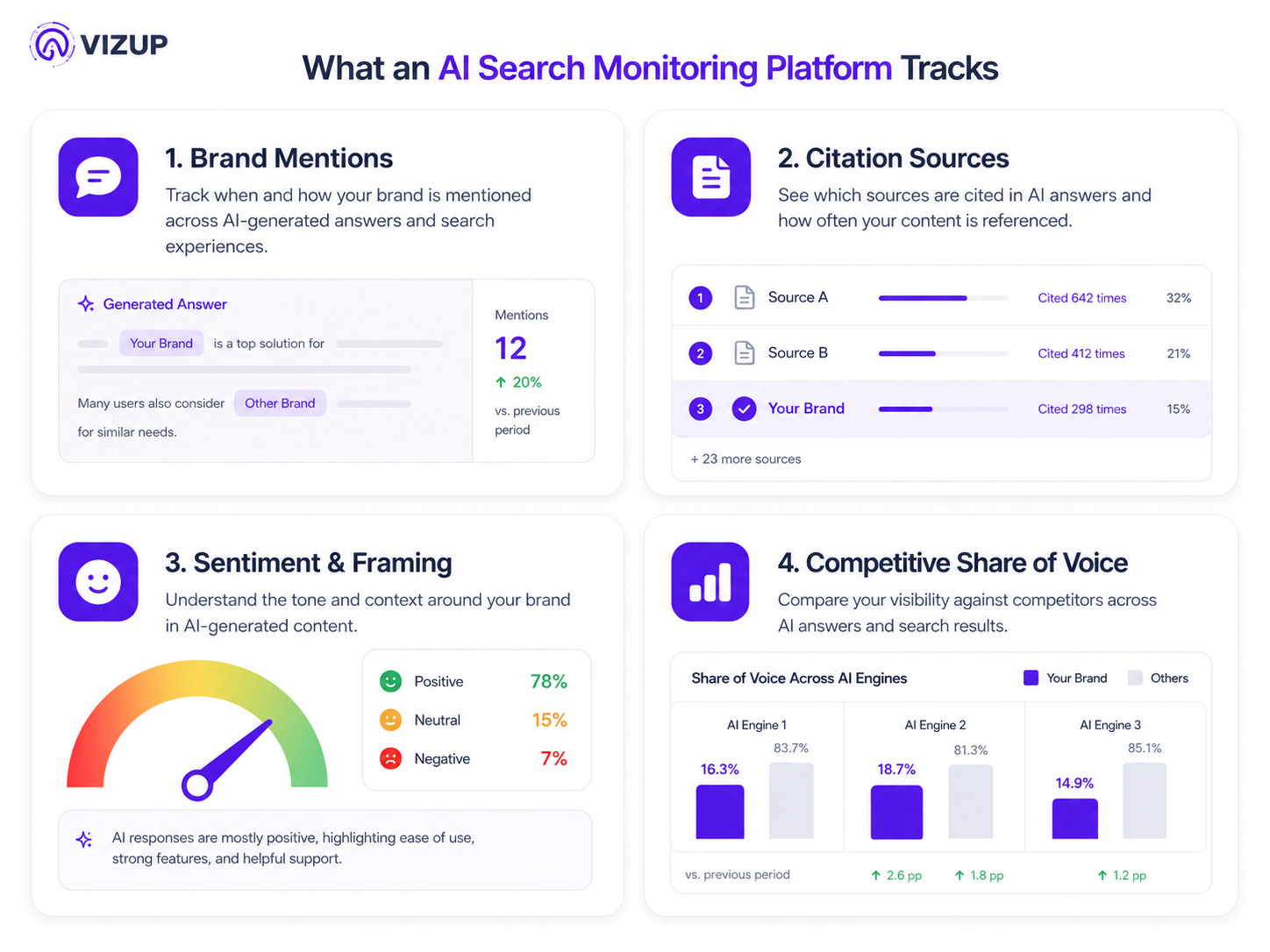
Most AI search monitoring tools start with the obvious: brand mentions, citation frequency, and sentiment inside AI-generated answers. That is table stakes. A platform builds on top of the raw counts with the context and connective tissue teams need to make decisions. The full stack usually includes:
Brand mention monitoring across multiple AI engines (ChatGPT, Google AI Overviews, Perplexity, Copilot) shows where you appear and, just as importantly, where you do not. As of early 2026, [AI Overviews show up in about 25% of Google search results](AI Overviews show up in about 25% of Google search results), meaning a quarter of the SERP experience is now partially or fully mediated by AI.
Citation source analysis is where many teams get caught flat-footed. When someone asks an AI engine about your category, the model leans on a set of sources to assemble an answer. It heavily favors third-party review platforms like G2, Capterra, and Trustpilot for brand-specific questions. If you are not tracking which sources get pulled in, you are guessing about where your off-site reputation management will matter most.
Sentiment and framing analysis answers a different question than “did we get mentioned?” It asks how you were characterized. An AI system can name your brand and still frame you as the budget option when you are trying to compete on quality. If you only count mentions, you miss that kind of positioning shift.
Competitive share of voice puts your visibility next to the competitors that matter, across the queries you care about, inside AI-generated responses. This is where monitoring stops being a novelty metric and starts turning into strategy.
How Is This Different from Traditional SEO Monitoring?
Traditional SEO tooling was built for a world of ten blue links. You watched keyword rankings, click-through rates, and backlink profiles. Those signals still count, but they miss what happens when an AI engine synthesizes an answer from multiple sources and the user never visits any site at all.
| Dimension | Traditional SEO Tool | AI Search Monitoring Platform |
|---|---|---|
| Primary metric | Keyword rank position | Brand mention frequency and sentiment in AI answers |
| Traffic signal | Clicks and impressions from SERPs | Referral traffic from AI platforms (about 1.08% of all web traffic per Conductor, 2025/2026) |
| Source tracking | Backlink profiles | Citation sources AI engines pull from |
| Competitive view | Rank comparison for keywords | Share of voice in AI-generated responses |
| Optimization target | Page-level SEO signals | Content structure for AEO and AI citation eligibility |
| Traditional SEO tools and AI search monitoring platforms solve fundamentally different problems. |
That referral traffic point is worth considering. The overwhelming majority of all AI-platform referral traffic comes from ChatGPT, making it the undisputed heavyweight in this new channel. If your search visibility tool only tracks Google’s traditional results, you are ignoring a parallel conversation happening inside the world's most popular chatbot.
What Should You Look for When Evaluating an AEO Platform?
This market is young, and plenty of products are essentially monitoring widgets dressed up as platforms. After evaluating several over the past year, the ones that actually behave like platforms tend to share a few consistent traits.
One: multi-engine coverage from a single interface. If you need separate logins to check ChatGPT versus Perplexity versus AI Overviews, you are looking at a bundle of tools, not a platform. Two: a direct line from monitoring to action. Knowing you are not getting cited is step one; understanding why (missing structured data, thin content, no presence on cited review sites) and getting guidance on what to change is what separates a platform from a dashboard.
Three, and this is the feature teams tend to wave away until it bites them: historical tracking. AI answers are volatile. A single snapshot is close to meaningless unless you can see how things moved over weeks and months. The brands doing this well watch how AI visibility shifts after specific content changes, and that only works if the system has been collecting data continuously.
Tip: If a vendor cannot show trend data going back at least 30 days in a demo, assume you are looking at periodic spot checks, not a real platform.
How Vizup Approaches AI Search Monitoring as a Platform
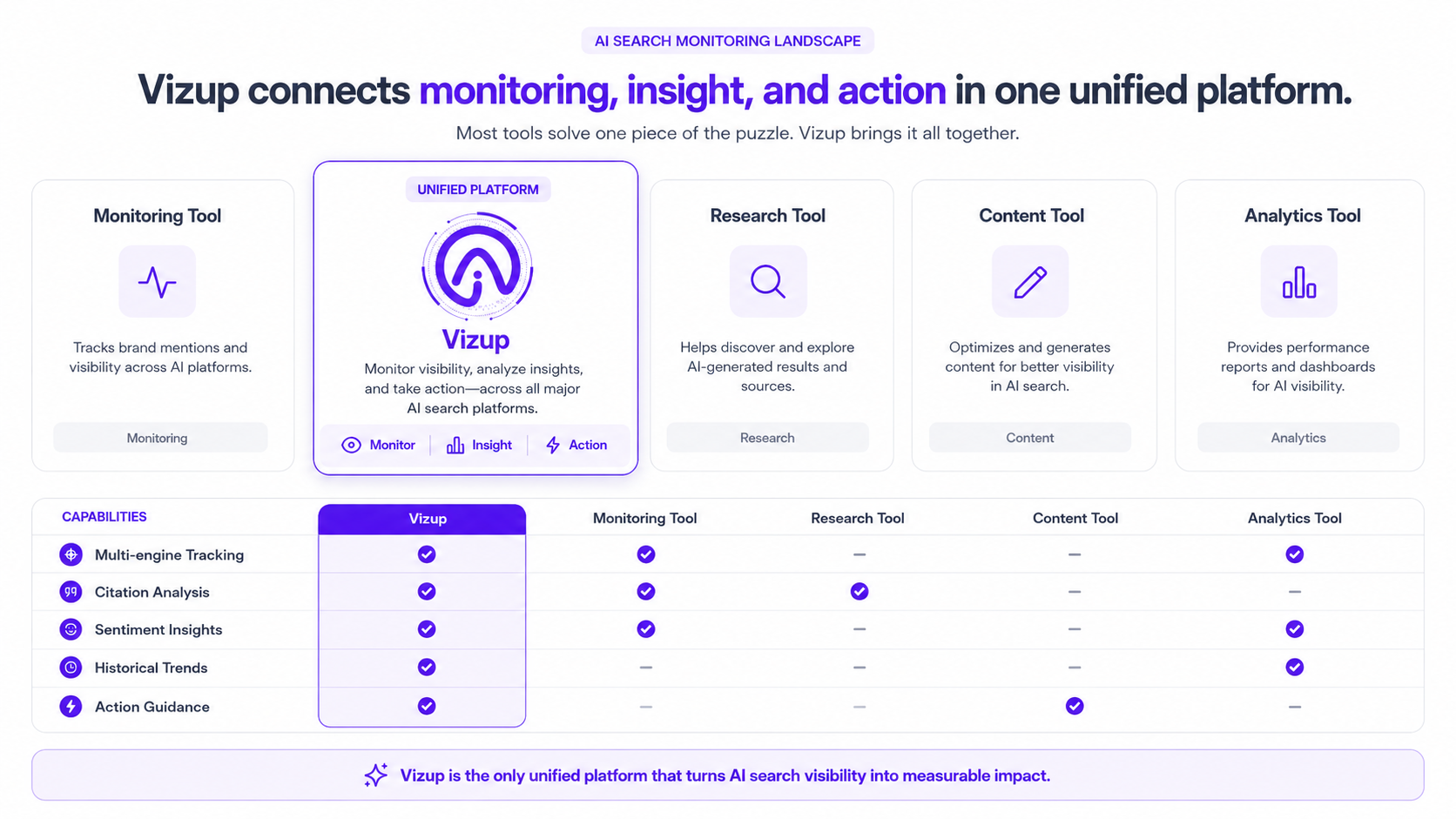
Vizup centers on digital presence and answer engine monitoring, pairing AI search monitoring with AEO capabilities in one platform. It is geared toward brands that want to track brand mentions in AI search and map their citation profile across engines. For the practical details, Vizup's pricing lays out how its tiers align with different monitoring needs.
The right pick always depends on your primary goal. Some teams need deep research and insights, while others want to scale up their AI-assisted content workflows. Vizup is built for teams who need a dedicated AI search monitoring platform that connects directly to broader marketing operations. The key is deciding whether you need a specialized tool or a wider suite that happens to include monitoring.
What Are the Most Common Misconceptions?
"AI search monitoring is just SEO with a new name." No. SEO is about influencing ranking systems. AI search monitoring is about observing how large language models select sources, synthesize information, and present it back to users. The signals differ, the levers differ, and so does measurement. Treat them as interchangeable and you end up improving brand visibility in AI search accidentally instead of deliberately.
"One tool can handle everything." This comes up constantly. A single-purpose tool can tell you whether ChatGPT mentioned your brand for one prompt. But prompts vary, models update, and the sources behind the answers shift. Without a platform that tracks changes across queries and engines over time, you are building a narrative out of one-off examples.
"This only matters for big brands." Smaller brands often have more to win. When an AI engine recommends three options and you are not on the list, that is a direct hit to revenue. Bigger brands tend to show up by default; mid-market and growth-stage companies are where visibility in AI answers can swing deals in either direction.
Key Takeaways
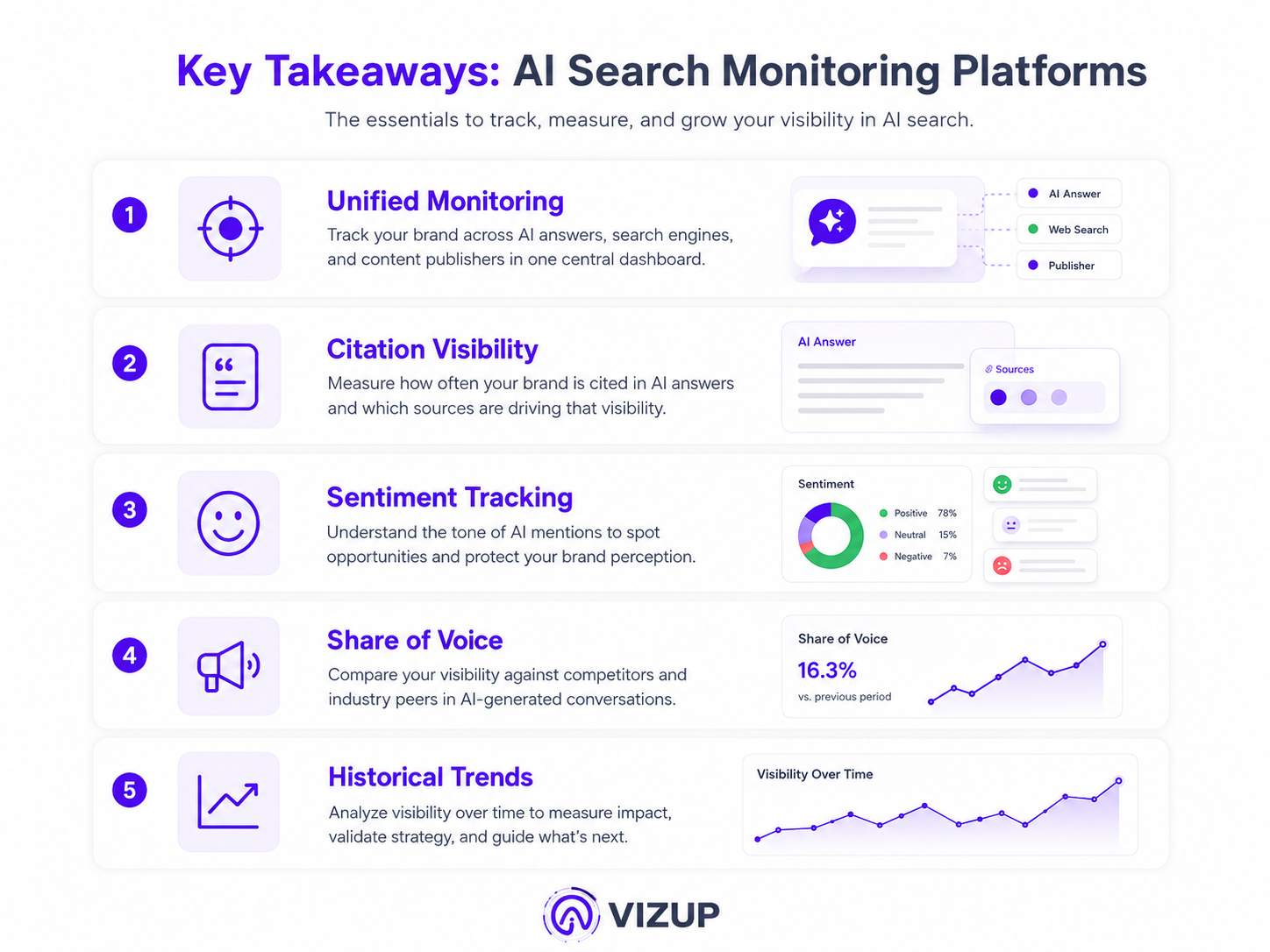
- An AI search monitoring platform pulls tracking, analysis, and optimization guidance for AI-generated results into one system; a standalone tool usually covers a single function.
- The core metrics stay the same: brand mentions, citation sources, sentiment, and competitive share of voice across engines like ChatGPT, Google AI Overviews, and Perplexity.
- Traditional SEO tools miss AI search behavior. AI answers are stitched together from multiple sources and often produce zero clicks, which makes legacy metrics feel incomplete.
- When comparing vendors, prioritize multi-engine coverage, recommendations you can act on (not just charts), and real historical trend data.
- Mid-market brands often see the biggest upside because AI engines surface only a few recommendations per query, and exclusion carries outsized consequences.
Frequently Asked Questions
How often should I check my AI search monitoring platform?
Once a week is a good floor. Models change often, and the sources they cite can shift after a single refresh. Monthly reviews are fine for big-picture trends, but weekly checks catch sudden visibility drops while there is still time to respond.
Can I use free tools instead of a dedicated AI search monitoring platform?
You can run manual queries in AI engines and track the outputs in a spreadsheet; some teams start there. It falls apart once you move beyond a handful of queries, and you lose consistent historical trend data. Free approaches work for spot checks; platforms are built for systematic monitoring.
What's the difference between an AEO platform and an AI search monitoring platform?
An AEO platform is focused on optimization: shaping your content so it shows up in answer-style results (featured snippets, voice responses, AI chat answers). An AI search monitoring platform is broader: it measures your presence across AI search engines and may include AEO as one component. Many platforms, including Vizup, combine both.
Does AI search monitoring replace traditional SEO tools?
No. Traditional SEO still delivers most organic traffic. AI search monitoring covers a growing, separate channel. In practice, teams use both and look at the data together to understand overall search visibility.
Which AI engines should I prioritize monitoring?
Start with ChatGPT and Google AI Overviews. ChatGPT drives 87.4% of AI-platform referral traffic (Conductor, 2025/2026), and AI Overviews appear in roughly 25% of Google searches. Add Perplexity once your baseline monitoring is running.
