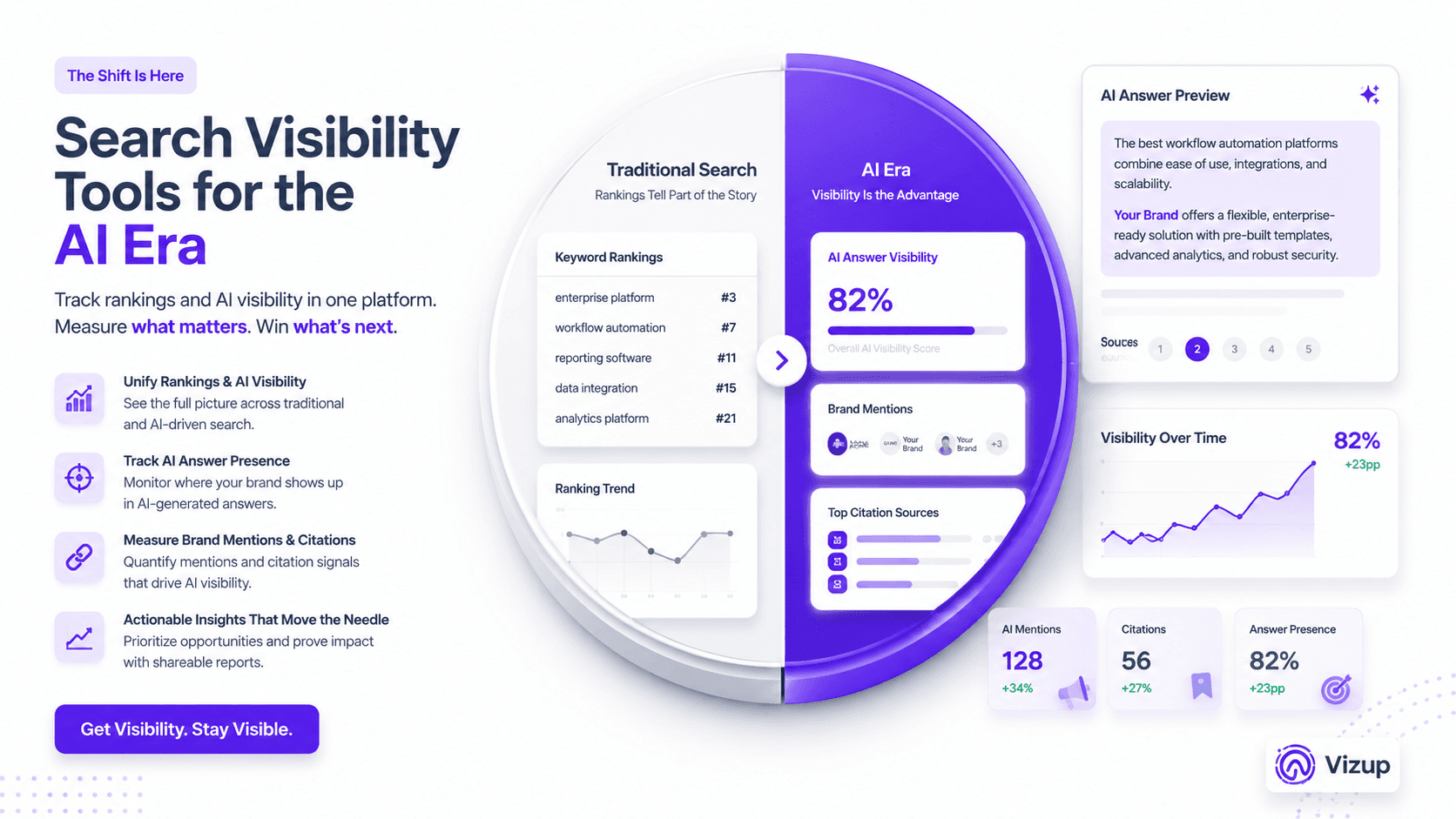
A search visibility tool tells you how prominently a website shows up in search results across a set of tracked keywords. Most platforms boil that down to a percentage score that factors in ranking positions, search volume, and estimated click-through rates. For years, it was the closest thing SEO teams had to a single dashboard-ready number for organic presence, without manually spot-checking hundreds of queries.
For a long time, that neat score functioned like an SEO vital sign. Now it has a blind spot roughly the size of ChatGPT, Perplexity, and Google’s AI Overviews. The model that used to summarize the state of search is starting to fail in obvious ways. Here’s what these tools really calculate, where the old assumptions fall apart, and what visibility tracking has to look like next.
What Does a Search Visibility Tool Actually Measure?
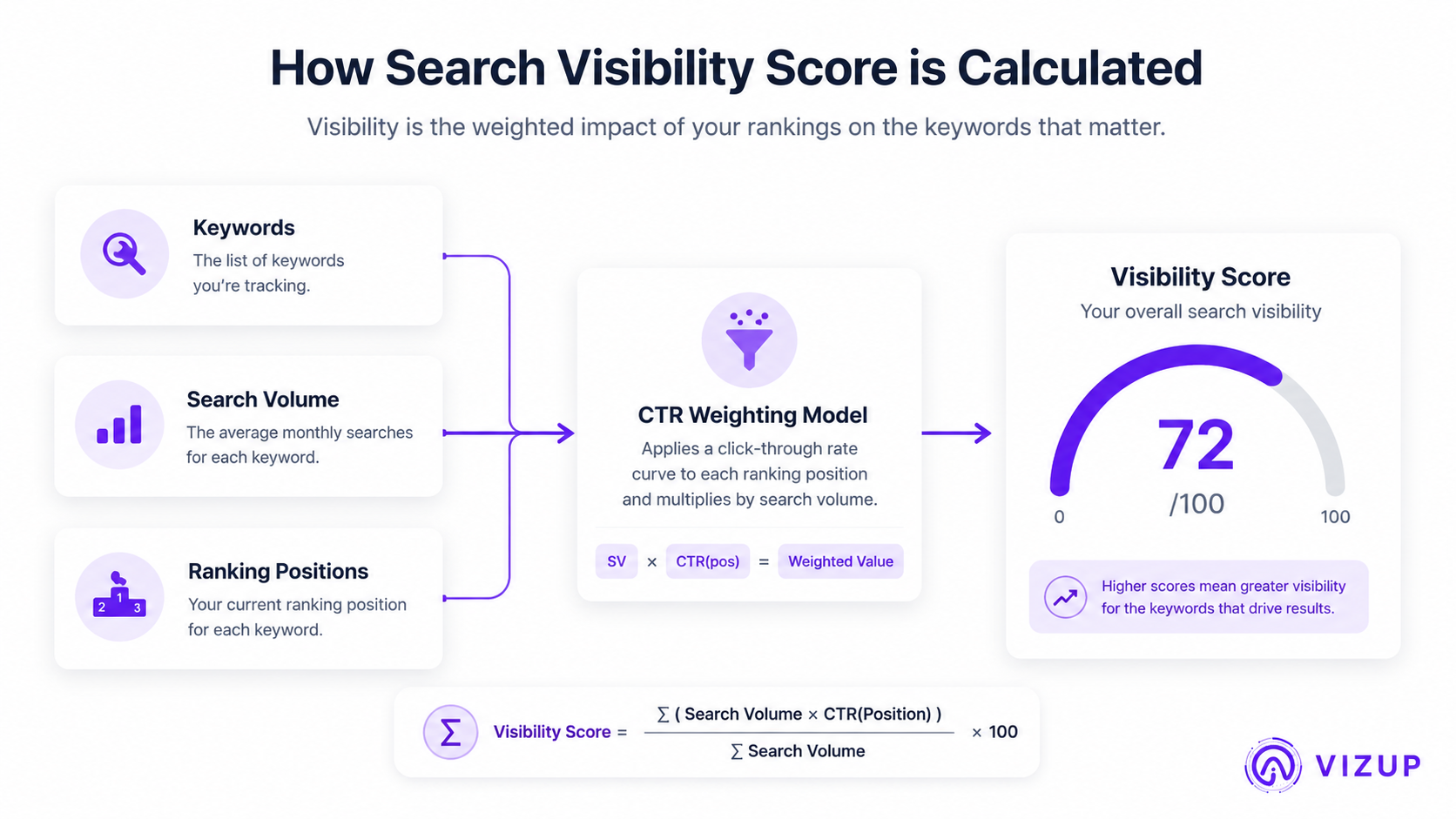
Strip away the dashboards and branding and the job is simple: turn a chaotic list of keyword rankings into one score you can chart over time. The usual workflow pulls rank tracking data for a keyword set you choose, applies an estimated click-through rate (CTR) to each ranking position, and rolls the result into an organic visibility number, typically on a 0-100% scale.
Everything hinges on the CTR weighting. The jump from #2 to #1 isn’t incremental; it’s a different economic tier. A model might treat #1 as worth ~30%, #5 as ~6%, and #10 as ~2%. Past page one, most tools effectively round the value down to nothing. That’s why slipping a couple of spots on a handful of high-volume terms can torpedo your score, while climbing from position 30 to 15 barely registers.
One catch: the score only describes performance against your keyword list. It’s not a universal measure of total organic traffic. A 75% visibility score across 10 obscure long-tail queries is trivia. A 25% score across 500 high-intent commercial keywords might represent serious revenue.
How Is the Score Calculated?
Each vendor tweaks the details, but the math usually follows the same outline: for every keyword, take its search volume and multiply it by the estimated CTR for your current ranking position. Add those up, then divide by the theoretical maximum (ranking #1 for every tracked term).
A simplified version looks something like this:
Σ (Estimated CTR for Position × Keyword Search Volume) / Σ (Max Possible CTR × Keyword Search Volume) × 100
This formula also explains why your visibility score from one tool won’t line up with another. Each platform bakes in a different CTR curve based on its own research. Some heavily reward the top three results; others try to account for SERP features like featured snippets or image packs, which can siphon clicks away from the classic blue links. None of them are objectively “correct” across every query. They’re competing models of how attention is distributed, which is why it's important to understand the methodology behind your chosen tool.
Why Should You Care About Organic Visibility?
Teams love to doomscroll daily rank changes. That habit rarely helps. The real usefulness of an organic visibility score is that it’s a leading indicator: it tends to move before traffic and revenue do, which makes it a decent early-warning signal. A sudden drop can hint at an algorithm shift in your niche or a technical regression on your site before the damage shows up in Google Analytics.
Visibility can also cut through noise that makes raw traffic hard to interpret. Did visits fall because you lost rankings, or because it was a holiday weekend and demand in your category dipped 30%? If visibility holds steady, you’re probably looking at seasonality, not an SEO problem. It’s also one of the few ways to benchmark performance: you don’t need a competitor's analytics access to compare visibility scores on the same keyword set.
What Changed When AI Entered Search?
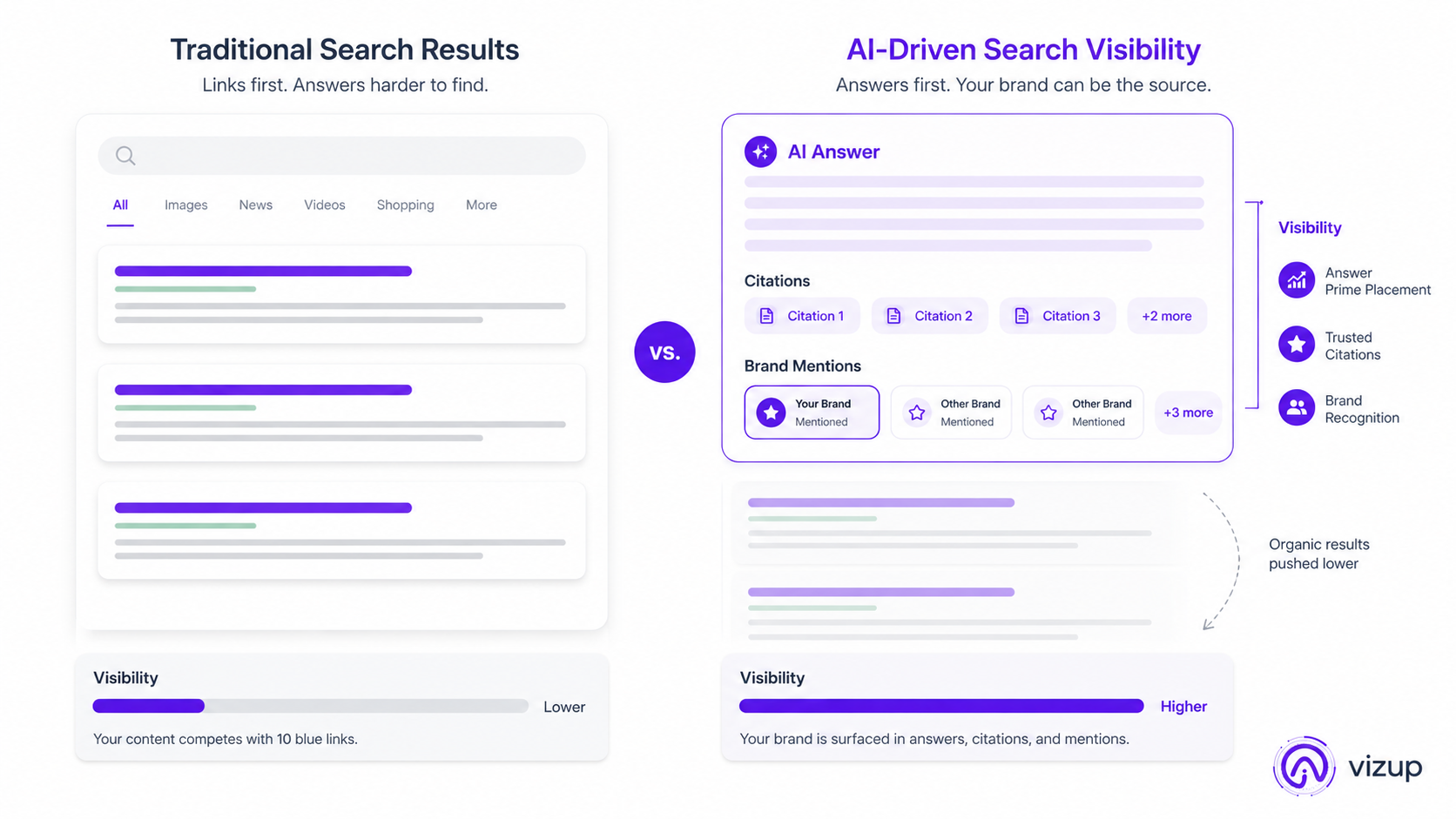
Here’s the break in the story: the entire framework above assumes a results page that behaves like ten blue links. That page is disappearing. AI Overviews, ChatGPT citations, and Perplexity-style answers warp the CTR curve that traditional visibility tools depend on.
A site can sit at #1 and still see almost no clicks if an AI-generated answer above it fully satisfies the query. Your visibility tool awards full credit for the top ranking. Your server logs tell a different story.
The Zero-Click Acceleration Problem
Even before the latest AI surge, zero-click search was already the trendline to worry about. Industry reports have shown for years that a majority of Google searches end without a click, and as of early 2026 that figure is around 65%. AI Overviews amplify the pattern. Traditional tools can’t tell the difference between a #1 result that earns the click and a #1 result pushed below an AI-generated block that absorbs the user’s attention. They record position, not the page’s actual layout or the user’s likely path.
AI Search Visibility: A New Layer to Track
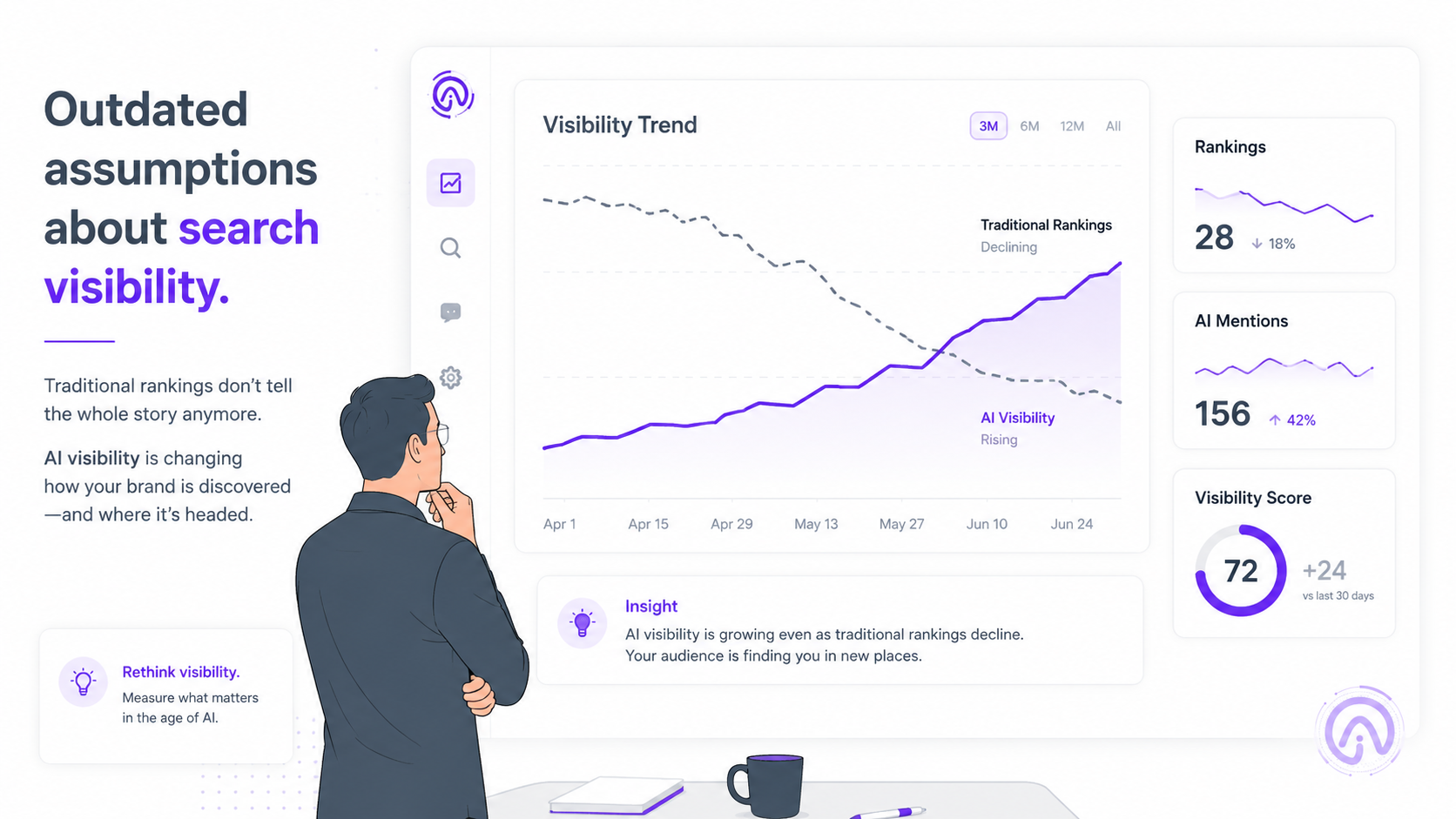
That gap creates a new metric worth caring about: AI search visibility. It’s not about rank; it’s about whether your brand, data, or content gets cited, mentioned, or linked inside AI-generated answers. This doesn’t replace rank tracking so much as sit beside it as a separate surface area to monitor. ChatGPT, Perplexity, and Google’s AI Mode increasingly behave like answer engines, not just search engines. If you’re not part of the answer, you’re not visible in the way users now experience search. Tools like Vizup’s Answer Engine Monitoring are showing up specifically to measure that presence where legacy SEO platforms still struggle.
What a Modern Search Visibility Tool Needs to Cover
If you’re shopping for tools in 2026, the checklist has grown. The classic features still matter, but they no longer tell the whole story.
A complete tool now requires a two-pronged approach:
- Traditional Rank Tracking (The Foundation): You still need daily or weekly position monitoring across Google and Bing. This is your baseline. It should also include SERP feature detection, does your result appear in a 'People Also Ask' box, a video carousel, or a featured snippet? This is table stakes.
- Answer Engine Monitoring (The New Requirement): This is the critical new piece. The tool must track brand mentions and citations in AI-generated answers across multiple platforms (Google AI Overviews, Perplexity, ChatGPT). Even better is sentiment and framing analysis. Are you being recommended, merely mentioned, or positioned unfavorably? This is where a tool like Vizup, which was purpose-built to combine digital presence monitoring with AI search visibility optimization, shows its value.
Choosing the Right Search Visibility Tool
The market for these tools is splitting. Many legacy platforms deliver strong traditional organic visibility scores but are still adapting to the new AI-driven search landscape. They often bolt AI tracking onto a system built for the old SERP. Other tools are AI-native but may lack the deep, historical rank-tracking capabilities that are still foundational.
Vizup is built specifically for this new reality. It integrates traditional organic visibility tracking with comprehensive monitoring of your presence inside answer engines. This approach provides a clearer view of why visibility metrics are crucial when clicks are no longer the only goal. Instead of a sprawling, all-in-one suite, Vizup focuses on delivering a unified and accurate picture of your true search presence today.
Common Misconceptions I Still Hear All the Time
Visibility scores come with a lot of baggage. A few assumptions show up so often they’re basically folklore.
- 'My visibility score dropped, so I lost rankings.' Not necessarily. Your rankings might be unchanged, but if Google drops a large AI Overview onto your most important SERP, the value of those positions can collapse. A tool that only tracks position won’t catch that shift.
- 'I need to track thousands of keywords for an accurate score.' Not really. A tightly curated set of 100-300 high-intent keywords usually produces a more useful signal than a bloated list stuffed with low-value informational queries.
- 'If I'm not in AI answers, it doesn't matter yet.' That’s the 2026 equivalent of “mobile doesn’t matter” circa 2014. AI Overviews already show up across a wide range of commercial queries. Treating AI search visibility as optional is choosing not to measure a channel that’s expanding fast.
Frequently Asked Questions
What is a good search visibility score to aim for?
There isn’t a universal target. A “good” score depends on your keyword set and the competitors you’re measuring against. In a brutal market, 20% can be strong; in a narrow niche, 60% might still mean you’re behind. The practical goal is sustained improvement and a score that trends higher than your closest competitors.
How often should I check my search visibility?
Checking every day is a fast way to overreact to noise. Weekly reviews are enough to spot trend shifts and investigate big moves. Save the real evaluation for monthly and quarterly cycles, when you can line visibility changes up with the work you shipped and the business results that followed.
Can a search visibility tool track my presence in ChatGPT or Perplexity answers?
Most traditional visibility tools can’t, because they’re designed around ranked results pages. For ChatGPT and Perplexity, you need a modern platform with Answer Engine Optimization (AEO) or AI search visibility capabilities, like Vizup, which is designed to track brand mentions in AI search.
Does search visibility account for Google AI Overviews?
A traditional search visibility score doesn’t reflect the impact of AI Overviews. It can report your organic rank (say, #1) without capturing the fact that an AI Overview is sitting above you and soaking up attention. That’s the core blind spot newer tools are trying to close.
What's the difference between search visibility and organic traffic?
Search visibility is a proxy for potential traffic, based on rankings and search demand. Organic traffic is the trailing metric: the visits you actually received. Visibility can rise while traffic falls if Google adds more zero-click elements to the SERP. That’s also why improving brand visibility in AI search matters more than it used to.
