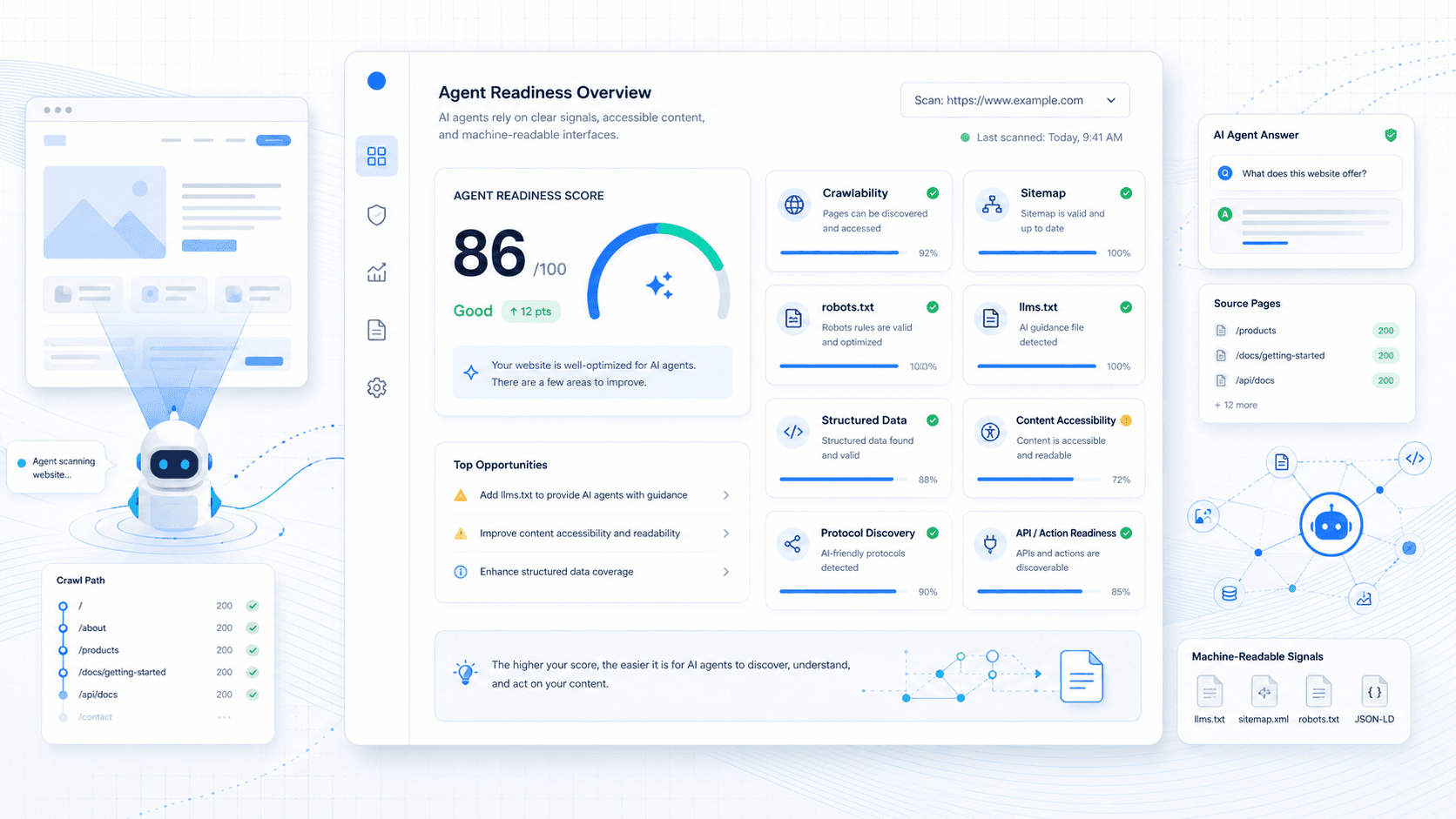
For years, websites have really had two audiences: humans and search crawlers. We tuned the UX for one and the technical SEO for the other. That split is starting to look quaint. A new kind of visitor is showing up in your server logs, and it doesn’t care about your typography or your keyword targets. It’s the AI agent, and it’s here to parse, extract, and execute on your site’s information for someone else.
If you’ve worked on the web long enough, you’ve seen this movie. A new technology shows up as a curiosity, gets dismissed as a niche, and then becomes the default way people do the thing. This feels like one of those pivots. Cloudflare, which sits in front of a meaningful chunk of the internet, saw the shift and shipped a measuring stick. It’s called the Cloudflare Agent Readiness Score, and it’s the sort of metric that makes website owners sit up a little straighter.
What Is Cloudflare’s Agent Readiness Score?
Cloudflare’s score is a blunt measure of how well your site communicates with machines. On April 17, 2026, the company launched a free checker at isitagentready.com that lets site owners see their pages through an AI agent’s lens. This isn’t a design critique. It’s a test of whether an AI can quickly find what you offer, make sense of your content, and reliably interact with the parts of your site that do work. The tool was announced as part of a broader push to prepare the web for agent-based interactions.
Cloudflare’s first scan of 200,000 top domains showed that adoption is still very early. While 78% of sites had a robots.txt file, only 4% declared AI usage preferences through Content Signals, 3.9% supported Markdown content negotiation, and newer standards like MCP Server Cards and API Catalogs appeared on fewer than 15 sites.
Why Agent Readiness Is More Than Just a New Buzzword
Plenty of "next big things" in marketing burn hot and then disappear. This doesn’t look like one of them. The lines between SEO, accessibility, structured data, and what people now call AI visibility are tightening fast. The shift is already visible in how discovery is changing:
- AI agents are the new discovery layer: More people are asking agents like ChatGPT or Perplexity to find products, compare services, and book appointments. If your site is a black box to those agents, you’re not part of that transaction. And you usually won’t get a clean signal that you lost the lead.
- Machine-readable signals are becoming paramount: For two decades, SEO meant leaving clues for Googlebot. Now you need clearer, more structured signals for a broader class of bots. A site a human can "figure out" visually can still be a dead end for an agent if the structure is messy or ambiguous.
- Agents need to complete actions: This isn’t only about reading. Can an agent understand your API? Can it tell how to add an item to a cart? If the site isn’t structured for that kind of interaction, the agent can’t do the job it was asked to do.
If your site isn’t an AI agent-friendly website, you’re effectively closing the door on a slice of your audience that’s only getting bigger. The upside: a lot of the work looks suspiciously like the web best practices we’ve been preaching for years.
What the Score Actually Looks At
Cloudflare’s scanner doesn’t care about your brand palette or how clever your copy is. It’s a pragmatic audit of the technical substrate your site runs on. The Cloudflare AI agent readiness check rolls up signals across a few core areas, which you can see in the URL Scanner changelog.
It’s a mix of old-school fundamentals and new-school standards:
- Discoverability: Can an agent find its way around? This covers basics like having a
robots.txtfile and a sitemap, which are foundational technical SEO signals. - Content Accessibility: This is where things get interesting. The scanner checks for Markdown negotiation, letting an agent request a clean, simple version of a page instead of wading through human-oriented HTML.
- Bot Access Control: This category checks for explicit permissions for AI agents. It looks for AI bot rules in
robots.txtand the use of Content Signals, a standard for declaring how content can be used. - Capabilities & Protocol Discovery: Can an agent actually do anything once it arrives? The scanner looks for signals like an API catalog, OAuth server discovery for authentication, and support for the Model Context Protocol (MCP).
The thrust of website agent readiness is a shift from pages that merely render well for humans to systems that describe themselves cleanly to machines. It’s about shipping usable data, not just shipping HTML.
What Is MCP and Why Does Cloudflare Mention It?
If you spend any time around the "agent-ready" conversation, you’ll see MCP come up constantly. MCP stands for Model Context Protocol, an open standard meant to give AI models a consistent way to connect to external tools and data sources. Anthropic introduced it in late 2024 with a pretty straightforward goal: stop forcing everyone to build one-off integrations for every new AI tool. You can read the official documentation on the Model Context Protocol site.
The idea is that, instead of an AI company writing a bespoke scraper for your site’s particular API quirks, it could connect to your MCP server. That server would describe, in a standard format, what tools exist, what they do, and how to call them. It’s basically a universal adapter for your site’s functions. Cloudflare calls it out because it sees MCP as foundational infrastructure for an agent-driven web.
How to Improve Your Agent Readiness Score
A low score from isitagentready.com stings, but at least the path forward is tangible. The tool even gives you prompts you can paste into an AI assistant to help draft the code changes. Start with the unglamorous stuff that tends to move the needle:
- Clean Up Your House: Begin with basics. Add or refresh your sitemap. Audit
robots.txtso you’re not accidentally blocking legitimate AI crawlers. Check your server’s crawl budget so bots aren’t running into limits. - Create an
llms.txtfile: This is one of the easier wins. Anllms.txtfile is a simple Markdown doc in your root directory that summarizes the most important parts of your site for AI systems. It’s a curated "start here" for agents. More details are at llmstxt.org, a community-driven standard. It can help make your site easier for AI systems to understand, but it should be treated as one signal among many rather than a guaranteed score booster. - Use Clean, Semantic HTML: The oldest web-dev advice keeps paying rent. Use
<header>,<nav>,<main>, and<article>appropriately. Keep headings (<h1>,<h2>, and so on) in a sensible hierarchy. Agents lean on that structure to understand what matters and how sections relate. - Add Structured Data: If you’re not using Schema.org markup (like JSON-LD) for products, articles, or events, you’re making agents guess. Structured data is the most direct way to label what a piece of content actually is.
- Improve Internal Linking: Strong internal links help humans, but they’re also how machines build a map of your content. Clear pathways make discovery easier for agents. For a deeper look at where discovery is headed, see this post on AI search visibility.
- Expose Actions Clearly: If you offer an API, document it. Consider publishing an OpenAPI spec and linking to it. The goal is to make available actions unambiguous to a machine.
Where Vizup Fits In
Running Cloudflare’s audit is a solid first move. It tells you whether the plumbing is hooked up. What it doesn’t tell you is whether anything is actually happening because of it. That’s where Vizup comes in. Cloudflare’s score speaks to technical readiness; Vizup helps you measure whether that readiness turns into real AI visibility.
Once you’ve raised your score, the obvious question is whether it changed outcomes. Are you showing up in AI-generated answers? Are agents citing your data? Is your brand appearing in the AI agent stack people use for discovery? An audit is a point-in-time snapshot; monitoring shows the trajectory. Start with a quick AI crawler checker to see how bots interpret your site today, then track how that view shifts as you ship fixes.
Frequently Asked Questions
What is Cloudflare Agent Readiness Score?
Cloudflare Agent Readiness Score is a metric that shows how prepared a website is for AI agents and machine-driven interaction. Cloudflare offers a free tool to run the check.
Is Agent Readiness the same as SEO?
Not exactly. It overlaps with technical SEO, but agent readiness is more narrowly about whether AI agents can access, understand, summarize, and interact with a site to complete tasks, not just index it for search.
Does llms.txt improve Agent Readiness?
It can. An llms.txt file gives AI systems a clear, machine-readable on-ramp to your most important content, which supports a more agent-friendly site. However, it's one of many signals and not a guaranteed score booster on its own.
What is an AI agent-friendly website?
An AI agent-friendly website is built to be crawled, understood, summarized, and used by AI systems. That usually means clean code, structured data, and explicit signals about what the content is and what actions are available. You can read more in our guide, 'Is Your Website AI Agent-Friendly?'.
How can Vizup help after an Agent Readiness audit?
Cloudflare’s score helps you identify and fix technical gaps. Vizup helps you watch what happens next by tracking visibility in AI-generated answers, citations, and brand mentions, so the score connects to real-world impact.
