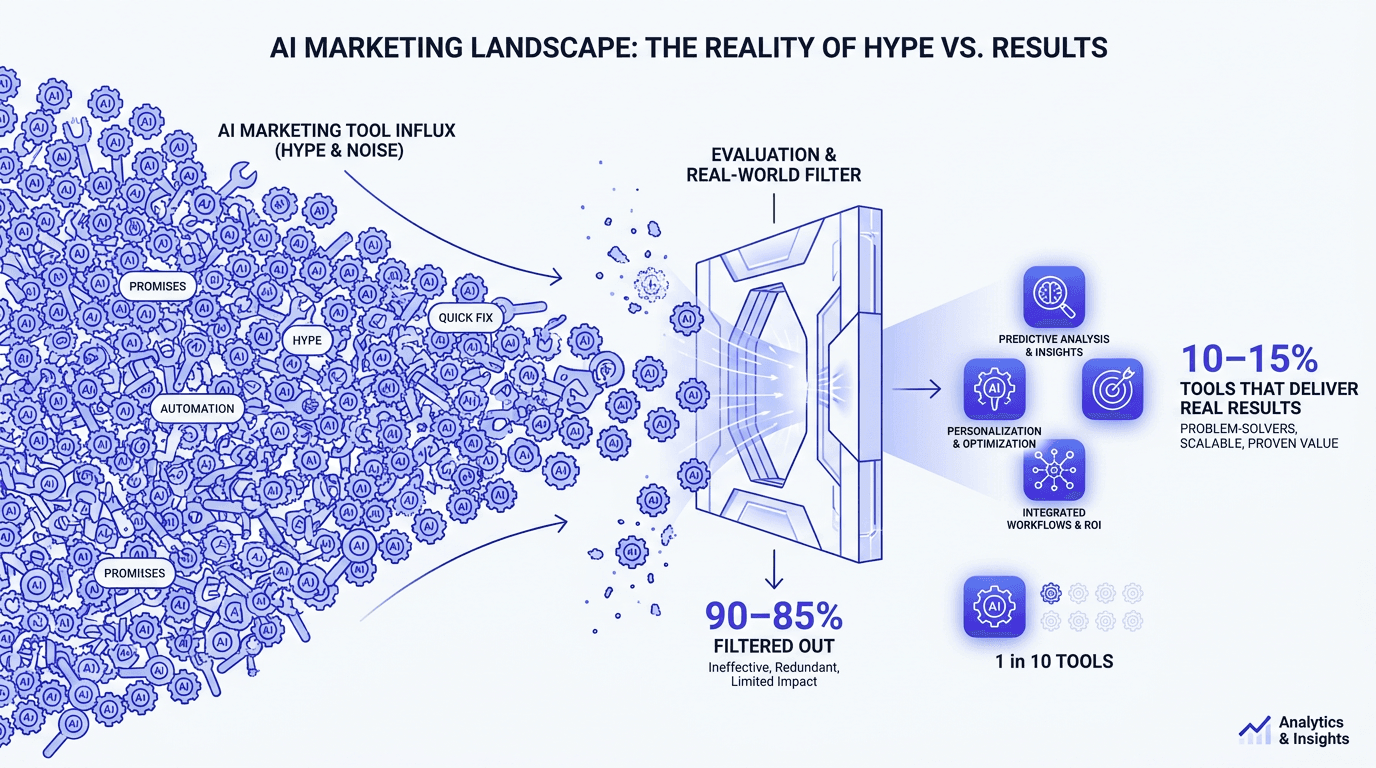
Every week, a new AI tool shows up claiming it’ll boost ROAS by 40%, spit out 10x more creative, and let you run marketing with half the headcount. The pitch decks look incredible. The demos are smooth. ↯ But here’s the part vendors won’t say out loud: maybe 10–15% of AI tools for marketing solve a real problem in a way that actually sticks. The rest are selling a future roadmap dressed up as a product you can rely on today.
⟡ This isn’t a “top 10 tools” list. It’s a map of what’s actually happening in marketing AI: where the leverage is real, and where teams are burning time and budget on tools that sound impressive but don’t move outcomes. If you’re a founder, CMO, or operator trying to decide which AI agents deserve a slot in your stack, here’s the honest version.
Why Most AI Marketing Tools Don't Create Real Leverage
A Forrester survey in 2025 found that 61% of B2C marketing organizations are exploring or experimenting with generative AI, while only 27% have use cases actually in production (Forrester, 2025). That gap is the story. Most teams are trying things, not running them. They’re piling on tools without a clear answer to whether any of it improves the work that matters.
Gartner tells a similar story from the other side. In a survey of 418 marketing leaders, 27% of organizations still have “limited or no GenAI adoption” in their marketing campaigns (Gartner, 2025). So about a quarter haven’t really started, and the rest are scattered across everything from “we used ChatGPT for a few blog drafts” to “we actually built it into the workflow.” It’s uneven. It’s messy. That’s normal.
⟡ The real question is: what does useful AI adoption look like inside an actual marketing team? Not the keynote version. The Monday-morning version, where someone opens a tool and it makes their next decision faster, cleaner, or more profitable.
Efficiency vs. Effectiveness: The Key Distinction in AI for Marketing
This sounds obvious, but most teams miss it: efficiency and effectiveness are different things. When you blend them together, AI adoption gets weird fast.
- Efficiency is time and effort. Less manual work. Fewer bottlenecks. You ship 50 ad variants instead of 5. Reporting runs on autopilot. A campaign brief goes from 3 hours to 20 minutes.
- Effectiveness is outcomes. Better ROAS. Lower CAC. Higher conversion rates. More pipeline. Creative that wins in the auction. Decisions that show up in revenue.
A tool can absolutely make you faster without making you better. ↯ You can generate 50 mediocre ad variants in 10 minutes instead of writing 5 decent ones in 3 hours. That’s efficiency without effectiveness. And it’s the trap most teams fall into because speed is easy to point at, while performance lift takes real measurement and usually a little pain.
The best AI tools for marketing do both. They help teams move faster, make better decisions, and improve performance. Not every tool needs to hit all three, but it should hit at least one in a way you can measure. If a tool doesn’t improve speed, decisions, or performance, it’s probably just another layer in an already bloated stack.
Mapping AI Marketing Tools to Core Marketing Workflows
If you want to understand this ecosystem, start with the workflows, not the logos. Every useful AI tool sits on top of a workflow that existed before “AI” was a line item. The only question that matters: does it make that workflow meaningfully better?
These are the marketing workflows where AI and automation have real room to help:
- Content creation and copywriting (blog posts, ad copy, email sequences, social content, landing pages)
- Paid media management (campaign setup, bid optimization, audience targeting, budget allocation, creative testing)
- Analytics and reporting (dashboard consolidation, attribution, anomaly detection, performance summaries)
- SEO and organic visibility (keyword research, content optimization, technical audits, search behavior analysis)
- CRM and lead management (lead scoring, segmentation, nurture sequences, pipeline forecasting)
- Creative production (image generation, video editing, design iteration, brand asset management)
- Personalization and customer experience (dynamic content, product recommendations, journey orchestration)
Each workflow has its own tool universe, its own level of maturity, and its own gap between what vendors promise and what teams actually live with. In a 2026 survey, 86.4% of marketing teams reported using AI in at least some capacity, with content creation being the most extensive use case at 42.5% (HubSpot, 2026). Content is where most teams start because it’s the easiest “win.” The higher-leverage compounding value tends to show up in the harder stuff (paid media optimization and analytics) where better decisions and faster iteration translate into real dollars.
How Most AI Marketing Tools Work: A Look Under the Hood
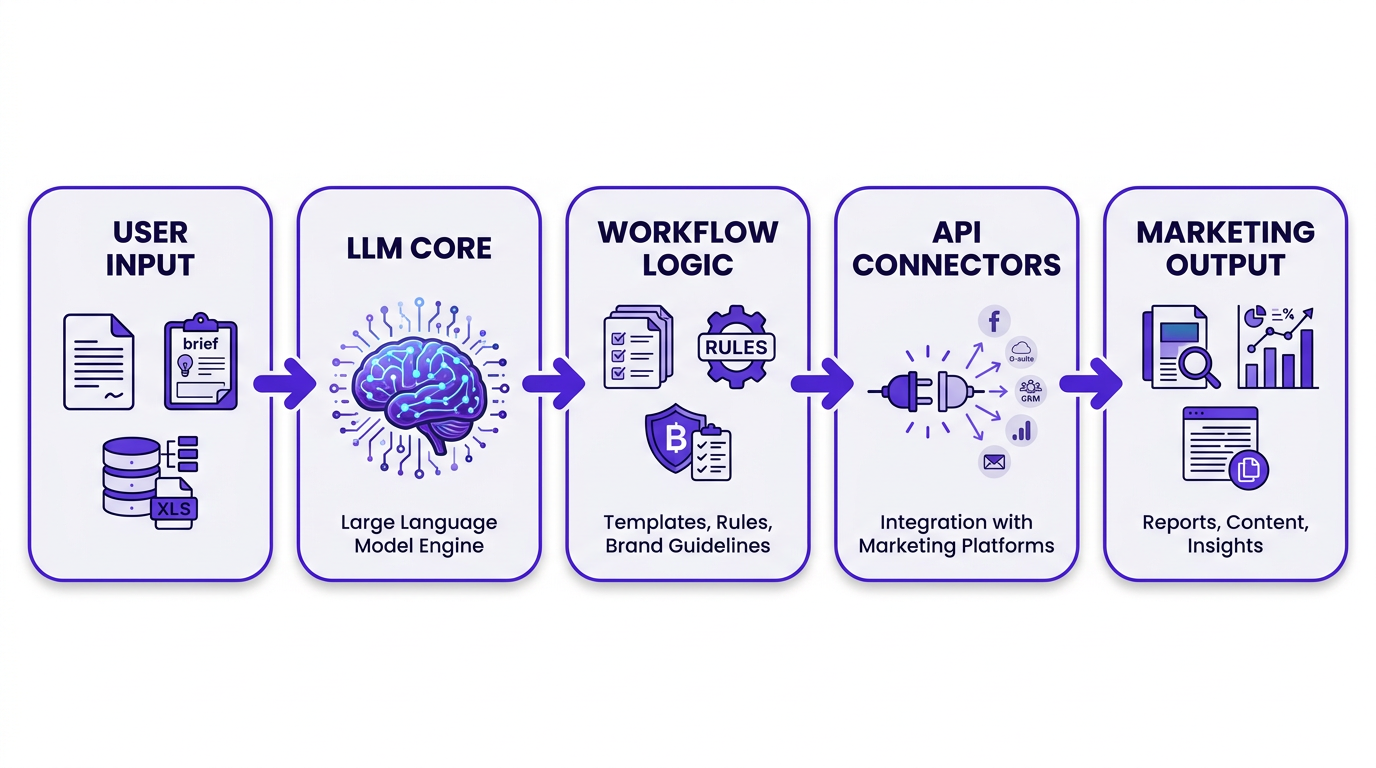
Here’s the part people don’t talk about enough: most AI tools for marketing are built on the same base layer. It’s usually a core LLM (large language model), plus workflows, connectors, and increasingly, MCP (Model Context Protocol) integrations. ⟡ In most cases, the “intelligence” isn’t the differentiator. The wrapper is: UX, integrations, guardrails, and whatever domain tuning they’ve done to make it usable for marketing.
Under the hood, a lot of these products follow the same pattern:
- Take a user input (brief, prompt, data set, campaign parameters)
- Route it through an LLM with some system-level instructions and context
- Apply workflow-specific logic (templates, rules, brand guidelines)
- Connect to external data sources or platforms via APIs or connectors
- Output something: copy, a report, a recommendation, an optimized bid
That’s not a knock. It’s just how the market works. The LLMs powering these tools are mostly the same ones everyone else can access. What separates a tool you keep from a tool you churn is whether it understands the marketing context it’s operating inside, and whether it fits into the place where the work actually happens.
The best tools sit close to the workflow. They don’t make you export CSVs, paste them into a new UI, and learn yet another system. They show up where your team already works. If you’re trying to understand how your own site fits into this new world, start with the basics: can AI crawlers and agents even interpret your content properly? You can test structured data for LLMs and see what they’re likely to pick up.
The Human-Machine Workflow Gap in AI Marketing
This is where most teams get it wrong. And honestly, this is where most tools get it wrong, too.
Tools can talk to each other. APIs are fine. Connectors exist. Zapier and similar platforms made it pretty easy to move data between systems. The plumbing is mostly handled. ↯ What’s still broken is the interaction between the tool and the human who’s supposed to trust it.
A lot of AI marketing tools are basically a one-way street. You give an input. You get an output. You judge it, tweak it, and move on. The feedback loop is weak or nonexistent. The tool doesn’t learn from your edits. It doesn’t understand why you rejected version A and shipped version B. It doesn’t build memory around what “good” looks like for this brand, this audience, this objective.
↯ most teams dont have an AI problem, they have a workflow problem. The models are fine. The failure is in how humans actually review, decide, and iterate. So you end up “using” six AI tools and still spending hours on manual QA, context-switching, and redoing work the AI was supposed to take off your plate.
The tools winning right now are the ones that treat feedback as first-class data. Not just prompts, but corrections, preferences, performance outcomes, and behavioral signals. The loop matters: the tool improves because the human uses it, and the human improves because the tool surfaces patterns they would’ve missed.
Google’s own framework for AI in marketing lands in the same place: the value isn’t “replace humans,” it’s augmenting it with better data and faster iteration. The teams getting results keep the tool and the operator in a tight loop, not a sloppy handoff.
The Modern AI Marketing Stack: Tools by Workflow
Let’s get concrete. Below is how I’d break down the main workflow categories, what the AI agent/tool landscape looks like in each, and the top 3 tools per category based on adoption, workflow fit, and whether they create real leverage. Not exhaustive. Definitely opinionated. And anchored in what works, not what has the prettiest landing page.
Content Creation and Copywriting
This is the noisiest category by far. Everyone has an AI writing tool. The only real differentiation is whether it can stay on-brand, fit into your team’s process, and improve performance, not just crank out more drafts.
- Jasper is still one of the stronger options for marketing-specific content. Brand voice training and campaign context make it more than a generic text box. The marketing knowledge graph gives it an advantage for teams that need on-brand output at volume.
- Writer wins when the problem is governance at scale. If you’re trying to keep a big team consistent, their style guides and compliance controls are legitimately useful.
- Copy.ai has leaned hard into workflow automation, not just copy generation. Their GTM AI workflows tie content into sales and marketing ops, which is where leverage tends to show up.
If you’re pushing AI content at scale, don’t skip QA. Run it through an AI Content Checker to sanity-check quality and originality before it hits production.
Paid Media and Ad Optimization
Paid media is where AI should create the most leverage. It’s math-heavy, data-rich, and iteration speed matters. It’s also the category where vendors overpromise the hardest, because “autopilot ROAS” sells.
- Smartly (formerly Smartly.io) combines creative production, media buying, and reporting. The creative-to-performance loop is tighter than most platforms, and that’s the whole game.
- Madgicx is Meta-focused and does a solid job blending audience intel, creative analytics, and automated optimization. If you spend real money on Meta, it can drive real efficiency.
- Revealbot is strong on automation rules and bid management across platforms. Not flashy, but rule-based automation saves a lot of time when you’re managing high-volume campaigns.
Analytics, Reporting, and Attribution
Reporting is where marketing hours go to die. Most teams has 4–7 dashboards and still can’t answer basic questions about what’s actually working. AI helps here when it finds the insight, not when it just draws prettier charts.
- Triple Whale is close to the default for DTC brands that want unified attribution plus AI-driven spend recommendations. Summary AI is useful because it translates performance into plain language you can act on.
- Northbeam leans into media mix modeling and attribution with a privacy-first approach. With signal loss post-iOS changes, that’s where the value is for a lot of teams.
- Databox isn’t the most “AI-native,” but automated reporting and anomaly alerts save hours of dashboard babysitting every week. Sometimes the best tool is the boring one that just works.
SEO and Organic Visibility (AEO)
SEO tools were early to AI, mostly around keyword research and content optimization. The newer shift is about something different: how AI agents and LLMs discover, interpret, and reference your brand. That’s not the same problem as “rank #1 for a keyword.” This is Answer Engine Optimization (AEO).
Top 3:
- Surfer SEO ties optimization and AI writing directly to search intent data. The NLP-based scoring is genuinely helpful for editorial teams trying to ship content that matches what people actually search.
- Clearscope is still strong for content briefs and optimization. It’s less bloated than a lot of competitors, which is a feature, not a bug.
- Vizup comes at it from the AI-agent angle: how LLMs see your brand, not just how Google ranks you. Their AI Crawler Checker and broader guide to AI marketing tools are built around AI-era visibility, not old-school SERP mechanics.
CRM, Lead Management, and Personalization
This category is owned by the big platforms, and the AI is increasingly bundled into the core product instead of sold as some separate “AI add-on.”
Top 3:
- HubSpot has pushed AI across CRM, marketing, and sales. Breeze is their AI layer for everything from content generation to lead scoring. If you’re already on HubSpot in the mid-market, this is leverage without introducing yet another tool.
- Salesforce Einstein plus the newer Agentforce platform is the enterprise end of the spectrum. Agents can handle customer interactions, qualify leads, and trigger workflows autonomously. Implementation isn’t cheap, but the capability is real.
- Clay is becoming the default for AI-driven lead enrichment and outbound personalization. It pulls from tons of data sources and uses AI to craft personalized outreach at scale. For B2B teams, that’s high-leverage when it’s wired into the right motion.
Comparing AI Marketing Tools: Efficiency vs. Effectiveness by Category
| Workflow Category | Primary Efficiency Gain | Primary Effectiveness Gain | AI Maturity Level | Biggest Gap |
|---|---|---|---|---|
| Content Creation | Much faster output volume | Moderate (brand voice consistency, SEO lift) | High | Quality control and originality |
| Paid Media | Automated bid and budget management | High (ROAS and CAC improvement) | Medium-High | Creative-to-performance feedback loops |
| Analytics & Reporting | Dashboards and alerts with less manual work | High (faster decisions, anomaly detection) | Medium | Cross-platform attribution accuracy |
| SEO & Organic (AEO) | Faster keyword research and briefing | Medium (content performance, AI visibility) | Medium | Keeping up with AI-driven search behavior |
| CRM & Personalization | Automated lead scoring and segmentation | High (conversion rates, pipeline) | Medium-High | Data quality and integration complexity |
| Creative Production | Rapid asset generation and iteration | Low-Medium (performance varies) | Medium | Brand consistency at scale |
| Assessment based on current tool capabilities and observed adoption patterns, 2025-2026 |
The Counterargument: Why 'Just Use AI for Everything' Fails
I hear this take a lot from founders and marketing leaders: AI is improving so quickly that the “right” move is to adopt aggressively, automate everything you can, and clean it up later. And yes, 75% of companies using AI for marketing plan to shift their talent into more strategic activities as AI automates repetitive tasks (Gartner, 2025). So why not go all-in?
I’m not buying the “everything, now” approach for one simple reason: tool sprawl kills teams faster than manual work does. Every new tool comes with onboarding, integration, ongoing maintenance, and the hidden tax of evaluation. ↯ If you add five AI tools and only one creates real leverage, the other four aren’t neutral. They’re negative. They drain attention, introduce switching costs, and split your data across more surfaces.
⟡ The goal is not to use more AI. The goal is to build a better marketing operating system. That requires being picky. Evaluate tools against specific workflow bottlenecks, not some generic “AI readiness” scorecard. And be honest: is this improving outcomes, or just giving the team a new way to feel busy?
Not every AI tool creates leverage. The ones that do tend to share the same traits: they sit close to the decision point, they fit into existing workflows, and they improve with use because they learn from human feedback. Everything else is noise with a fresh coat of “innovation.”
A Practical Framework for Adopting AI Marketing Tools
The teams getting real results from AI in 2026 aren’t the ones with the biggest stacks. They’re the ones who know exactly where the bottlenecks are, and pick tools that hit those bottlenecks directly.
What tends to work in practice:
- Start with the workflow, not the tool. Find where the team spends the most time on low-value work. That’s your automation target. Then choose the tool that fits that job, not the other way around.
- Measure effectiveness, not just efficiency. Time saved matters, but it’s not the win by itself. Track whether the tool improves conversion rate, ROAS, pipeline velocity. ⟡ Saving time is useful. Improving decisions is more valuable.
- Consolidate before you add. Most stacks are redundant. Before you buy another AI tool, check whether something you already pay for shipped AI features that cover the same use case. HubSpot, Salesforce, and most major platforms shipped meaningful AI capabilities in the last 12 months.
- Build feedback loops. The tools that compound are the ones that learn from corrections and preferences over time. Prioritize products that support iterative learning, not one-off outputs.
- Audit your AI visibility. AI-generated answers and recommendations are becoming a channel. You need to know how agents see your site. Check if your website is AI agent-friendly.
Teams that treat AI as a layer in the operating system (rather than a pile of point solutions) get compounding returns. They’re also the teams that can turn AI into revenue pipeline instead of stopping at “we saved a few hours.”
Building Your AI Marketing Stack in 2026: An Evaluation Framework
If you’re evaluating AI tools right now, here’s the framework I’d use:
- Does this tool address a specific bottleneck? If you can’t name the bottleneck, you don’t need the tool.
- Does it improve a decision or just automate a task? Both matter, but decision improvement compounds. Task automation hits a ceiling.
- Does it integrate into my existing workflow or create a new one? New workflows carry adoption risk. Tools that plug into what you already do have lower friction.
- Does it get better with use? Learning loops based on your data, feedback, and performance signals create more leverage than static tools.
- Can I measure the impact in 30 days? If there’s no signal within a month, it’s probably solving the wrong problem, or solving it too slowly.
⟡ the question is simple - does it improve the work? If yes, keep it. If not, cut it. This market will keep growing. Gartner predicts AI software will reach $297 billion by 2027. More tools will launch. More promises will get made. Your job isn’t to try everything. Your job is to build a stack that creates real leverage for your team, your goals, and your constraints.
Choosing the Right AI Tools for Marketing
The right AI tools for marketing create leverage. They help you move faster, make better decisions, or improve performance. But not every tool creates leverage. The market is flooded with options, and it's easy to get stuck with another subscription that doesn't improve your core metrics. The real question is whether a tool helps you acquire customers more efficiently, not just create content faster.
Success with AI in marketing comes from strategic integration, not just adoption. The best tools fit into your existing workflows, connect to your data, and help your team focus on strategy instead of repetitive tasks. Look for platforms that offer clear ROI, whether it's improved ROAS, lower CAC, or higher conversion rates. According to a 2025 report, organizations using AI marketing tools see performance improvements of 15-25% over traditional methods.
The goal is not to use more AI. The goal is to build a better marketing operating system. A good OS is built with fewer, more integrated tools that compound over time. Start by identifying the biggest bottlenecks in your workflow and test one tool that solves a specific problem. That’s the stack worth building. Everything else is just another browser tab you’ll eventually stop opening.
