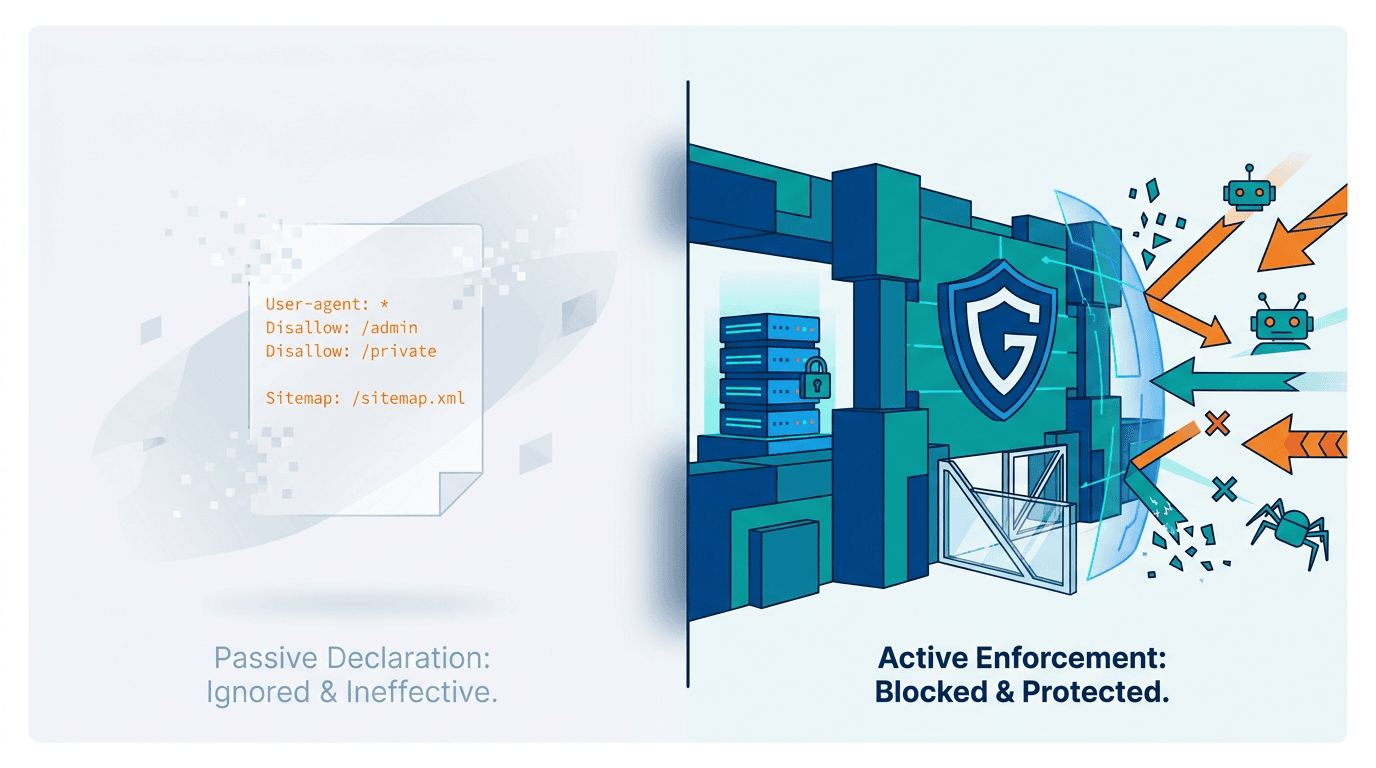
Cloudflare's Content-Signal directive in robots.txt has no known adoption among major crawlers or LLM providers as of July 2026. In a Reddit discussion, Google's John Mueller said he was not aware of any crawler or LLM using the directive and noted that unsupported entries add unnecessary robots.txt maintenance. The directive should therefore be treated as a publisher preference rather than a dependable technical control.
That does not mean Cloudflare's technical controls do not work. The important distinction is between a preference declared in a text file and a rule enforced at the network edge. AI crawler access can be controlled through Cloudflare AI Crawl Control, firewall rules, bot-management settings, and server-side protections, regardless of whether a crawler voluntarily follows robots.txt. Unsupported formats such as llms.txt and Content-Signal should not be treated as substitutes for enforceable access controls.
What Google Actually Said About Content Signals
On July 6, 2026, Mueller replied in a Reddit discussion about Content-Signal and llms.txt. He said that, to his knowledge, the Content-Signal robots.txt directive had no effect on crawlers or LLMs and added unnecessary file maintenance. He also stated that Google does not use llms.txt or llms-author.txt. A Search Engine Roundtable summary of Mueller's comments provides additional context. His response supports treating these entries as unsupported by Google, but it should not be presented as verified proof about every crawler operating on the web.
The useful part of Mueller's answer is the reminder that crawlers only act on directives they are built to recognise. Content-Signal is not included in the standardised Robots Exclusion Protocol defined by RFC 9309. It is a nonstandard extension for expressing content-use preferences, so website owners should not assume that adding it to robots.txt will independently change crawler behaviour.
Info: Mueller did not say the content-signal directive is dangerous. He called it inert. If you already shipped it, there is no fire drill. Just stop treating it like a control surface.
Declaration vs. Enforcement: The Distinction That Matters
This is the distinction that crawler-control discussions often miss. robots.txt communicates crawling instructions, but it is not an authentication system or a network-level access barrier. Google's robots.txt documentation explains that blocked URLs may still appear in search results when Google discovers them through external links or other sources. Compliance therefore depends on crawlers choosing to recognise and respect the supported directives.
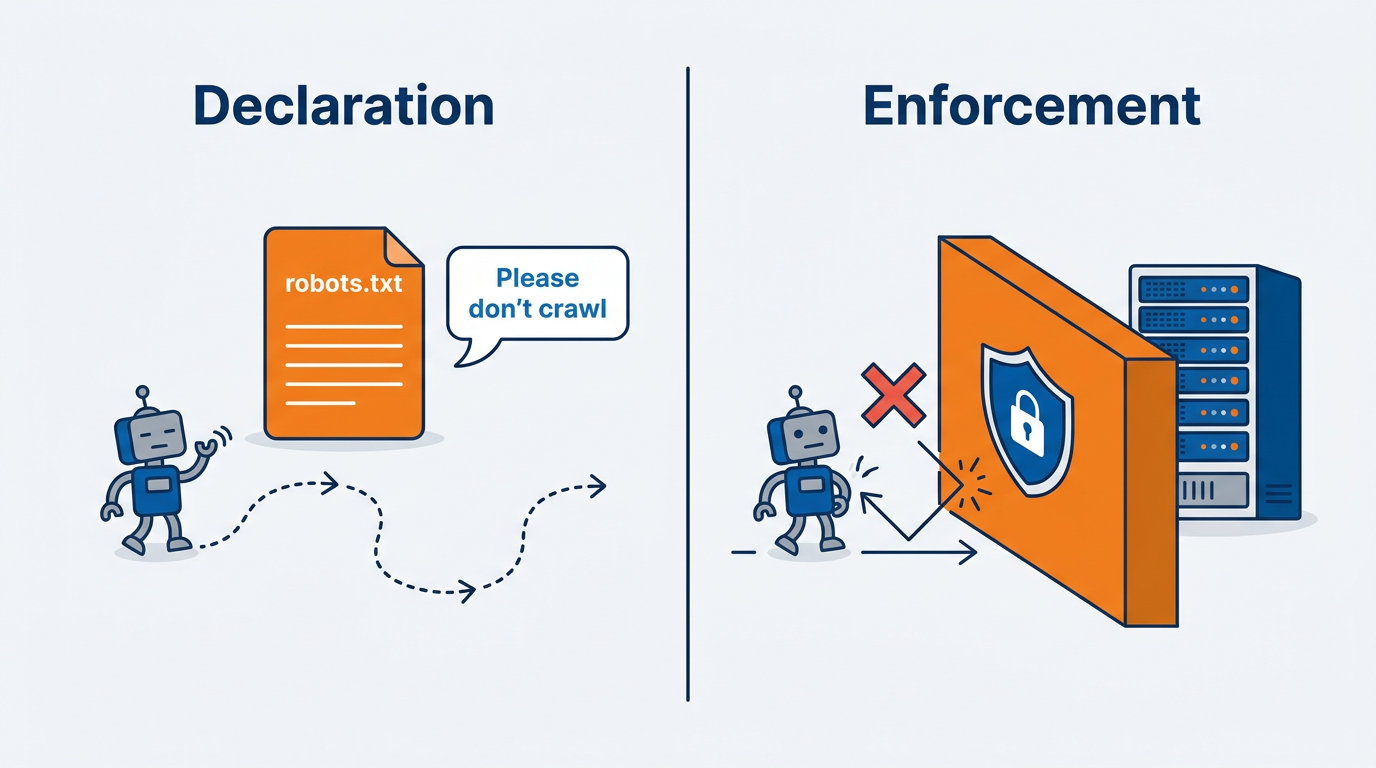
User-agent and Disallow work in practice because major crawlers like Googlebot and Bingbot have chosen to honor them for decades. That informal agreement does not magically extend to new, nonstandard robots txt ai directives like content-signal. No crawler shipped support for it. No LLM provider committed to respecting it. So the directive just sits there, unparsed and unobserved.
Enforcement takes place at the network or server layer. Cloudflare AI Crawl Control can use verified bot identities and traffic classifications to allow, monitor, or block crawler requests before content is served. Cloudflare says that new crawler-policy defaults are scheduled to take effect on September 15, 2026, including different treatment for Search, Agent, and Training categories on eligible ad-supported pages. Because mixed-purpose crawlers may operate across more than one category, brands should review the settings carefully rather than applying blanket restrictions. For a Vizup-focused explanation, read Cloudflare AI crawler categories: Search, Agent, and Training bots.
Do Content Signals Work? An Honest Assessment
The answer depends on which layer is being assessed. As a standalone robots.txt entry, Content-Signal has no known support among major crawlers and should not be treated as an enforceable block. Cloudflare's broader platform controls can still restrict access at the network edge. Cloudflare also distinguishes between its Content Signals Policy, which communicates publisher preferences, and the technical controls used to enforce crawler access. Website owners should therefore evaluate the declaration and the enforcement mechanism separately.
| robots.txt Directives (content-signal, llms.txt) | Network-Level Enforcement (Cloudflare Firewall, Server-Side Detection) | |
|---|---|---|
| Mechanism | A text file bots can choose to read | Edge identification and blocking before anything is served |
| Effectiveness | None, per Google (Mueller, 2026) | High, because it does not depend on cooperation |
| Bot Compliance | Only works if a bot implements the directive; these are not supported | No cooperation required; blocks via signature and behavior |
| Vizup Recommendation | Do not spend engineering cycles here | Make this the main investment for AI crawler control |
| The robots.txt directive and network-level blocking are fundamentally different mechanisms with different outcomes. |
Once declaration and enforcement are separated, the practical decision becomes clearer. A robots.txt preference only affects crawlers that recognise and follow it, while an edge or server-level rule can actively deny a request. Use Vizup's AI Crawler Checker to review which major search and AI crawlers your robots.txt currently declares as allowed or blocked. Confirm actual network-level enforcement separately through Cloudflare security events, server logs, or equivalent infrastructure monitoring.
What You Should Do Now (and What You Shouldn't)
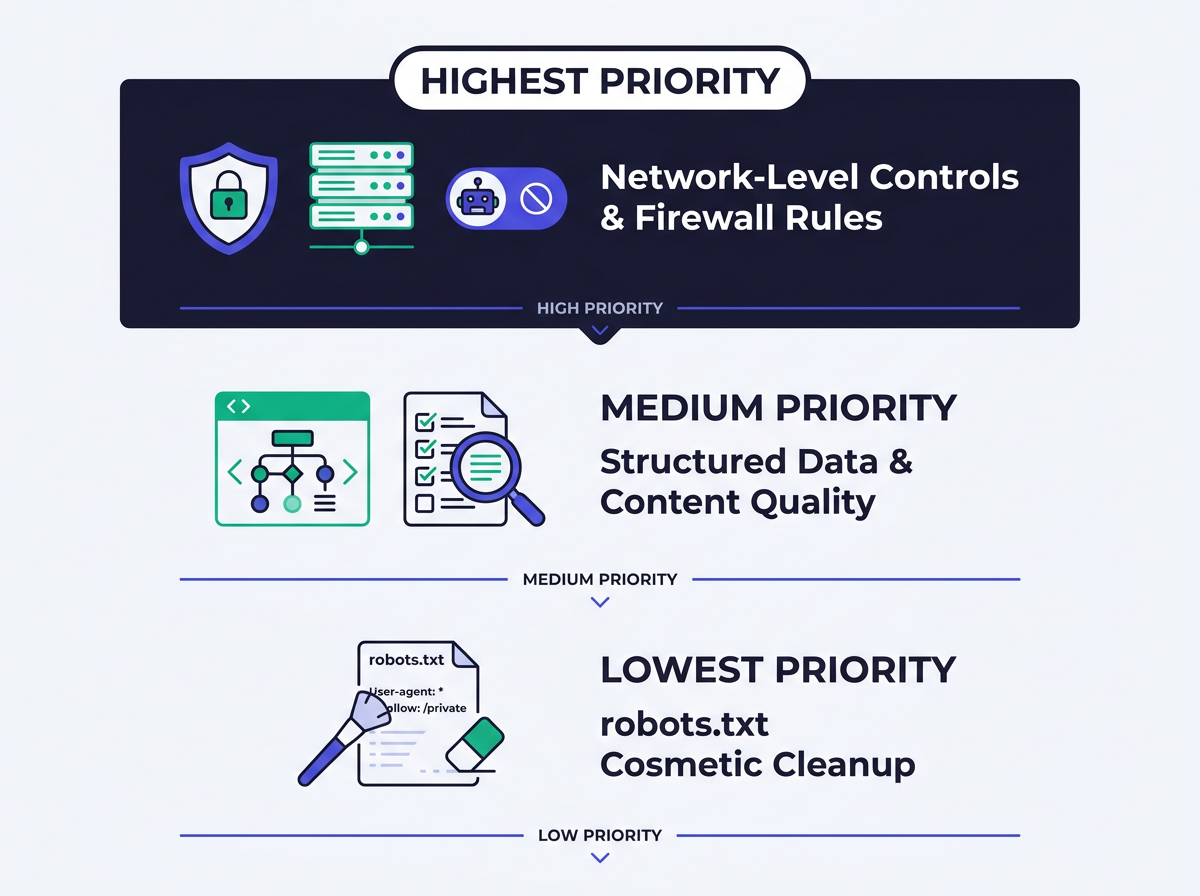
If you already added content-signal to robots.txt, do not panic. Mueller's point was that it is inert, not harmful. Leave it until your next scheduled robots.txt cleanup, or remove it when you are touching the file anyway. Nothing is on fire. It is dead weight, not an exploit.
If you need to control AI crawler access, direct engineering effort toward enforceable infrastructure settings. Cloudflare firewall rules, WAF configuration, bot-management controls, and server-side detection can restrict requests without relying solely on voluntary robots.txt compliance. Standardised crawler verification may also improve identification over time. Review Google's experimental Web Bot Auth documentation, then read Vizup's analysis of Google testing Web Bot Authentication for its potential impact on search and AI discovery.
Crawler access is only one part of modern organic visibility. Vizup's Organic Autopilot for modern discovery helps brands monitor, create, optimise, publish, and learn across Search, Social, Communities, AI Answer Engines, and Local Discovery. It combines AI agents, human experts, and live SEO, pSEO, AEO, and GEO tools to turn visibility gaps into prioritised actions. Paid ads are available as an amplification add-on when additional reach is required.
If your current strategy treats robots.txt as the primary AI-crawler defence, calibrate expectations. Vizup's guide explains how to check if AI crawlers are blocked by robots.txt, what standard User-agent and Disallow rules can communicate, and where voluntary compliance ends. These directives can guide compliant crawlers, but they cannot independently stop a crawler that ignores them.
The Counterargument: Isn't Declaring Intent Still Valuable?
The strongest argument for retaining Content-Signal is that it records publisher intent even when it does not independently enforce access. Cloudflare describes its Content Signals Policy as a mechanism through which publishers can communicate preferences for search use, AI-input use, and model training. Whether such declarations carry legal significance will depend on the jurisdiction, contractual context, and future industry standards, so organisations should seek appropriate legal advice rather than assuming the declaration creates an enforceable right.
That argument is coherent, and it is still not where I would spend time first. SEO has a long track record of betting on speculative standards that never become real behavior. The llms txt Google situation is the same story: a well-meaning format that no major player adopted. Meanwhile, the controls that do work today are right in front of you, and they are often underconfigured. Declarations are easy to publish and easy to feel good about. Enforcement is configuration, testing, and monitoring. That is why it gets skipped, and why it deserves the budget.
Spend Effort Where Behavior Actually Changes

Cloudflare content signals in robots.txt function as a statement, not a control. They reflect a legitimate publisher demand: more say in how AI systems use their work. But the implementation misses the point. Governance does not happen because a line exists in a text file; it happens when the network enforces a decision. If no bot parses the line, it is not governance. It is wishful thinking.
SEO, AEO, and GEO strategies should clearly distinguish between what a file declares and what infrastructure actually enforces. Development time is finite, and effort spent maintaining unsupported directives can take resources away from content quality, structured data, technical discovery, and access controls. Use Vizup's Crawl Budget Checker to identify sitemap issues and technical inefficiencies that may waste crawl budget, then combine those findings with server logs and infrastructure data when evaluating real crawler behaviour.
A declaration is not enforcement. Enforce at the edge. That is the lesson.
Frequently Asked Questions
Does Google use llms.txt or content-signal in robots.txt?
No. John Mueller said in July 2026 that Google does not use llms.txt, llms-author.txt, or the content-signal directive. Crawlers read what they are built to support, and these are not on that list.
Is it harmful to have the content-signal directive in my robots.txt file?
No. Mueller described it as inert rather than harmful. It adds bloat and a bit of future maintenance, but it should not trigger crawl errors or indexing issues. Remove it during routine cleanup, or leave it.
How can I actually block AI crawlers from my site?
Use network-level enforcement. Cloudflare firewall rules and bot management can identify and block crawlers at the edge before they reach your content. Server-side bot detection can add another layer. None of this depends on a bot voluntarily obeying robots.txt.
What is the difference between a robots.txt directive and a network-level block?
robots.txt is a request: it asks bots to comply, and it only works when they choose to. A network-level block is a gate: it identifies bots by signature and behavior and denies access before any content is served. The block holds even if the bot would have ignored your robots.txt.
Should I remove llms.txt and content-signal from my robots.txt?
There is no urgency. Neither one provides protection, and neither one is described as harmful. If you are already cleaning up robots.txt, removing them trims file size and reduces maintenance. Put engineering time into CDN or firewall enforcement instead.
