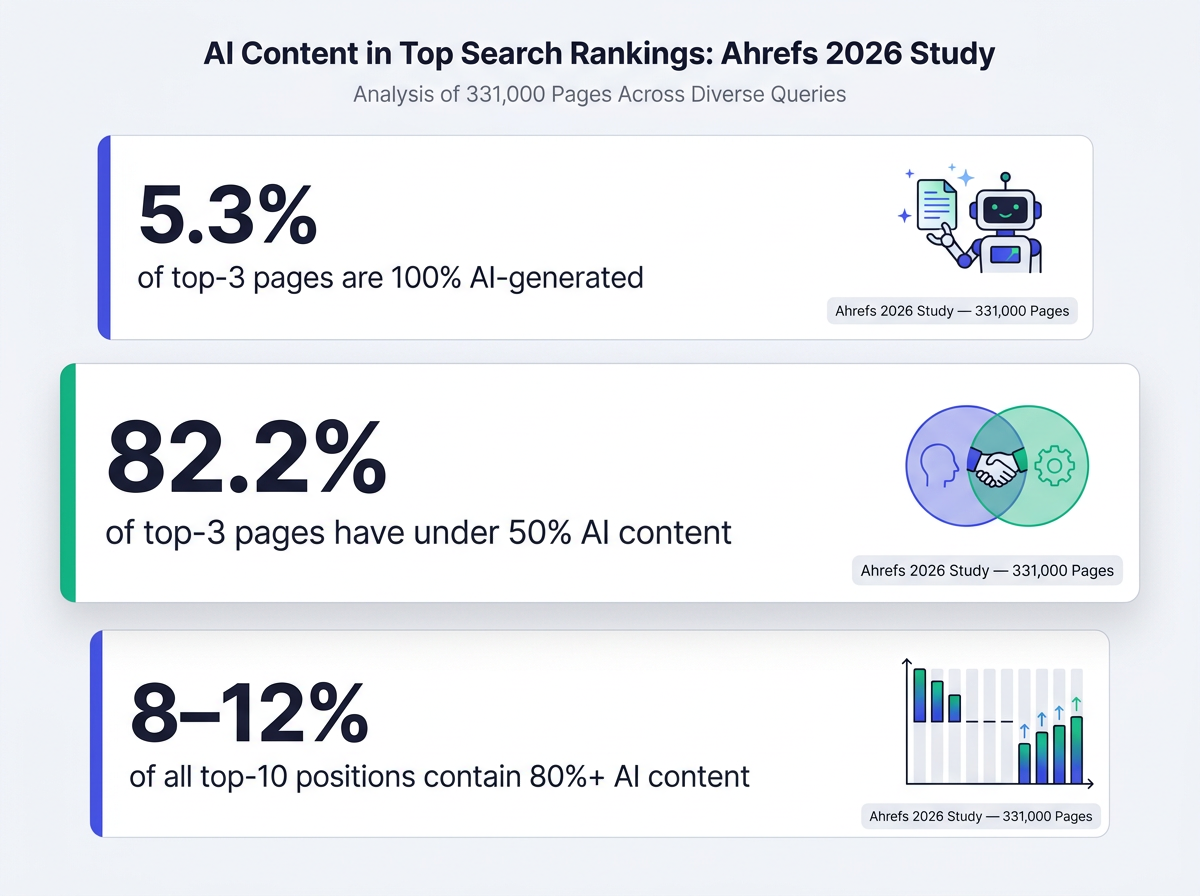
AI generated content Google rankings are not automatically punished. In Ahrefs' 2026 research, which combined several samples totalling roughly 331,000 pages, 5.3% of the eligible ranking pages in positions 1 through 3 were classified by Ahrefs' detector as 100% AI-generated. Meanwhile, pages with under 50% AI content made up 82.2% of those same top spots. Read that as a correlation, not a switch: pages with lower detected AI-content levels were more common near the top, but the study does not prove that authorship mix alone caused the ranking difference.
For content leads and editorial directors, that nuance is the whole fight. The "is AI content safe?" argument burns budget in the least productive way: teams rewrite pages that were never in danger and draft policies built on vibes instead of evidence. The pattern looks a lot like what we're seeing with citations, too: commodity pages get ignored by AI Overviews, while distinctive work gets referenced. The differentiator isn't who typed the first draft. It's whether the page is any good.
What 331,000 Pages Say About AI Generated Content Google Rankings
Ahrefs' 2026 research combined separate analyses of ranking, indexation and Search Console performance data. For the ranking analysis, Ahrefs started with one million URLs from 100,000 SERPs; roughly 150,000 pages contained enough text for its AI detector. Three results matter most, and each one should change how you design (and police) your editorial workflow.
One caveat belongs up front: AI detectors output probabilities, not courtroom proof. Ahrefs says as much. Every percentage here comes with noise, and false positives are part of the deal. The fair takeaway is that Google doesn't seem to punish pages simply for being AI-generated. That is very different from saying AI-heavy pages perform just as well.
Finding #1: Yes, 100% AI Pages Reach the Top 3
Does AI content rank? According to this dataset, yes. Ahrefs flagged 5.3% of pages in positions 1 through 3 as entirely AI-generated, and 9% as 80%+ AI. That's not the majority, but it's also not a rounding error. Fully automated pages can land at the top of Google's results, which is exactly why the idea of an automatic, sitewide Google AI content penalty doesn't hold up here.
Semrush gets to a similar conclusion from a different angle. In 2026, it analyzed 42,000 blog posts and found that human-written content is 8 times more likely to hold the #1 spot than purely AI-generated content (80% vs. 9%). The gap is the story, but the 9% still matters: pure AI pages do win sometimes. The debate isn't about possibility. It's about how often it happens.
Finding #2: A Human-Assisted Sweet Spot Dominates the SERPs
If you only remember one number, make it 82.2%. That's the share of top-3 pages with less than 50% AI-generated content. The winning pattern isn't "all AI" or "no AI". It's human-led, AI-assisted work. That framing is what the human vs AI content SEO debate usually misses: it's not a binary choice. It's a question of how much judgment, expertise, and editing makes it into the final page.
Digital Applied's 16-month study (concluded March 2026) adds context to why that mix shows up in the rankings. Pure AI content ranked 23% lower on average than human-written articles. AI-assisted content that went through substantive human editing, though, performed within 4% of fully human-written pages. That's the leverage point: the editing layer. Teams that formalize how automated drafts get challenged, improved, and expanded get the speed benefits without paying the ranking tax.
Finding #3: There Is a Gradient, Not a Cliff
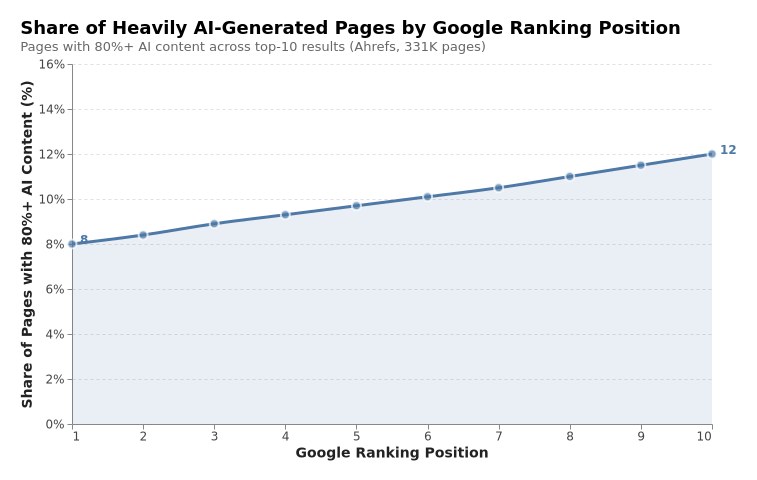
Pages that are heavily AI-generated (80% or more) show up across every slot in the top 10, making up roughly 8 to 12% of results at each position. But that share shrinks as you move toward position 1. It's a gradual slope, not a sudden drop. Google rewards signals that tend to track with quality, depth, and differentiation. Pure AI output doesn't reliably produce those signals, so it underperforms statistically rather than getting cut off outright.
Why Teams Still Fear the AI Content Penalty
So why does the panic stick around when the numbers don't support it? Three things keep it alive. First, Google's enforcement against low-quality AI content farms is real and widely covered, and a lot of teams collapse "scaled content abuse" into "any use of AI." Second, AI detection has become its own mini-industry, and the business model runs on anxiety. Third, internal policy tends to drift toward the most conservative reading because nobody wants to be the person who signed off on a page that later got deindexed.
Google's public stance is not complicated. Its spam policies target scaled content abuse and low-value output, not the tool used to produce the text (Google Search Central, 2026). If a page exists mainly to manipulate rankings, it's spam whether a human wrote it or a model did. If it exists to help users, it's allowed regardless of process. Google's policies around generative AI make that explicit, and Google's March 2026 spam update went after the abuse pattern, not "AI" as a category.
Warning: Google's core ranking systems primarily evaluate individual pages, while also using some site-wide signals. A pattern of unhelpful content can affect Google's understanding of pages across a site, but poor site-wide signals do not mean every page will rank poorly. A large volume of unhelpful pages, whether AI or human-written, can drag down rankings across an entire domain (Pravin Kumar, 2026). The risk is not AI. The risk is low quality at scale.
The AI Detector Dilemma: Measuring the Wrong Thing
A lot of editorial policy has quietly turned into detector policy: run the draft, check the score, rewrite until it drops below a threshold. That breaks down in two places. First, detectors are probabilistic classifiers with meaningful false-positive rates, and Ahrefs calls out that limitation in its own work. When a tool says "95% AI," it's reporting statistical confidence, not a forensic finding. Second, "passing" a detector is a proxy metric that doesn't map cleanly to the outcome you actually care about: organic performance.
Even the Ahrefs dataset inherits this mess, because it relies on the same detection tooling. Some pages labeled "100% AI" could be human-written text that tripped a false positive. Some pages labeled "0% AI" could have started as model output and been edited enough to slip through. The signal is noisy. Workflows built on noisy signals tend to produce noisy, inconsistent decisions.
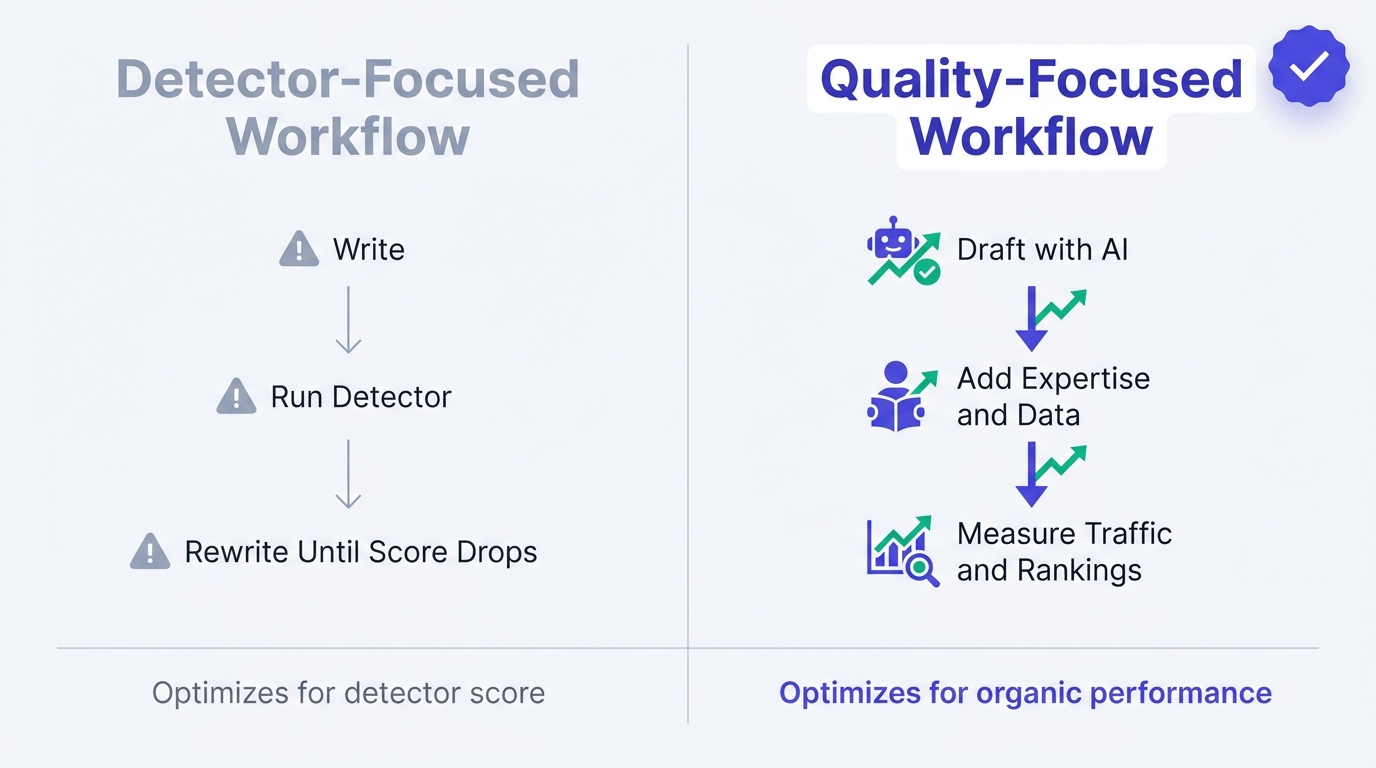
| Dimension | Detector-Focused Workflow | Quality-Focused Workflow |
|---|---|---|
| Primary Goal | Clear AI detection (stay under a score threshold) | Reach top-5 rankings and maintain traffic |
| Success Metric | AI detection score below 10% | Click-through rate, time on page, conversions |
| Typical Activity | Paraphrase or run "humanizer" tools to change phrasing | Add unique data, expert quotes, original analysis |
| Content Investment | Spend budget rewriting pages that were likely fine | Spend budget on depth, differentiation, and insight |
| Risk Profile | False positives trigger unnecessary rewrites | Weak pages get audited, improved, and re-tested |
| Alignment with Google Policy | Optimizes for a signal Google does not use for ranking | Optimizes for quality signals Google says it rewards |
| A detector-focused workflow optimizes for a metric Google does not use. A quality-focused workflow optimizes for what Google rewards. |
If you're going to spend time before publish, spend it where it compounds: substantive editing. Add proprietary data, tighten the argument, and bring in real expertise that a language model can't conjure on demand. The point isn't to hide the tool. The point is to ship pages that deserve to rank.
A Better Framework: Value vs. Commodity
The 2026 AI content study data supports a simpler question than "how much AI is in this draft?" Ask instead: "what does this page give the reader that competing pages don't?" Differentiation is the variable that keeps showing up, not provenance. A page that synthesizes original research, includes expert perspective, or publishes a unique dataset will typically beat a page that just restates the standard talking points, regardless of whether a human or a model wrote the first version.
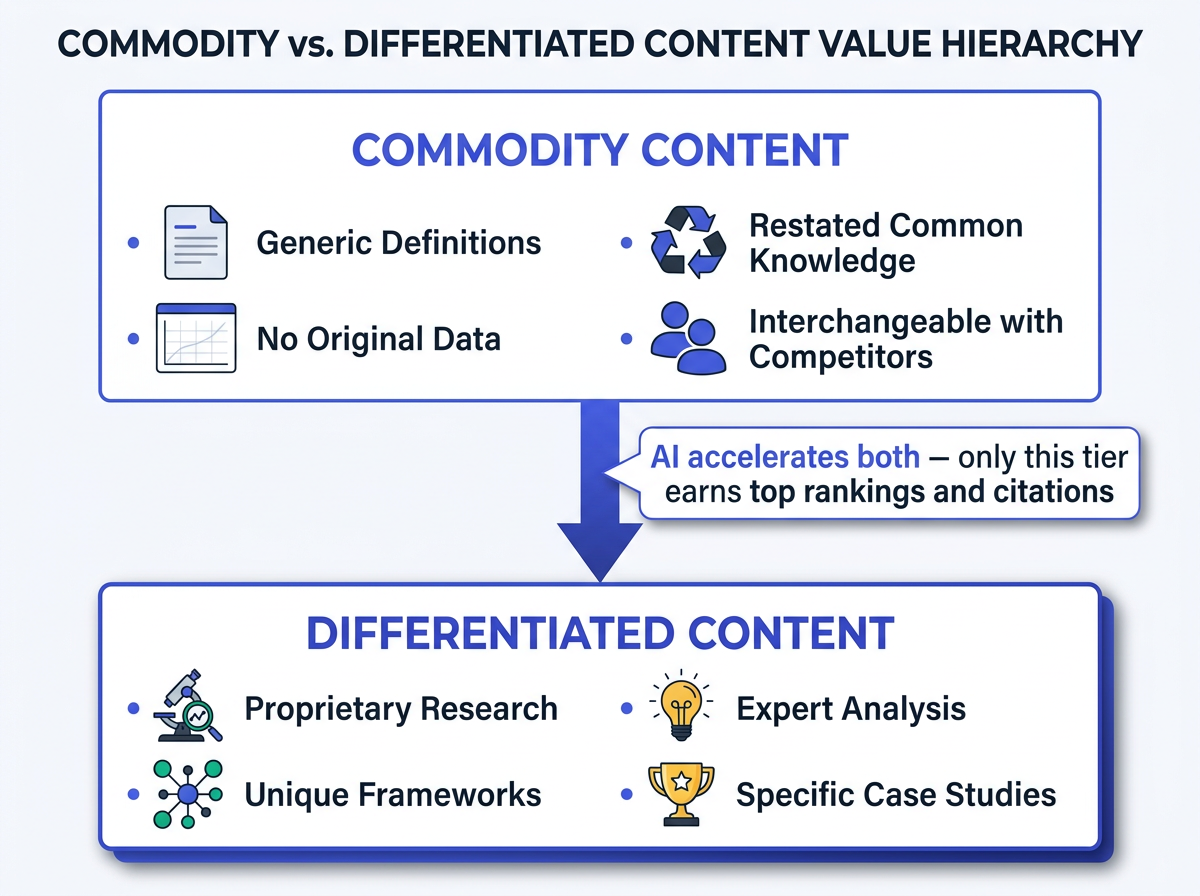
Used well, AI speeds up the parts of writing that don't create defensibility: early research, structural outlines, and commodity sections like definitions, background, and standard comparisons. Save human attention for the sections that actually move the needle: original analysis, proprietary data, narrative clarity, and recommendations with teeth. The May 2026 core update during this period, but Google did not publish evidence that it specifically rewarded expert pages over comprehensive pages. The recommendation is instead consistent with Google's established people-first content guidance.
From there, the governance answer is pretty obvious. If AI is a production tool rather than a risk category, your controls should enforce quality standards, not detector thresholds. That means editorial rubrics, performance-based review cycles, and clear ownership for what goes live. It also helps to understand how AI search engines retrieve and cite content, because "quality" now has to hold up in both classic search results and AI-powered surfaces.
Key Takeaways for Your 2026 Content Strategy
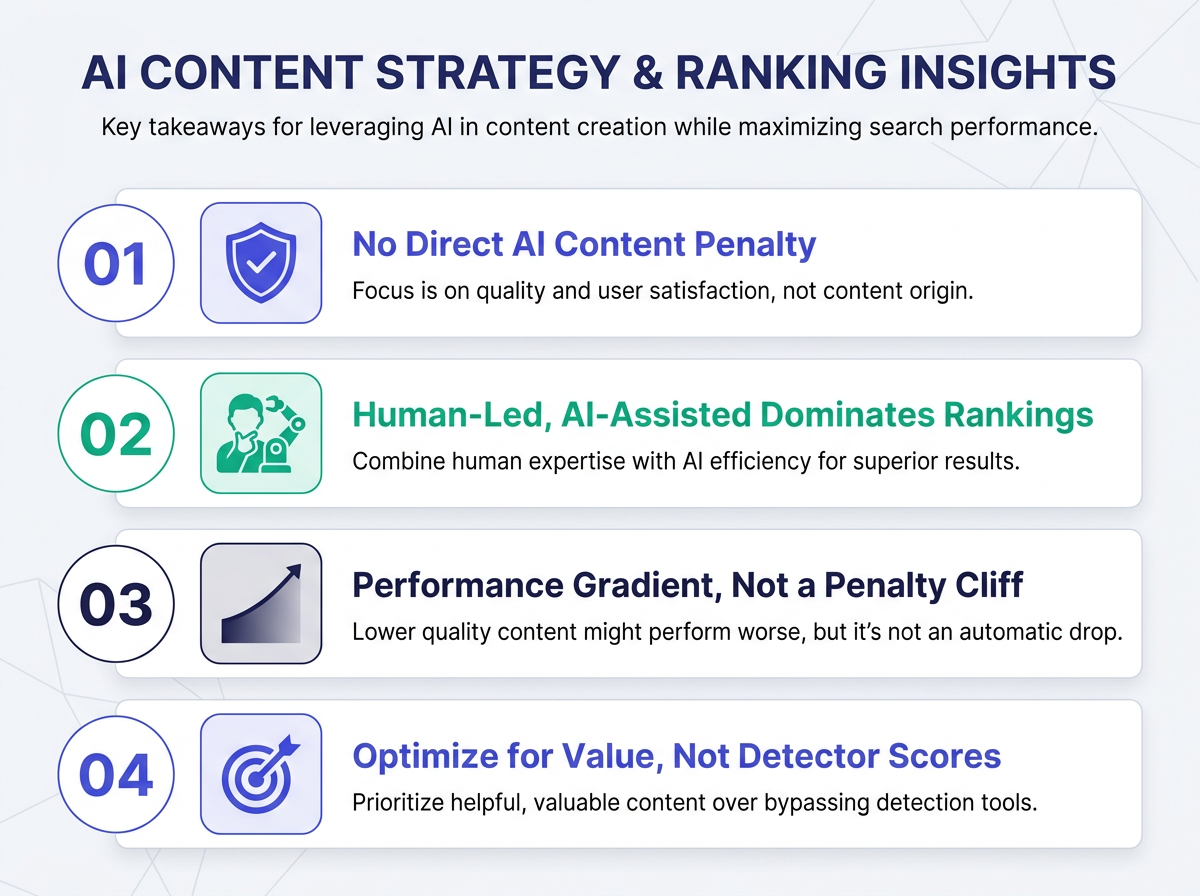
- There is no evidence of a direct Google AI content penalty. 5.3% of top-3 pages are flagged as 100% AI-generated. Don't spend cycles rewriting pages purely out of fear.
- The highest-performing content is human-led and AI-assisted. 82.2% of top-3 pages have under 50% AI content. The ranking edge shows up in the editing layer.
- Google's quality algorithms create a performance gradient, not a penalty cliff. Heavily AI content (80%+) appears at every position in the top 10 but becomes less common as you approach position 1.
- Focus on creating value and differentiation, not on passing AI detection tests. Track traffic, rankings, and conversions. A detector score isn't a ranking signal.
- Align your policy with Google's actual position. The spam policies target scaled, low-value content abuse. The production method isn't the variable; quality and originality are.
If you're ready to review existing content through this lens, Vizup's SEO content audit prompt can help identify pages that need stronger evidence, differentiation or editorial work. Vizup works as an Organic Autopilot for modern discovery—helping brands monitor, create, optimise, publish and learn across Search, Social, Communities, AI Answer Engines and Local Discovery using AI agents, human experts and live SEO, pSEO, AEO and GEO tools. Paid ads are available as an amplification add-on. For draft-level review, Vizup's AI Content Checker highlights passage-level patterns and editorial opportunities; it should be used as a quality diagnostic, not as a Google ranking predictor.
Frequently Asked Questions
Can Google detect AI-generated content?
Google appears to have internal systems that can identify AI-generated content. A Search Quality team member's LinkedIn profile (reported by Search Engine Journal, 2025) listed "detection and treatment of AI-generated content" as part of his role. But Google's public policy does not treat "AI-written" as an automatic negative. Detection and punishment are different steps. The stated use case is identifying scaled content abuse, not downranking every AI-assisted page.
Will I get a manual action for using AI content?
Using AI as a production tool, by itself, is not what triggers a manual action. Google's spam policies (2026) focus on content created primarily to manipulate search rankings, regardless of whether it came from a human or a model. Manual actions are tied to patterns like scaled content abuse, thin auto-generated pages with no editorial oversight, or deceptive practices. AI-assisted content that serves users and shows real expertise isn't the target.
Is it better to use an AI humanizer before publishing content?
If "humanizer" means paraphrasing to satisfy a detector, it doesn't improve quality or ranking potential. The work that tends to pay off is substantive: add original data, bring in expert perspective, and sharpen the argument so the page says something specific. Ahrefs' data shows pages with under 50% AI content dominate top positions, and that advantage comes from what humans add during editing, not from cosmetic rewording.
What percentage of AI content is 'safe' for SEO?
There isn't a magic number. Ahrefs reports that 82.2% of top-3 pages have under 50% AI content, and Digital Applied (2026) found AI-assisted pages with substantive human editing performed within 4% of fully human-written pages. The direction is clear: more human expertise tends to correlate with better results. But the variable that matters is the quality of the finished page, not an AI percentage score.
How does Google's E-E-A-T guidance apply to AI content?
E-E-A-T (Experience, Expertise, Authoritativeness, Trustworthiness) is about the quality and credibility of what's published, not the tool used to draft it. An AI-drafted article can meet E-E-A-T if it includes genuine expert analysis, cites authoritative sources, and reflects real-world experience. A human-written article that lacks expertise or original insight can still fail. Operationally: use AI for speed, then invest human effort in the parts that demonstrate E-E-A-T, like original data, named expert perspectives, and firsthand experience.
