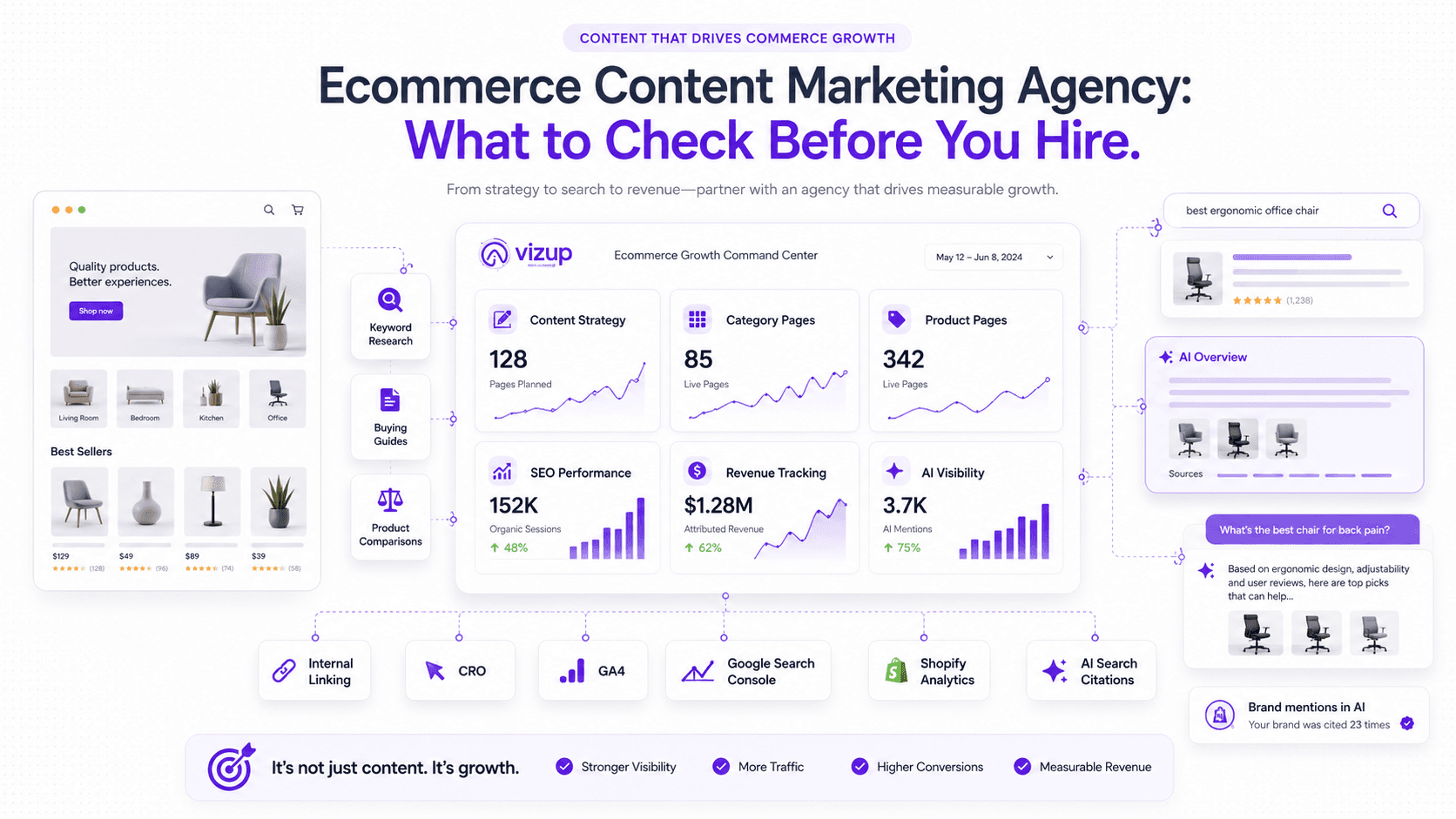
Hiring an ecommerce content marketing agency is not the same thing as hiring someone to crank out blog posts. That story usually ends with a content graveyard and a spreadsheet full of "traffic" that never turns into customers. The right agency behaves more like a growth partner: it treats content as a system that improves product discovery, organic visibility, purchase intent, and, yes, revenue. This is less about offloading tasks and more about bringing in expertise you do not have in-house. What follows is what to look for before you sign, shaped by a decade of watching what works and what fails in predictable, expensive ways.
What Does an Ecommerce Content Marketing Agency Do?
Start with the plain definition: a real ecommerce content marketing agency is not chasing generic "awareness" for its own sake. Its work is built around how online retail actually functions: search, category pages, product pages, merchandising, and the messy middle where people compare options before they buy. They are not just publishing content; they are building a commercial engine that connects information to transactions.
Ecommerce SEO and content strategy
This is the base layer. It begins with keyword research that cares about intent, not just volume: what people search when they are browsing, comparing, or ready to buy. You want to hear plans for supporting category pages with targeted content, writing product-led articles that naturally move readers toward a purchase, and building a blog strategy that covers the full journey. The part many teams miss is internal linking. Strong agencies can explain, concretely, how authority should flow from high-traffic informational posts into the product and category pages that actually pay the bills.
Product and category content
This is where specialization shows. Instead of recycling generic product descriptions, a serious shop-focused team writes collection-page copy that helps people choose, builds buying guides that answer the questions shoppers bring to Google, and produces comparison pages that do the hard work of decision support. For a D2C luggage brand, this might look like a series of comparison pages for carry-on versus checked bags or guides for "best luggage for a two-week trip". That kind of content is what turns "just looking" into "I know what I want." Done well, it preempts objections and removes uncertainty before it has a chance to stall the sale.
Full-funnel content creation
A good agency should be comfortable talking about the entire funnel without turning it into jargon. Top-of-funnel (TOFU) content is often problem-solving content that matches the need your product addresses. A skincare brand, for example, could create ingredient explainers or guides to building a routine for a specific skin type. Middle-of-funnel (MOFU) is where buying guides, comparisons, and product education live. Bottom-of-funnel (BOFU) is the unglamorous but high-leverage work on product pages, FAQs, and trust builders like testimonials. If an agency only wants to publish TOFU blog posts, you are not buying a growth strategy; you are buying a content calendar.
Email, social, and retention content
Content should not sit on your site and hope Google does the rest. A capable agency treats a strong guide as source material: it becomes social posts, an email nurture sequence, and even scripts for video ads. For a fashion brand, a styling guide showing three ways to wear a new jacket can be broken into short-form videos, Instagram carousels, and an email to recent purchasers of that item. More importantly, they plan for what happens after the first purchase. Retention content, onboarding, and post-purchase education can keep customers coming back, which is usually a better deal than paying to reacquire them every time.
Why Ecommerce Brands Hire Content Marketing Agencies
The reasons brands reach out have matured. A few years ago, the pitch was mostly about traffic. Now the questions are sharper: where does content fit in the business, and what does it do that paid media cannot?
To grow organic traffic
This is still the obvious starting point. A solid content strategy improves how often your site shows up when people search for the problems you solve and the products you sell. More visibility means more qualified visitors arriving with intent, not just curiosity. The upside is durability: you are building an audience you earn over time, rather than renting attention one click at a time.
To reduce dependence on paid ads
Paid ads can feel like a treadmill: stop spending and the traffic disappears. Too many ecommerce brands end up with a business model that only works as long as paid social keeps humming. Content works differently. A piece that ranks and converts now can keep doing it months or years later, which makes it closer to an owned acquisition asset than a recurring expense. That is the appeal: a channel you can build, improve, and actually own.
To improve product discovery
The best ecommerce sites do not behave like static catalogs. They guide people to the right choice. Content can do that guidance work: comparisons that make specs understandable, explainers that match products to use cases, and posts that show how an item fits into real life. This is not only an SEO play; it is user experience. Reduce confusion, reduce friction, and you increase the odds of a purchase people feel good about.
To support revenue, not just traffic
Traffic is a vanity metric if it does not show up in the business. The agencies worth hiring understand that from day one. Their definition of success is not "we hit a sessions target"; it is purchases supported, assisted conversions, qualified email signups, and measurable product interest. When an agency leads with traffic charts, skepticism is healthy. When it leads with how content influences revenue, the conversation gets serious.
What to Check Before Hiring an Ecommerce Content Marketing Agency
Here is the vetting process that matters. The goal is simple: figure out who can actually operate in ecommerce, and who is just selling a nice-looking package.
- 1. Do they understand ecommerce buying journeys? They should be able to walk you through how a query like "best running shoes for flat feet" turns into a category-page visit, then a comparison, then a specific product decision. If what you get is a keyword list and a promise, they are missing the point.
- 2. Do they have ecommerce-specific case studies? Vague claims like "increased traffic" are not enough. Ask for receipts: organic revenue growth, improved rankings for commercial category pages, and data on assisted conversions. A portfolio without live URLs or real numbers is a red flag.
- 3. Do they connect content with product and category pages? This is where a lot of agencies fail. They publish polished blog posts that live on an island, with no meaningful links or strategy that supports what the store sells. That is wasted effort. You want a clear plan for how informational content lifts commercial pages.
- 4. Do they understand SEO, CRO, and content together? Getting a visitor onto a page is only step one. What happens next matters more. The agency should be ready to talk about conversion rate optimization (CRO): how content nudges action, how layout supports decision-making, where CTAs belong, and how trust gets built. An ecommerce SEO agency that ignores conversions is leaving money on the table.
- 5. Do they know your ecommerce platform? Shopify experience is not the same as Magento or BigCommerce experience. Ask directly about your setup, whether that is WooCommerce, an Amazon-first marketplace brand, or a custom build. Platform familiarity shapes everything from implementation speed to what is realistic.
- 6. Do they create content for every funnel stage? A strong proposal is not just a list of blog topics. It is a map: top-funnel guides, mid-funnel comparisons and product education, bottom-funnel FAQs and category support, plus post-purchase content that helps retention.
- 7. Do they have a clear reporting system? Ask to see a sample report. It should go well past traffic and rankings into what you actually run the business on: organic revenue, assisted conversions, pages driving revenue, content decay alerts, and where the next opportunities are. If the report is basically a GA export, you are not getting a strategy partner.
The New Angle: Can They Help You Win in AI Search Too?
Search is shifting quickly. In 2026, it is not enough to fight for a spot among Google's ten blue links. More and more of the battle is about showing up in AI-generated answers.
Why ecommerce content now needs to be AI-ready
Customers are already finding products through Google AI Overviews, asking ChatGPT and Perplexity for recommendations, and using Gemini as a shopping assistant. If your content is not built clearly enough for answer engines, your brand may miss out on some high-intent discovery opportunities. Agencies that actually track ecommerce growth are treating this as part of the job now, not a nice-to-have.
What AI-ready ecommerce content looks like
This is not about stuffing keywords into paragraphs and hoping for the best. It is about being unambiguous: clear product information, explicit comparison sections, direct answers in FAQ-style formats, and content that reflects real expertise. Structured data (schema markup) is not optional. You are trying to make it easy for a machine to understand what the product is, who it is for, and how it stacks up against alternatives. The framing in what content marketing means in the AI search era gets at the shift.
Why brand mentions and citations matter
The target is no longer only a ranking; citations and brand mentions are becoming important visibility signals too. When someone asks an AI, "What's the best durable carry-on luggage under $200?", you want your brand to appear in the answer, not just somewhere in the sources list. That does not happen by accident. It takes a deep bench of trustworthy content that signals authority and earns mentions across the topic.
Questions to ask the agency
A quick way to see if an agency is current: ask how they track visibility in AI Overviews. Ask whether brand mentions and citations are KPIs they monitor. Ask how they evaluate competitor presence across multiple AI platforms. A team with a real content marketing strategy for AI search will answer without hand-waving. A team that stalls out is telling you where they are in the curve.
Red Flags to Watch Before Hiring
These are the patterns that show up right before the disappointment. Catch them early and save yourself the cycle.
- They only sell blog packages. If the proposal is "8 blogs per month" with no strategy, funnel mapping, or plan to tie content to revenue, you are looking at a content mill.
- They report only traffic. Traffic can be dressed up in a dozen ways and still mean nothing for the business. If they cannot connect work to sales, conversions, or leads, you are paying for activity, not outcomes.
- They ignore category and product pages. In ecommerce, commercial pages often matter more than the blog. An agency that lives exclusively in blog land does not understand ecommerce SEO content.
- They do not understand analytics. They should be fluent in GA4, Google Search Console, and your ecommerce analytics (like Shopify Analytics). If they cannot talk attribution and revenue tracking comfortably, they cannot measure what matters.
- They use generic AI content at scale. Using AI for research and outlines is one thing. Using it to pump out bland, interchangeable posts is another. That content does not build trust and rarely converts, and it is easy to spot. If you need to sanity-check output, an AI Content Checker tool can help.
Questions to Ask an Ecommerce Content Marketing Agency
Bring this checklist to sales calls and treat it like a filter, not a formality.
| Question | Why it matters |
|---|---|
| Have you worked with ecommerce brands in our niche before? | Confirms domain familiarity and reduces ramp-up time. |
| Can you show me content-led revenue results, not just traffic? | Separates agencies chasing sessions from partners driving business impact. |
| How do you choose content topics? | Signals whether there is real strategy behind the calendar, not just a keyword export. |
| Do you provide content support for category and product pages? | Non-negotiable for ecommerce SEO. The only acceptable answer is yes. |
| How do you measure success and what does your reporting look like? | Shows whether they track business outcomes or stop at vanity metrics. |
| What is your process for refreshing and updating old content? | Protects against content decay and shows they plan beyond launch. An ecommerce SEO audit guide can be a useful starting point for identifying what needs attention first. |
| How are you tracking and optimizing for AI search visibility? | Checks whether they are building for where discovery is headed, not where it used to be. |
| How do you collaborate with internal product, SEO, and paid media teams? | Tests whether they can integrate like a partner instead of operating as a silo. |
Ecommerce Content Marketing Agency vs. General Content Agency
This comes up constantly. The difference is not talent; it is focus. In ecommerce, that focus shows up in what gets prioritized, what gets measured, and what gets shipped.
| Factor | General Content Agency | Ecommerce Content Marketing Agency |
|---|---|---|
| Main focus | Blogs and brand awareness | Product discovery, SEO, and revenue |
| Content type | Mostly articles and whitepapers | Blogs, category pages, buying guides, FAQs, product descriptions |
| Metrics | Traffic, impressions, social shares | Revenue, conversions, assisted sales, lead value |
| SEO approach | Keyword-led | Keyword + product + funnel-led |
| Best for | Building top-of-funnel brand awareness | Driving measurable ecommerce growth |
How Vizup Helps Ecommerce Brands Build Smarter Content Growth
This is where the tooling starts to matter. When you can connect content decisions to outcomes, you stop guessing and start managing a system. Vizup is built for growth teams that want that line of sight: from content strategy to visibility to business results.
Instead of juggling separate tools for rank tracking, content audits, and analytics, Vizup pulls those views together. It tracks both SEO and AI visibility so you can see where your brand shows up and where competitors are taking the space. It also monitors content performance over time, making it easier to spot which assets are driving revenue and which ones are quietly decaying.
Vizup also pushes opportunity discovery beyond gut feel. Keyword and topic research is tied to content gap analysis against key competitors, which supports full-funnel planning based on data. The reporting is built to be readable by the people who run the business: it is designed to speak in revenue terms, not just rankings.
Final Checklist Before You Hire
Before you decide, run this list one more time and see where the agency is strong - and where it is vague.
- Ecommerce experience: They have worked with online stores before.
- Product and category page understanding: They have a plan for your commercial pages.
- SEO + CRO knowledge: They care about getting traffic and converting it.
- Strong case studies: They can prove their impact on revenue.
- Clear content strategy: They present a plan, not just a list of deliverables.
- Revenue-focused reporting: Their metrics align with your business goals.
- Content refresh process: They have a plan to keep content from going stale.
- AI search visibility understanding: They are prepared for the future of search.
- Transparent workflow: You know who you'll be working with and how.
- Good communication: They feel like a partner, not a vendor.
Conclusion
Hiring an ecommerce content marketing agency shouldn't be a leap of faith. It's a business decision, deserving business-grade scrutiny. Ignore low prices that don't pencil out, traffic promises that skip over conversions, and pitches that sound great but lack specifics on how content supports commerce. The right partner understands how buyers search, compare, and ultimately purchase. They don't just create content; they build a system that drives revenue. At Vizup, our team of SEO experts works with you to build the right strategy, execute it, and track performance. We combine our agency expertise with our own AI-powered platform to turn content from a cost center into a reliable growth engine. If you want to see how this combination of expert-led strategy and powerful tools can provide a clear view of your opportunities, book a demo of Vizup.
Frequently Asked Questions
What does an ecommerce marketing agency do?
An ecommerce marketing agency builds and runs content programs designed to grow organic traffic, improve product discovery, and support revenue. That can include SEO, blog and category-page content, buying guides, and work to make content visible in both traditional and AI-driven search results.
How much does it cost to hire an ecommerce content agency?
Pricing varies, but ultra-cheap packages usually signal trouble. A few hundred dollars a month tends to buy low-quality work or AI-spun content. A strategic partner often costs more because you are paying for planning, creation, measurement, and iteration, not just words on a page.
What's the difference between a content agency and an ecommerce SEO agency?
There is overlap, but the emphasis can change. A pure ecommerce SEO agency may lean harder into technical SEO and link building, while a content agency focuses on production. The strongest partners blend both, producing high-quality ecommerce SEO content inside a single strategy.
How long does content marketing for ecommerce take to show results?
Anyone selling instant results is selling a fantasy. In most cases, meaningful traction in organic traffic and rankings shows up in roughly 3-6 months. The point is to build an asset that compounds over time, which requires consistency.
Can an agency help with our Shopify/BigCommerce/Magento store?
Yes - and you should expect platform-specific experience. A strong ecommerce growth agency understands the technical SEO details, app ecosystems, and features of major platforms like Shopify, BigCommerce, and Magento, then tailors recommendations to your setup.
