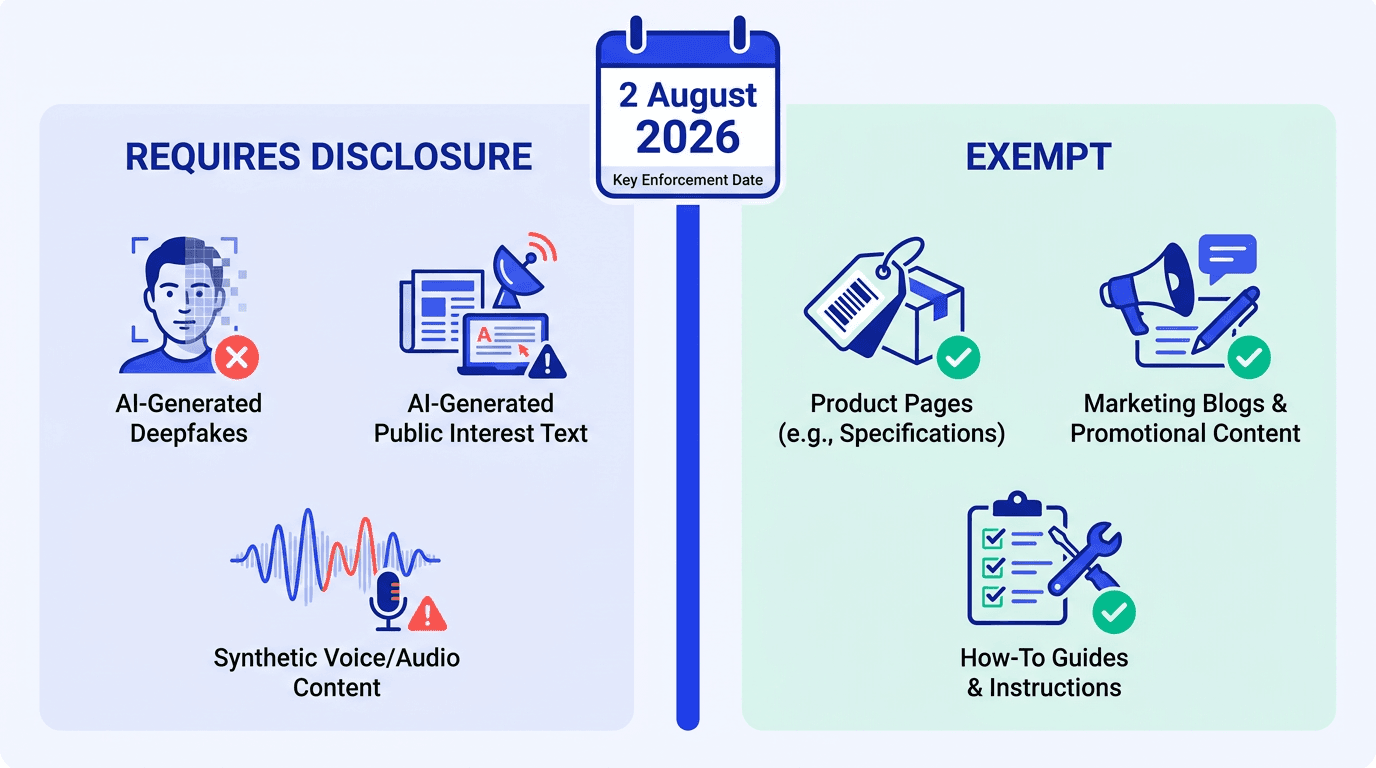
The EU AI Act's Article 50 transparency rules have applied since 2 August 2026. They require clear disclosure for a limited set of AI-generated content: mainly deepfakes and certain text published to inform the public on matters of public interest. Despite how it is often summarized, Article 50 does not require a visible label on every AI-touched marketing sentence.
That nuance is the difference between a workable policy and a mess. A lot of the chatter among publishers assumes EU AI Act content labelling means slapping a disclaimer on every blog post, product description, and landing page that passed through a generative tool. Article 50 is narrower than that. Misread it and you end up in one of two bad places: over-labelling (which makes pages noisier and can backfire on trust) or dismissing the rule as impossible and doing nothing. Platforms are tightening disclosure expectations too: Google's AI ad disclosures already push transparency for AI-assisted creative in paid media. Rules are converging from more than one direction, so the only efficient response is to be precise about what each one actually requires.
What Does Article 50 of the AI Act Actually Require?
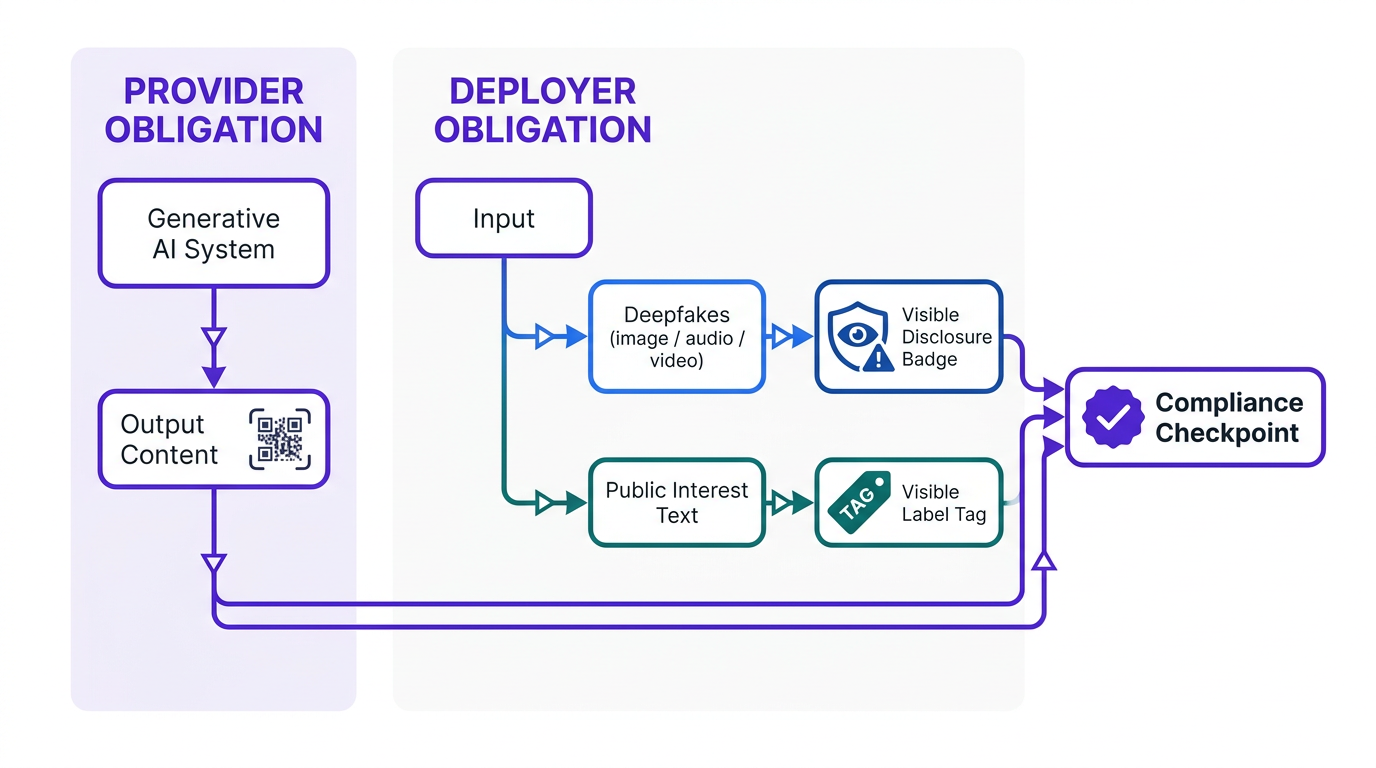
Article 50 sets out two separate transparency obligations: one for providers of generative AI systems, and one for deployers (the companies and publishers that use those systems). This is not framed as a ban on AI. It is a disclosure regime meant to help people tell authentic media from synthetic media in situations where that distinction can change what audiences believe or do.
The Provider's Duty: Machine-Readable AI Marking
Providers of generative AI systems must ensure that AI-generated or AI-manipulated output is marked in a machine-readable format and detectable as artificially generated or manipulated. Article 50 requires these technical measures to be effective, interoperable, robust, and reliable as far as technically feasible, taking content-specific limitations, implementation costs, and the state of the art into account. The obligation does not apply where an AI system performs only standard editing or does not substantially alter the input or its meaning. For a practical view of why machine-readable structure matters beyond compliance, see how AI search engines retrieve and cite content
The Deployer's Duty: When You Must Label AI Content
For content leaders, the deployer requirement is the one that touches day-to-day publishing. It triggers in two cases, and only those two.
Case 1: Deepfakes. If you use AI to generate or manipulate audio, image, or video that resembles real people, places, or events, you must clearly disclose that the content is artificially generated or manipulated. Topic does not matter here.
**Case 2: **Text on matters of public interest. If AI-generated or AI-manipulated text is published to inform the public on a matter of public interest, its AI origin must be disclosed unless the content has undergone human review or editorial control and a natural or legal person holds editorial responsibility for the publication. Routine product descriptions and software how-to guides are less likely to fall within this category, but commercial format alone is not a blanket exemption. Teams should assess the publication's purpose, subject, editorial process, and applicable Commission guidance.
There is also an exception for evidently artistic, creative, satirical, fictional, or analogous work, where disclosure can be handled in a way that does not hamper enjoyment of the work (The Guardian, 2026).
The 'Public Interest' Gray Area and the Role of Human Review
"Matters of public interest" is not tightly defined in the regulation, which is why teams keep asking where the line is. The European Commission's guidelines on transparency obligations try to narrow the interpretation, and the voluntary Code of Practice on marking and labelling AI-generated content lays out practical compliance methods. If providers and deployers sign the Code, they have a clearer way to show good-faith compliance, and the AI Office encouraged signature by 22 July 2026.
| Likely Requires a Visible Label | Likely Does Not Require a Visible Label |
|---|---|
| An AI-generated article analyzing upcoming EU elections | A product description for a new SaaS feature |
| A simulated video of a public figure speaking | A 'how-to' guide for using your software |
| AI-written public health advisory content | An SEO-focused blog post on marketing trends |
| AI-generated news summary on climate policy | An email campaign promoting a product launch |
| Synthetic audio resembling a real politician | AI-assisted internal knowledge base articles |
| The obligation targets content that informs the public on public interest matters, not routine commercial publishing. |
Human review is more than a risk-reduction factor in this context. Article 50 states that the disclosure obligation for public-interest text does not apply when the AI-generated content has undergone human review or editorial control and a natural or legal person holds editorial responsibility for its publication. Teams should therefore define what meaningful review involves, document who approved the content, and retain a clear record of editorial responsibility.
The Commission has also published a standardized set of icons for labelling. The guidance is clear about what does not count: disclosures buried in terms and conditions, tucked into a footer, or flashed briefly. If you disclose, do it where the audience actually encounters the content.
Key Dates and the Grace Period
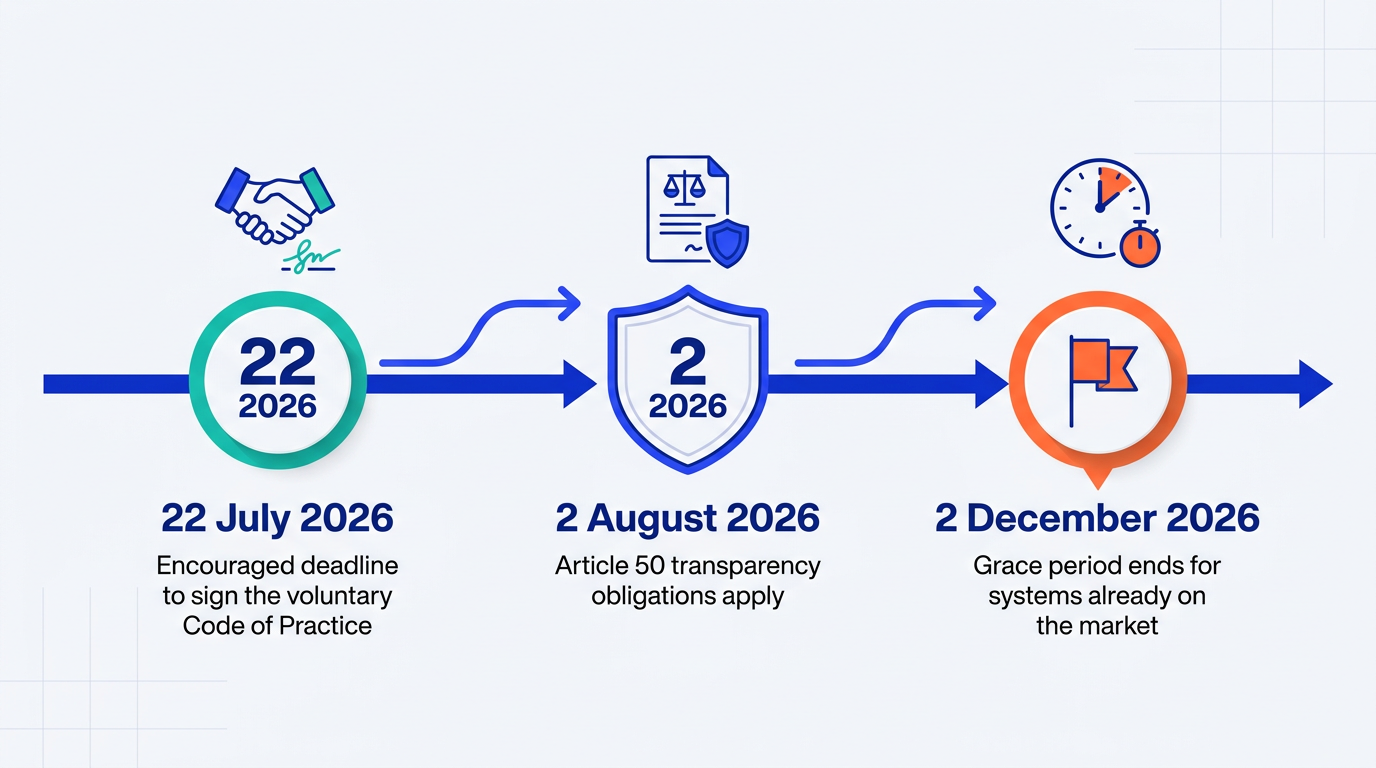
- 27 July 2026: Deadline for organisations that wanted to appear on the initial list of Code of Practice signatories published before Article 50 became applicable. Organisations may still sign the voluntary Code after this date.
- 2 August 2026: Article 50 transparency obligations became applicable, including deployer duties concerning deepfakes and qualifying public-interest text.
- 2 December 2026: Deadline for providers of qualifying generative AI systems placed on the market before 2 August 2026 to comply with the Article 50(2) machine-readable marking duty.
These obligations can reach any company whose AI outputs are used in the EU, even if the company is headquartered elsewhere. Non-compliance can trigger fines of up to EUR15 million or 3% of global annual turnover, whichever is higher (European Commission, 2026). This pressure is landing alongside other enforcement activity that affects digital publishing, including the CMA's investigation into Google's ranking changes.
Create an Internal AI Disclosure Standard
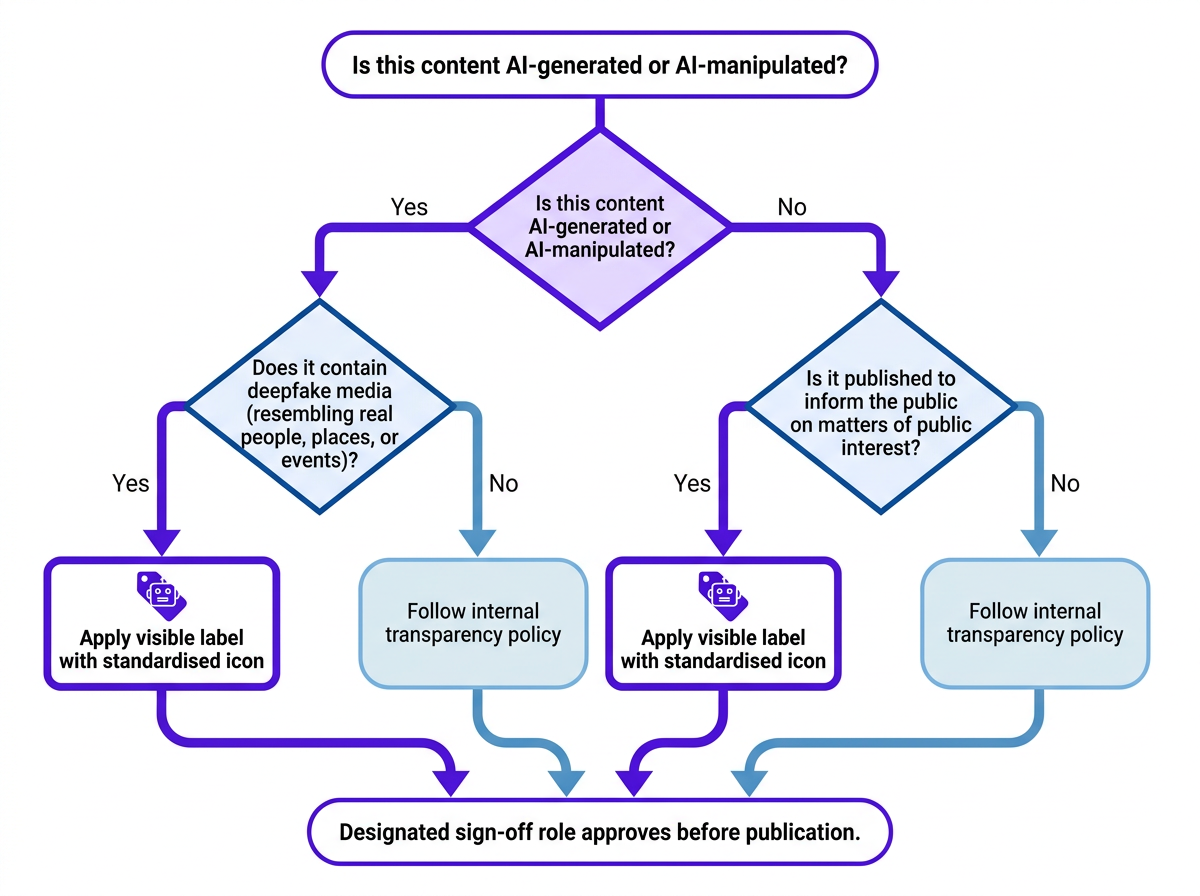
If you try to litigate the "public interest" question one URL at a time, you will burn cycles and still end up inconsistent across teams. A more implementable move is to set one internal ai generated content disclosure eu standard and run everything through it. That standard should settle three points.
- What gets labelled. Classify your content types. Public interest editorial and any deepfake-adjacent media get a visible disclosure. Standard marketing content follows your internal transparency policy, which can go beyond the legal minimum without increasing legal risk.
- Where the label sits. Use the Commission's standardized icons or a plain-text disclosure placed at the point of consumption, not hidden in a footer or a terms page.
- Who signs off. Name the role (editor, compliance lead, content ops manager) that owns the labelling decision for each piece before it goes live.
Vizup is positioned as an Organic Autopilot for modern discovery, helping brands monitor, create, optimise, publish, and learn across Search, Social, Communities, AI Answer Engines, and Local Discovery. It combines AI agents, human experts, and live SEO, pSEO, AEO, and GEO tools, while paid ads remain available as an amplification add-on. Legal and disclosure decisions should still be approved by the appropriate editorial or legal owner.
This mirrors what paid media has already learned: consistency beats improvisation. To keep it consistent, the policy has to live in the workflow, not in a wiki no one opens. That is where content governance automation earns its keep, especially as automated content creation grows as a share of output. Teams building broader AI content strategy frameworks should bake disclosure into the framework early instead of bolting it on after the fact.
Warning: This article provides general information and is not a substitute for legal advice. EU-facing publishers should confirm their specific obligations under the EU AI Act with qualified legal counsel.
Key Takeaways
- Article 50 of the AI Act applies from 2 August 2026 and creates separate obligations for AI system providers (machine-readable marking) and deployers (visible labelling in specific cases).
- Deployers must visibly label deepfakes and AI-generated text published on matters of public interest. Most commercial marketing content does not fall under the public interest clause.
- The AI Omnibus grants a grace period until 2 December 2026 for systems already on the market before the effective date.
- Human editorial review is a factor the guidance addresses when determining whether the labelling duty applies to public interest text, but it is not an automatic exemption.
- Rather than parsing each piece against a legal edge case, set one internal AI disclosure standard covering what gets labelled, where the label sits, and who signs off.
Frequently Asked Questions
Does the EU AI Act require labelling every AI-assisted blog post?
No. Article 50's visible labelling duty for deployers is limited to two situations: deepfakes (AI-generated or manipulated audio, image, or video resembling real people, places, or events) and AI-generated text published to inform the public on matters of public interest. Standard marketing blog posts, product pages, and how-to guides do not trigger that obligation. Many teams still choose to adopt an internal disclosure policy that goes beyond the legal minimum for brand trust reasons.
How does the Act distinguish AI-assisted from AI-generated content?
The European Commission's guidance separates fully AI-generated content from AI-assisted work where a human provides substantive editorial input. That level of human review is treated as a factor when assessing whether the public interest labelling duty applies. There is no single bright-line test for when human involvement is enough to remove the obligation, so teams should document their editorial process and treat review as a compliance control rather than an automatic safe harbour.
What is a machine-readable AI mark?
A machine-readable AI mark is a technical provenance signal applied to AI-generated or manipulated output so that downstream systems can detect its synthetic origin. This provider obligation is different from a visible disclosure shown to an audience. Detecting technical provenance markers is also different from probabilistic analysis of writing patterns. Vizup's AI Content Checker can help identify AI-like patterns in marketing copy, but it should not be presented as proof that an Article 50-compliant machine-readable mark is present.
Are there official icons or wording for AI content disclosure?
Yes. The European Commission has produced a standardized set of icons for labelling AI-generated content, and the voluntary Code of Practice on marking and labelling describes recognized compliance methods. The guidance also makes the placement requirement explicit: disclosures must be clear and distinguishable at the point of consumption. Labels hidden in terms and conditions, buried in footers, or shown only briefly do not meet the threshold.
What are the penalties for failing to comply with EU AI Act labelling rules?
Non-compliance with Article 50's transparency obligations can lead to fines of up to EUR15 million or 3% of global annual turnover, whichever is higher (Cooley, 2026). The rules apply to any company whose AI outputs reach users in the EU, regardless of where the company is headquartered. Given that reach, EU-facing publishers should confirm their obligations with legal counsel.
