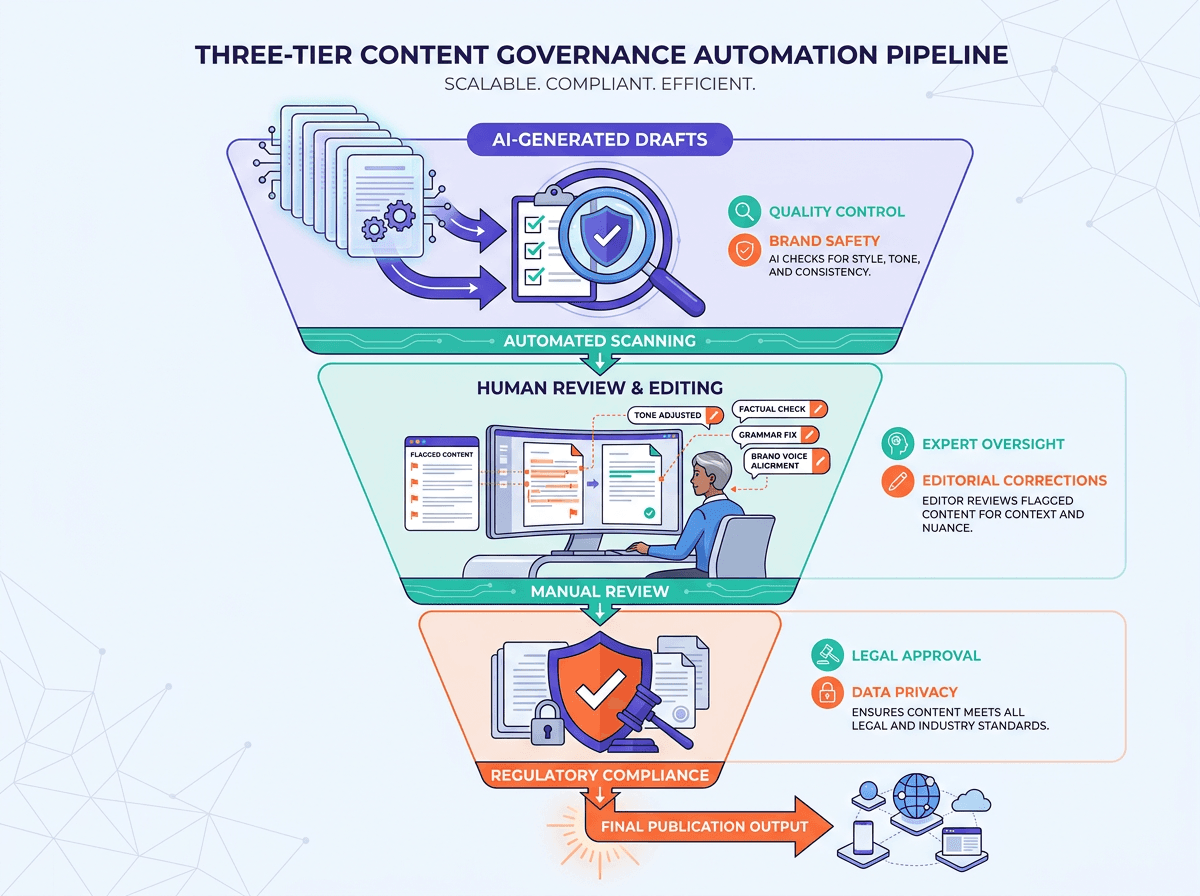
Most teams shipping AI content at scale still don't have a real quality gate between generation and publication. Content governance automation is what closes that gap. Ignore it, and the failure modes show up fast: organic traffic slides, brand safety blowups, and compliance messes that land on Legal's desk after the damage is already done.
This piece lays out a full governance workflow for AI-generated content: review tiers, brand safety controls, compliance sign-off, and the tooling that keeps the whole thing from collapsing under volume. If you're a content ops lead running a distributed team, or an editorial manager trying to put guardrails around an AI pipeline that's gotten ahead of you, the framework below is meant to be implementable this quarter. You'll get: what content governance actually means, the cost of ungoverned AI output, a three-tier workflow map, common implementation mistakes, a tool comparison, a practical four-step framework, and the edge cases that tend to break "standard" processes.
What Content Governance Actually Means (and Why Most Teams Get It Wrong)
Content governance is the set of guidelines, processes, policies, and roles that decide how content gets created, reviewed, published, and maintained over time. That sounds bureaucratic until you run it in production. Governance is the mechanism that answers two questions: what gets published, and who gets to say no.
Most governance programs were built for human-written content moving at human speed. Drop AI into that system and three things fail at once. Volume swamps manual review. Tone drifts across hundreds of pieces until the brand voice becomes a suggestion, not a standard. Errors multiply because no single reviewer sees enough of the output to notice the recurring patterns. The Content Marketing Institute has documented how cross-functional editorial boards keep organizations aligned at scale, but those models assume a cadence that AI production blows past.
Tip: Skip ahead to the workflow map section if you already run a documented editorial workflow with defined approval stages and escalation rules. If your current process is informal or undocumented, start here.
The Real Cost of Ungoverned AI Content
A SaaS company published 200-plus AI blog posts with no editorial review and watched organic traffic fall 34% in three months. Search engines did what they're supposed to do: they treated thin, duplicative posts as low-value. That's painful, but it's fixable. Brand safety incidents are the ones that linger.
The failure modes are familiar: factual mistakes, bias that reinforces stereotypes, and a voice that changes from post to post. On the ground, that can look like an AI draft inventing competitor endorsements, making legally risky health or financial claims, or contradicting your own positioning in the same quarter you're paying to promote it. Brand safety refers to measures that protect a brand from being associated with inappropriate or damaging content. AI output adds new paths to risk that many traditional review processes were never built to catch.
If you're in a regulated industry, the margin for error is thinner. In finance, health, and legal verticals, unverified claims can invite FTC scrutiny or create GDPR compliance problems without a human ever approving the copy. Gartner projected that by 2026, more than 80% of enterprises would have used GenAI APIs, models, or GenAI-enabled applications, making governance a practical requirement rather than a future concern. Most teams are still assembling them after something goes wrong. The NIST AI Risk Management Framework is a voluntary but credible baseline for building transparency and accountability into AI-driven content operations.
Mapping a Content Governance Automation Workflow
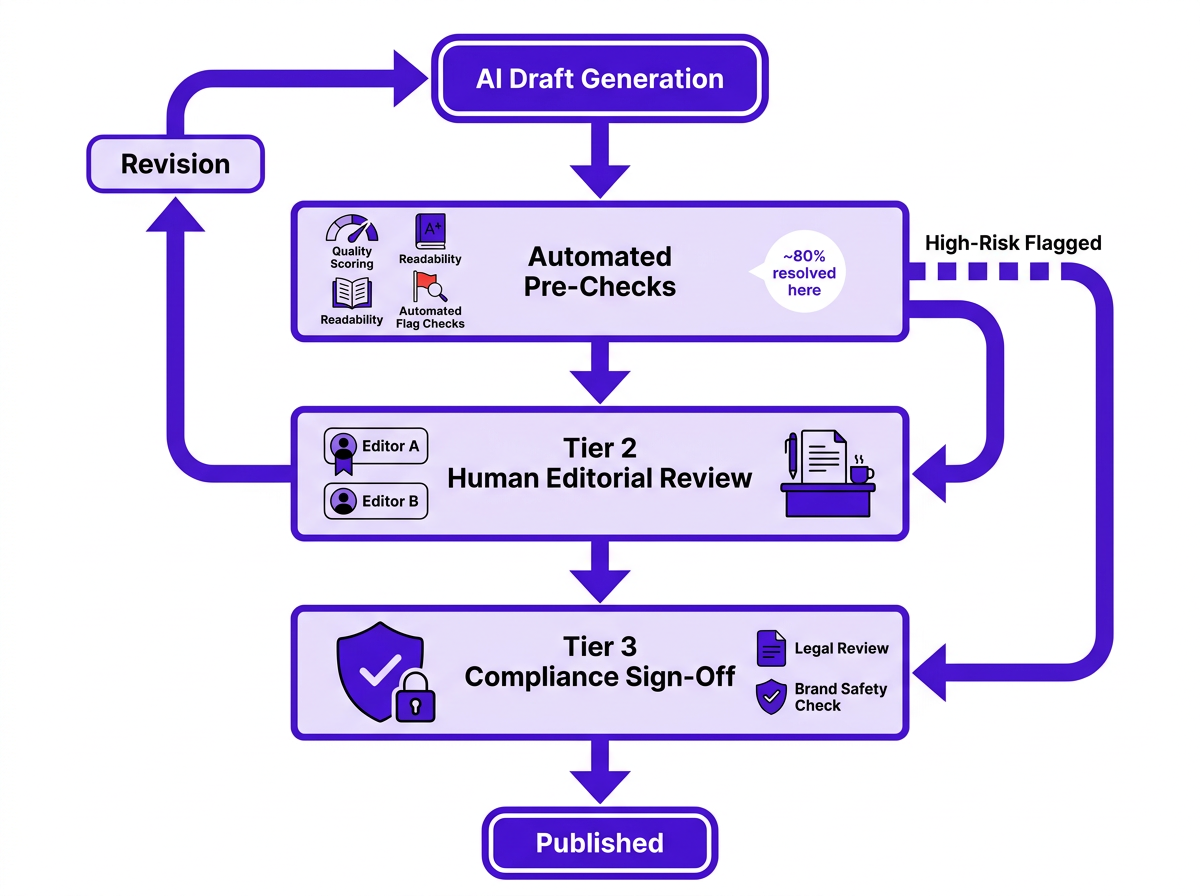
A three-tier model treats governance as a funnel, not a choke point. Tier 1 absorbs volume with automation. Tier 2 applies human judgment to the substance. Tier 3 is a targeted compliance gate, reserved for the pieces that actually warrant it. Done right, roughly 80% of content never needs to move past Tier 1.
Tier 1: Automated Pre-Checks and AI Content Quality Control at Scale
Tier 1 is where you catch the obvious problems before a human spends time on them. AI content quality control here typically includes flags for internal inconsistency, readability scoring, keyword stuffing detection, duplicate content checks, and brand voice scoring. Grammarly Business can enforce style, Originality.ai can handle AI detection and plagiarism, and custom GPT-based validators can be trained on brand terminology to catch off-message language. You can also scan drafts for policy or regulatory red flags and automatically redact sensitive information, which matters if you're publishing across multiple markets. If you are scaling AI content production, Tier 1 automation is what keeps scale from turning into chaos.
Tier 2: Human Editorial Review
Automation is decent at spotting what's wrong. Editors earn their keep by noticing what's missing. A draft can clear every automated check and still fail the basic test of usefulness. Tier 2 works best when responsibilities are explicit: a content lead checks strategic alignment and substance, a subject-matter expert validates claims and accuracy, and an editor tightens voice and flow.
Warning: If your editorial review is just checking grammar and formatting, you do not have editorial review. You have proofreading. Those are different jobs with different outputs.
Tier 3: Compliance Sign-Off and Brand Safety
Tier 3 should trigger based on clear characteristics: health or financial claims, competitor mentions, references to user data, or targeting regulated markets. Brand safety AI tools can surface risky drafts before they reach Legal using sentiment analysis, claim verification, and competitor mention detection. Quality control in AI marketing at this stage includes pre-generation filters, real-time validation against brand rules, and human approval workflows. Keep Tier 3 tight. If every asset needs legal review, Tiers 1 and 2 aren't carrying their weight.
What Most Teams Get Wrong About Content Governance Automation
Four mistakes that undermine otherwise well-designed governance systems:
- Treating governance as a one-time setup. Governance is a living system. Brand guidelines change, regulations move, and model behavior shifts. A framework that looked solid six months ago can already be outdated.
- Over-automating and removing human judgment. "Clean" content that doesn't move strategy forward is still a miss. Automation catches issues at scale; it doesn't replace editorial thinking.
- Building governance around volume targets instead of quality outcomes. Shipping 500 governed pieces isn't automatically better than shipping 100. Watch rejection rates and post-publication error rates, not just output.
- Ignoring post-publication monitoring. Governance doesn't stop at publish. Content can drift out of compliance as rules change, competitors reposition, and AI search surfaces your work in new contexts.
Tools and Platforms for Content Governance Automation
| Category | Example Tools | What It Automates | What It Misses | Cost Tier |
|---|---|---|---|---|
| AI Quality Control | Grammarly Business, Originality.ai | Style enforcement, readability checks, plagiarism and AI detection | Strategic alignment and niche-domain factual accuracy | Low to Mid |
| Editorial Workflow Platforms | Notion, Airtable, CoSchedule | Assignment routing, approvals, and SLA tracking | Substance review and compliance risk flagging | Low to Mid |
| Compliance and Brand Safety AI | Acrolinx, Writer.com | Brand voice scoring, regulatory term flags, competitor mention detection | Jurisdiction-specific legal nuance and visual content | Mid to High |
| Post-Publication Monitoring | Vizup | AI search visibility, answer engine performance, and content drift detection | Pre-publication quality problems | Mid |
| No single tool covers the full governance pipeline. The real skill is assembling the right stack for your content volume and risk profile. |
Vizup sits in the post-publication layer, monitoring how AI-generated content shows up and performs across search and answer engines. Once governed content is live, making content discoverable in AI engines becomes part of the governance job: you need to see how answer engines cite your pages and what they claim your content says.
Building Your Governance Playbook: A Practical Framework
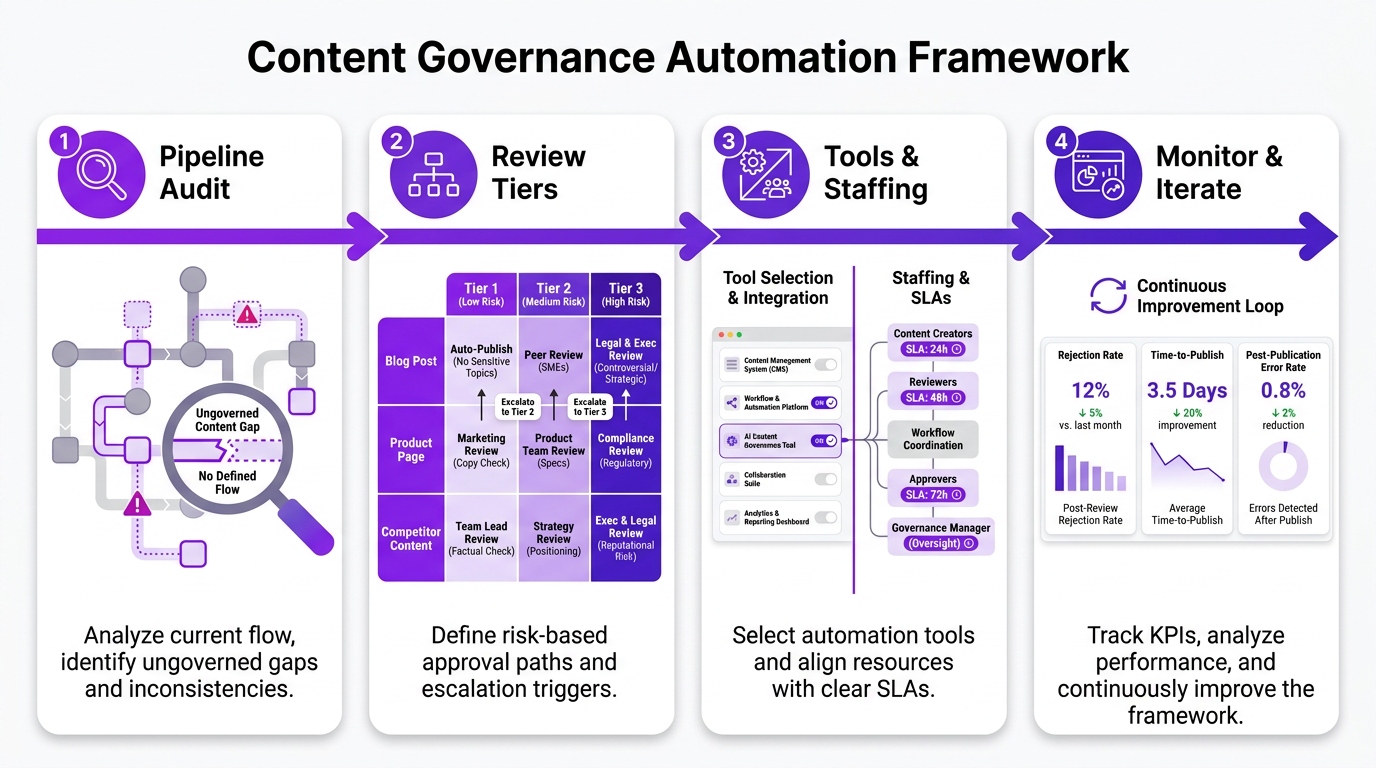
Step 1: Audit Your Current Content Pipeline
Map every touchpoint from brief to publish. Most teams uncover a couple of ungoverned gaps they didn't realize they had, usually between AI generation and first human review, or between editorial approval and the moment something goes live. Call out the content types with the highest risk: product pages, comparison content, and anything that makes data claims tend to be the repeat offenders. Cleaner inputs help too; better crafting high-quality AI content prompts upstream means fewer problems piling up in your review tiers downstream.
Step 2: Define Review Tiers and Escalation Rules
Build a decision matrix that maps content type and risk level to the right review tier. A standard blog post on a non-regulated topic should run through Tier 1 and Tier 2. Content that makes financial projections or names a competitor should automatically escalate to Tier 3. Write the triggers down in plain language so the system can run without a debate on every draft.
Step 3: Automate What You Can, Staff What You Must
Pick Tier 1 tools based on volume and budget, then staff the human checkpoints with explicit service-level agreements. "Reviewed within 48 hours" is governance. "Reviewed when someone gets to it" is a backlog with a nicer name. You'll see the difference in your publication error rate.
Step 4: Monitor, Measure, and Iterate
Measure three governance KPIs: rejection rate at each tier, time-to-publish, and post-publication error rate. Use Vizup's answer engine monitoring to compare governed content against older, ungoverned cohorts in AI search results. That side-by-side is often the cleanest justification for investing in AI content strategy frameworks that treat governance as foundational, not optional.
Advanced Considerations: When Governance Gets Complicated
Enterprise teams running multiple brands or markets get hit with the hard version of governance. Different voices, regional compliance requirements, and language-specific standards all need to live in one operating model. In practice, that usually means a shared governance architecture with market-specific rule sets layered on top, not separate systems for every brand.
One edge case that doesn't get enough airtime: governing AI-generated content that becomes input for other AI systems. Product descriptions consumed by answer engines, for instance, have to satisfy compliance requirements and AEO expectations at the same time. If the source copy is wrong or off-brand, answer engines can amplify it by repeating it as fact. That's where content compliance and answer engine optimization collide, and many governance programs still don't account for it.
The next frontier is governance for AI-generated visuals and video. Text-first frameworks don't map cleanly to images or motion assets, and most compliance tooling still lags. If you're producing multimodal AI content, extend your review tiers to cover visual assets explicitly rather than assuming text governance covers the whole package.
Info: Content governance automation is not about slowing down your content machine. It is about making sure the machine does not drive off a cliff while you are celebrating output numbers.
Frequently Asked Questions
How does content governance automation differ from a standard editorial workflow?
A traditional editorial workflow is mostly a sequence of manual handoffs. Content governance automation adds enforceable rules, automated pre-checks, and escalation triggers that don't depend on someone remembering to look for a problem. That makes the system scale with AI volume without requiring a matching increase in editorial headcount. It also extends beyond publication into monitoring, which many editorial workflows never formalize.
Can AI content quality control tools replace human editors?
No. Automated tools are strong at high-volume checks like readability, duplication, brand terminology violations, and regulatory keyword flags. They don't reliably judge strategic alignment, contextual accuracy in a specific industry, or whether the piece is actually worth a reader's time. Human editorial review is still the backstop for substance, not just polish.
Which industries need content compliance checks most?
Finance, healthcare, and legal carry the most risk because AI-generated claims can trigger FTC scrutiny, GDPR issues, or sector-specific enforcement. Pharmaceuticals and insurance are close behind, along with any industry governed by advertising standards bodies. Even outside regulated verticals, any brand making comparative claims or citing data benefits from compliance checks.
How do you know if a content governance system is working?
Track rejection rate at each tier (a healthy Tier 1 catches 70-80% of issues), time-to-publish (governance shouldn't add more than 20-30% to your cycle), and post-publication error rate (complaints, corrections, legal flags). For outcomes, compare organic and AI search performance between governed and ungoverned content cohorts.
What is the minimum team size to implement content governance automation?
A two-person team can run a functional system: one person configures and monitors Tier 1 automated checks, and one person owns Tier 2 editorial review. Tier 3 compliance can be a part-time legal or compliance resource that only engages when escalation rules trigger. Workflow design matters more than headcount; clear tiers and triggers beat a larger team working from an undocumented process.
Key Takeaways and Your Next Move
Content governance automation works best as a three-tier funnel: automated pre-checks catch most issues, human editorial review covers what automation can't, and a targeted compliance gate handles high-risk content without dragging everything through Legal. It only holds together when all three tiers are defined, staffed, and connected with documented escalation rules.
Treating governance as overhead is a classic false economy. Ungoverned AI content creates brand safety incidents, compliance exposure, and SEO decay that cost far more to unwind than it costs to prevent. The teams that win are the ones that publish at AI speed while keeping human-grade controls in place.
Start this week with a pipeline audit using the four-step framework above. Find the ungoverned gaps, write down the escalation rules, and use Vizup's AI content checker to add post-publication monitoring as the last layer in your governance stack.
