If your SEO program has been humming along for years and your traffic numbers suddenly started acting strange, you're not imagining things. Rankings can look fine while leads soften, branded searches wobble, and customers swear they "found you in an AI answer" you can't even track. That disconnect is real, and it's growing.
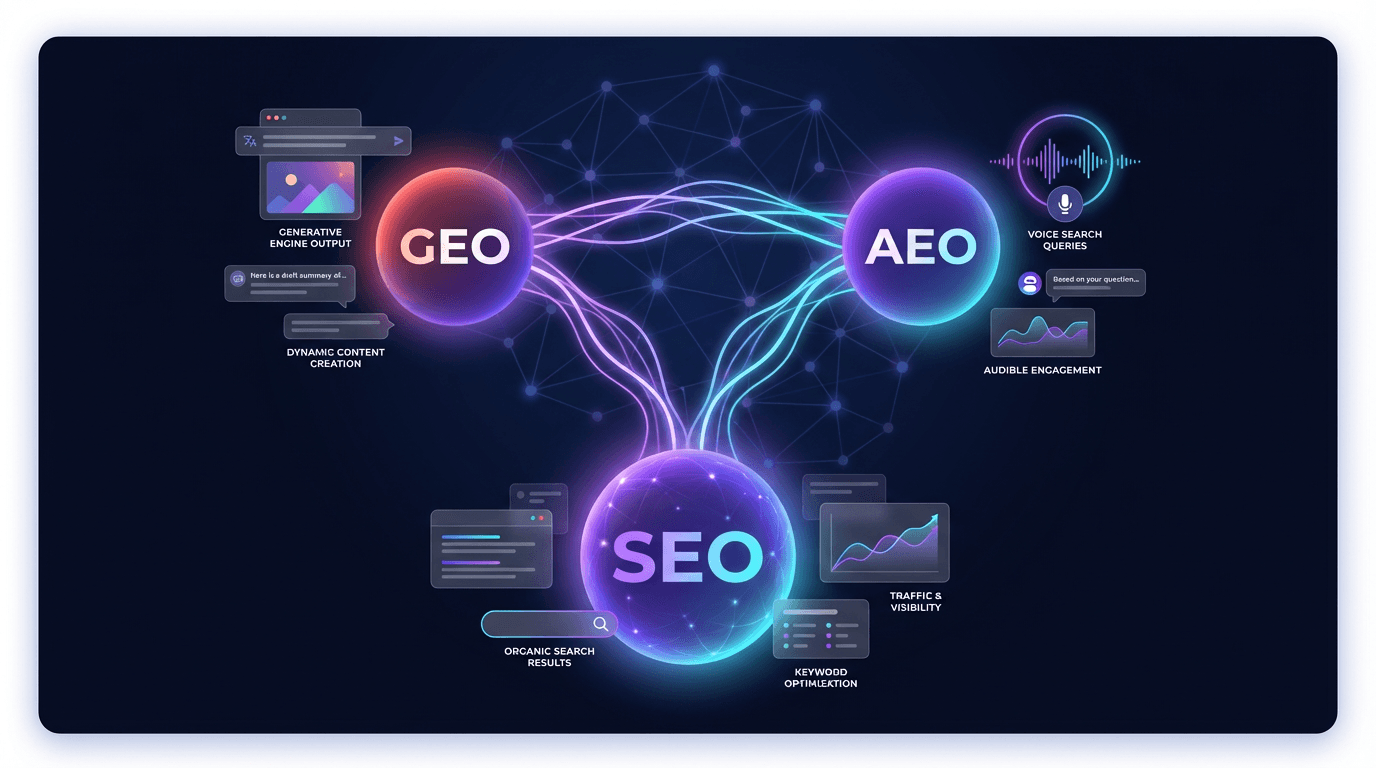
"GEO vs AEO vs SEO" keeps surfacing in marketing conversations because these aren't interchangeable buzzwords. They represent different visibility layers, each with different mechanics and different failure modes. SEO gets you ranked in traditional results. AEO gets you selected as the direct answer. GEO gets you cited or pulled into generative AI responses. They don't always overlap, and understanding how Google's AI mode changes SEO is a useful starting point for why this suddenly feels urgent.
SEO: The Foundation That Still Holds (With Caveats)
SEO still pays the bills. It just changed jobs.
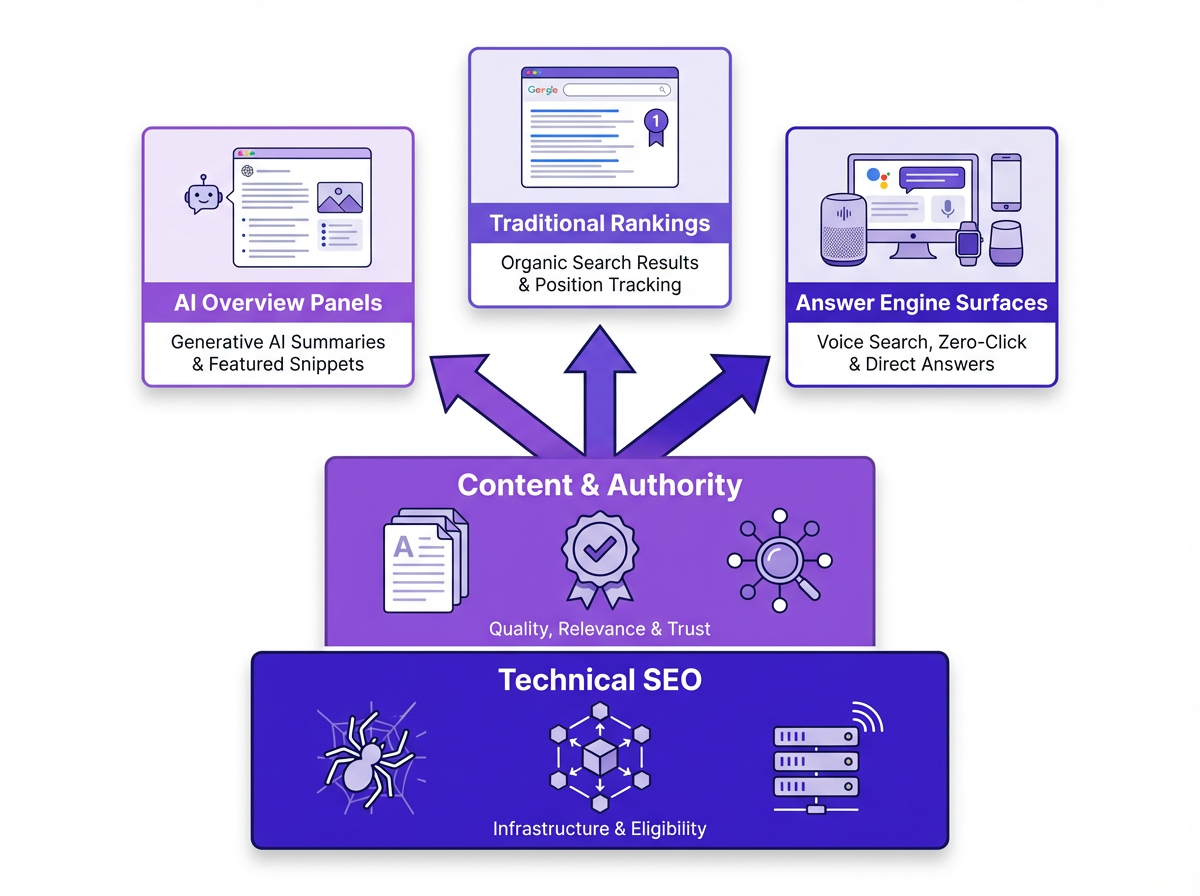
Search Engine Optimization covers how search engines crawl, index, and rank pages. That's the textbook definition. In practice, SEO is the part that makes you eligible to show up anywhere, including answer surfaces and AI summaries. If Google can't reliably fetch your pages, understand what they're about, and trust them, AEO and GEO become wishful thinking.
Why Rankings Alone Are Misleading
Obsessing over "position 1" is often a distraction in 2026. I've seen teams celebrate a ranking win while conversions drop because the query got swallowed by an AI Overview, or because the page didn't actually resolve the intent. Rankings still matter, but they're not the whole scoreboard anymore. The metric that actually moves pipeline is whether your page gets used, not just displayed.
Two Problems That Keep Showing Up in Audits
First, content volume is not a strategy. Publishing 200 thin pages doesn't outperform 30 genuinely useful ones. Second, "SEO best practices" copied from 2018 are quietly harmful. If you're trying to map what changed and why your old playbook stopped working, recent Google core updates are a clean place to start, then bring those learnings into your content standards and QA process.
AEO: Optimizing for the Answer, Not the Click
If you want a practical bar for modern SEO, use this: can a new visitor land on your site, understand what you do in 10 seconds, and find the next relevant page without hunting? If the answer is no, your technical SEO and internal linking might be "fine" but your information architecture isn't. And that's what search systems are increasingly evaluating.
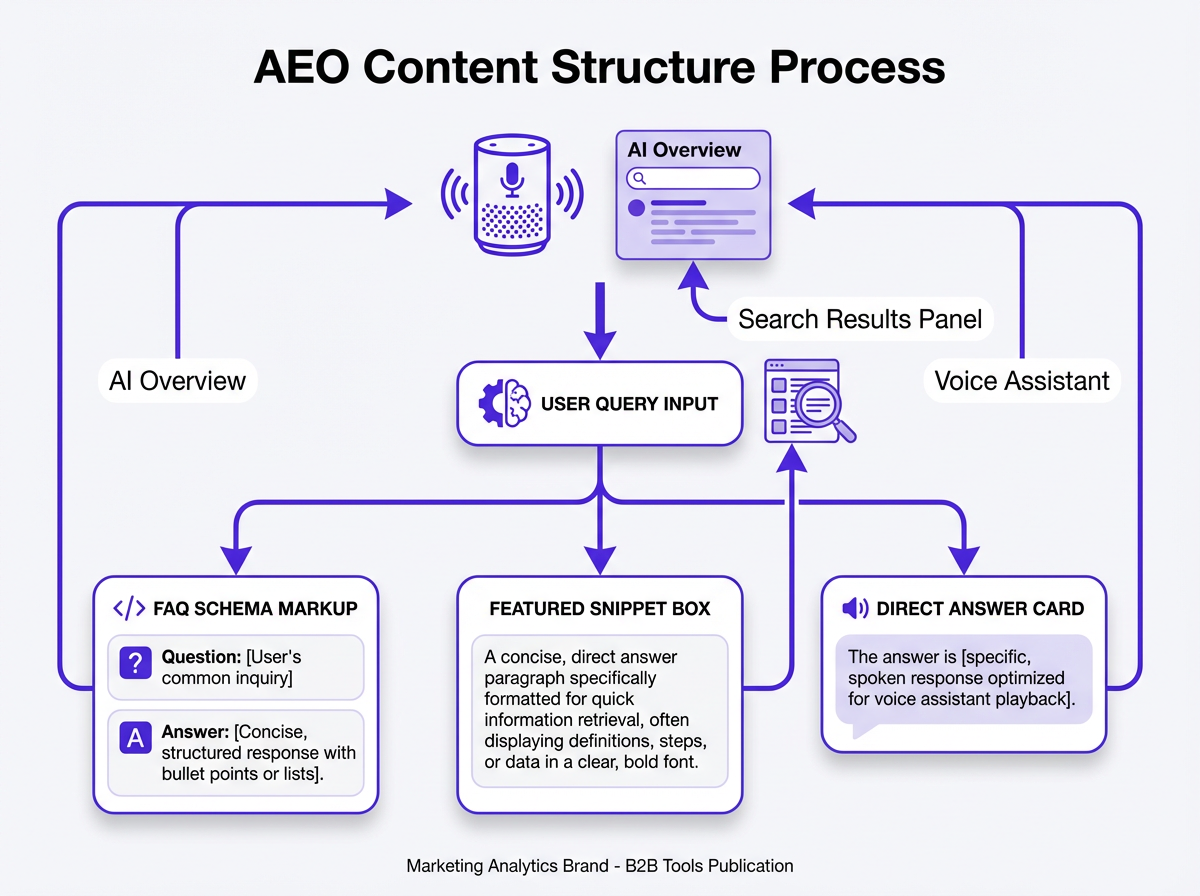
AEO is where a lot of "we're getting traffic but not outcomes" problems get solved. Answer Engine Optimization is about structuring content so it gets surfaced as the direct answer in AI Overviews, featured snippets, and voice assistant responses. Not a blue-link click. The answer itself.
The Scale of the Shift
The usage trend is hard to ignore. As of 2026, there are an estimated 8.4 billion voice assistants in use globally, and reports show that mobile voice searches are three times more likely to be for local queries compared to text searches. Those two stats explain why answer surfaces keep stealing attention from classic SERPs.
AEO isn't "SEO for voice." Voice is just the most unforgiving version of the same dynamic. When someone asks a device "where can I get a good espresso near me," they're not browsing. They're delegating. The engine picks one or two options, and everyone else becomes invisible.
What Actually Wins in AEO
The approach is simpler than most guides make it. Pick a high-intent question, answer it directly in a tight paragraph, then back it up with specifics that prove you know what you're talking about. Hours, pricing ranges, constraints, definitions, steps, whatever the query demands. If you've tried this and gotten garbage results, you're not alone. The usual culprit is that the page never commits to an answer. It dances around it.
The Local Connection Most Teams Underestimate
AEO and local marketing are more tightly connected than most people admit. Schema markup and FAQ sections matter, sure. But so do obvious location signals and consistency. If your address format changes across pages, or your service area is vague, you force the engine to guess. Engines guess poorly. A neighborhood bakery with well-structured local content can win "near me" voice results that a national chain can't, because the query is inherently local.
GEO: Getting Cited by Generative AI
GEO is the layer most teams feel but can't measure yet. That's why it gets hand-wavy fast.
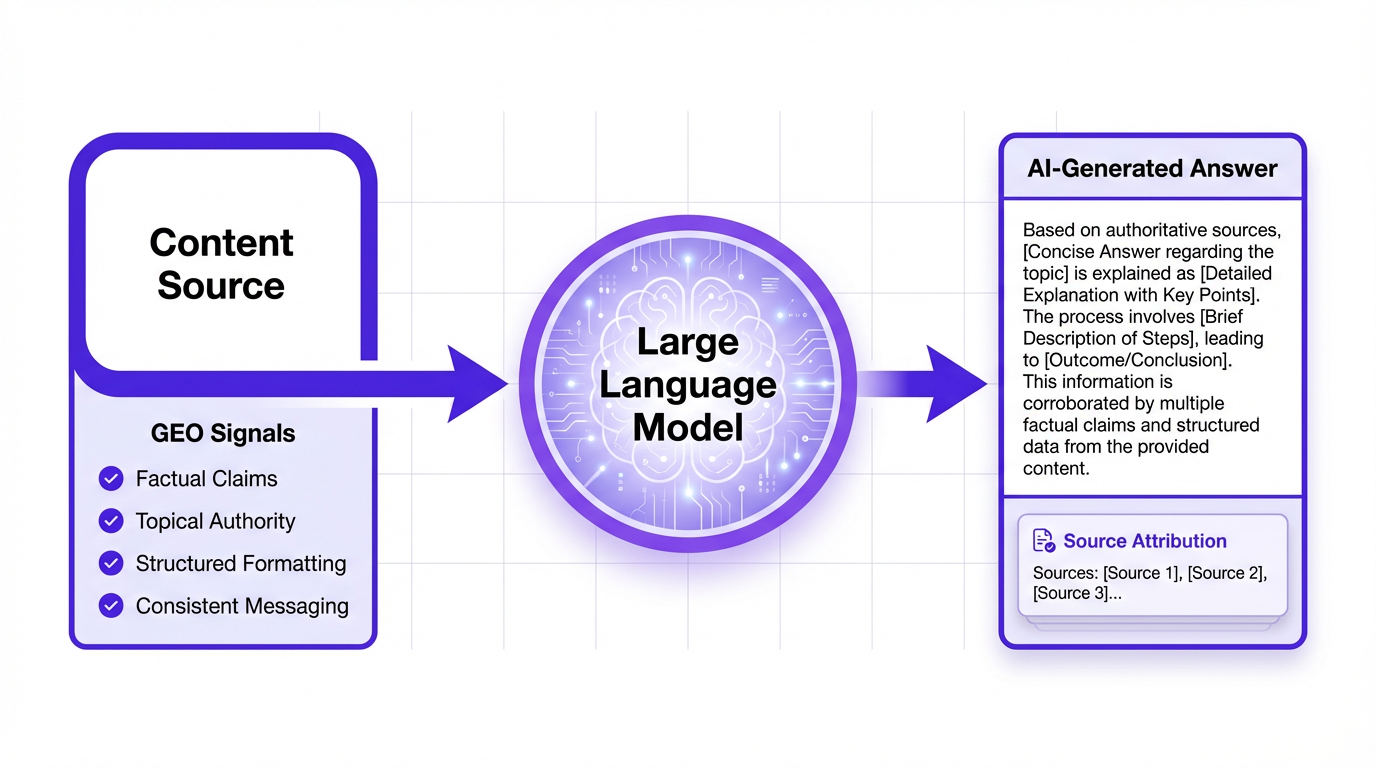
Generative Engine Optimization is the practice of optimizing content so that large language models can understand, cite, and incorporate it into their generated responses. It's newer than SEO and AEO, and the playbook is still settling. But the stakes are already clear: if your brand isn't in the AI's answer, someone else's is.
GEO Is About Being a Source, Not Gaming a System
GEO isn't about ranking. There's no position one. The goal is to become a source that AI systems trust enough to reference when generating answers. That pushes you toward clear factual claims, credible citations, structured formatting that models can parse, and enough topical authority that your work shows up in training data and live retrieval contexts. If you're already working on building an AI-powered SEO strategy, GEO is the extension that forces you to write like a source, not like a content farm.
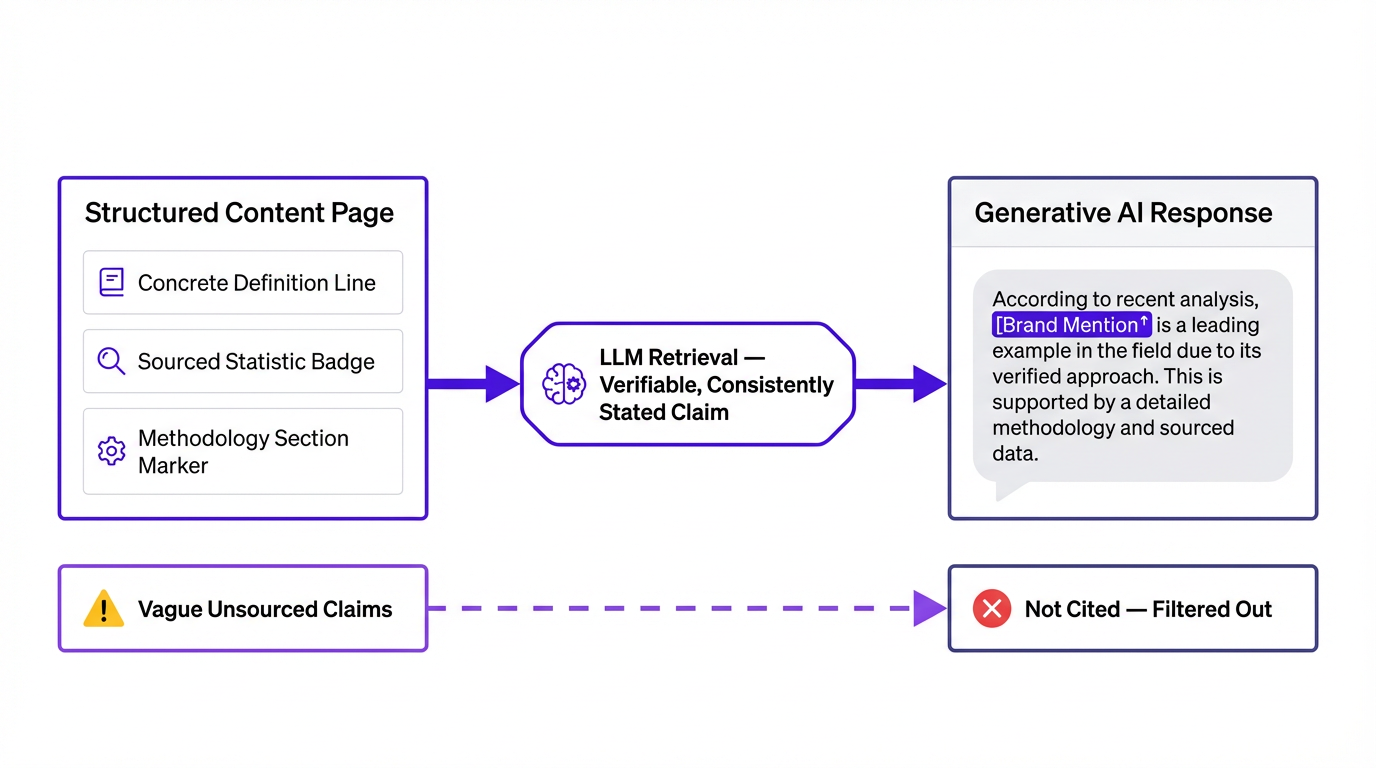
Here's the part most people get wrong. They treat GEO as a trick, like "add a few citations and AI will quote us." It doesn't work that way. AI systems tend to echo the most repeatable, verifiable, consistently stated information. If your messaging changes every quarter, or your claims aren't anchored to anything, you won't get pulled in. Not because you're "penalized," but because you're ignorable.
How GEO, AEO, and SEO Actually Compare
| Dimension | SEO | AEO | GEO |
|---|---|---|---|
| Primary Target | Search engine rankings (Google, Bing) | Voice assistants, AI Overviews, featured snippets | Generative AI responses |
| Success Metric | Organic traffic, SERP position | Direct answer appearances, voice result wins | AI citations, brand mentions in generated content |
| Content Format | Long-form, keyword-optimized pages | FAQ structure, schema markup, concise answers | Authoritative, well-sourced, structured prose |
| Local Relevance | Moderate (local SEO tactics) | High (voice search is 3x more local) | Moderate (depends on AI retrieval context) |
| Maturity | Established (30+ years) | Emerging (5-7 years) | Very new (2023-present) |
| Comparison based on current platform behaviors as of 2026. Boundaries between disciplines continue to evolve. |
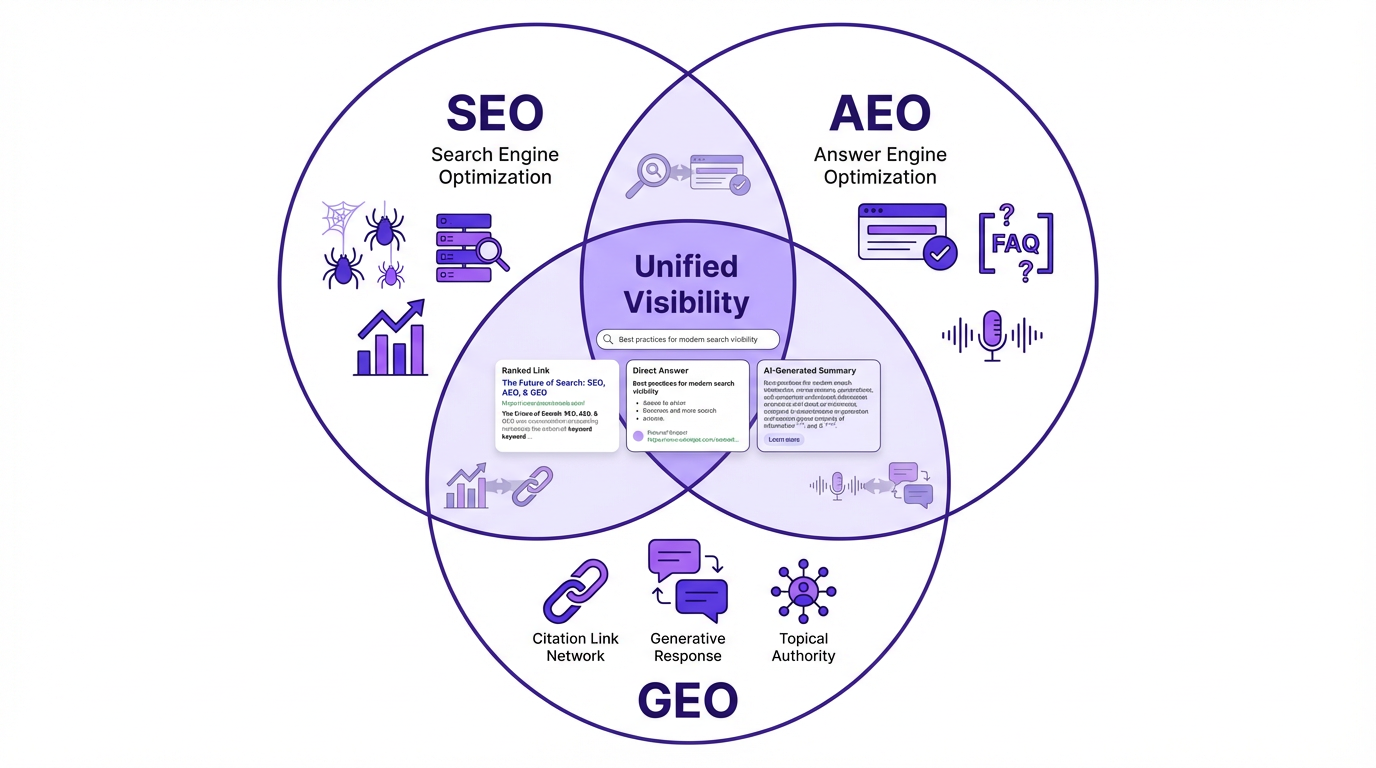
These three aren't competing strategies. They're layers.
SEO is eligibility. It gets you crawled, understood, and ranked. AEO is selection. It gets you chosen as the direct answer when the interface collapses ten links into one response. GEO is synthesis. It gets your brand pulled into the generated output when users stop searching and start asking.
What Happens When You Skip a Layer
Skipping a layer creates a specific kind of gap. If you rank but never show up in answer boxes, you're leaving high-intent queries to whoever structures content better. If you win snippets but never get pulled into AI answers, you become a commodity source instead of a named source. The reason organic marketing is now so much more than just SEO is that those gaps are now visible in pipeline, not just in Search Console charts.
Common Misconceptions Worth Correcting
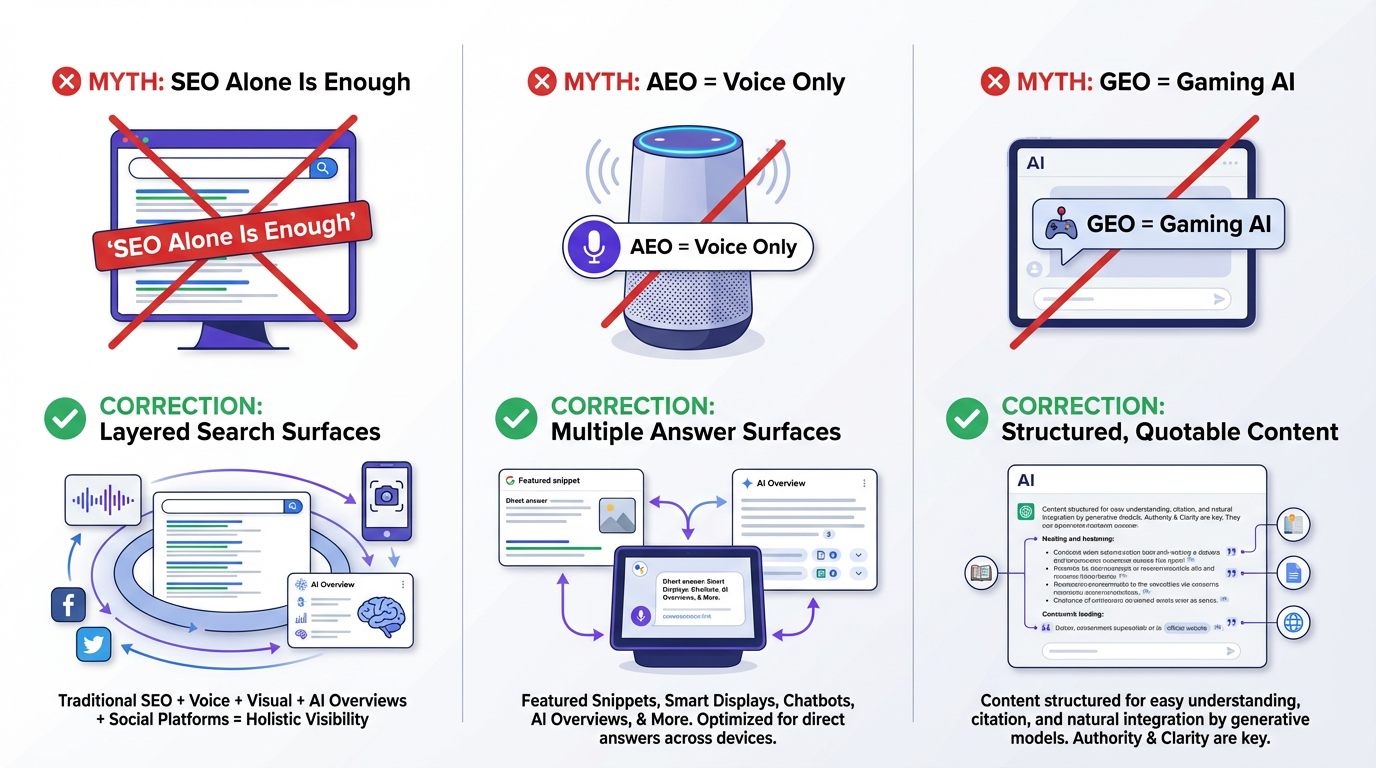
"AEO Is Just SEO for Voice Search"
It isn't. AEO covers any surface where content is returned as a direct answer, including AI Overviews on desktop, featured snippets, and chatbot-style interfaces. Voice is one channel. The underlying requirement is the same: your page has to answer a question cleanly enough that a machine can extract it without making stuff up.
"GEO Means Building a Separate Content Library"
Usually false. In practice, GEO improvements overlap heavily with content fundamentals: clear structure, cited sources, original analysis, demonstrated expertise. You're not starting over. You're raising the quality bar on what you already publish, and you're making your claims easier for AI systems to reuse.
"Small Businesses Can't Compete in AEO or GEO"
This is where the conventional SEO playbook misleads people. Local specificity is an advantage in AEO. A neighborhood bakery with well-structured local content can win "near me" voice results that a national chain can't, because the query is inherently local. I've watched this happen with boring consistency. Domain authority matters less than relevance and structure when the question is hyperlocal.
Putting It Together: A Practical 2026 Playbook
Most teams don't need a new strategy deck. They need a better operating system.
Start With a Layer-by-Layer Audit
Separate symptoms from causes. Are pages ranking but not winning featured snippets or AI Overviews? That's an AEO gap. Getting traffic but never showing up when users ask AI systems about your category? That's a GEO gap. Skipping location signals or publishing inconsistent business details? You're kneecapping local intent, which is where a lot of the highest-converting searches live.
A 10-Query, 90-Day Rollout
This doesn't have to turn into a six-month project. Ten queries is enough to prove what works for your niche, your site, and your sales motion.
A 10-query, 90-day rollout:
- Pick 10 money queries, the ones that lead to demos, calls, or store visits, not vanity traffic.
- For each query, decide the target surface: classic SERP (SEO), direct answer (AEO), or generative citation (GEO). Sometimes it's two surfaces, but be explicit.
- Rewrite the page so the first 120 words commit to an answer. Then add proof: sources, constraints, examples, and internal links to supporting pages.
- Add structured data where it makes sense (FAQPage, HowTo, LocalBusiness). Don't spam schema. Align it with visible content.
- Measure outcomes by layer: rankings and clicks for SEO, snippet impressions for AEO, and brand mentions or citations in AI outputs for GEO. Track it monthly for 90 days before you declare it "not working."
Tooling That Connects the Layers
Most teams trying to manage GEO vs AEO vs SEO end up with a messy stack: one tool for rankings, another for schema, a spreadsheet for AI mentions, and a lot of guesswork in between. Platforms built for AI-powered organic marketing, like Vizup, are designed to reduce that chaos. Instead of stitching together legacy workflows, Vizup gives you one place to run crawls, generate content briefs, check schema against what the page actually says, and report performance across SEO, AEO, and GEO.
Vizup's Visibility Graph is the part I wish more teams had earlier. It maps how queries, platforms, and content are connected, so you can spot the failure mode fast. A page can rank, but still lose the answer box because the opening paragraph never commits. Another page can be perfectly written, but never get pulled into AI answers because it lacks quotable claims or consistent sourcing. Seeing those gaps visually changes the conversation from "publish more" to "fix the one thing that's blocking selection."
A Practical GEO Habit That Pays Off
Write at least one paragraph per key page that contains concrete, quotable statements. Definitions. Numbers. Boundaries. A short methodology. The kind of text a model can lift without rewriting. I've seen teams spend weeks chasing AI visibility when the fix takes an afternoon of tightening claims and adding real sourcing.
The Future of Engine Optimization: Where SEO, AEO, and GEO Are Headed
The lines between these three disciplines are blurring faster than most roadmaps can keep up with. A few data points paint the picture clearly.
Back in early 2024, Gartner projected that traditional search engine volume would drop 25% by 2026 as AI chatbots and virtual agents absorbed queries that used to hit Google. We're living in that window right now, and the early numbers suggest the shift is tracking close to that forecast. Data from analytics firms in 2025 showed AI Overviews appearing in anywhere from 13% to over 50% of Google search results, depending on the month and query type, up from near zero just two years prior. That's not a niche feature anymore. It's a core part of the results page, and tools like Vizup help marketers track exactly how their content performs within these AI-generated summaries.
SEO isn't dying, but it's losing ground fast. Generative and answer surfaces are eating into the clicks that traditional search results used to own, and that shift is accelerating. GEO sits at the center of where discovery is headed because AI-generated responses are becoming the first touchpoint for millions of queries. If your content isn't structured to be cited, summarized, and surfaced by large language models, you're invisible in the fastest-growing channel in search. Teams still treating SEO as their only optimization discipline are optimizing for a shrinking slice of where buying decisions actually happen. GEO is the discipline that closes that gap, and Vizup's AI visibility tracking helps you measure exactly how much ground you're gaining (or losing) across these generative surfaces.
Convergence, Not Replacement
The most likely trajectory isn't that GEO replaces SEO or AEO replaces both. It's convergence. Google's own product direction tells the story: AI Overviews pull from indexed pages (SEO), select direct answers (AEO), and synthesize multi-source responses (GEO) all within one results page.
For marketers, the implication is that siloed teams (one group doing "SEO," another doing "AI content") will increasingly produce fragmented results. The winning structure is a single visibility function that thinks in layers, not channels.
Three Trends to Watch Through 2027
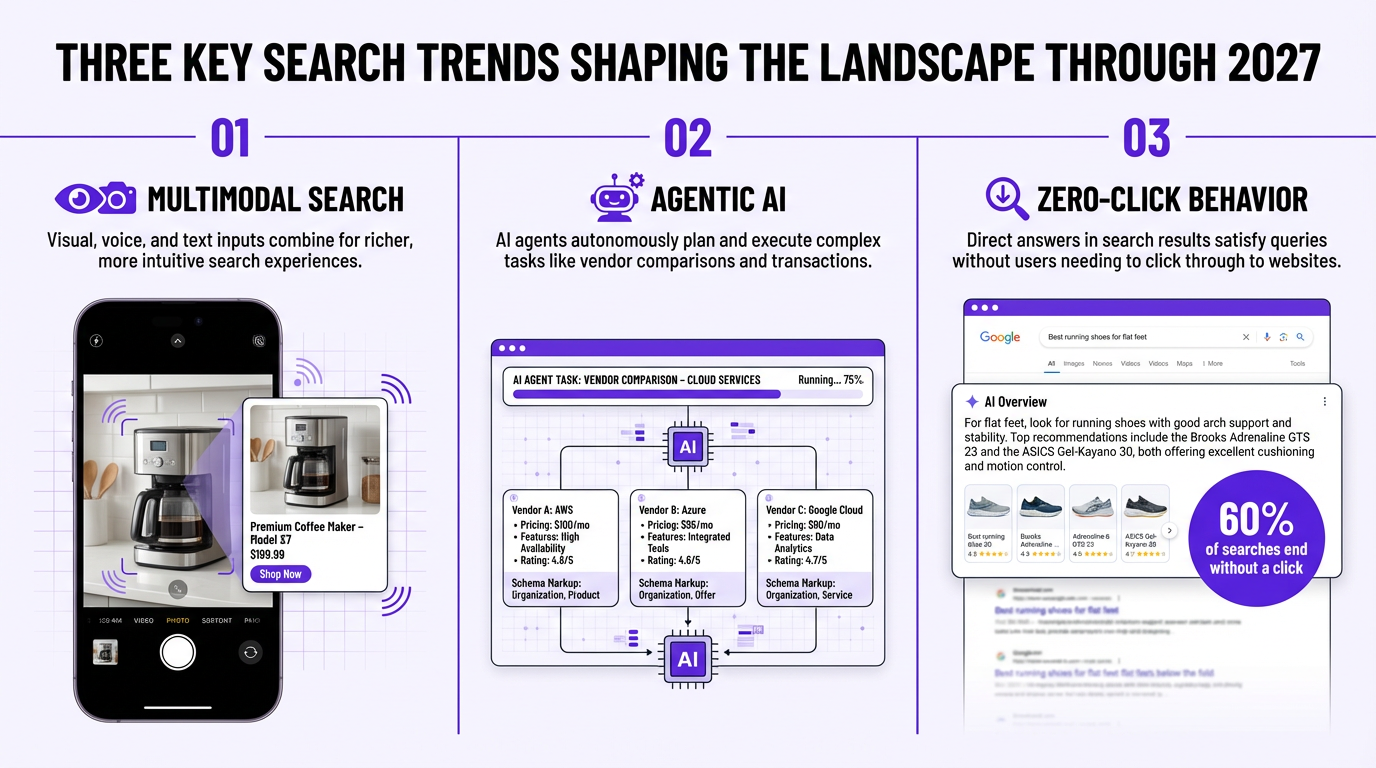
Multimodal search is accelerating. Google stated in 2025 that Google Lens now processes over 20 billion visual searches per month, and those queries feed into the same AI Overview pipeline as text. If your product images lack descriptive alt text and structured data, you're invisible to a growing query type that most SEO audits still ignore.
Agentic AI is the next disruption nobody's fully prepared for. When AI agents book flights, compare vendors, and place orders on behalf of users, the "search result" isn't a page a human reads. It's a data object an agent parses. Schema, API accessibility, and machine-readable pricing will matter more than persuasive copy in those contexts. We're not there yet for most industries, but the early signals from OpenAI's Operator and Google's Project Mariner suggest 2027 will force the conversation.
As AI Overviews get richer, the number of searches that end without a click will only grow, with some studies showing 58% of Google searches already result in zero clicks. The brands that thrive won't be the ones fighting for clicks. They'll be the ones ensuring their name, their data, and their expertise show up inside the answer itself, whether a human or an agent is reading it.
Key Takeaways
What to carry forward:
- SEO optimizes for traditional search rankings and organic traffic. Still essential, no longer sufficient on its own.
- AEO structures content to appear as direct answers in AI Overviews, featured snippets, and voice search. Voice queries are 3x more likely to be local.
- GEO optimizes for citations within generative AI responses. Credibility and specificity outperform volume.
- All three disciplines work together. A gap in any layer creates measurable visibility losses.
- Small businesses hold a genuine advantage in AEO through hyperlocal content specificity.
- The future points toward convergence: hybrid search interfaces that blend SEO, AEO, and GEO into a single results experience, with multimodal queries and agentic AI expanding the playing field.
Frequently Asked Questions
What is the difference between GEO and AEO?
AEO (Answer Engine Optimization) focuses on getting content surfaced as direct answers in AI Overviews, featured snippets, and voice assistant responses. GEO (Generative Engine Optimization) focuses on getting your content cited or referenced inside generated responses. AEO is about extraction and selection on answer surfaces, GEO is about being treated as a trustworthy source during synthesis.
Does traditional SEO still matter in 2026?
Yes. Traditional search results still drive substantial traffic, and recent Google core updates continue to reward well-structured, authoritative content. SEO is the foundation that makes AEO and GEO possible because it determines whether your pages are crawlable, understandable, and trusted in the first place.
How does geo-targeting boost conversions for small businesses?
Location-based personalization lets businesses serve highly relevant content and offers based on where users are. Combined with AEO tactics, local businesses can appear as the direct answer to "near me" and hyperlocal queries, which carry strong purchase intent. If you want to tighten this end-to-end, start by auditing your local intent pages and entity signals, then align them with your broader AI visibility work so the same pages can win both classic rankings and answer surfaces.
How do you optimize content for GEO?
GEO optimization centers on the credibility signals models use when selecting sources: clear factual claims with cited sources, original data or analysis, structured formatting, demonstrated topical expertise, and consistent brand presence across authoritative platforms. Publishing less but going deeper on topics where you have genuine authority consistently outperforms high-volume thin content strategies.
Can one content piece serve SEO, AEO, and GEO simultaneously?
Often yes, with intentional structure. A well-researched article with clear headings, FAQ sections with schema markup, cited sources, and original analysis can rank in traditional search (SEO), appear in AI Overviews (AEO), and get cited in generative answers (GEO). That overlap is real, which is why a unified AI-powered SEO strategy is more efficient than treating each discipline as a separate workstream.
How do you prioritize GEO vs AEO vs SEO if you have limited time?
For most teams, start with SEO fundamentals (crawlability, internal linking, intent match), then add AEO formatting (direct answers, FAQ blocks, schema), then tighten GEO signals (quotable claims, consistent sourcing, brand consistency). The fastest wins usually come from fixing AEO extraction issues on pages that already rank.
How do you measure GEO results and AI citations?
Track a mix of classic and AI surfaces. Use Google Search Console for clicks and queries, monitor featured snippet and AI Overview visibility for AEO, and run a recurring set of prompts in major AI systems to log brand mentions and citations for GEO. If you're tired of juggling separate workflows, Vizup's Visibility Graph and AI visibility tracking are built to centralize those checks so you can see what changed by layer, not just by keyword.
What are the biggest trends shaping the future of engine optimization?
The biggest shifts include multimodal search (visual queries feeding AI Overviews), agentic AI (autonomous agents parsing structured data instead of reading pages), and rising zero-click behavior. The trajectory points toward convergence, where every major search interface blends traditional ranking, direct answers, and generative synthesis into one experience.
What does "GEO vs AEO vs SEO" mean for content teams in 2026?
It means your content has to do three jobs at once: stay crawlable and trustworthy for classic rankings (SEO), answer questions cleanly enough to be extracted (AEO), and read like a credible source that can be cited in AI responses (GEO). Teams that only optimize for clicks tend to miss where visibility is moving: inside the answer.
What schema markup matters most for AEO in 2026?
FAQPage, HowTo, and LocalBusiness are the usual workhorses, but only when they match what the page visibly says. In audits, the fastest AEO wins often come from tightening the first 120 words, then using schema to reinforce that same answer, not to invent new claims for bots.
How do you track AI citations for GEO without a dedicated tool?
Pick 10 to 20 high-intent prompts, run them weekly across the major AI answer surfaces your buyers actually use, and log whether your brand is mentioned and whether a citation appears. Keep the prompts stable for 90 days so you can see trend lines, not noise. If you want to avoid the spreadsheet grind, this is also the kind of recurring check that fits neatly into Vizup's AI visibility tracking workflow.
