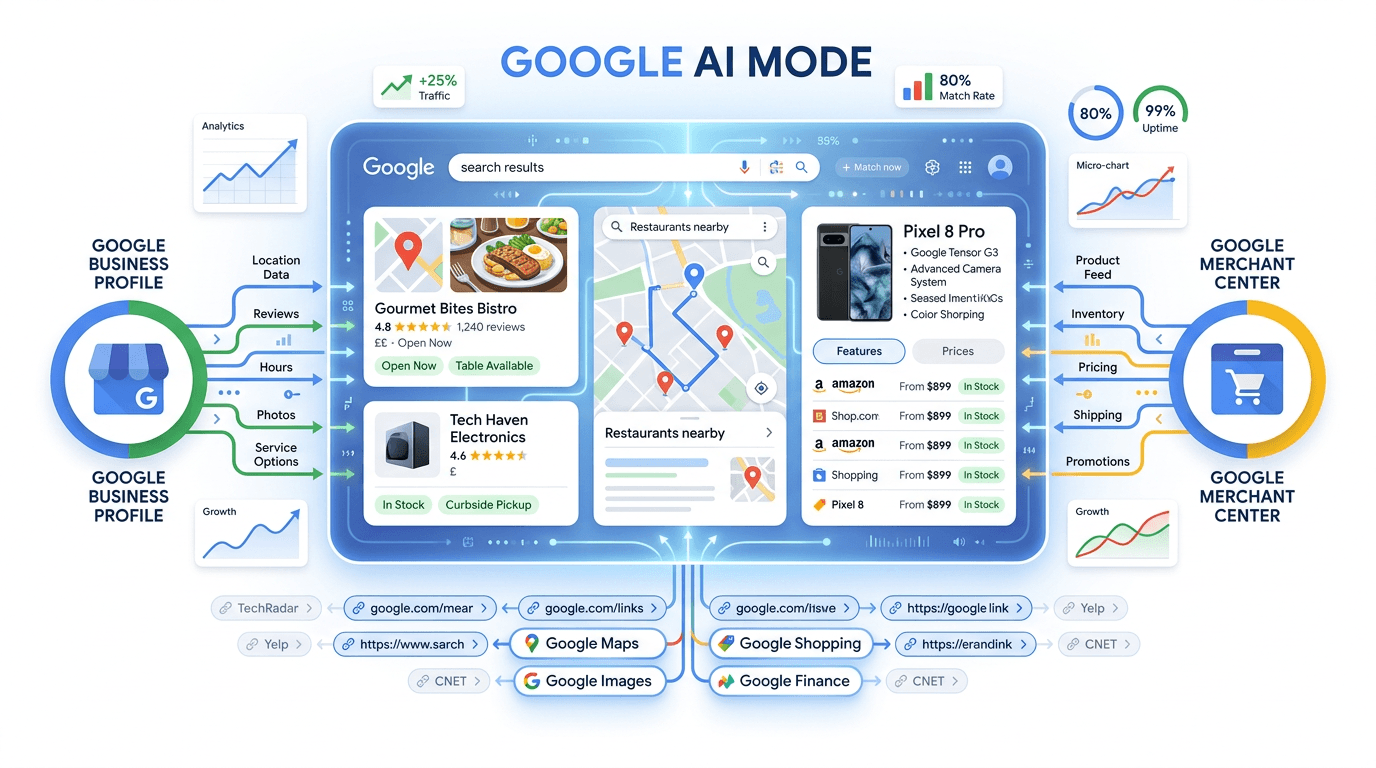
According to an analysis reported by Search Engine Journal, google.com became the second most-cited domain in the study's Google AI Mode dataset after its citation share increased 8.4× between April 15 and June 30, 2026. The analysis covered more than 32 million google.com/searchviewer instances and attributed most of the growth to Google Business Profile cards and Product Knowledge Panels. These figures measure citation appearances, not clicks, leads, sales, or a universal ranking across every AI Mode dataset.
What is happening is less about Google "winning" citations and more about Google tightening the loop between its AI answers and its own data stores. If you care about visibility, you now need to understand how Google AI Mode citations are being assembled and why Google-owned sources are showing up so often. Below is the why, plus a practical playbook for updating your SEO and local strategy without chasing shiny objects.
The Big Shift: What It Means When Google Cites Itself
The headline finding is easy to misread. AI Mode is not suddenly sending everyone to Google's homepage; it is citing google.com because it is extracting structured information from Google's own products. For certain query types, those products are being treated as the canonical record. That is a meaningful change in how AI Mode changes SEO, because the citation source is increasingly a Google-hosted entity rather than a third-party page.
Two Google properties are doing most of the work here:
- Google Business Profiles (GBP): For local and location-based queries, from service providers to restaurants, GBP has become the default dataset.
- Product Knowledge Panels: For e-commerce, these panels (fed by Google Merchant Center) provide the product details, pricing, and availability AI Mode needs for shopping questions.
The practical takeaway is blunt: for plenty of queries, your website is no longer the first stop. The first stop is your data inside Google's ecosystem. Visibility is shifting from "rank the page" to "win the dataset" by keeping your on-platform information complete, consistent, and specific enough for AI to reuse.
For Local Businesses: Your Google Business Profile is Your New Homepage
If you serve a defined area, Google Business Profile has moved from "nice to have" to front door. When someone asks AI Mode a local-intent question like "find a plumber near me with 24-hour service," the system increasingly builds the answer from GBP fields and attributes. Profiles that explicitly list "24-hour service" and match the geography have a cleaner path to being pulled into the response.
That changes the funnel. A strong GBP can leapfrog the usual battle for blue-link rankings and become the cited source inside an AI-generated answer. For local search, the quality of your structured data on Google properties is now a direct lever for visibility in AI Mode, not just a supporting signal.
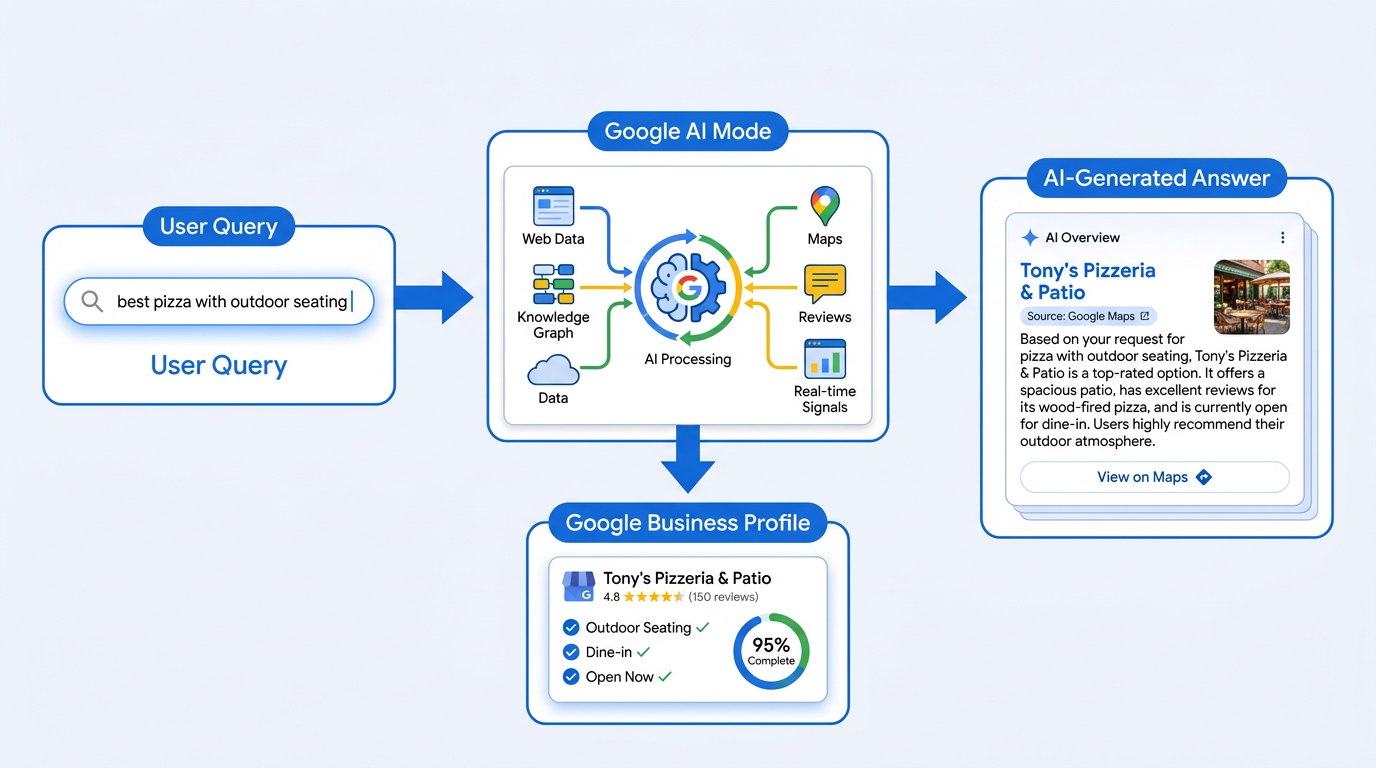
A complete Google Business Profile gives AI Mode the structured attributes it needs to cite your business directly.
Action Plan: Mastering Your Google Business Profile for AI
Checking the "complete" box on your profile is no longer the bar. Treat GBP like a structured database that needs to be query-ready. The goal is to give AI Mode unambiguous fields it can confidently reuse, not vague marketing copy.
Key areas for deep optimization include:
- Fill Out Every Field: Do more than name, address, and phone number. Google's official guidance on local ranking is based on three factors: relevance, distance, and prominence. Completeness is a key part of relevance. Document services with clear descriptions, add every relevant attribute (for example, "women-led" or "wheelchair accessible entrance"), and set accurate hours, including variations by service where applicable. According to Google, businesses with complete and detailed information are easier to match with the right searches. These fields become the raw inputs AI systems pull from. For Google's official documentation, see its guide on how to improve your local ranking.
- Leverage Q&A and Reviews: Seed the Q&A section with the questions customers actually ask, then answer them in short, specific language. Encourage customers to leave honest, detailed reviews about their actual experience, without prescribing wording, sentiment, or keywords. That user-generated text gives AI more context than a generic five-star rating.
- Utilize Google Posts and Products: Use Google Posts like a lightweight update channel: offers, events, seasonal changes, and operational updates. It is a simple way to keep the listing fresh. Even if you are service-based, the Products tab can function as a structured menu of core offerings with descriptions and images. For step-by-step help, optimizing your Google Business Profile is a solid reference point.
For E-commerce: Winning the 'Citation' on Google's Own Turf
E-commerce plays by the same rules, just with different plumbing. AI Mode pulls specs, price, stock, and reviews straight from Google's Product Knowledge Panels. Those panels are largely built from your Google Merchant Center feed. That makes feed quality a core part of modern AI search optimization for any brand that sells online.
The upside is obvious: clean, complete product data can get your product cited and recommended directly inside an AI answer. The downside is just as real: weak data can keep you out of the candidate set entirely. AI will default to the product with the most structured, reliable information available.
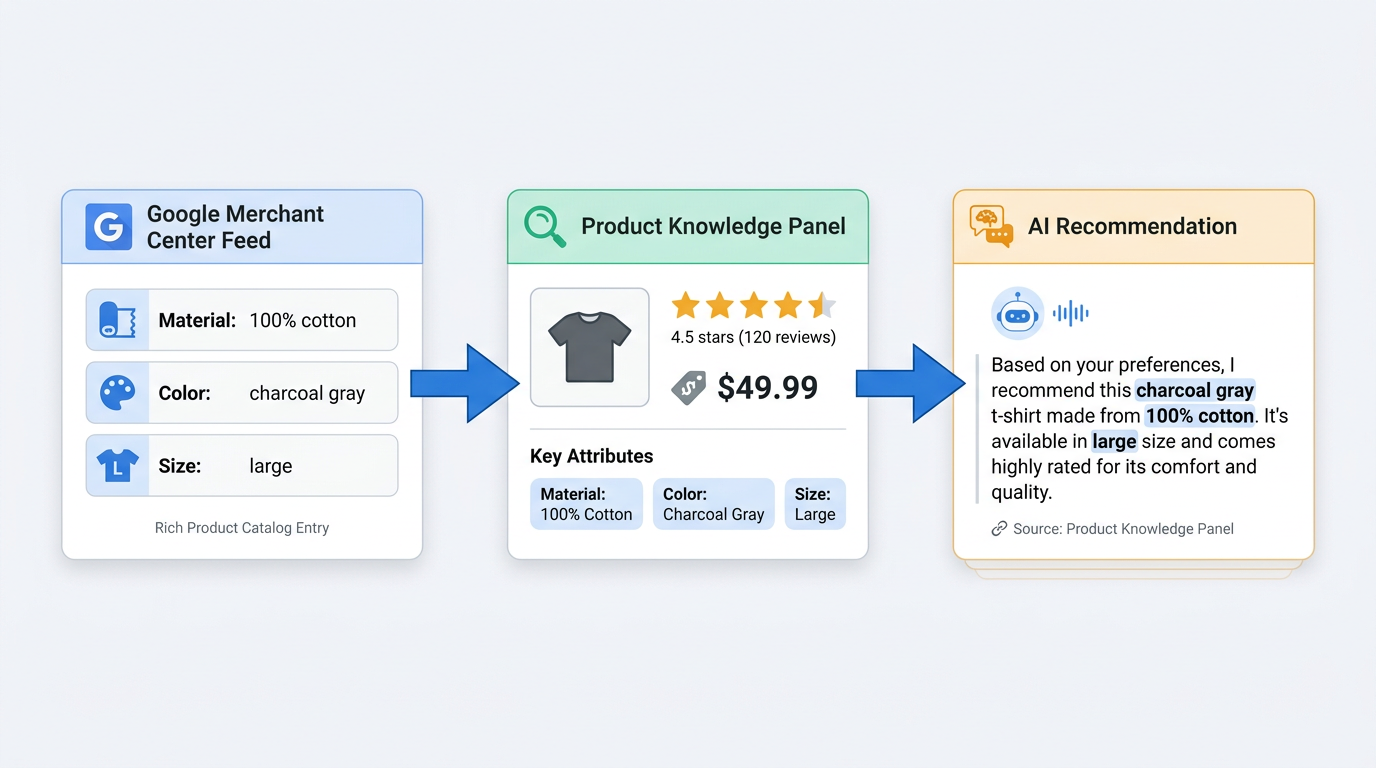
Feed quality (not just ad approval) determines whether your product earns a Google AI Mode citation.
What Most SEOs Get Wrong About Product Feeds
A lot of teams still treat the Merchant Center feed as paperwork required to run Shopping Ads. That mindset does not hold up in an AI-first results page. Your feed is effectively the interface between your catalog and Google's systems. A feed that is merely "approved" is a baseline, not a competitive advantage.
Small gaps add up fast. Missing attributes like color, material, or size can knock you out of the kinds of specific, long-tail queries AI search tends to generate (for example, "show me 100% cotton bath towels in charcoal gray"). On the flip side, a strong product_highlight can become the right line AI uses to justify recommending your SKU over the next one. If you are refreshing your process, a thorough ecommerce SEO audit guide should include a serious pass on feed enrichment, not just on-site fixes.
The Future of Google AI Mode Citations: What's Next?
Expect the pattern to continue. As AI Mode matures, Google has every incentive to pull from more first-party properties like Google Flights, Hotels, and YouTube. The logic is simple: if the goal is fast, authoritative answers, Google-controlled structured datasets are the easiest sources to trust and normalize at scale.
For SEOs, that pushes the job description closer to "Answer Engine Optimization." The target is not just a top-ranking page; it is becoming the most dependable structured source in your category. Some of that data still lives on your site, but more of it will need to be maintained inside Google products with the same rigor. If you need a framework for that shift, this AI search optimization playbook is built around on-platform visibility, not just traditional rankings.

Tracking Google AI Mode citations alongside GBP views signals the rise of Answer Engine Optimization.
Key Takeaways & Your Next Move
Google citing itself in AI Mode is not a weird edge case. It is a built-in outcome of answers being assembled from Google's structured data systems, especially GBP and Merchant Center. The line between "your website" and "your Google presence" is getting thinner; AI increasingly treats them as one connected profile of your business.
Your immediate priorities should be:
- Audit and Enrich Your Google Business Profile: Run a real audit, not a quick skim. Fill every field you can, add relevant attributes, and document services clearly. Treat GBP like a primary marketing asset, because AI Mode is already treating it that way.
- Supercharge Your Google Merchant Center Feed: Do not stop at minimum requirements. Follow Google's full product data specification and add every relevant attribute to give AI Mode the richest possible information. Keep pricing and availability accurate, and use strong images and descriptions so Product Knowledge Panels have enough detail to work with.
- Adopt an Answer Engine Optimization Mindset: Keep doing the fundamentals for rankings, but broaden the goal: supply the best structured data wherever customers ask questions, including on Google's own platforms.
Frequently Asked Questions
Does this mean my website SEO no longer matters?
No. Your website is still the hub for your brand and remains a major source Google can use. Traditional SEO fundamentals still matter. The shift is that you also need to optimize Google-owned surfaces (like GBP and Merchant Center) because they can feed AI answers directly.
How do I track my Google AI Mode citations?
Start with Google Search Console's Generative AI performance report, where available. Google began rolling it out to a subset of websites in June 2026, with dedicated visibility reporting for AI Mode and AI Overviews. Because availability and diagnostic depth remain limited, complement Search Console with Vizup's AI visibility monitoring and controlled spot-checks of commercially important prompts.
Will optimizing my Google Business Profile support visibility in local Search and Maps?
Often, yes. An active, well-optimized Google Business Profile can reinforce relevance and legitimacy signals that support performance in local search and can spill over into organic visibility. The tie-in between GBP and AI is also tightening, including updates like Google Business Profile comes to Gemini.
Could Google citing itself raise antitrust concerns?
Possibly. Regulators are already scrutinizing the market power of major tech platforms, and self-preferencing claims are a recurring theme. Google will argue it is prioritizing reliable structured data to improve the user experience, but the policy and legal side could still draw attention.
What is the single most important Google Business Profile field to optimize for AI search?
A complete profile wins, but if you have to prioritize, focus on "Attributes." Attributes are discrete structured fields (like "has outdoor seating" or "offers curbside pickup") that AI can parse cleanly when answering specific queries.
