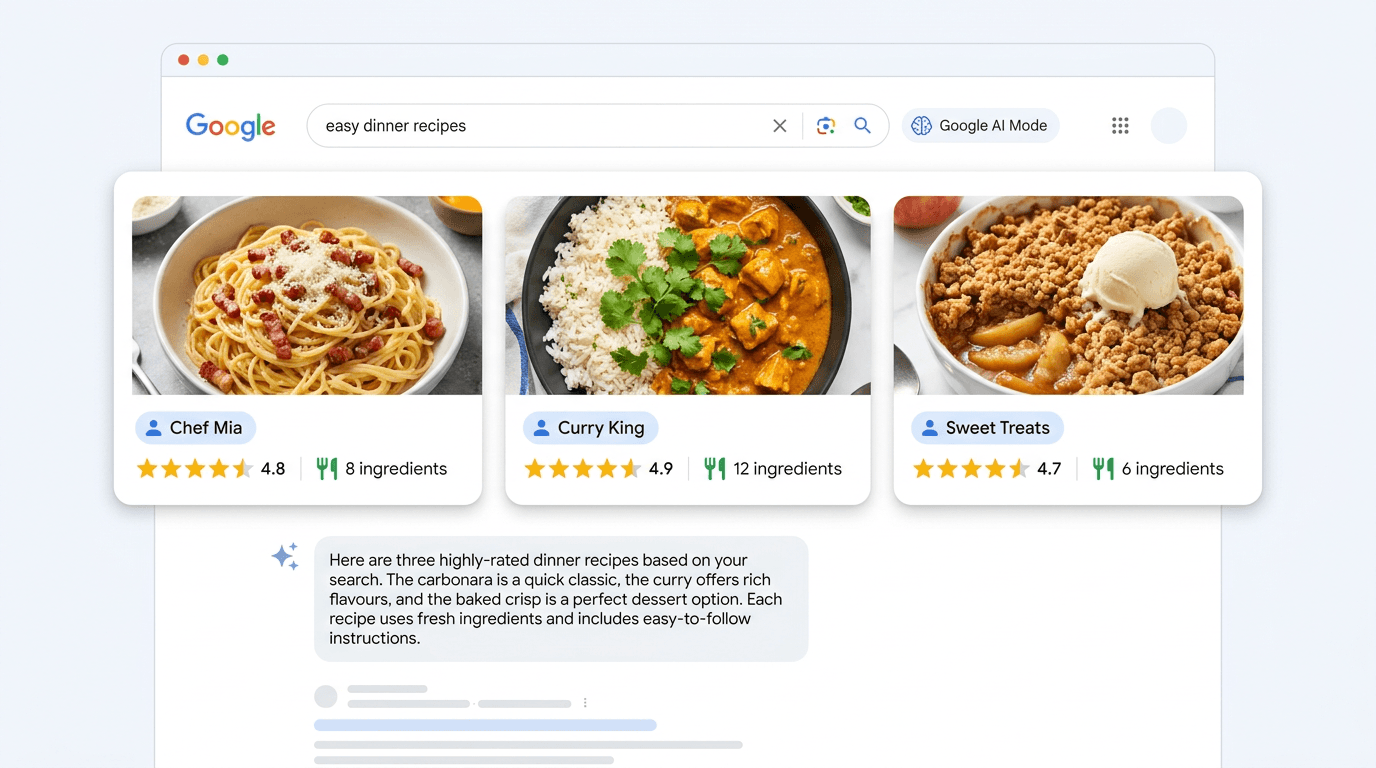
Google AI Mode recipe links are a new placement that pins 3-4 visual recipe cards to the top of AI Mode responses for food queries with clear cooking intent. Each card leads with the creator name, an aggregate rating, and a total ingredient count next to a dish image, so publishers get attribution before the AI summary gets a single word in.
Robby Stein, Google's VP of Product for Search, announced the update in late June 2026. It picks up work Google flagged back in March 2026 after months of pushback from food bloggers over traffic drops and fuzzy attribution. For food publishers and food-vertical SEOs, the question is plain: what earns a slot in that top row? Knowing how AI Mode changes SEO helps frame the shift, but recipes now have their own rules worth spelling out.
What Exactly Changed in AI Mode for Recipes?
Before June, AI Mode would spit out a recipe-style answer and tuck the source links inside or below the generated text. Attribution technically existed, but it was the kind you had to go looking for. If a reader got workable steps from the AI, there was little incentive to click through to the publisher. The June 2026 update flips that order.
Now, when the query reads like a recipe request, the links show up first as cards, not footnotes. Each card is built around three fields: the creator/author name, an aggregate star rating, and the ingredient count, with a dish image doing the heavy lifting visually. These are not generic web results. They behave more like recipe rich results than blue links, and they sit in the most expensive pixels on the page.
Stein framed the rollout as a continuation of the recipe-panel work Google started in March 2026. The UI also happens to line up neatly with Recipe schema properties: author.name, aggregateRating, and the length of recipeIngredient. Google still has not said schema is required, but the mapping is close enough that I treat it like a markup audit checklist, not a coincidence. If you publish recipes, a structured data audit is the most defensible move you can make right now.
Why This Isn't Just Another SERP Tweak
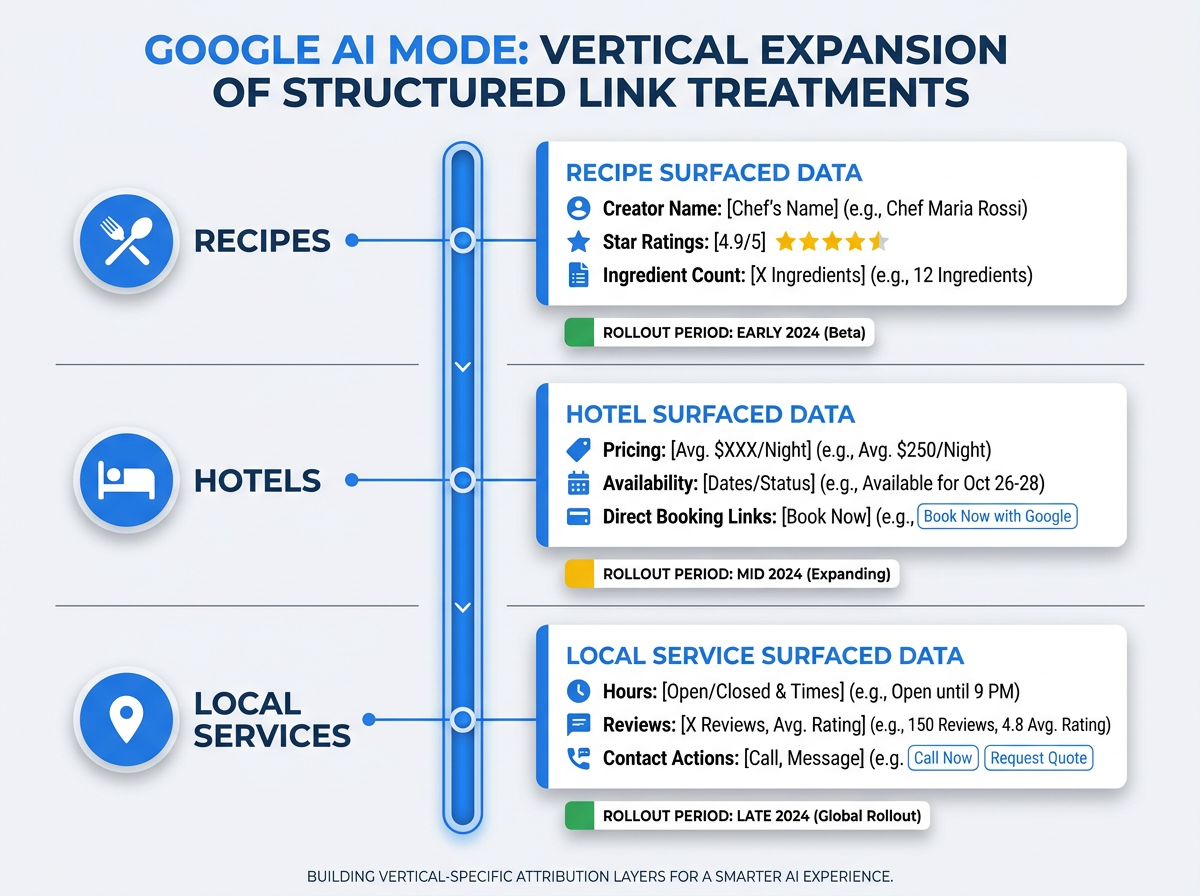
This is not a one-off product flourish. Google has been building vertical-specific link treatments into AI Mode, one category at a time. The recipe carousel tracks with similar updates for hotel booking links, where prices, availability, and direct booking links got pulled to the top of travel-intent answers. The playbook is consistent: AI answers soak up intent, publishers complain about the leak, and Google adds a structured card layer that routes users back out to sources.
For food blogger SEO, the signal goes beyond a potential traffic bump. Google is effectively saying that recipes are a vertical where identity and quality cues are UI-worthy, not just relevance cues. Putting creator names and ratings in the card isn't subtle: the who is being treated as part of the result, not a footnote beneath it.
Some publishers have welcomed the attribution improvements while still raising concerns about AI-generated summaries and traffic impact. Inspired Taste called it progress, while still pointing at the same unresolved problem: the AI summary under the cards can drift from the actual recipe. A card at the top restores a click opportunity, but the copy beneath it can still describe the dish in a way the creator wouldn't sign off on. If you're tracking this rollout, watch the summaries as closely as you watch the carousel.
How to Earn a Spot in the New Recipe Carousel
Auditing Your Recipe Structured Data
The card fields are basically a Schema.org checklist. Start with Recipe schema and focus on the properties the UI is already advertising: author.name (or creator.name) for attribution, aggregateRating with both ratingValue and reviewCount, and recipeIngredient as an array with each ingredient broken out so Google can count them cleanly. Google's recipe structured data documentation calls recipeIngredient and recipeInstructions required for rich result eligibility, so treat those as table stakes, not optional polish.
Priority schema properties to audit for AI Mode recipe card eligibility:
author.nameorcreator.name: match the visible byline exactly; schema that disagrees with on-page text is a trust leakaggregateRating: include bothratingValueandreviewCount; a rating node without counts reads as incomplete and can get ignoredrecipeIngredient: keep one ingredient per array item; a single concatenated string makes the ingredient count unreliableimage: offer multiple image objects in different aspect ratios; the card is visual-first and image quality will shape clicksname: align the schema recipe title with the on-page H1, character-for-character
Validate URLs with Google's Rich Results Test, then use Search Console's Enhancements report to find the pages throwing structured data errors at scale. Both are useful because they fail at the property level, which is where fixes actually happen. Pair that with a structured data audit workflow, AI crawler access checks through your sitemap, and the ability to track AI visibility across Google AI surfaces, so you can connect markup changes to AI Mode appearances instead of guessing.
For teams managing large recipe libraries, this is not just a one-time schema cleanup. Vizup acts as an Organic Autopilot for modern discovery, helping brands monitor, create, optimise, publish, and learn across Search, Social, Communities, AI Answer Engines, and Local Discovery. Paid ads can still amplify high-performing content, but the core advantage is building an always-on organic system that keeps recipe pages discoverable, cited, and trusted.
Beyond the Code: Content and Authority Signals
Ratings are not something you solve with JSON-LD alone. aggregateRating is only as credible as the review collection behind it. If your recipes have thin or nonexistent ratings, you need a plan to earn them: visible rating widgets on the recipe, post-cook email prompts, and comment flows that can feed back into the schema value. A 4.8 average across 340 reviews is a stronger candidate than a perfect 5.0 off two votes, because the volume reads like real engagement.
The byline matters, too, because it's the on-page proof for whatever you put in author. If the schema says "Maria Chen" but the page has no byline, or hides behind a generic "Staff" credit, you're asking Google to trust a name it can't verify. A linked author profile with credentials, a photo, and a consistent publishing history tightens that loop between markup and person. That's food blogger SEO at the content layer, not just a technical cleanup pass.
Warning: Google has not confirmed which queries trigger the recipe card carousel, which regions see it, or whether schema is strictly required. Treat the markup audit as a prerequisite, not a guarantee. Monitor appearance in AI Mode recipes separately from traditional rich results in Search Console.
What We Know vs. What We Don't
| What We Know (Confirmed) | What We Infer (Educated Guess) |
|---|---|
| Cards show creator name, aggregate rating, and ingredient count | Recipe schema is the main source for those three fields |
| Links sit at the top of AI Mode responses, above the AI summary | Strong, multi-format images are likely a gating factor for inclusion |
| Google VP Robby Stein announced the feature in June 2026 | The query needs clear recipe intent to trigger the carousel |
| It continues recipe-panel work Google announced in March 2026 | Author E-E-A-T signals likely affect which creators get surfaced |
| The AI summary still appears below the cards and can misrepresent content | Structured data validation errors probably knock a recipe out of the carousel |
| It mirrors the vertical-specific treatment Google applied to hotel links | The rollout is likely global, with early weighting toward English-language queries |
| Sources: Robby Stein announcement (June 2026), Search Engine Journal (2026), Search Engine Roundtable (2026). Inferences based on schema field alignment and vertical treatment patterns. |
Key Takeaways for Food Publishers
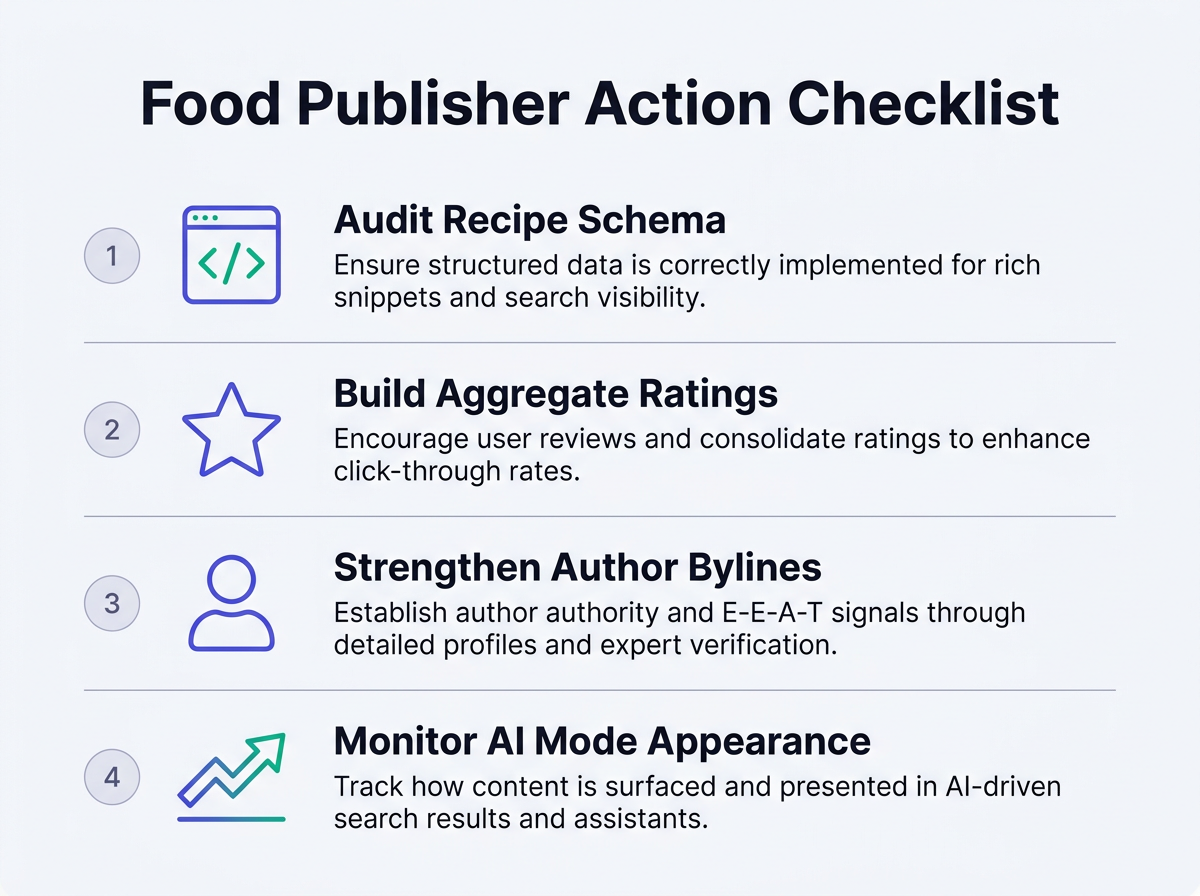
Essential actions following the Google AI Mode recipe links update:
- Run a full recipe schema audit now. Check
author.name,aggregateRating,recipeIngredient, andimageagainst Google's recipe structured data documentation. Clean up errors before you chase new features. - Treat ratings as a content system, not a markup checkbox. The presence of
aggregateRatingin the card UI is Google telling you ratings are an input here, not decorative metadata. Build a repeatable way to collect and publish genuine user ratings. - Align schema author values with visible on-page bylines. The creator label is coming from your markup. If your byline and schema disagree, fix it. A linked author profile with consistent publishing history makes the signal easier for Google to trust.
- Monitor AI Mode recipes separately from traditional SERP features. Use Vizup as your Organic Autopilot for AI discovery to track which queries trigger cards, when your recipes show up, and whether the AI summary below the card matches your page. For deeper AI Mode checks, you can also monitor AI Mode side-by-side visibility across priority recipe and food-intent queries.
- Watch the AI summary, not just the card. Carousel visibility is a win, but the generated text underneath can still drift. Capture examples where the summary diverges and use them to tighten markup specificity over time.
Frequently Asked Questions
Is Recipe schema markup required to show up in Google AI Mode?
Google has not said Recipe schema is mandatory for the AI Mode recipe card carousel. Still, the three fields shown in the cards (creator name, ratings, ingredient count) line up directly with author.name, aggregateRating, and recipeIngredient in Recipe schema. In practice, treat complete, valid schema as the baseline. Without it, Google has less structured data to reliably populate the card.
How do I verify my recipe structured data is implemented correctly?
Run individual URLs through Google's Rich Results Test to see validation at the property level. For site-wide visibility, use the Enhancements section in Google Search Console, which surfaces errors and warnings across indexed recipe pages. Both tools point you to missing or invalid properties rather than a vague pass/fail.
Does this recipe carousel replace Google's AI recipe summaries?
No. The AI-generated recipe summary still shows below the card carousel. The change is about putting attribution links first, not removing the summary. Inspired Taste and other publishers have flagged the same ongoing risk: the AI text can still misrepresent the original recipe even when a creator card appears above it.
Does the creator name come from schema or the on-page byline?
Given the field alignment, the creator label likely pulls from author.name or creator.name in structured data. Google's systems also look at on-page signals, which is why mismatches tend to get messy. The safest setup is simple: make the schema value match the visible byline exactly, and have that byline link to an author profile that reinforces identity and expertise.
What should I do if my recipes don't have user ratings yet?
If you do not have aggregateRating, that field cannot be surfaced in the card, which likely hurts eligibility. Start collecting ratings deliberately: add a star-rating widget to recipe pages, prompt readers to rate after cooking via email follow-ups, and make sure the widget updates your schema values dynamically. Even a modest set of genuine ratings with valid markup beats having no rating data at all.
