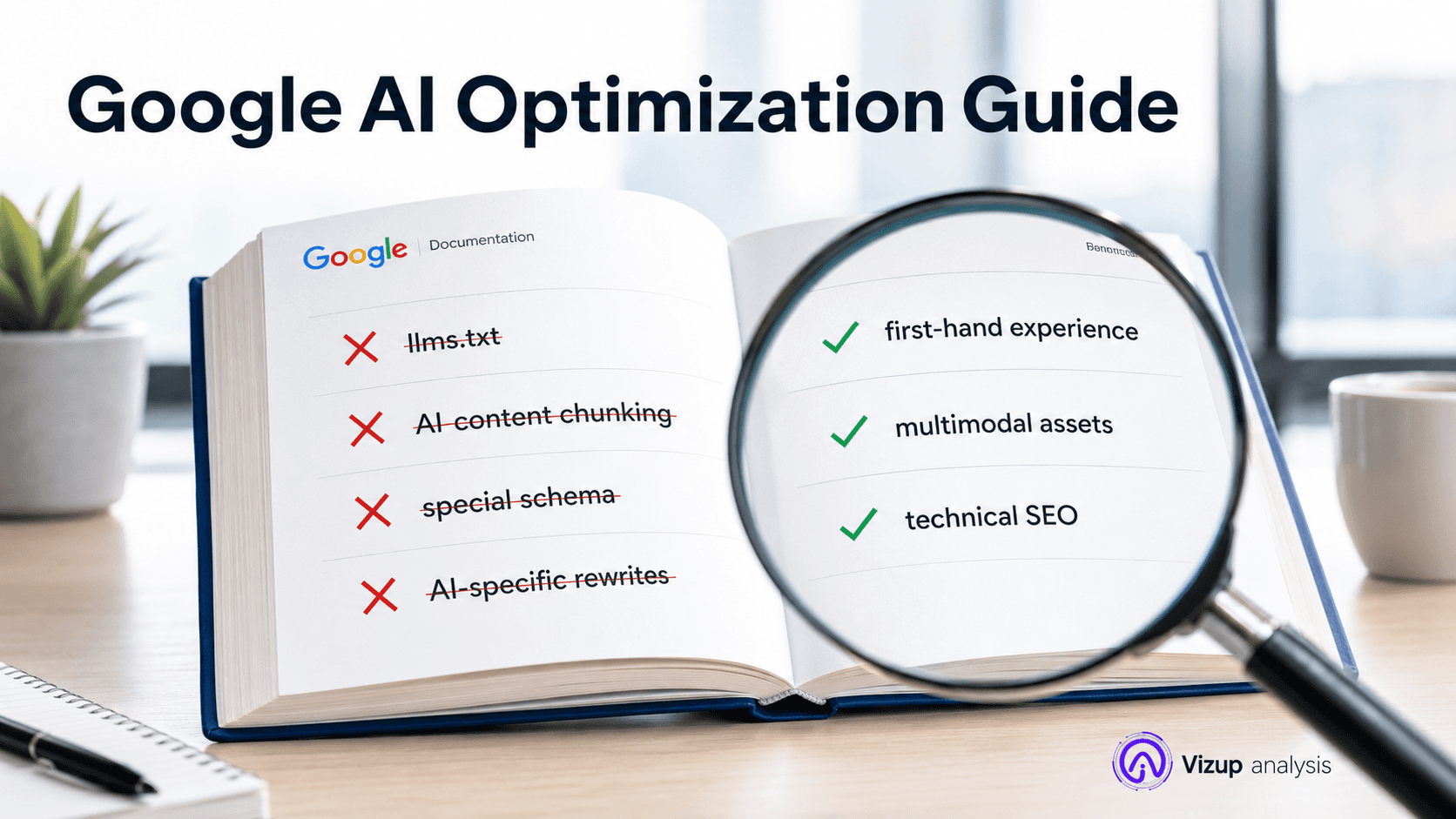
On May 15, 2026, Google quietly published an official AI optimization guide, and the most important thing in it is everything it tells you not to do. For two years, the SEO industry has built an entire cottage industry around AI-specific optimization tactics: special files for LLMs, content restructuring for AI parsers, novel schema types, and prose rewritten to sound 'machine-friendly.' Google's documentation dismantles most of it in plain language.
The Google AI optimization guide is unusually direct. It confirms that AEO (Answer Engine Optimization) and GEO (Generative Engine Optimization) are not separate disciplines. They are SEO. The guide explicitly states that site owners do not need llms.txt files, content chunking, special schema, or AI-specific rewriting to appear in AI Overviews or AI Mode. What actually matters: first-hand experience content, multimodal assets, and core technical hygiene. This piece walks through the official documentation section by section, separating what's real from what's noise.
Info: Featured Snippet: Google's official AI optimization guide (May 15, 2026) states that AEO and GEO are 'still SEO' for Google Search. It explicitly says site owners do not need llms.txt files, content chunking, special schema, or AI-specific rewriting to appear in AI Overviews or AI Mode. What matters: first-hand experience content, multimodal assets, and core technical hygiene.
What you'll find below:
- The Backstory — Why Google published prescriptive AI guidance now, after two years of silence
- AEO Is SEO — The foundation Google wants every site owner to internalize
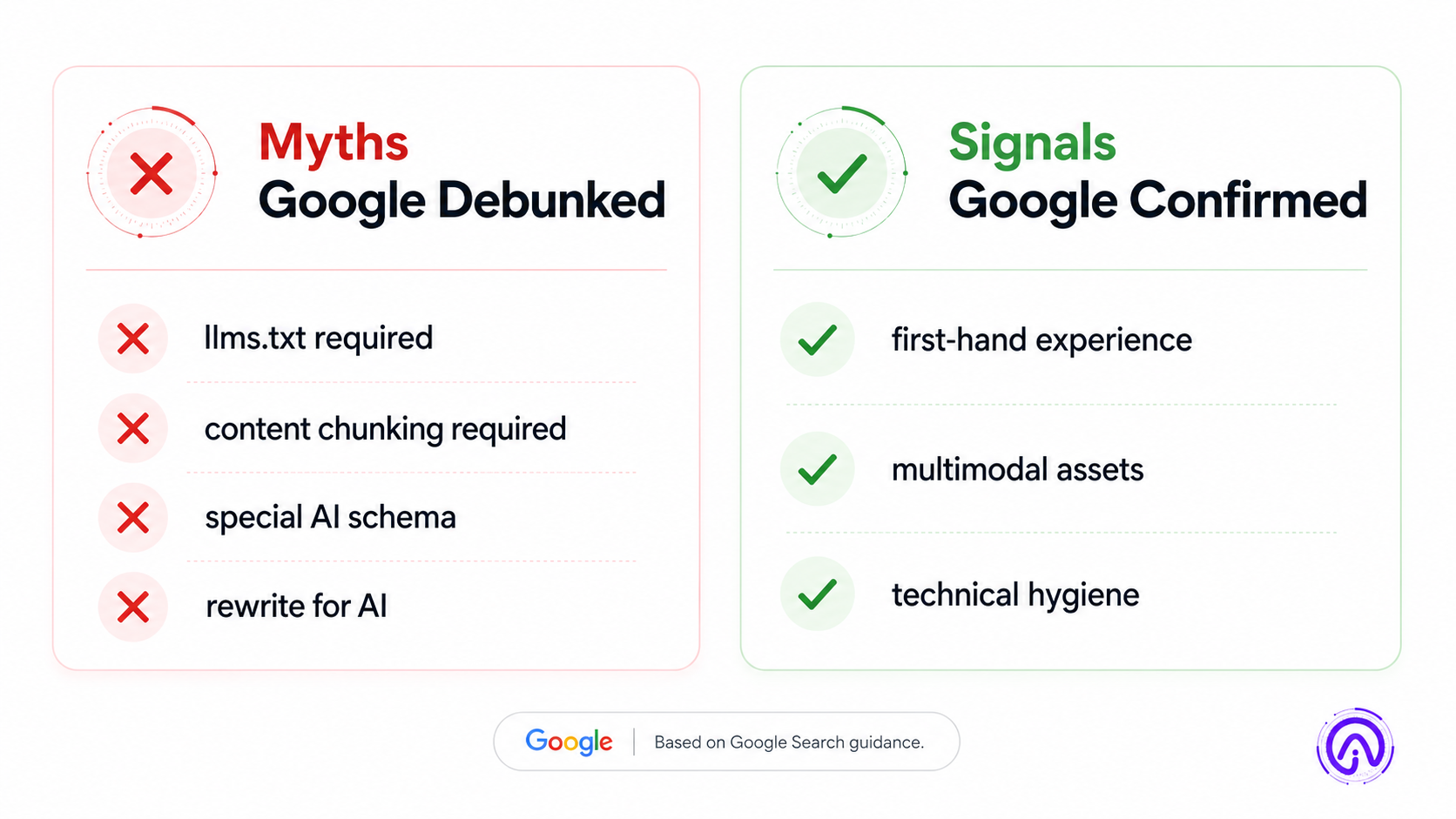
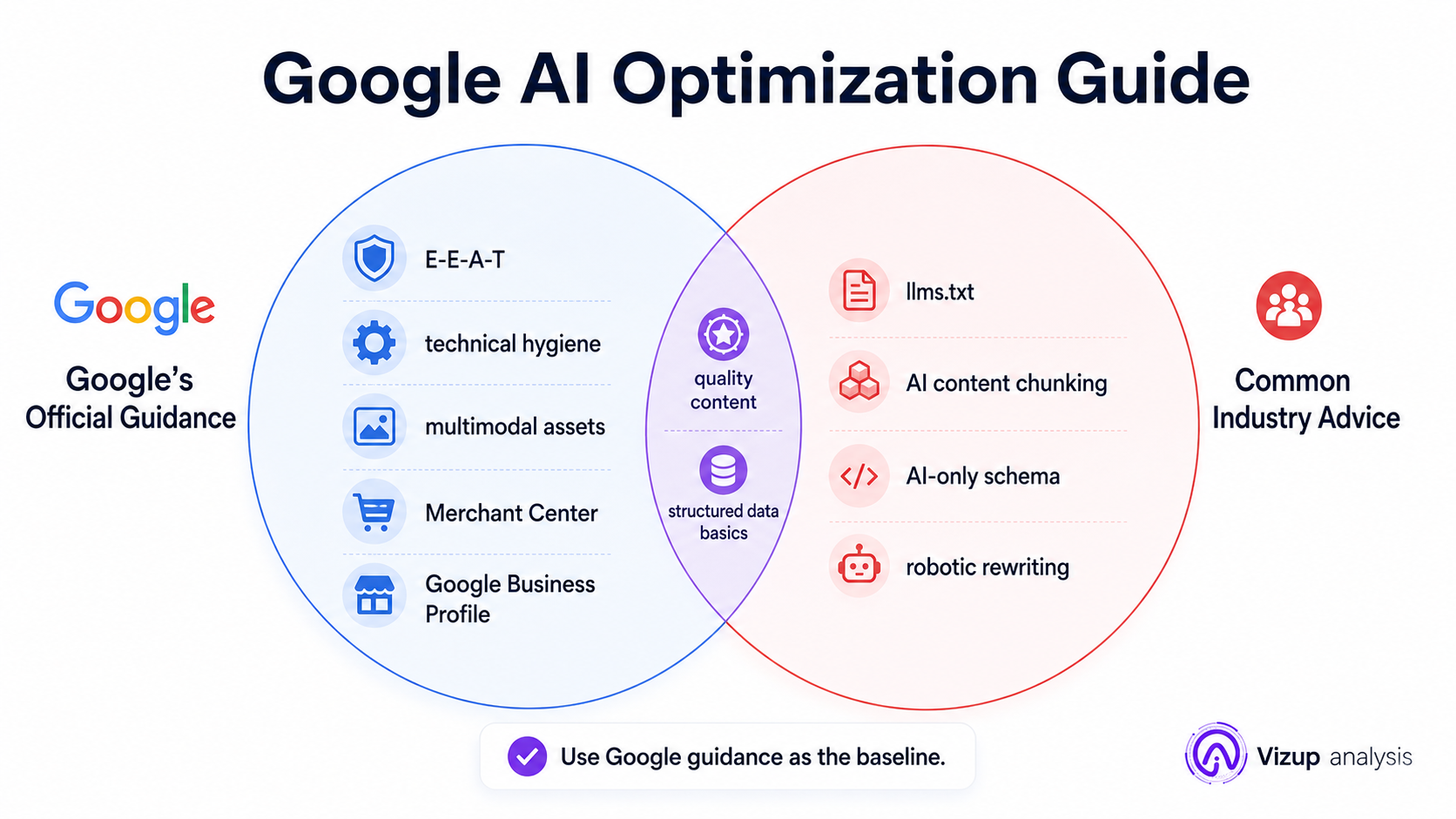
- The 4 Myths Google Debunked — llms.txt, content chunking, special schema, and AI-specific rewriting
- The 3 Confirmed Signals — First-hand experience, multimodal assets, and technical hygiene
- Official vs. Industry Advice — A comparison table showing where the gap is widest
- Local and Ecommerce — The angle most commentary skipped entirely
- Agentic Experiences — What's coming next and how much to invest now
- Monitoring AI Visibility — How to measure what the guide doesn't tell you to measure
The Backstory: Why Google Published This Now
AI Overviews, launched in the U.S. in May 2024 and have since rolled out to over 100 countries. AI Mode followed in early 2026. Between those two milestones, Google said almost nothing prescriptive about how to optimize for these features. The vacuum filled predictably: consultants, tool vendors, and content creators rushed to define the rules themselves.
The result was a flood of speculative tactics. Site owners started creating llms.txt files (a proposed standard borrowed from the broader LLM ecosystem), restructuring pages into 'AI-friendly chunks,' layering on experimental schema types, and rewriting perfectly good content in a stilted, definition-heavy style they assumed machines preferred. Google's motivation for publishing the guide appears straightforward: too many site owners were doing counterproductive things that added noise without improving quality. This is the first time Google has released prescriptive guidance specifically for its generative AI search features, not just traditional search.
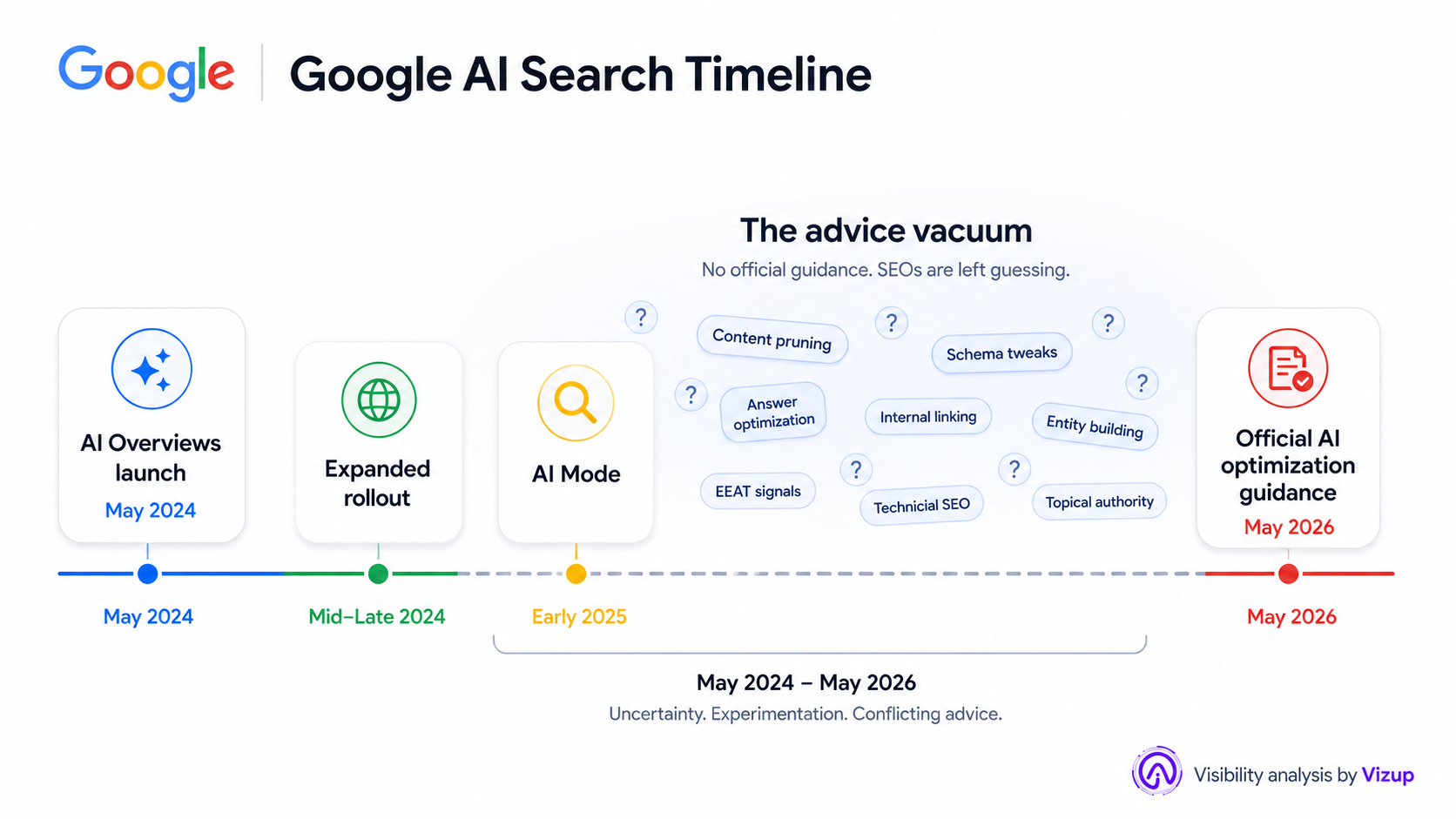
AEO Is SEO: The Foundation Google Wants You to Understand
The guide's core thesis is blunt: there is no separate discipline called AEO or GEO. From Google Search's perspective, these terms describe the same thing as SEO. The phrase 'AEO is SEO Google' is not a simplification; it is the literal position of the documentation. AI Overviews pull from the same index, use the same quality signals, and rely on the same E-E-A-T framework as traditional organic results. Google's AI features use retrieval-augmented generation (RAG) to surface information from the existing Search index, not from a separate AI-specific database.
Why does this matter commercially? Because companies selling 'AEO services' or 'GEO packages' as distinct from SEO are, according to Google's own documentation, selling a repackaged product. The underlying work (quality content, technical health, authority signals) is identical. If you already treat AI search optimization as an extension of SEO rather than a replacement, you can skip ahead to the myths section. If your agency or vendor has been pitching these as separate line items, this is the moment to consolidate. For a broader look at how AI Mode specifically changes the SEO landscape, see Vizup's breakdown of how AI Mode changes SEO.
The 4 Myths Google Explicitly Debunked (and the 3 Signals It Confirmed)
These are not vague suggestions. Google used the words 'don't' and 'not needed' in the documentation. That level of directness is unusual for a company that typically hedges its guidance. The infographic below is designed to be the most shareable asset from this piece: four myths marked with a clear ✗ and three confirmed signals marked with a ✓.
Myth 1: You Need an llms.txt File for AI Overviews
The llms.txt proposal gained traction as a way to tell large language models how to read your site, similar to how robots.txt communicates with crawlers. Multiple SEO tools and consultants began recommending it as a standard practice. Google's guide is unambiguous: llms.txt files are unnecessary for Google Search. Their systems do not look for or use this file when determining what appears in AI Overviews. The nuance worth noting: llms.txt for Google AI Overviews has zero confirmed impact, but it may still hold value for third-party LLMs like ChatGPT or Perplexity, which operate outside Google's ecosystem.
Myth 2: Content Chunking Is Required for AI Search
The content chunking AI search theory proposed that pages need to be broken into LLM-friendly segments with specific formatting, headers at exact intervals, and self-contained answer blocks. Google's position is clear: their systems handle content parsing internally. Artificial chunking can actually hurt readability and traditional SEO performance by fragmenting naturally flowing content into awkward segments. Write comprehensive, well-structured content. Google's AI will extract what it needs.
Myth 3: Special Schema Markup Unlocks AI Overviews
No new schema types are needed. Standard structured data (FAQ, HowTo, Product) still helps traditional rich results but is not a special key to AI features. To be eligible to appear in AI Overviews, a page must be indexed and eligible to be shown in Google Search with a snippet, meeting standard technical requirements. The guide's advice: use schema where it is already appropriate. Do not add it hoping to game AI Overviews.
Myth 4: You Should Rewrite Content for AI Consumption
The temptation to write 'LLM-friendly' prose is real. Short declarative sentences, excessive definition-style formatting, and a robotic tone stripped of personality became a trend in 2025. Google's stance: write for humans. Their AI systems are sophisticated enough to parse natural language, nuance, and complex arguments. Dumbing down your content to sound like a glossary entry hurts more than it helps, both for user experience and for the quality signals Google's systems evaluate.
What the Google AI Optimization Guide Actually Tells You to Do
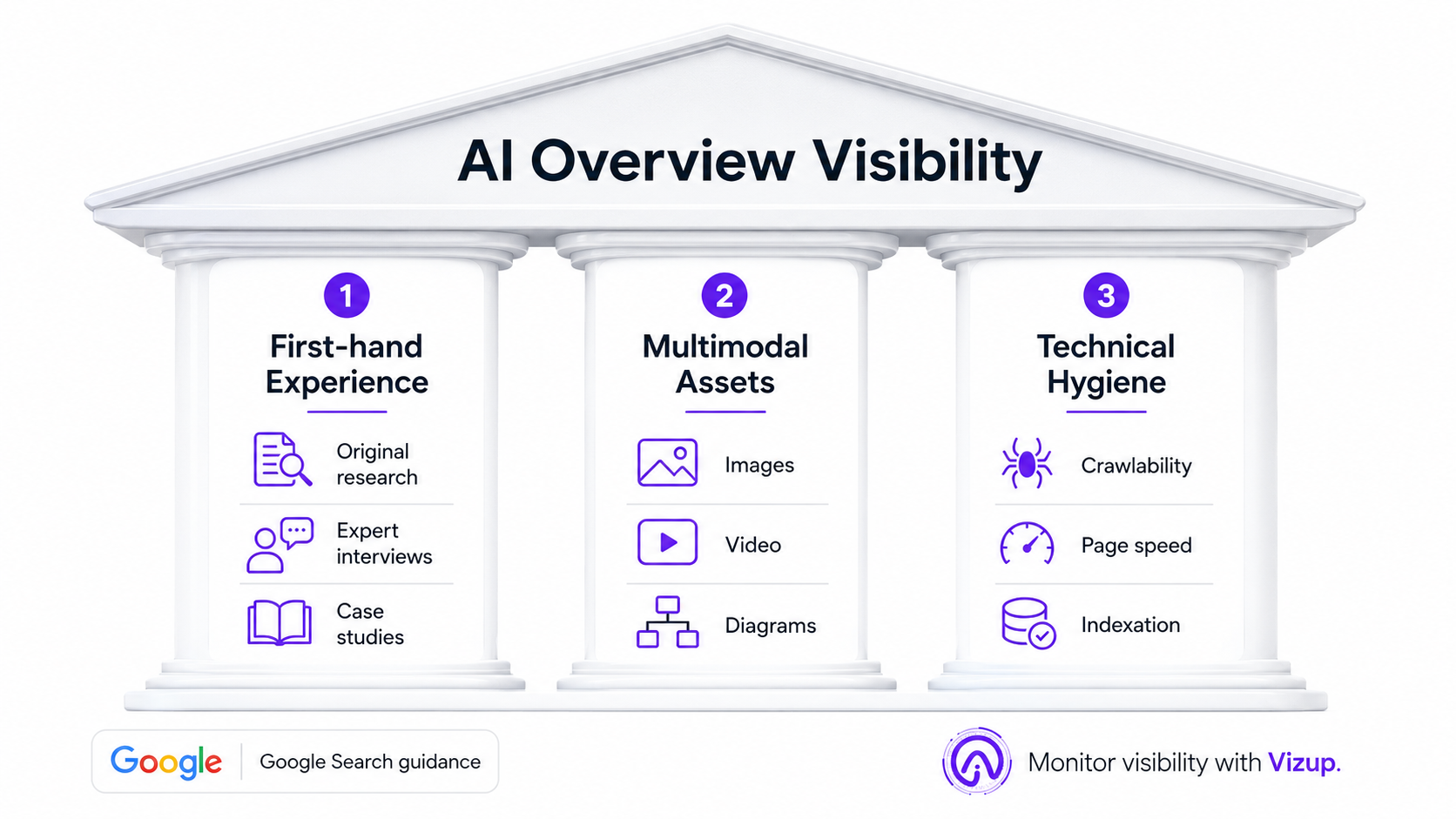
With the noise cleared, the guide's positive recommendations come down to three pillars. None of them are new to experienced SEOs. All of them are newly confirmed as the specific signals that matter for AI features.
Create Non-Commodity Content With First-Hand Experience
Google's language around 'valuable, non-commodity content' is E-E-A-T's experience signal made explicit for AI features. Original research, proprietary data, expert interviews, and real-world case studies are what AI Overviews preferentially cite. The logic is straightforward: AI systems trained on web-scale data already 'know' commodity information. What they surface to users is content that adds something the model cannot generate on its own. If your content strategy is 'research competitors and rewrite their articles,' you are producing exactly the commodity content Google says it deprioritizes. This aligns with Google's latest spam update, which increasingly targets low-originality content.
Invest in Multimodal Assets
The guide emphasizes multimodal content, not just text. AI Overviews increasingly pull images, videos, and visual elements into their responses. The actionable version: add original images with descriptive alt text, create explainer videos, and use diagrams that illustrate processes. Stock photos do not count. One pattern worth noting: a B2B SaaS blog that added original process diagrams to existing posts saw measurable increases in AI Overview citations within eight weeks. The investment was modest (a designer spending two days per month), but the signal was clear. Google's systems reward content that helps users understand topics visually, not just textually.
Maintain Core Technical Hygiene
The unsexy truth: crawlability, site speed, mobile-friendliness, clean URL structures, and proper indexation are still the foundation. Google generative AI search best practices start with the same technical checklist that has mattered for a decade.
Technical hygiene checklist from the guide:
- Googlebot access not blocked by robots.txt or meta tags
- No excessive JavaScript rendering issues preventing content indexation
- Proper canonical tags on all indexable pages
- Fast Largest Contentful Paint (LCP) scores
- Working internal links with no orphaned pages
- Mobile-friendly layout and responsive design
- Clean, descriptive URL structures
Official Google Recommendations vs. Common Industry Advice
The gap between what Google's documentation says and what the industry has been selling is significant. The table below maps eight common tactics against the official guidance, with a verdict for each.
| Tactic | Google's Official Position | Common Industry Advice | Verdict |
|---|---|---|---|
| llms.txt files | Not needed for Google Search | Recommended as standard practice | Debunked |
| Content chunking for AI | Unnecessary; systems parse content internally | Required for AI-friendly formatting | Debunked |
| Special/new schema markup | No new types needed; use existing schema normally | Add AI-specific schema to unlock features | Debunked |
| AI-specific content rewriting | Write for humans; AI parses natural language | Rewrite in short, declarative, definition-style prose | Debunked |
| E-E-A-T and first-hand experience | Explicitly confirmed as a priority signal | Widely recommended (alignment here) | Confirmed |
| Core technical SEO | Foundation for all search visibility, including AI | Sometimes deprioritized in favor of 'AI tactics' | Confirmed |
| Multimodal content (images, video) | Emphasized as increasingly important for AI features | Mentioned but often treated as secondary | Confirmed |
| Local/ecommerce structured data | GBP completeness, Merchant Center feeds confirmed | Inconsistently covered | Confirmed (often overlooked) |
| Comparison based on Google's May 15, 2026 AI optimization documentation vs. prevailing industry recommendations. |
The gap exists because there is money in complexity. Simple advice ('keep doing good SEO') does not sell consulting retainers, SaaS subscriptions, or conference tickets. The Google GEO guide official documentation is the authoritative baseline. Use it as your filter when evaluating any vendor's pitch.
The Local and Ecommerce Angle Most Guides Miss
Google's guide includes a specific section on local business and ecommerce optimization for AI features. Most commentary skipped over this entirely, focusing on informational content. For local businesses, the confirmed signals are Google Business Profile completeness, consistent NAP (name, address, phone) data, and reviews. These feed directly into AI-generated local recommendations. For ecommerce, product structured data, Merchant Center feeds, and accurate pricing and availability data are what power AI shopping experiences. If you run an ecommerce site and have not connected your Merchant Center feed, you are invisible to an entire category of AI-generated results.
Tip: Decision point: If your business serves local customers, prioritize Google Business Profile optimization and review acquisition. If you sell products online, prioritize Merchant Center integration and product schema. If both apply, do both. Neither requires any AI-specific tooling beyond what Google already provides.
Agentic Experiences and What's Coming Next
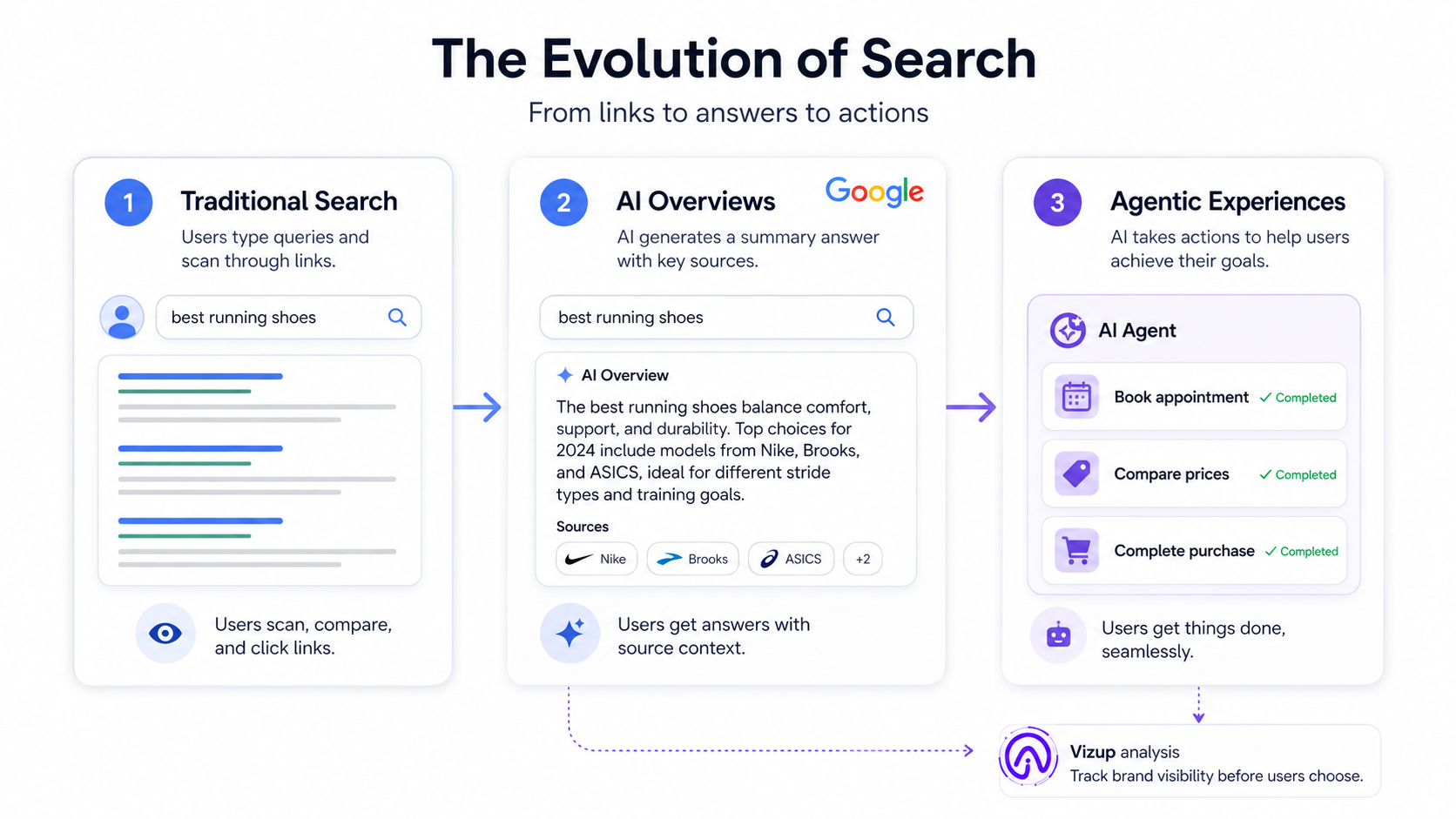
The guide includes a forward-looking section on 'agentic experiences,' where AI does not just answer questions but takes actions on behalf of users. Think: AI agents that book appointments, compare prices across vendors, fill out forms, or initiate purchases. Sites that enable these workflows through clean APIs, structured product data, and booking integrations will have an advantage as these features roll out. AI Overviews optimization 2026 is about answering questions. The next phase is about enabling transactions.
Honest caveat: this is the most speculative part of the guide. Google's documentation is vague on timelines and specifics. Do not over-invest in agentic preparation until the features are live and measurable. The practical step today is ensuring your site's transactional paths (booking flows, product pages, contact forms) are clean, fast, and machine-readable. That work pays dividends for current users regardless of whether agentic AI arrives in six months or two years. For a broader strategic framework, Vizup's AI search visibility playbook covers preparation steps in more detail.
How to Actually Monitor Your AI Search Visibility
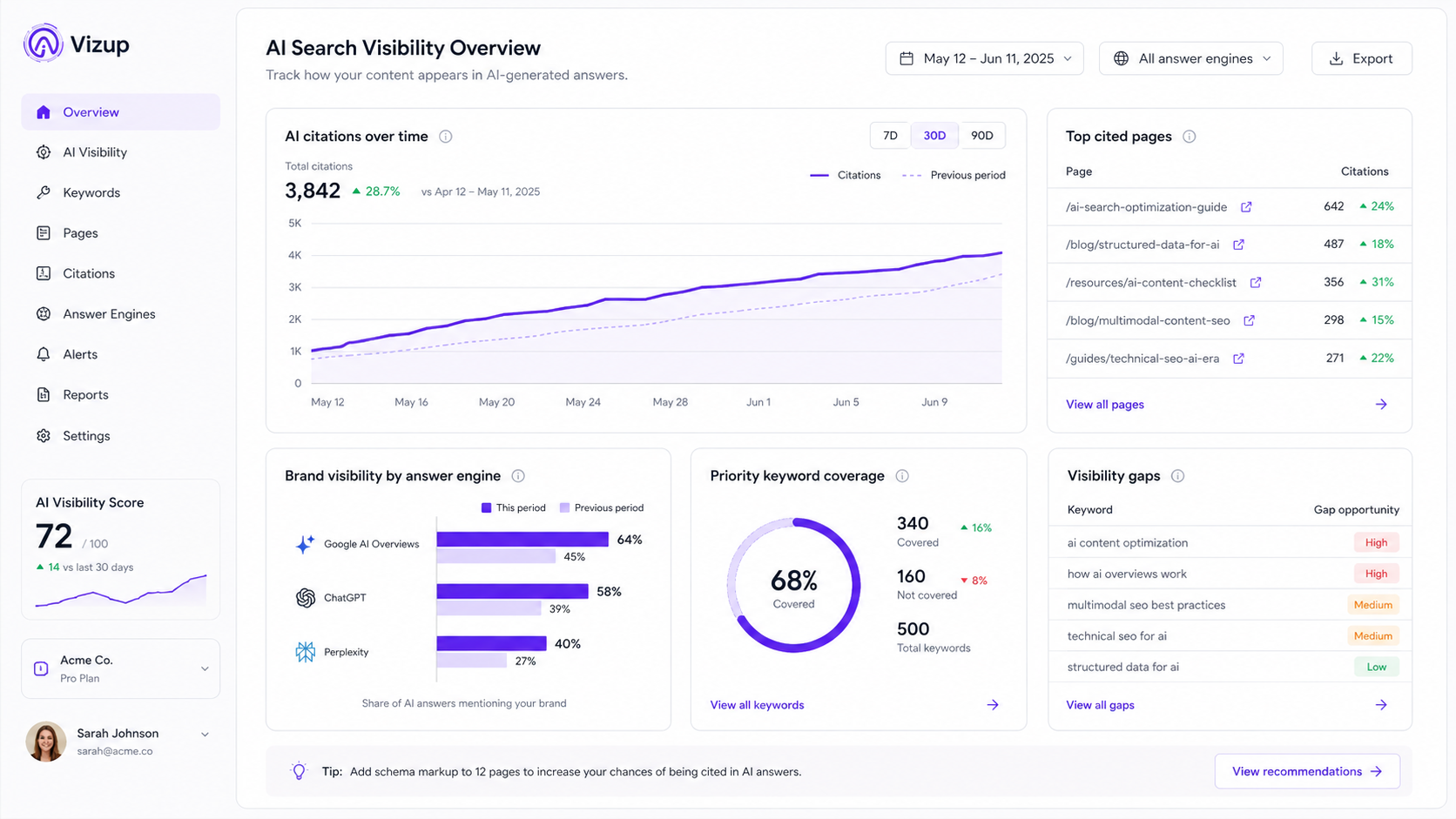
The biggest gap in Google's guide: it tells you what to do but not how to measure whether it is working. Google Search Console now shows AI Overview impressions (as of early 2026), but the data is limited in granularity. You can see aggregate impression counts, but drilling into which queries triggered AI Overview appearances, what content was cited, and how your brand presence changes across answer engines and priority queries requires more specialized tooling.
This is where tools like Vizup fit. Digital presence monitoring and answer engine monitoring give you visibility into how your brand appears across AI-generated answers, not just traditional SERPs. The practical workflow involves setting up baseline tracking for your priority keywords, monitoring AI citation frequency weekly, and correlating content changes with visibility shifts. Without measurement, you are optimizing blind. Other analyses of AI Overview behavior can provide useful third-party benchmarks for comparison.
Frequently Asked Questions
Does Google use llms.txt files to determine what appears in AI Overviews?
No. Google's official AI optimization guide (May 2026) explicitly states that llms.txt files are not needed for Google Search. Their systems do not reference this file when generating AI Overviews. The llms.txt standard may still be relevant for third-party LLMs like ChatGPT or Perplexity, but it has zero confirmed impact on Google's AI features.
Is AEO (Answer Engine Optimization) a separate discipline from SEO?
According to Google, no. The documentation states that AEO and GEO are 'still SEO' for Google Search. AI Overviews pull from the same index and use the same quality signals as traditional organic results. Treating AEO as a distinct discipline adds unnecessary complexity without changing the underlying work.
Do I need to reformat my existing content for AI search in 2026?
Google says no. Artificial content chunking, definition-heavy rewriting, and LLM-specific formatting are unnecessary. Google's AI systems parse natural language effectively. Focus instead on adding first-hand experience, original visuals, and ensuring your technical SEO fundamentals are solid.
How can I check if my pages are appearing in Google AI Overviews?
Google Search Console now shows AI Overview impressions as of early 2026, though the data is limited. For deeper analysis, including which specific queries trigger citations andhow your brand presence changes across answer engines and priority queries, tools like Vizup provide answer engine monitoring that tracks AI-generated citations across search platforms.
Will traditional organic rankings still matter as AI Overviews expand?
Yes. AI Overviews use retrieval-augmented generation (RAG) to pull information from Google's existing Search index. Pages that rank well organically are the source material for AI-generated answers. Strong organic rankings remain the prerequisite for AI Overview visibility, not a separate concern.
What to Do This Week
Google's AI optimization guide confirms that good SEO is AI optimization. Stop doing the four debunked tactics. Double down on the three confirmed signals. The best thing about the guide is that it simplifies the landscape. The worst thing is that simplicity does not sell, so expect the noise to continue. Use the official documentation as your filter.
Three actions for this week:
- Audit your content for first-hand experience signals. Identify your top 20 pages by traffic. For each one, ask: does this contain original data, expert perspective, or real-world examples that a competitor could not replicate by reading other articles? If not, upgrade it.
- Add original visual assets to your top 10 pages. Process diagrams, data visualizations, explainer screenshots, or short video walkthroughs. Stock photos do not count. Each visual should explain something the text alone does not. For guidance on how visuals and UX improvements compound, see Vizup's guide to AI and UX for conversion optimization.
- Run a technical hygiene check. Verify Googlebot access, check for JavaScript rendering issues, confirm canonical tags are correct, test your Core Web Vitals scores, and fix broken internal links. This takes a few hours and removes the most common silent barriers to AI Overview eligibility.
The Google AI optimization guide did not introduce a new playbook. It confirmed the old one and told the industry to stop inventing unnecessary complexity. For SEO managers, content leads, GEO practitioners, agency owners, and SaaS founders, that is the clearest signal Google has given in years. Act on it.
