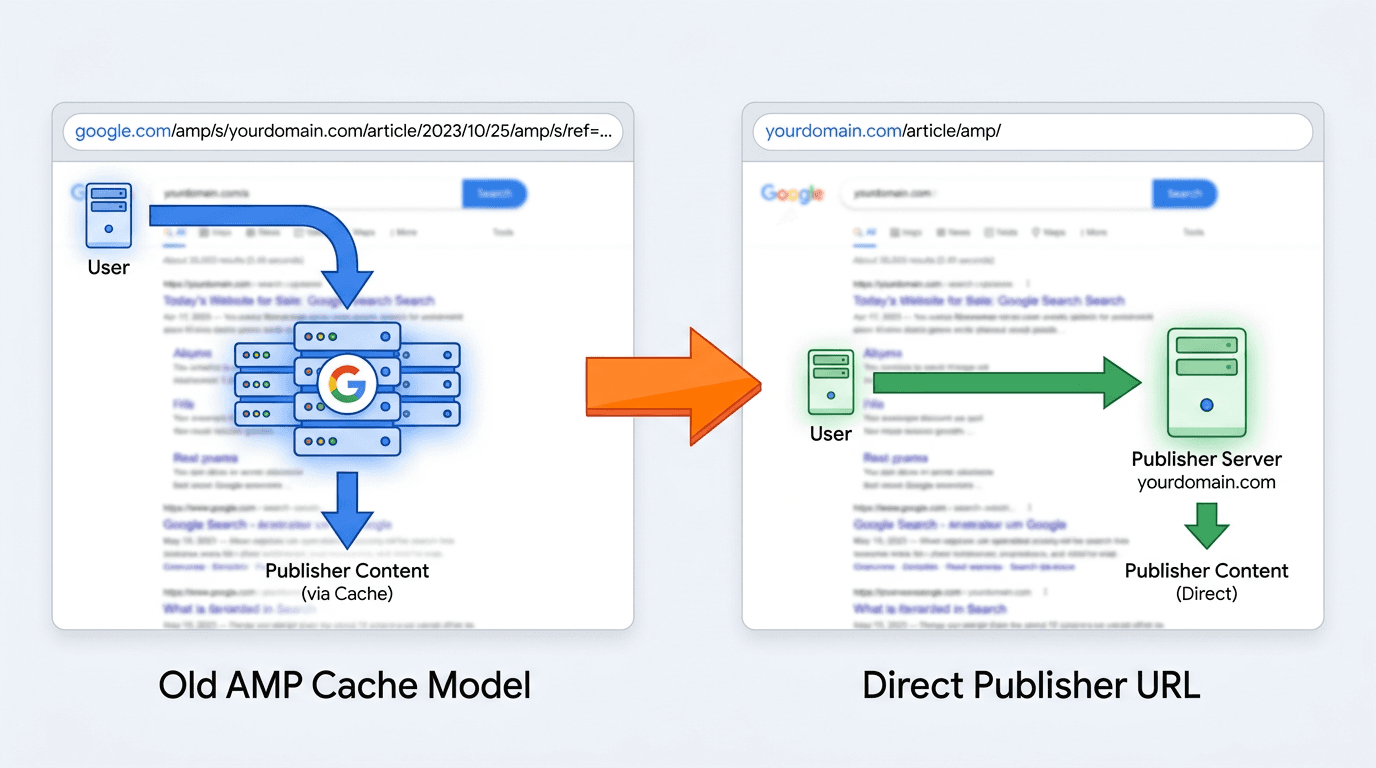
Google AMP direct links refer to a July 2026 change in how Google Search opens AMP results. When a user clicks an eligible AMP result, Google now sends them directly to the publisher-hosted AMP URL rather than serving the page through Google's AMP viewer and AMP Cache.
For publishers, this means the publisher's domain appears from the first page load, while the publisher's hosting or CDN stack handles delivery. The change may simplify parts of URL management, AMP maintenance and analytics, but it also makes publisher-controlled performance more important. It raises a practical question for editorial and engineering teams: does maintaining a separate AMP implementation still deliver enough value to justify the work?
The change also fits the wider evolution of how Google Search Live and AI Mode are changing organic discovery, with brands increasingly needing to monitor visibility across traditional results, AI experiences and other discovery surfaces.
What Actually Changed with AMP URLs in Search
Before July 1, 2026, Google Search could deliver eligible AMP pages through its AMP viewer and AMP Cache. In some configurations, signed exchanges allowed the publisher's URL to appear while content was delivered through Google's infrastructure. After the update, Google Search links directly to the AMP page hosted on the publisher's domain, such as yourdomain.com/article/amp/.
Google's updated AMP guidance for Search no longer describes the AMP viewer, AMP Cache or signed exchanges as part of the default Search delivery path. Search Engine Journal's summary of Google's AMP direct-link update also outlines the practical effect for publishers: users now open the publisher-controlled URL directly, and the publisher's hosting or CDN stack serves the request.
| Aspect | Before the update | After the update |
|---|---|---|
| Search click destination | AMP viewer or cached delivery could be used | Publisher-hosted AMP URL |
| Visible domain | Could involve a Google-controlled viewer or delivery layer | Publisher domain from the initial load |
| Delivery responsibility | Google's AMP delivery infrastructure could be involved | Publisher hosting or CDN stack |
| Signed exchanges | Could preserve the publisher URL during distributed delivery | Not required solely to show the publisher URL for AMP Search clicks |
| Analytics | Could require cache-specific or AMP-specific configuration | May be simpler, but still depends on analytics implementation |
| Direct ranking change | Not applicable | None announced; technical performance should still be monitored |
| Summary of changes introduced by Google's July 2026 AMP direct linking update. |
What You Can Stop Maintaining Now
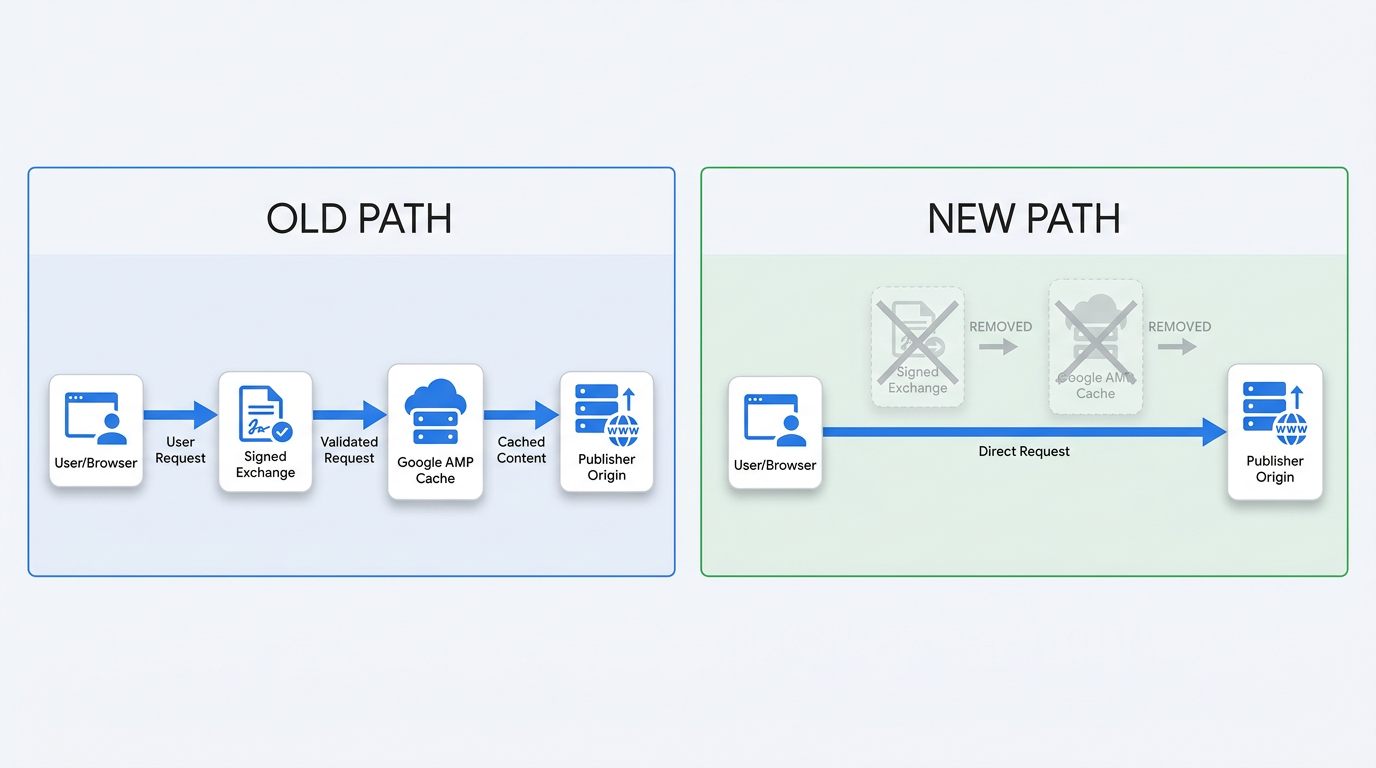
The update reduces the need to maintain two technologies solely for AMP delivery from Google Search. The first is signed exchanges. Signed exchanges are a web-packaging mechanism that allows a distributor to serve publisher-signed content while preserving a verifiable relationship with the publisher's origin.
Publishers no longer need signed exchanges simply to display their own domain when users open AMP results from Google Search. However, signed exchanges may still have uses outside this specific AMP workflow. Teams using them elsewhere should review their implementation before removing the technology entirely. web.dev's technical guide to signed exchanges provides additional implementation context.
The second change concerns the AMP Cache. Google Search no longer uses the AMP viewer and AMP Cache as its default delivery path for AMP results. Publishers can therefore stop maintaining cache-specific Search workflows that exist only to support that path.
The wider AMP Cache technology continues to exist and may still be used by other platforms or implementations. The official AMP Project documentation should remain the reference point for teams that continue to publish AMP content.
Because users now open the publisher-hosted AMP URL directly, analytics may become simpler for sites that previously handled cached AMP traffic separately. However, clean attribution is not automatic. It still depends on analytics tags, consent configuration, redirects, channel rules and other measurement settings.
Info: Google's updated Search documentation no longer presents the AMP viewer, AMP Cache or signed exchanges as part of the standard AMP delivery path from Google Search. Review internal runbooks, CDN rules, analytics documentation and deployment processes that still assume Google-hosted AMP delivery.
What Has Not Changed: Rankings and Discover
Google describes direct linking as a delivery change rather than a separate ranking update. AMP pages can continue to appear and rank in Search like other eligible web pages, and the update does not reintroduce special ranking treatment for AMP.
Publishers should still monitor performance after the transition. A slow publisher-hosted response, incorrect canonical configuration, faulty redirects or other implementation problems could indirectly affect crawling, user experience and organic visibility.
AMP's special role in Google surfaces had already been reduced before this update. In 2021, AMP stopped being a requirement for eligibility in Top Stories, and Google removed the AMP lightning-bolt icon from Search results. The direct-link change therefore brings delivery infrastructure closer to the broader direction of Google's move toward direct publisher and provider links.
The New Responsibility: Speed Is Fully Yours
When users open the publisher-hosted AMP URL directly, the performance of the publisher's own hosting, CDN and rendering stack becomes more visible. Publishers should not assume that historical AMP performance will remain unchanged after the delivery shift.
Sites that previously benefited from cache-based delivery, preloading or other Google-controlled optimisations may see different latency patterns. Compare post-change field data, server response times and real-user monitoring with earlier baselines. Pay particular attention to time to first byte, Largest Contentful Paint, Interaction to Next Paint, caching rules and mobile performance.
This is also where Vizup's Organic Autopilot for modern discovery can support a broader monitoring workflow. Vizup helps brands monitor, create, optimise, publish and learn across Search, Social, Communities, AI Answer Engines and Local Discovery. Its AI agents, human experts and live SEO, pSEO, AEO and GEO tools help teams identify technical regressions, track visibility changes and improve content performance. Paid ads are available as an optional amplification add-on rather than a substitute for organic performance.
Continue tracking changes in Google Search performance reporting after the transition so that unexpected traffic or visibility changes can be investigated early.
Is AMP Still Worth It? How to Decide Now
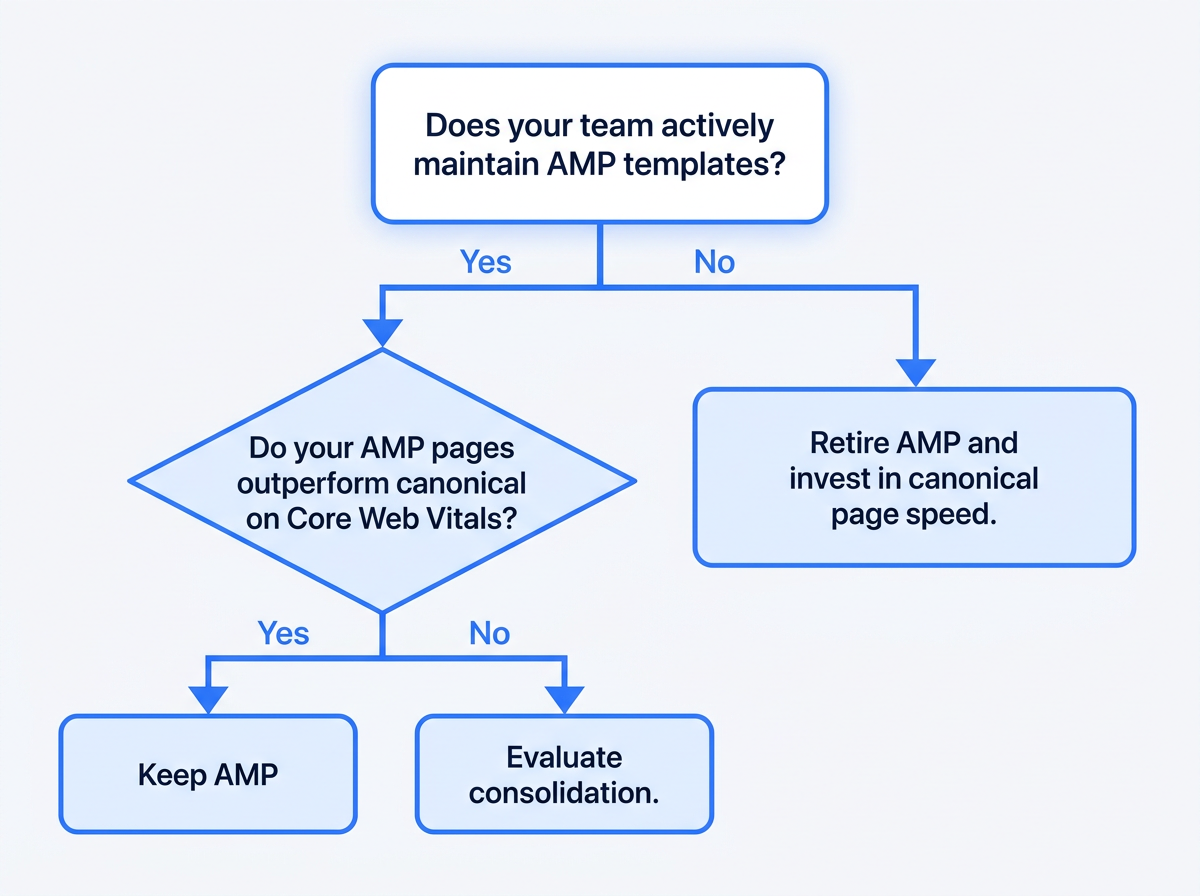
With Google Search no longer relying on cached AMP delivery and AMP no longer required for Top Stories, the decision becomes a standard engineering and publishing tradeoff. The central question is whether maintaining a separate AMP template produces better user outcomes than investing the same resources in the canonical experience.
Signals that may support keeping AMP
- Publisher-hosted AMP pages consistently outperform canonical pages in field Core Web Vitals data.
- The CMS produces valid AMP pages with minimal additional maintenance.
- AMP constraints provide useful performance guardrails for high-volume publishing.
- Retiring AMP would introduce substantial migration work without a clear user or business benefit.
- Important distribution partners outside Google Search still depend on the AMP implementation.
Signals that may support retiring AMP:
- AMP templates require dedicated engineering resources that could improve canonical pages instead.
- Canonical pages already meet performance and usability targets.
- AMP limits features or creates friction within the current publishing framework.
- Analytics, consent or personalisation require duplicated implementation across AMP and canonical templates.
- No meaningful distribution channel or user benefit depends on retaining AMP.
If you retire AMP, treat the change as a technical migration rather than simply deleting the templates. Map each AMP URL to the correct canonical destination, implement permanent redirects where appropriate and update internal links, canonical tags, XML sitemaps, structured data and analytics configuration.
Use monitoring legacy AMP links in Search Console to confirm that old AMP URLs resolve correctly and that the migration has not introduced crawl errors, redirect chains or conflicting canonical signals.
Key Takeaways
- From July 1, 2026, Google Search began linking directly to publisher-hosted AMP URLs instead of using its AMP viewer and cache as the default delivery path.
- Signed exchanges are no longer required solely to show the publisher's domain for AMP clicks from Google Search.
- The AMP Cache still exists, but it is no longer part of the standard Google Search delivery workflow described in Google's AMP guidance.
- Direct linking may simplify measurement, but analytics quality still depends on implementation and configuration.
- Google has not announced a separate ranking change connected to direct AMP linking.
- Publishers should compare post-change performance against previous field and server-side baselines.
- Keeping or retiring AMP should be based on maintenance cost, user outcomes, distribution requirements and canonical-page performance.
- Vizup can support continuous monitoring and optimisation across Search and other modern discovery surfaces, but it does not replace hosting, CDN or AMP migration work.
Frequently Asked Questions
Does this Google AMP update change my rankings?
Google describes it as a delivery change rather than a separate ranking update. AMP pages can continue to appear and rank like other eligible pages. However, publishers should monitor technical performance because slow delivery, incorrect redirects or canonical errors could still affect organic visibility indirectly.
Do I have to remove AMP from my site now?
No. AMP pages can still be crawled, indexed and linked from Search. Whether AMP should be retained depends on maintenance cost, publisher-hosted performance, distribution needs and whether the implementation provides a measurable benefit over the canonical experience.
What happens to old amp URL search results in analytics?
New Search visits should open the publisher-hosted AMP URL directly rather than a Google-hosted viewer or cached path. This may simplify measurement, but attribution still depends on the analytics implementation, consent settings, redirects and channel rules. Historical reporting will retain the measurement patterns produced by the previous setup.
Is the AMP lightning bolt icon gone for good?
Yes. Google removed the lightning bolt icon in 2021 when it dropped AMP as a Top Stories requirement. It has not come back, and Google has not suggested it will. In Search results, AMP listings look the same as standard ones.
Can I keep using the AMP framework if I want?
Yes. The AMP framework remains available, and publishers can continue creating and serving AMP pages. Google Search can still crawl and index those pages. The change affects how AMP results are delivered from Search, not whether publishers are allowed to maintain AMP content.
