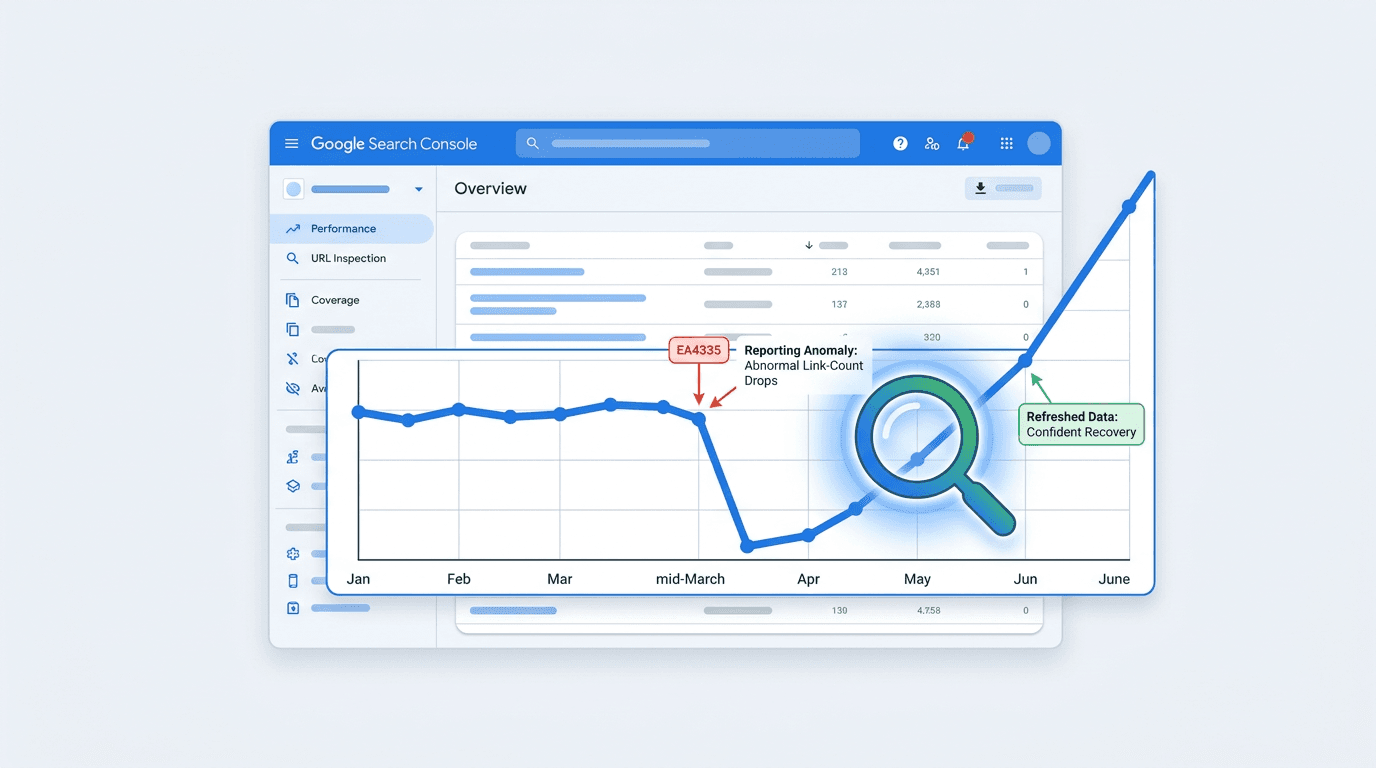
Google Search Console link report fixed" is shorthand for a display bug getting corrected in GSC. The drop many site owners saw was in the interface, not necessarily in their actual backlink profile. Search Engine Roundtable reported on June 12, 2026 that the Links report appeared to be fixed and updated after weeks of abnormal link-count drops that began around mid-March, with refreshed link data showing again across affected properties.
For weeks, SEO and content teams watched link counts in Google Search Console fall off a cliff, and the theories got dark fast: penalties, mass link loss, fallout from the May 2026 core update. The explanation was much simpler: the report was wrong. What matters now is the cleanup work - verifying what changed, auditing the refreshed numbers against other sources, and avoiding knee-jerk decisions based on what was ultimately a reporting anomaly.
What Actually Happened: A Search Console Reporting Issue
That sudden collapse in link counts was a Search Console reporting issue, not a live readout of your site's authority evaporating. Beginning in mid-March 2026, a bug caused the Google Search Console Links report to show steep declines - sometimes down to zero - across many sites. Google's temporary workaround was to roll the report back to older, historical data from before the bug. According to a June 12 Search Engine Roundtable report, the Links report appeared to be fixed and updated.
The practical risk is straightforward: if you made decisions off the broken report between mid-March and early June, you may have optimized for a phantom problem. Some teams rushed into disavows, kicked off outreach that wasn't needed, or warned clients about "lost authority" that never actually disappeared. This was a display and aggregation problem inside GSC, not an event in the link graph itself.
Info: Treat this reporting issue as separate from the May 2026 core update. There is no confirmed connection between the two. Core updates change ranking systems; this was a problem with how Search Console displayed data.
How the Google Search Console Link Report Works
The bug is easier to interpret once you remember what the Links report is - and what it isn't. It's a sampled, aggregated view of links Google has discovered and processed, not a complete, real-time inventory of every backlink. Even in normal conditions, totals can move around because of processing lag, canonicalization, and aggregation logic.
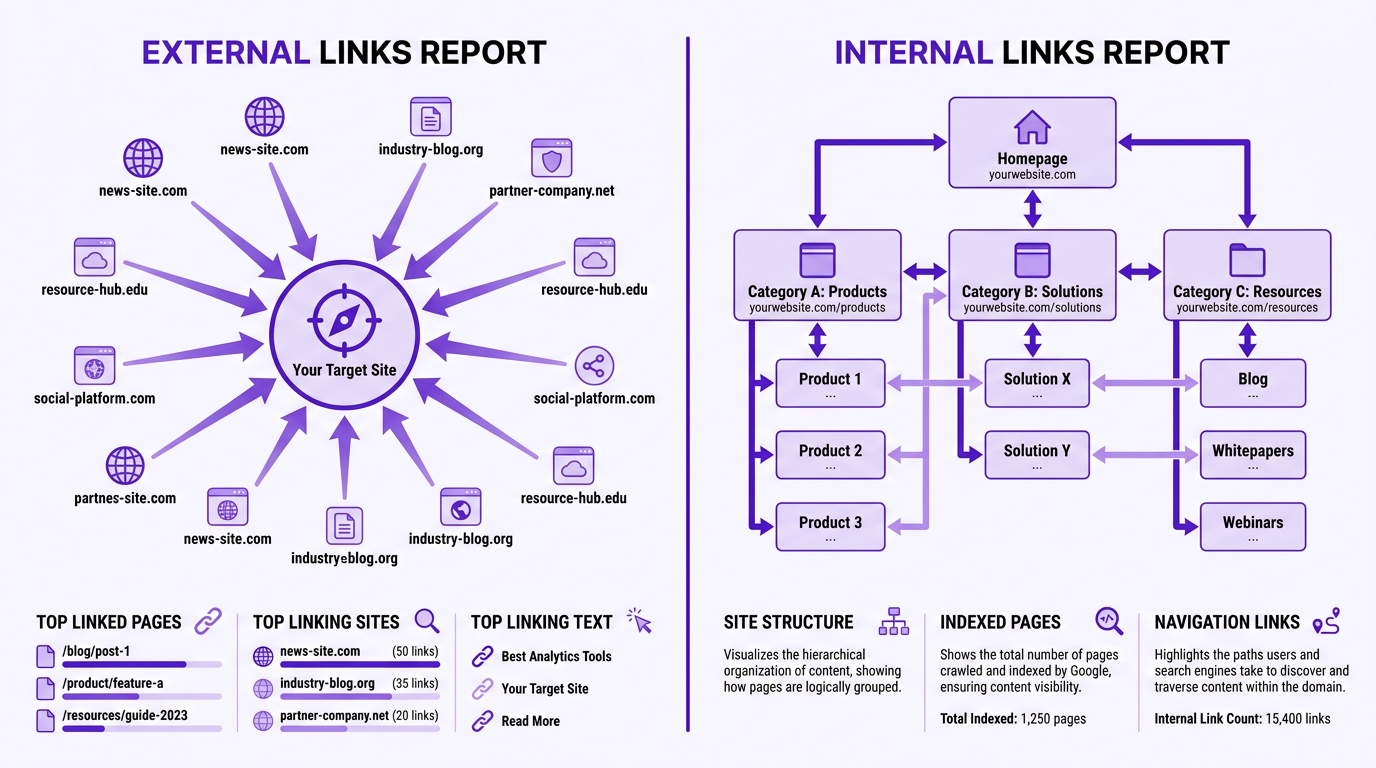
Inside the report, you'll see two main views: external links and internal links. They answer different questions, and they fluctuate for different reasons.
External Links Report: What the Numbers Represent
The external links view breaks down into three reports: Top linked pages, Top linking sites, and Top linking text. Each aggregates differently, which is why the same site can look "stable" in one view and chaotic in another. One common driver of big swings is how Google clusters domains and subdomains - for example, deciding whether m.domain.com, www.domain.com, and domain.com should be counted separately or rolled up. What you're seeing is Google's processed interpretation of your external link profile, not raw link logs.
Internal Links Report: Why It's Not Your Crawl Tool
The internal links report reflects Google's understanding of your site structure based on what it has discovered and indexed. It won't replace a full crawl from something like a dedicated site crawler, and it isn't trying to. Large shifts here can come from very normal site work: a nav redesign, canonical changes, updated parameter handling, or JavaScript rendering problems that change how Googlebot perceives links on a page.
What to Expect Now That the Google Search Console Link Report is Fixed
Now that the Google Search Console link report is fixed, expect discontinuities. The "fix" isn't just a visual patch; it includes corrected reporting and refreshed calculations, so totals often jump as backfilled data fills in. Some sites saw external link counts move from 135,000 to 165,000 overnight during rollout. It's also normal for "Top linked pages" and "Top linking sites" to reshuffle as the corrected dataset settles.
Here is a quick sanity check for what a normal rebound looks like versus a real issue:
- Normal Rebound: A sharp increase in total external and internal link counts, restoring them to levels seen before mid-March 2026 or higher.
- Normal Rebound: Previously 'missing' linking domains or linked pages reappearing in the reports.
- Potential Real Issue: Link counts remain flat or low even after the June 12th fix, especially if you can't find high-authority links you know exist.
- Potential Real Issue: The corrected data reveals a genuine downward trend that was previously masked by the bug.
What SEOs Should Check Now: A Calm Audit Workflow
Start by triangulating. Your job is to confirm that the "GSC links dropped" story was purely a reporting artifact - or to catch the rare case where the glitch distracted from a real problem. That means comparing Search Console link data to other sources and resisting the urge to spin up emergency link building or disavows off a single volatile report.
Step 1: Confirm the Anomaly is Isolated to the Links Report
Pull up the Performance report for the same window (mid-March through June 2026). Did clicks, impressions, or average position move in the same direction as the Links report? If rankings and traffic held steady while the Links report fell apart, that strongly supports the "display bug" explanation. Correlation isn't proof, but a clean lack of correlation is useful evidence.
Step 2: Compare Against Exports and Third-Party Crawlers
Lean on your own history first. Export the current link data from GSC and compare it to older exports you may have parked in decks, spreadsheets, or Looker Studio. Then cross-check against third-party backlink crawlers, then use Vizup as the monitoring layer that helps reconcile those signals with GSC and analytics. You should expect mismatches - every crawler has different coverage - but you want directional agreement. Close by spot-checking a handful of high-value backlinks manually to confirm the referring pages are live and still link to you.
Step 3: Validate Canonical and Redirect Changes
Links also "move" without being removed. If you recently migrated, adjusted redirect rules, or changed canonical logic, links that used to be credited to one URL may now be attributed to another. That can reorder the "Top linked pages" report in a way that looks like loss when it's really consolidation. If you need to work through large exports at scale, you can connect Google Search Console to Claude to help process and interpret the dataset.
Comparison Table: Reporting Bug vs. Real Link Loss
| Signal | Reporting Bug Symptom | Real Link Loss Symptom | Recommended Action |
|---|---|---|---|
| Links Report | A sudden cliff-drop in link counts, then a sharp recovery after June 12. | A steady decline over time, or a drop that doesn't correct after the fix. | Export the refreshed data and compare it to historical baselines. |
| Performance Report | Traffic, impressions, and rankings look stable or follow expected seasonality. | Organic traffic or rankings drop in the same window, especially on key pages. | Treat it as a performance incident and investigate immediately. |
| Third-Party Tools | Ahrefs/Semrush show a stable or growing profile during the GSC bug window. | Third-party tools also show fewer referring domains or backlinks. | Use consensus across multiple sources as your working truth. |
| Live Spot-Checks | High-value backlinks still exist when you check the referring pages manually. | Manual checks show key links removed, or the linking pages now return 404s. | Escalate outreach/recovery work if high-value links are actually gone. |
| Key signals to differentiate a reporting glitch from a genuine backlink problem. |
What Not to Overreact To (and What's Worth Escalating)
Separate noise from signal. Big count swings, reordered leaderboards, and temporarily missing rows that now reappear are consistent with the bug and the backfill. Those aren't, by themselves, a reason to rewrite your link strategy.
Escalate when your audit turns up something concrete: verified link removals from important referring domains, widespread 404s on your most-linked URLs, or an organic performance decline that lines up with the timeline. Those cases warrant a real investigation with your SEO lead and often development and content in the loop. That's a different situation than reacting to a known Search Console reporting issue, like another recent GSC bug that hit impression data.
How Vizup Helps Teams Monitor and Improve Organic Visibility
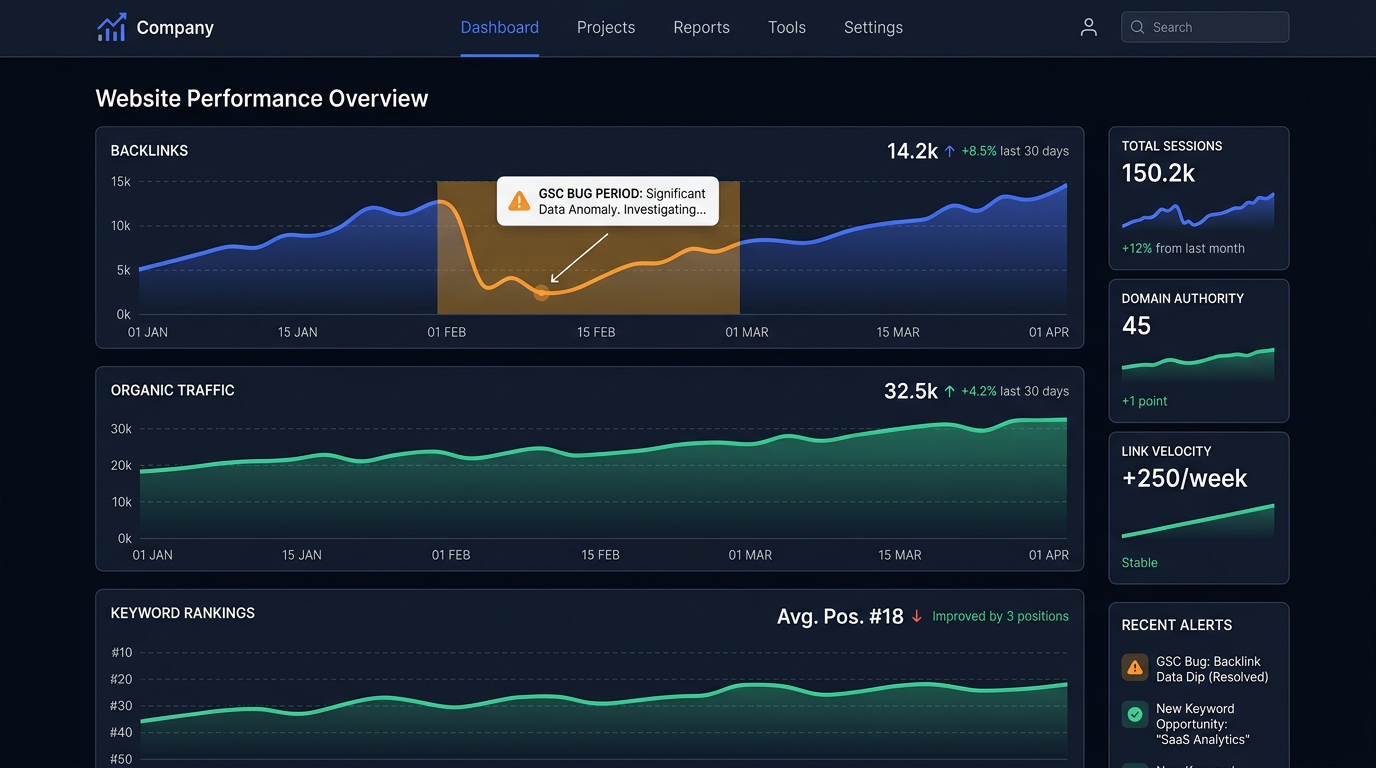
Living in GSC tabs all day doesn't scale, especially when a single report can be wrong for weeks. Vizup helps teams create, optimize, index, monitor, and improve organic visibility across Google and AI answer engines, so link-report anomalies are reviewed in the context of the full search visibility picture.
Instead of treating backlink data as a standalone signal, Vizup helps teams connect what is happening across GSC, analytics, content performance, indexing, and AI answer engine visibility. For teams building an AI visibility workflow, Vizup's guide to AI visibility platforms explains how brands can track and improve discoverability beyond traditional rankings.
Pulling from multiple sources - including GSC, third-party crawlers, analytics, and visibility data - gives teams a sturdier view of SEO health than any single dashboard. Vizup supports that process by helping teams monitor anomalies, annotate known data issues, and prioritize fixes that improve discoverability across both traditional Google search and AI-driven answer experiences. Teams can also use Vizup's Google Search Console and Claude workflow to process large GSC exports more efficiently, then connect those findings back to content optimization, indexing, and visibility improvements.
Key Takeaways
- It Was a Reporting Bug: The mid-March to June 2026 drop in GSC links was a display issue, not proof your backlinks vanished. Treat the rebound as a data correction.
- Audit, Don't Panic: Validate the refreshed link numbers against Performance, historical exports, and third-party tools before you change strategy.
- Separate from Core Updates: Don't pin this on the May 2026 core update unless your traffic and rankings data supports that story.
- Use GSC Directionally: The external and internal link reports are useful directional signals from Google, not an exhaustive backlink inventory.
Frequently Asked Questions
Does "Google Search Console link report fixed" mean my backlinks are back?
It mainly means the reporting is back. The bug affected how GSC displayed link data, so the fix restores visibility into links that likely never disappeared. Counts should trend closer to where they were before mid-March 2026.
Why did "GSC links dropped" show up if my rankings didn't change?
That's a common pattern with reporting bugs: the UI says one thing while rankings and traffic say another. If Performance stayed stable, it's a good sign Google's ranking systems still had access to the underlying signals even though the Links report was malfunctioning.
How often is Search Console backlink data updated in the Google Search Console links report?
Google doesn't publish a fixed refresh schedule. Link data updates as Google re-crawls and re-processes the web, and it's a lagging indicator - new links can take weeks or months to appear, and removed links can take just as long to drop out.
Should I disavow links or start emergency link-building after a GSC link report bug?
No. Strategic moves based on volatile or incorrect data are how teams create self-inflicted problems. Validate with multiple sources (third-party tools plus performance metrics) before you disavow anything or invest in new campaigns.
What's the fastest way to compare the external links report vs internal links report for anomalies?
Export the external "Top linked pages" report and the internal "Top internally linked pages" report, then compare the overlap. It's a quick way to spot pages that attract external links but don't get enough internal support (or the reverse), especially now that the data is reliable again.
