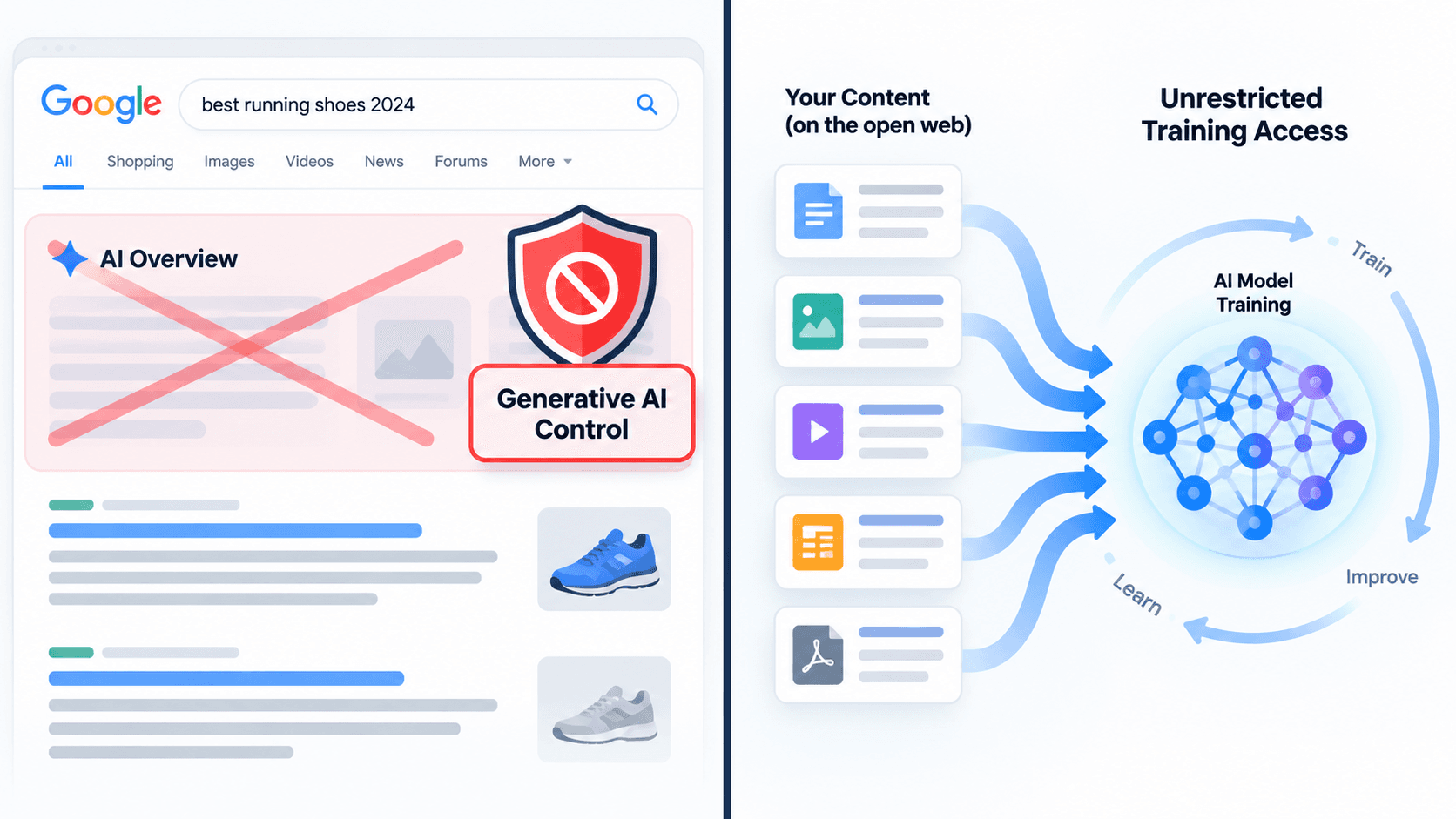
Google's Search generative AI control is a site-wide setting in Google Search Console that lets publishers exclude their links and content from AI Overviews, AI Mode, and generative AI features in Discover. It does not prevent Google from using content for AI model training. Google's documentation explicitly distinguishes this Search visibility control from Google-Extended, a separate robots.txt product token used to limit certain training and grounding activities.
For publishers deciding how to control what you share with Google Search, this is now a governance question. The available settings are scattered across crawling, indexing, presentation, and training or grounding uses, and they operate independently. Pick the wrong one and you either vanish from Search or change nothing you meant to change. Before deploying anything, map the requested outcome to the layer it actually affects.
What Google Actually Changed (and Didn't Change) in October 2026
In October 2026, Google revised its control what you share with Google Search documentation, grouping seven existing methods in a cleaner table. Coverage from outlets including Search Engine Roundtable (2026) made the change look like a new opt-out launch. It was not. Google Search Central's changelog calls it a documentation reorganization, not a product release. No new Search generative AI control arrived in October. If a team began scoping a newly announced switch, stop before building around it.
The Search Generative AI Control: What It Blocks and What It Doesn't
Google's Search generative AI control is available through Search Console under Settings > Search generative AI. Website owners can include their content in supported generative AI features, exclude it, or inherit the setting from a parent property. The control covers AI Overviews, AI Mode, and generative AI features in Discover. The control rolled out worldwide on August 31, 2026. It is not implemented through robots meta directives.
The boundary matters: this is a Search presentation control, deciding whether content appears in supported generative Search and Discover features. It is not itself a training control. Google-Extended allows publishers to restrict specified AI training and grounding uses without removing their pages from traditional Google Search. However, it should not be treated as a universal guarantee that Google will never use indexed content in any AI-related system. Publishers must evaluate the scope of each control separately.
Google-Extended vs. Generative AI Control
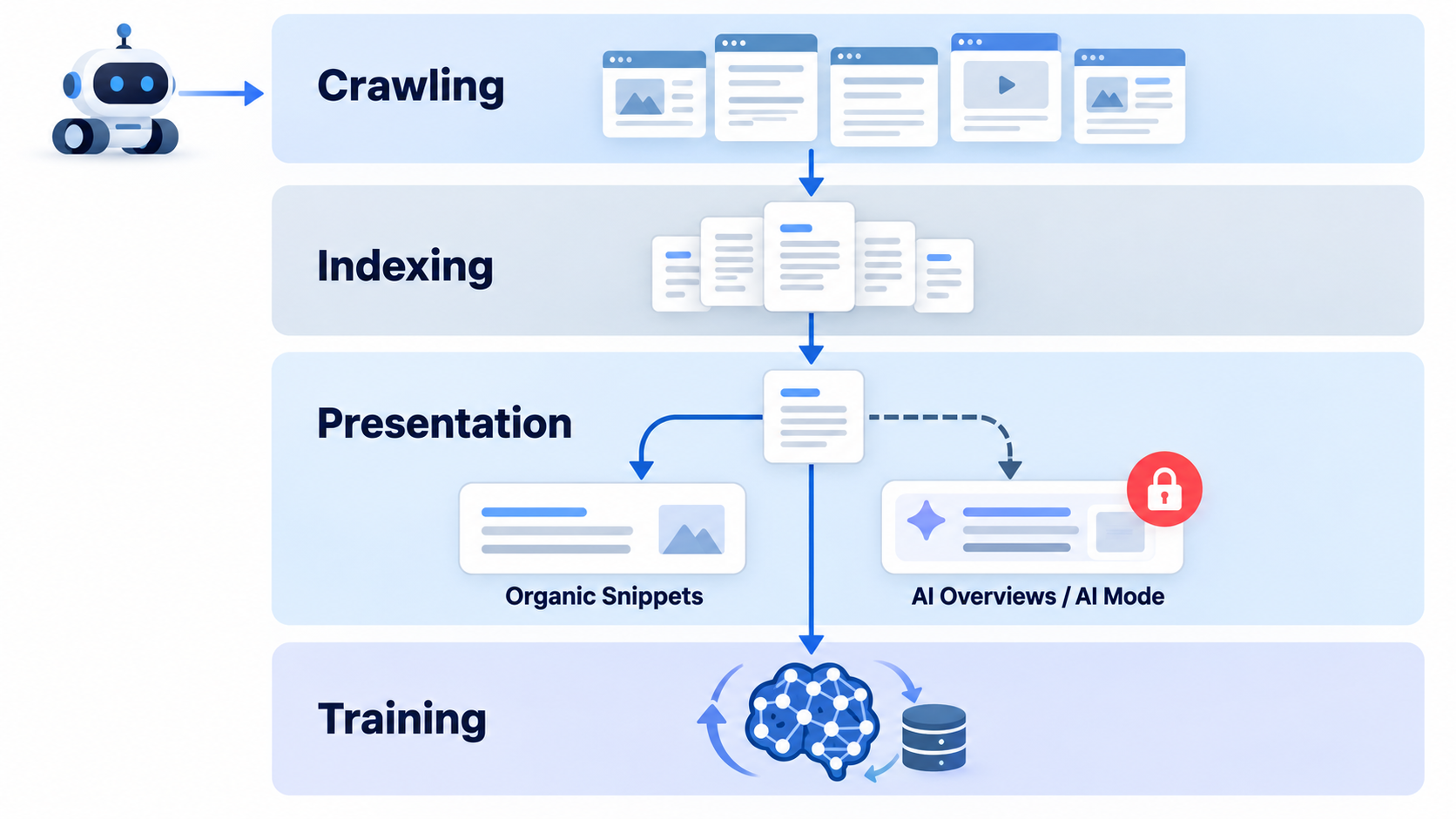
Google-Extended is a robots.txt product token, not a separate crawler. Google's current documentation identifies its use for controlling training of future Gemini models powering Gemini Apps and the Vertex AI API for Gemini, as well as grounding in Gemini Apps and Grounding with Google Search on Vertex AI. It does not affect a site's inclusion or ranking in Google Search. Google also directs publishers to Google-Extended when they want to limit training of models used to generate responses in Search generative AI features.
How Google-Extended Limits Specified AI Uses Without Removing Search Visibility
Google's Search presentation controls and documented training or grounding controls are separate. The Search generative AI setting governs inclusion in supported AI Overviews, AI Mode, and Discover experiences. Google-Extended restricts the specified Gemini training and grounding uses listed in Google's current documentation without changing organic Search inclusion or ranking. It is not a universal opt-out from every possible AI-related use, so teams should define the products and activities they intend to restrict before implementation.
How the Controls Actually Work: Crawling, Indexing, Presentation, Training, and Grounding
Five functions are routinely collapsed into one: crawling through robots.txt, indexing through noindex, snippets through nosnippet, max-snippet, and data-nosnippet, generative Search presentation through the Search Console setting, and specified AI training or grounding uses through Google-Extended. These controls are not interchangeable. Bad deployments start when one setting is expected to do another setting's job.
To exclude a site from Google's supported generative Search features, open Search Console, navigate to Settings > Search generative AI, and select the exclusion option for the relevant property. This is a property-level control rather than a page-level robots meta tag. Google also supports inheritance and overrides through parent and child properties. For individual pages or specific text, use Google's documented snippet controls, such as nosnippet, max-snippet, or data-nosnippet, understanding that these do not provide the same site-level AI-feature exclusion.
The data-nosnippet Tag: Element-Level, Not Page-Level
data-nosnippet applies to individual HTML elements, including spans, divs, and sections. Text marked with data-nosnippet is excluded from eligible snippet content, including direct input for AI Overviews and AI Mode. However, the attribute does not guarantee that the page itself will never be linked or cited in these features. Other unmarked content and eligible structured data can remain available for Search presentation.
Warning: Wrapping an article body in one data-nosnippet div does not reproduce a page-level nosnippet directive or the property-level Search generative AI exclusion. Google can still use unmarked page content, eligible structured data, and metadata for Search presentation.
noindex vs. nosnippet: Choosing the Right Control
The noindex vs. nosnippet choice is where governance discussions often stall. noindex removes a page from Google's index, so it cannot appear as an organic result or in supported generative Search features. nosnippet leaves the page indexed and eligible to rank but disables its traditional text snippet. Google also states that content covered by nosnippet will not be used as direct input for AI Overviews and AI Mode, although this is not the same as a property-level exclusion. data-nosnippet applies only to marked text and does not exclude the entire page. The Search generative AI control offers a separate way to exclude a site's content from supported AI Search features while retaining eligibility for traditional organic results. Unlike noindex, it does not remove pages from Google's index. Unlike nosnippet, it does not disable traditional text snippets. Publishers who need site-level exclusion from AI Overviews and AI Mode should use the Search Console control instead of relying on unsupported robots directives.
The Traffic Decision Nobody Talks About
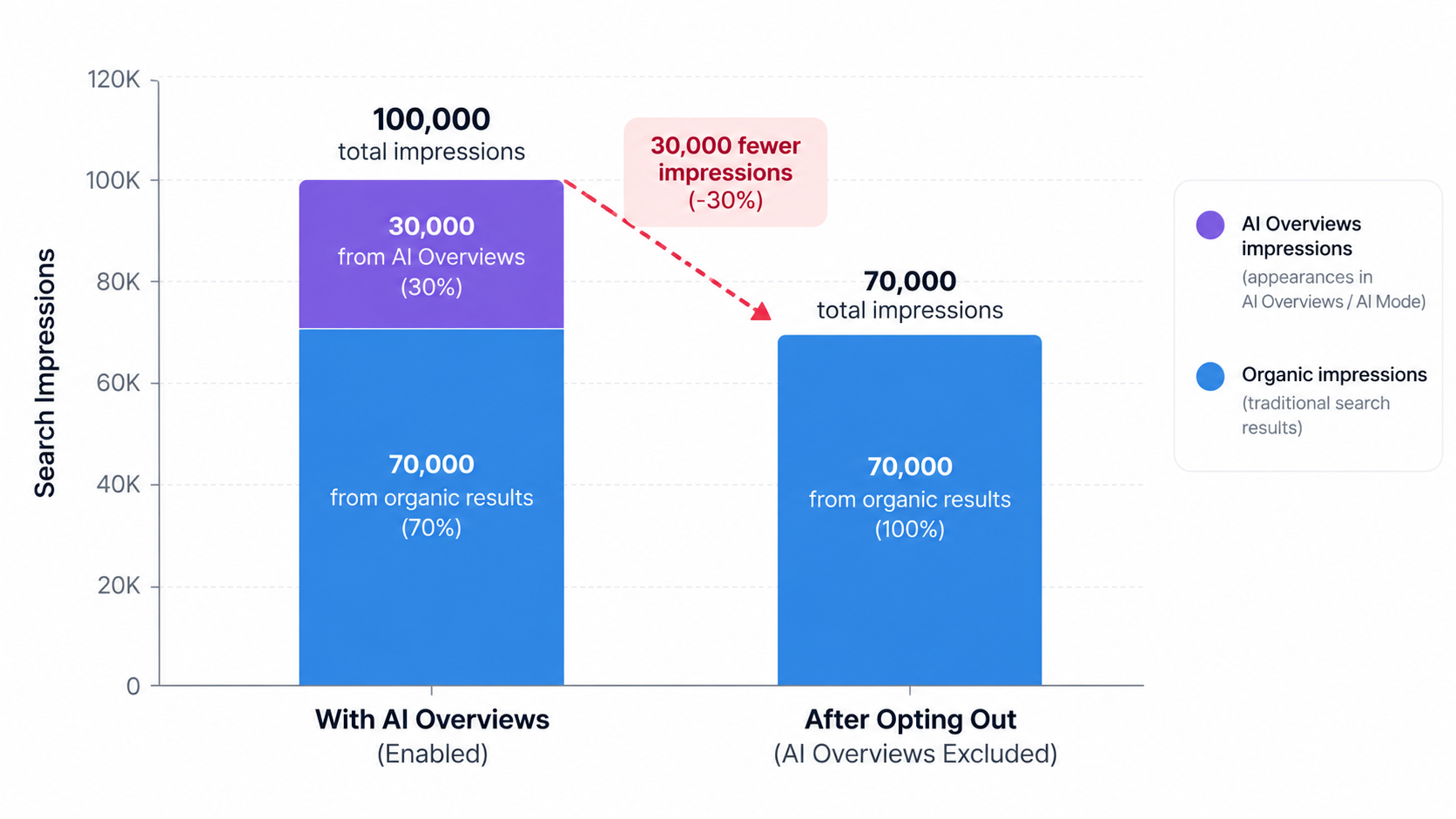
Opting out of AI Overviews, AI Mode, and supported generative AI features in Discover also gives up potential impressions and visits from those surfaces. AI Overviews appear across a growing range of informational and commercial searches, although their prevalence varies significantly by query type and industry. Publishers should measure their actual exposure before deciding to opt out. Google introduced dedicated generative AI performance reports on June 3, 2026, and completed their worldwide rollout on August 31, 2026. These reports help publishers track impressions, affected pages, countries, devices, and trends, but they do not provide dedicated click metrics for generative AI features.
Common Misconceptions That Lead to Bad Implementations
Misconception 1: "I set the Search generative AI control, so Google cannot train on my content." Wrong. The Search Console setting controls presentation in supported generative Search and Discover features, not training. Google-Extended is a separate product token covering specified Gemini training and grounding uses.
Misconception 2: "data-nosnippet on my article body guarantees the page cannot appear in AI Overviews." Wrong. It works at element level. Marked text is excluded from eligible snippet content and direct input, but unmarked content and eligible structured data remain available. The page can still be linked or cited.
Misconception 3: "Google launched a new opt-out control in October 2026." Wrong. Google reorganized its documentation; it shipped no new control that month. Verify coverage against Google's own documentation before changing production settings.
A Decision Matrix for Content Governance Teams
The table makes the distinction between Search presentation and training controls explicit. It maps each control to the five outcomes teams commonly expect it to affect. Google Search opt-out options operate at different levels, and the training or grounding scope of Google-Extended must be assessed against Google's current documented product list.
| Control | Crawling | Indexing | Search snippets | AI Overviews / AI Mode | AI training |
|---|---|---|---|---|---|
| robots.txt Disallow for Googlebot | Blocks Googlebot crawling | URL may still be indexed | No crawled page text available | Not a reliable AI-specific opt-out | Not a universal training opt-out |
| noindex | Crawling allowed | Removes eligible URL from Search index | Removed | Excluded as an indexed Search page | Not a training-specific control |
| nosnippet | Crawling allowed | Allowed | Text snippets disabled | Direct content input restricted, not guaranteed link exclusion | No training-specific control |
| data-nosnippet | Crawling allowed | Allowed | Marked text excluded | Marked text excluded from eligible input | No training-specific control |
| max-snippet | Crawling allowed | Allowed | Limits snippet length | Limits eligible direct input | No training-specific control |
| Search generative AI control | Crawling allowed | Allowed | Unaffected | Excludes supported AI Search features, including eligible Discover features | Does not control training |
| Google-Extended | Does not block ordinary Googlebot crawling | Unaffected | Unaffected | Does not opt a site out of Search AI features | Restricts specified model training and grounding uses |
| The Search Console setting controls supported generative Search presentation. Google-Extended separately restricts specified Gemini training and grounding uses. |
Implementation Summary: How to Control What You Share With Google Search
- The Search Console generative AI control excludes a site's content from supported AI Search features, not AI training.
- Google directs publishers to Google-Extended to limit specified model training uses, including models used for generative Search responses. Its documented product coverage is not universal.
- Google-Extended governs specified Gemini model training and grounding uses without affecting inclusion or ranking in traditional Google Search.
- data-nosnippet excludes marked text from eligible snippets and direct input, but it does not guarantee that the entire page will never be linked or cited.
- noindex removes a page from Search, while nosnippet preserves indexing but disables traditional text snippets and direct use of the covered content in AI Overviews and AI Mode.
- The October 2026 documentation change was a reorganization, not a new control launch.
- Google introduced dedicated generative AI performance reports on June 3, 2026, with worldwide rollout completed on August 31, 2026.
- Controlling Search presentation, crawling, indexing, snippets, training, and grounding requires separate controls with separately evaluated scopes.
Vizup's AI Overview monitoring tools let publishers track visibility in AI Overviews and AI Mode after a control change, replacing guesswork with traffic evidence.
Frequently Asked Questions
Does the Search generative AI control stop Google using my content to train AI models?
No. The Search Console generative AI control excludes a property's links and content from supported AI Overviews, AI Mode, and generative AI features in Discover. For training-related restrictions, Google directs publishers to Google-Extended, which governs specified Gemini model training and grounding uses without affecting ordinary Search inclusion.
How do noindex and nosnippet differ when preventing Google AI summaries?
noindex removes the page from Google's index and Search results. nosnippet retains indexing and ranking but disables traditional text snippets and prevents covered content from being used as direct input for AI Overviews and AI Mode. To exclude a site from supported generative Search features while retaining traditional snippets, use the Search generative AI setting in Search Console.
Can data-nosnippet opt an entire page out of AI Overviews?
No. data-nosnippet is an element-level HTML attribute that excludes only the text it marks from eligible snippets and direct input. Other unmarked content and eligible structured data remain available, and the page can still be linked or cited. For exclusion from supported generative Search features, use the Search Console setting. data-nosnippet only controls marked page text.
Which Google search opt-out options block AI training for publishers?
Google directs publishers to Google-Extended for specified training-related restrictions. It governs specified training of future Gemini models powering Gemini Apps and the Vertex AI API for Gemini, as well as grounding in Gemini Apps and Grounding with Google Search on Vertex AI. It does not affect ordinary Search inclusion or ranking, but its documented product coverage is not universal.
Will opting out of AI Overviews remove my site from regular Google Search results?
No. The Search Console generative AI control excludes supported AI Search features without directly changing eligibility for ordinary organic results. Pages remain indexed and eligible for traditional results and text snippets.
