
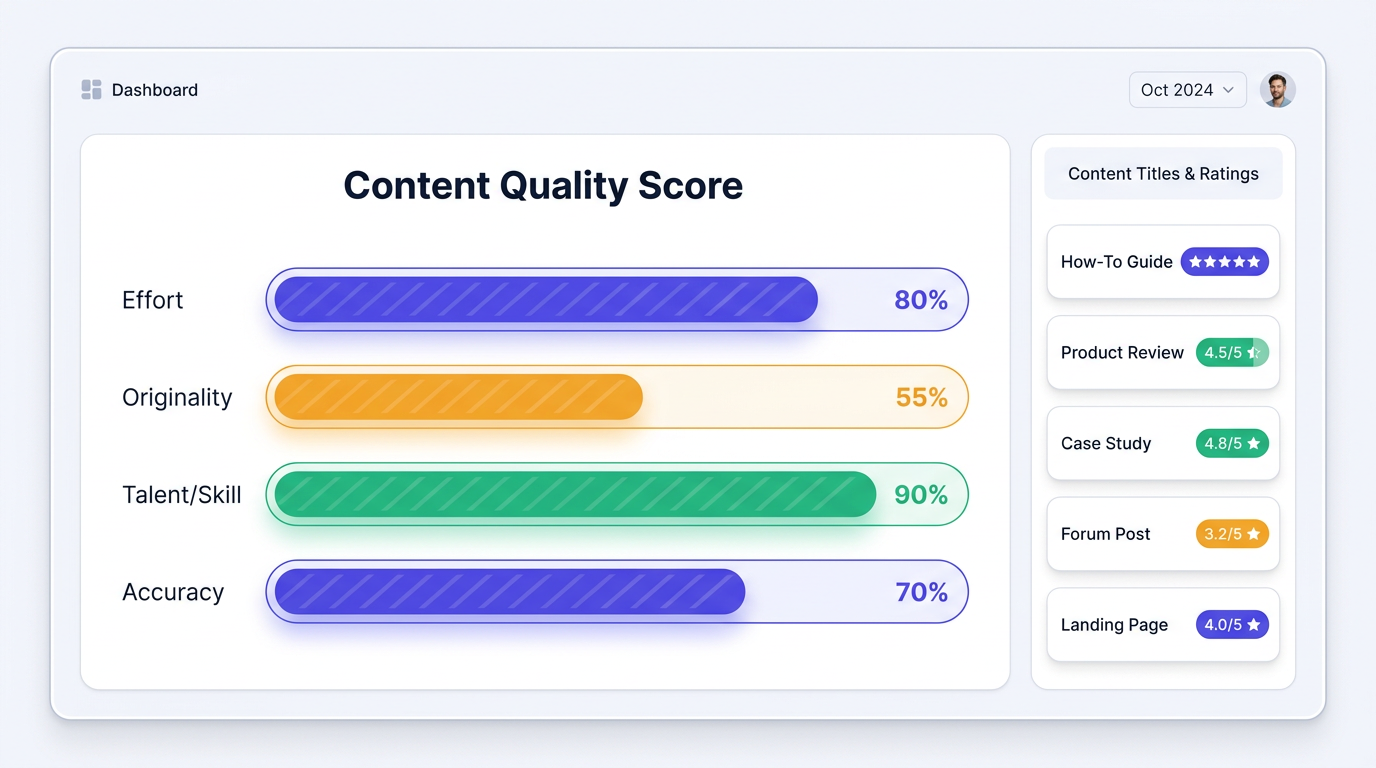
Google now asks human quality raters to judge main content against four attributes: Effort, Originality, Talent/Skill, and Accuracy. Google's updated guidance now makes four main-content attributes explicit: Effort, Originality, Talent or skill, and Accuracy. For simplicity, this article refers to these four attributes as EOT-SA, but EOT-SA is not Google's official name for the framework.
For years, teams have used E-E-A-T as a broad principle with little page-level guidance. Google's October 2026 update to its people-first content guidance update narrows the question. By naming four criteria tied to a page's main content, Google has published something close to an editorial rubric for Content Strategy Directors, SEO Managers, and Editorial Leads. Each criterion has practical implications for drafts, reviews, and publishing gates.
How Main Content Quality Fits Alongside E-E-A-T
E-E-A-T - Experience, Expertise, Authoritativeness, and Trustworthiness - has long framed Google's quality guidance. It is not a direct ranking factor, but it informs feedback from Google's 16,000+ human quality raters that shapes ranking algorithms (Originality.ai, 2025). Its limitation is scope: E-E-A-T speaks to the author and site. A credentialed expert on an authoritative domain can still publish thin, recycled material.
EOT-SA addresses the page itself. Google's updated people-first content guidance defines Main Content as anything that directly helps a page fulfill its purpose, including text, media, interactive features, and user-generated contributions. Raters assess the effort, originality, talent, and skill behind that material. This is more than a wording change: the focus shifts from who made the page to how well the page was made.
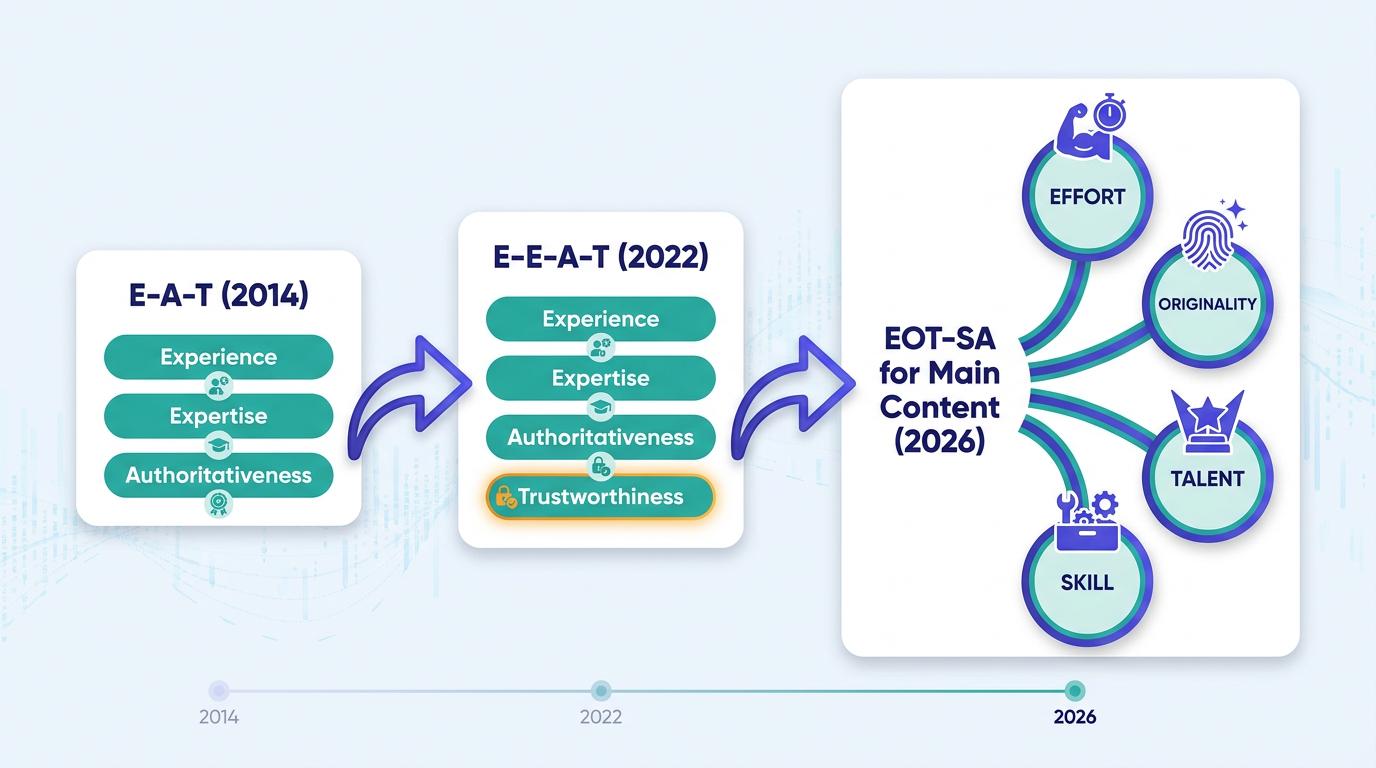
The timing tracks with the web's flood of AI-assisted pages. A large language model can produce grammatical, relevant copy for a reputable domain, yet the result may lack genuine work, a distinct perspective, capable execution, or verified facts. Those are the qualities EOT-SA isolates. What Google actually said about content signals helps distinguish Google's position from industry inference.
The Four Pillars of Content Quality Assessment: A Deep Dive
The 2026 guidelines give raters four ways to inspect main content. Each covers a separate quality dimension. A high rating does not demand perfection in every category, but a serious weakness in one can pull down the page's overall assessment.
Pillar 1: Effort
Effort is visible investment: time, resources, and care. Google explicitly asks raters to look for it. Word count and budget are beside the point. A 500-word post built on original survey data shows more effort than a 3,000-word recap of existing articles.
Strong signals include proprietary datasets, custom charts or annotated screenshots, named expert interviews, case studies with outcomes, and documented testing methods. Weak ones include a summary of three blog posts with no added insight, filler stock photography, or analysis that merely restates the obvious. The practical test is simple: did the creator do meaningful work, or take the shortcut?
Tip: Effort is not a budget line. A solo blogger who photographs every recipe step, tests three variations, and records the results has done more than a media company that rewrites a press release.
Pillar 2: Originality
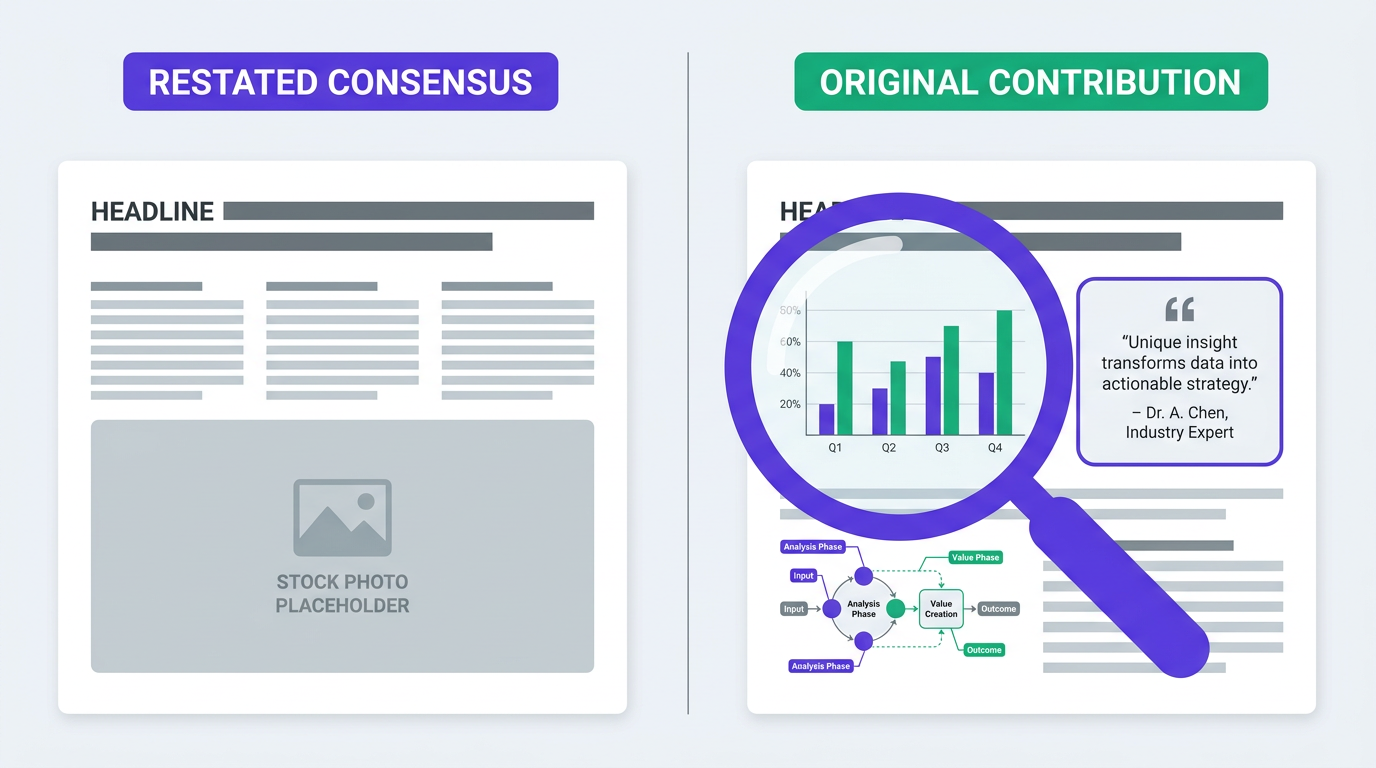
Originality means more than avoiding plagiarism. Google asks whether a page offers information, analysis, or a perspective readers cannot readily get elsewhere. A polished restatement of the consensus can still miss the mark. For teams publishing at scale, the question is not "is this text unique?" It is "what does this add?"
That contribution might be first-party data, proprietary research, a voice grounded in real experience, a new framework built from familiar ideas, or a format that serves readers better. The same standard matters for user-generated content. A forum post documenting an otherwise undocumented troubleshooting path has more value than a generic reply repeating official documentation. How AI search engines retrieve and cite content underscores why: AI systems tend to surface sources that add information rather than recycle it.
Pillar 3: Talent and Skill
Talent and Skill concern execution: precise writing, logical structure, engaging presentation, and functional design. A skilled writer makes a complex financial concept accessible without flattening it. A capable designer turns dense data into something readers can scan. Raters are asking whether the creator has the craft to fulfill the page's purpose.
Titles, headings, and main-content structure all matter. Descriptive, hierarchical headings that move readers through a clear sequence demonstrate skill; "More Info" and "Details" do not. Formatting makes the same point. Use tables for comparisons, numbered steps for sequences, and short paragraphs when explaining an idea. Those choices show that the page was built for the reader, not poured into a template.
Pillar 4: Accuracy
Accuracy is non-negotiable, especially for YMYL (Your Money or Your Life) topics. Google's guidelines say health, finance, safety, and civic content must be highly accurate and align with established expert consensus to receive a high quality rating (Google Search Central, 2026). On a medical page, one unsupported claim can undermine the whole assessment.
Accuracy still counts outside YMYL, with the bar scaled to possible harm. Wrong product specifications and incorrect recipe measurements are quality failures. Teams can protect against them with named, dated sources; peer-reviewed studies or official documentation; an internal fact-checking process; and flags for claims resting on one source. Google also directs raters to give the lowest rating to deceptive E-E-A-T tactics, including fabricated author profiles, AI-generated headshots, and false credentials (Search Engine Journal, 2026).
Warning: Accuracy includes restraint: do not overstate conclusions, cherry-pick evidence, or present opinion as settled fact. Raters are trained to recognize each pattern.
What High Quality Looks Like: EOT-SA Applied
A framework becomes useful when reviewers can recognize pass and fail cases. The table maps each EOT-SA criterion to examples across content types. Use it while reviewing drafts, not after the page is already live.
| Criterion | Low Quality Example | High Quality Example |
|---|---|---|
| Effort | Blog post summarizing three competitor articles with no new data or perspective | Blog post presenting original survey data from 200 respondents, with quotes from two named industry practitioners |
| Originality | Product comparison listing the same specifications found on every review site | Product comparison with hands-on testing, original benchmark scores, and a unique scoring methodology |
| Talent/Skill | Forum answer presented as a wall of text with unclear terminology | Forum answer with a structured troubleshooting sequence, clear headings, and links to relevant documentation |
| Accuracy | Health article citing unnamed 'studies' with no links, dates, or author credentials | Health article citing three named peer-reviewed studies with publication years, reviewed by a credentialed medical professional |
| These examples apply across blog posts, product pages, and user-generated content. The standard scales to page purpose, not page type. |
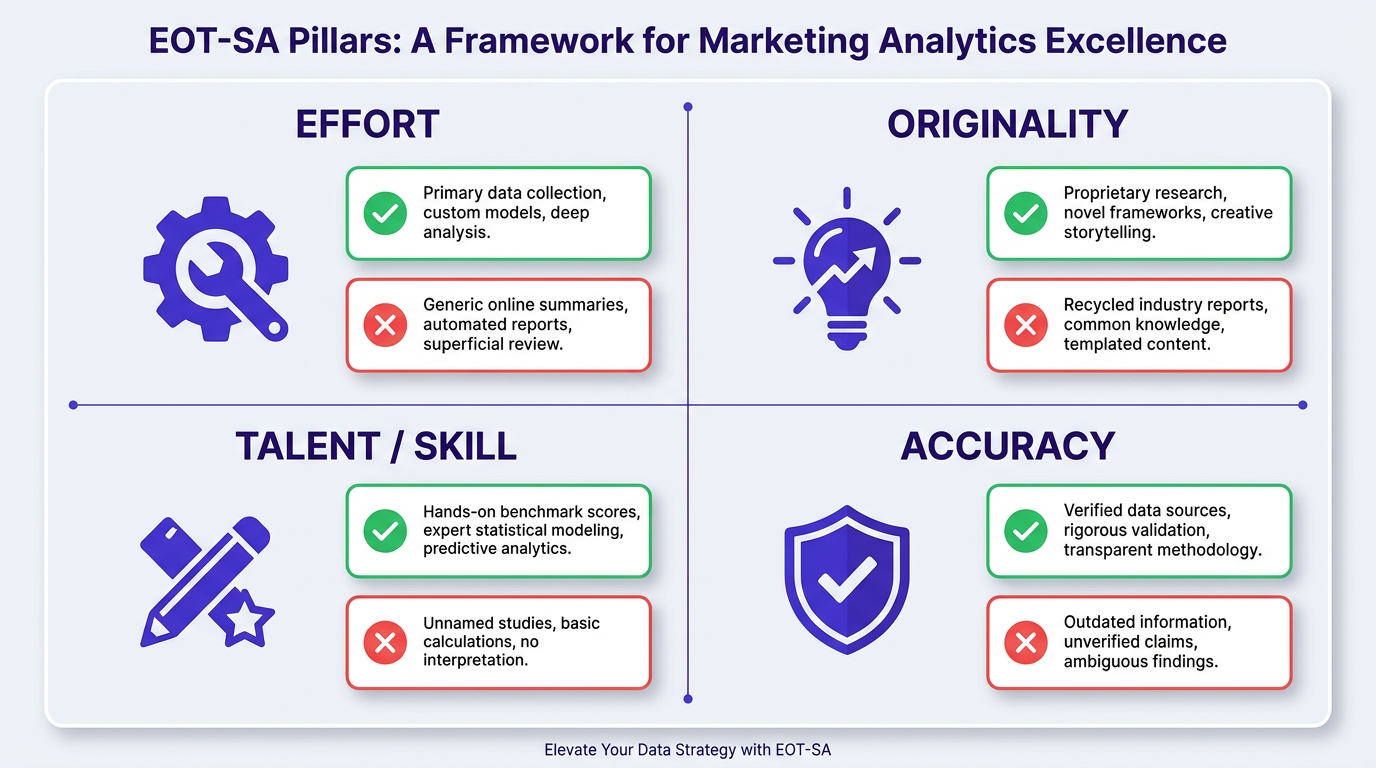
Page purpose governs every judgment. A product page need not publish original research, but it should show care through accurate specifications, original photography, and skilled presentation. A YMYL health page faces a much higher accuracy bar than a gardening hobby blog. EOT-SA scales to intent rather than imposing one universal format.
The Editor's Pre-Publish Checklist: An EOT-SA Audit
Most teams do not fail because they missed the criteria; they fail because the criteria never become part of the review process. Use the questions below as a publishing gate. Add them to a CMS workflow, a review template, or the editorial brief.
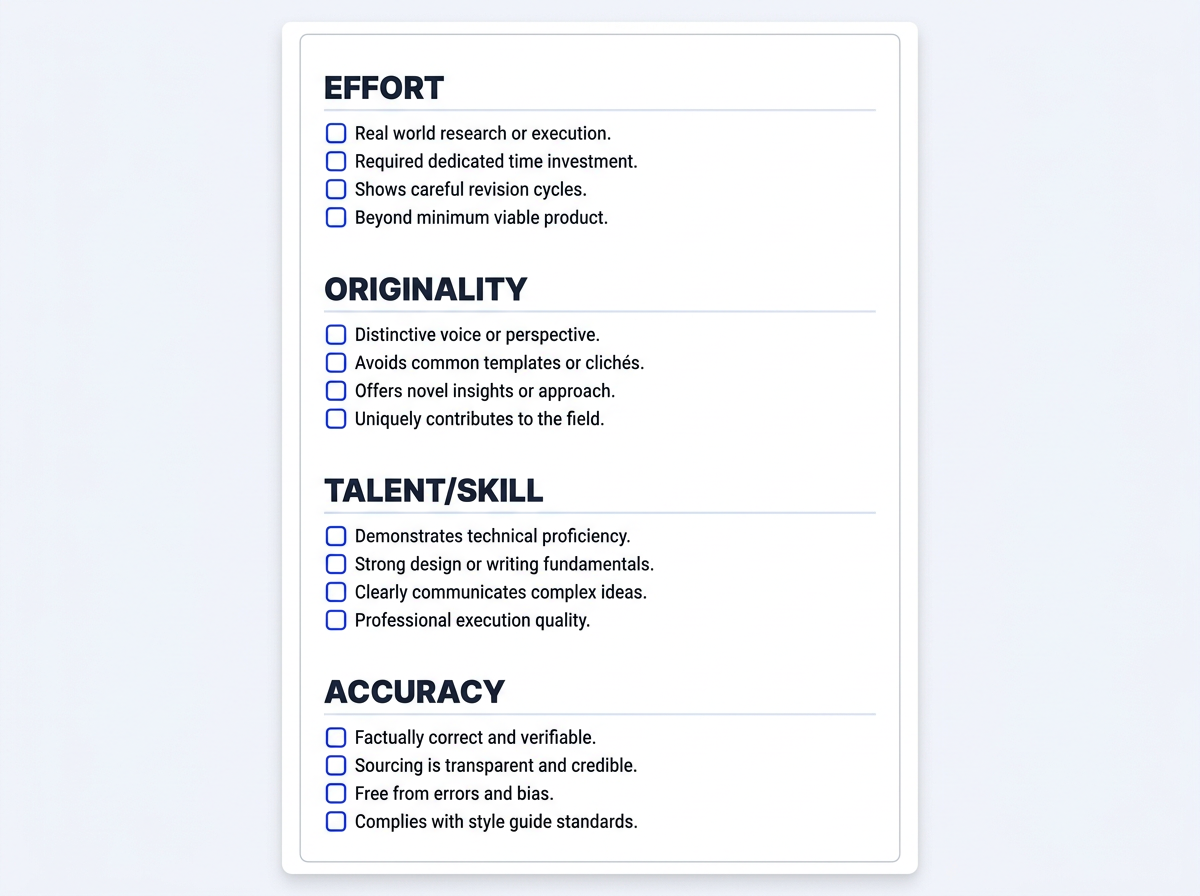
Effort
- Does the page contain at least one element that required real work: original data, custom visuals, expert input, or hands-on testing?
- Can we identify resources invested beyond writing and formatting?
- Would a competitor need meaningful work to replicate this, or could they match it in an afternoon?
Originality
- Does the page offer something absent from the top five results for the target query?
- Have we added a perspective, framework, data point, or format?
- If the page disappeared, would searchers lose information unavailable elsewhere?
Talent and Skill
- Is the writing clear, precise, and free of filler?
- Do headings create a logical, scannable path through the reader's expected information flow?
- Does each format - prose, table, list, or visual - suit the information it carries?
Accuracy
- Does every factual claim have a named, dated source?
- For YMYL content, does the draft align with established expert consensus?
- Has a subject-matter expert or fact-checker reviewed the final draft?
- Are author credentials real, verifiable, and relevant to the topic?
Apply the same lens to published pages. A prompt for an SEO content audit provides a systematic way to assess existing content against the four criteria and prioritize updates.
Common Misconceptions About the EOT-SA Framework
Three misconceptions are already driving wasted work and misplaced confidence.
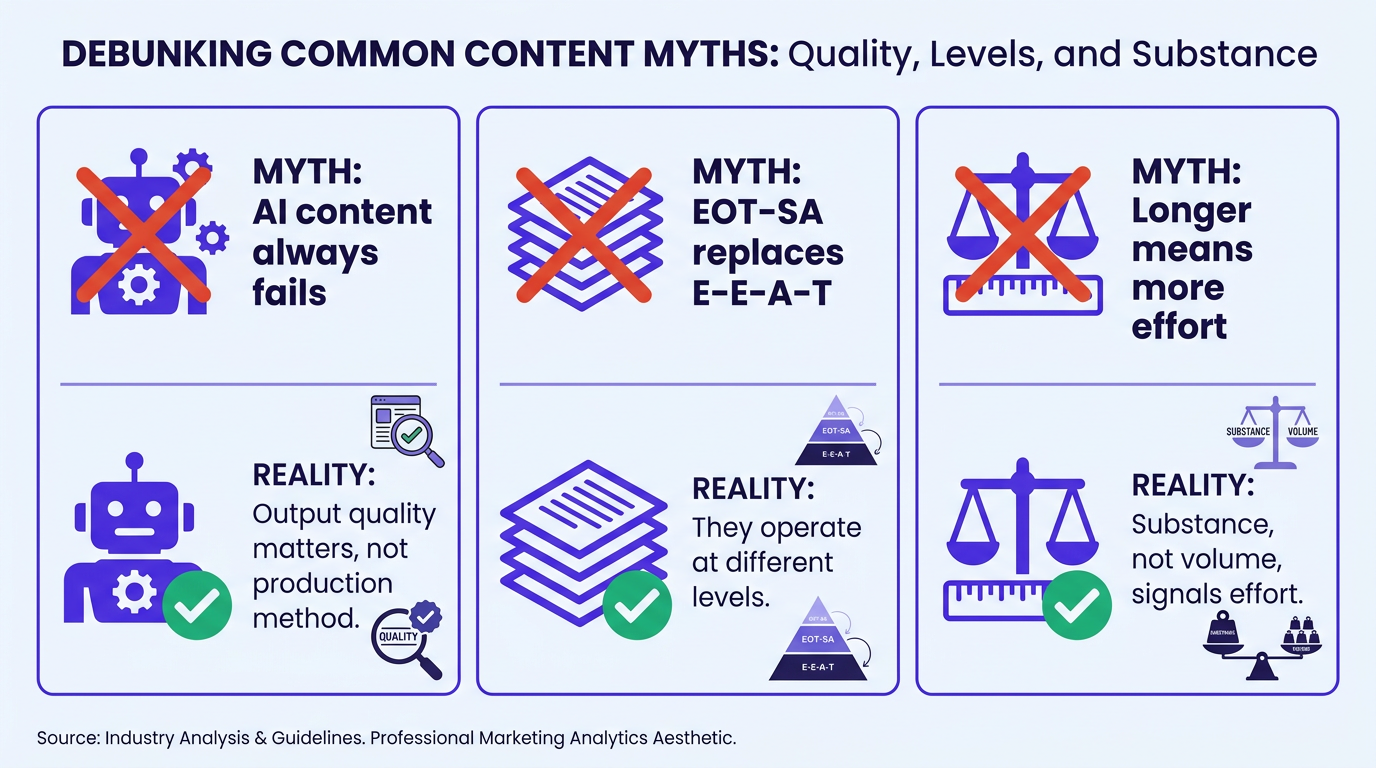
"AI content automatically fails." No. Raters judge the finished page, not its production method. AI-assisted work with original analysis, verified facts, and skilled editing can rate well. Content published at scale without human effort, original insight, or fact-checking will fail because of its quality, not because of the tool. The analysis of whether AI content ranks on Google reaches the same distinction: the page matters more than the production method.
"EOT-SA replaces E-E-A-T." It does not. E-E-A-T remains relevant to the author and site; EOT-SA evaluates the page-level content. One addresses source credibility, the other the quality of the specific work. Both contribute to the overall Page Quality rating.
"High effort means long content." Length is not evidence of effort. An 800-word analysis based on original data can show more work than a 4,000-word page padded with definitions and Wikipedia-level background. Raters assess substance, not volume.
Key Takeaways for Your Content Strategy
Google's raters now use four named criteria for main content. The editorial implications are straightforward.
- Google's EOT-SA framework evaluates Effort, Originality, Talent/Skill, and Accuracy on individual pages, separately from site-level E-E-A-T.
- Effort comes from real investment - original data, custom visuals, expert interviews - not volume.
- Originality is judged against what is already available. A polished consensus restatement is not enough.
- Talent and Skill cover clear writing, sound structure, appropriate formatting, and navigable design.
- Accuracy is essential for YMYL content and requires named, dated, verifiable sources.
- AI assistance is not automatically penalized, but unreviewed content often fails several pillars at once.
- The framework applies to all content types, including forums and review platforms.
- Use the checklist above as a repeatable quality gate in the editorial process.
Applying these standards consistently becomes harder when organic discovery extends beyond Google Search. Vizup's Organic Autopilot for modern discovery helps brands monitor, create, optimise, publish, and learn across Search, Social, Communities, AI Answer Engines, and Local Discovery using AI agents, human experts, and live SEO, pSEO, AEO, and GEO tools. Teams can also use Vizup's AI Content Checker as one pre-publish quality check for AI-assisted marketing content. Paid ads are available as an optional amplification add-on.
Frequently Asked Questions
How does EOT-SA differ from E-E-A-T for main content?
E-E-A-T assesses the credibility of the creator and website: Experience, Expertise, Authoritativeness, and Trustworthiness. EOT-SA assesses the content itself through Effort, Originality, Talent/Skill, and Accuracy. Both inform Page Quality, but at different levels. E-E-A-T asks whether the source is credible; EOT-SA asks whether this page earns the reader's time.
Does the update mean AI-generated content will always receive a low quality rating?
No. Google evaluates the finished content rather than the production method. AI-assisted pages can score well when they show real effort, original perspective, careful editing, useful structure, and factual accuracy. The risk is publishing at scale without human oversight, which commonly fails on effort, originality, and accuracy at once.
Did Google publish new Search Quality Evaluator Guidelines in 2026?
No. The current publicly available Search Quality Evaluator Guidelines are dated September 11, 2025. In October 2026, Google updated its people-first content guidance for site owners to more explicitly describe the four attributes raters consider when evaluating main content: Effort, Originality, Talent or skill, and Accuracy.
How can text-based content demonstrate 'effort'?
Text can show effort through original reporting with named sources, first-hand observations, distinctive analysis of public data, coverage of edge cases competitors omit, or a clear methodology explaining how conclusions were reached. Custom graphics and video are not required. The test is whether the work reflects real intellectual labor instead of information already available elsewhere.
Does EOT-SA apply to user-generated content such as forum posts or reviews?
Yes. Google's documentation includes user-generated contributions in main content. For UGC, raters look for effort and originality in detailed personal experience, skill in clear writing and useful formatting, and accuracy, especially on YMYL topics. Site owners remain responsible for the quality environment, including moderation that elevates strong contributions and limits low-quality ones.
