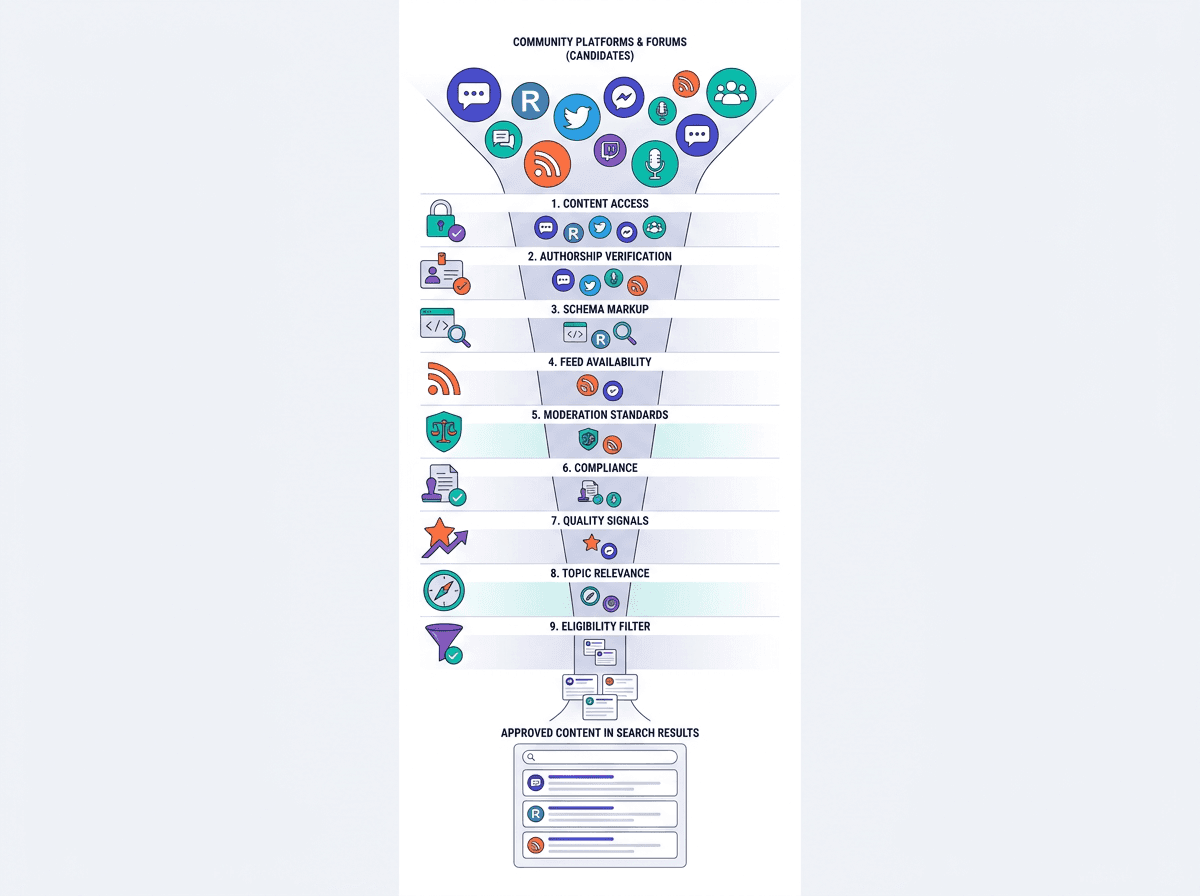
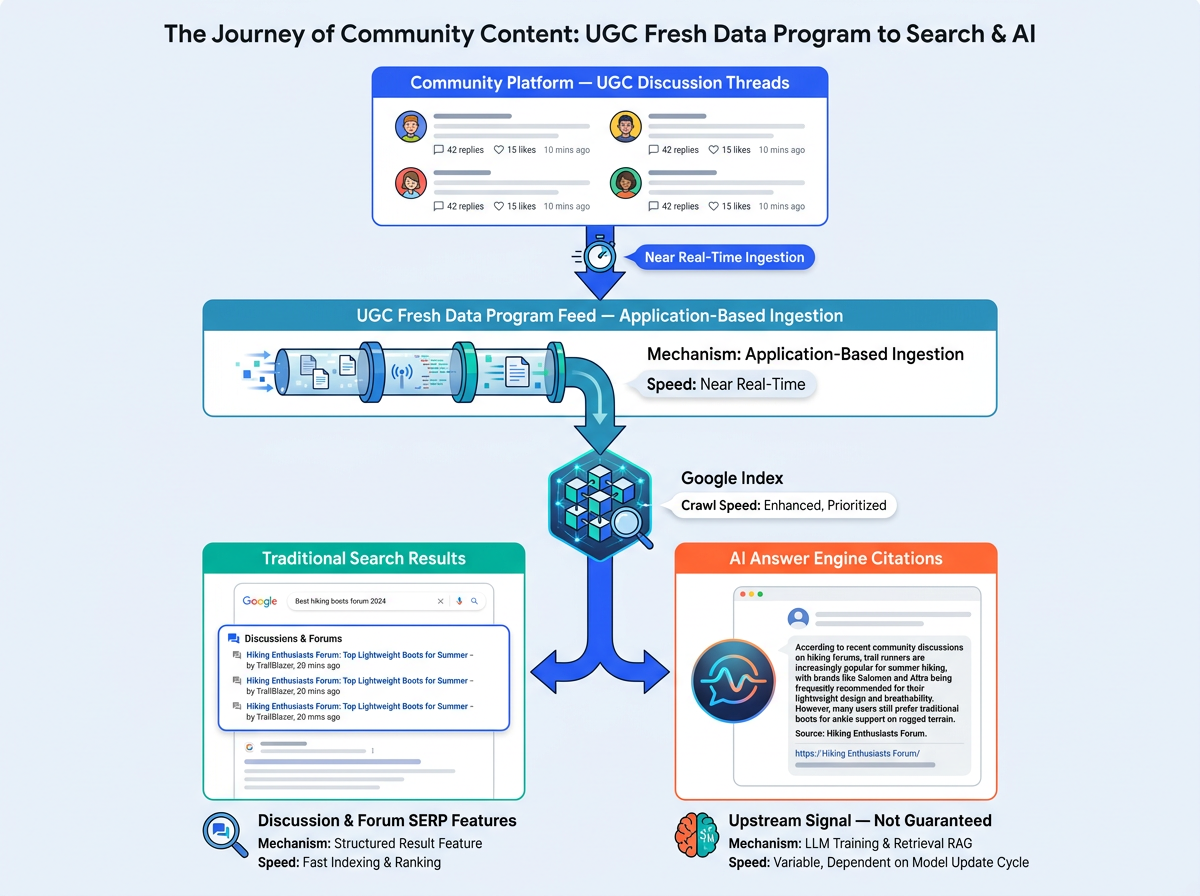
Google's UGC Fresh Data Program gives qualifying community and forum platforms a dedicated pipeline for new user posts. Approved platforms can submit fresh user-generated content and interaction signals through a dedicated ingestion pipeline. Google aims to process this content quickly but does not guarantee that it will appear in Search within a specific timeframe. It is separate from both the Google Indexing API and traditional crawling.
Slow indexing is often treated as the cost of running a UGC platform. The programme changes that equation: accepted platforms get a separate ingestion route, while everyone else still competes for crawl budget. The practical question is not whether the programme sounds useful, but which of its nine gates your platform fails and what it takes to clear it.
Why Forum Content Gets Buried and Why Google Built a Fix
Under standard Googlebot crawling, a discussion thread competes with product pages, documentation, and everything else on a domain. Crawl budget is finite. A Reddit thread or Stack Overflow answer can take off on social media before Google finds its URL, and the traffic window closes. How Googlebot accesses content at scale explains why passive crawling struggles with real-time discussion.
Google has expanded the visibility of user-generated discussions through features such as its Forums filter and discussion-related search results. The UGC Fresh Data Program provides an additional way for eligible platforms to submit fresh content directly. The UGC Fresh Data Program is Google's answer: a fresh-content pipeline that avoids the crawl-discover-parse sequence.
What the UGC Fresh Data Program Actually Is (and Is Not)
Accepted platforms submit a structured feed of new and updated posts for near-real-time ingestion, outside normal crawl discovery. It is not a ranking boost, a SERP-placement guarantee, or a substitute for on-page SEO. Google says participation does not guarantee that submitted content appears in Search (Search Engine Roundtable, 2026)
The google indexing api vs ugc program distinction should shape the submission architecture. The Indexing API tells Google a URL should be crawled. The UGC programme sends structured content directly and skips crawl-then-parse. These are separate ingestion models, not the same tool at different speeds.
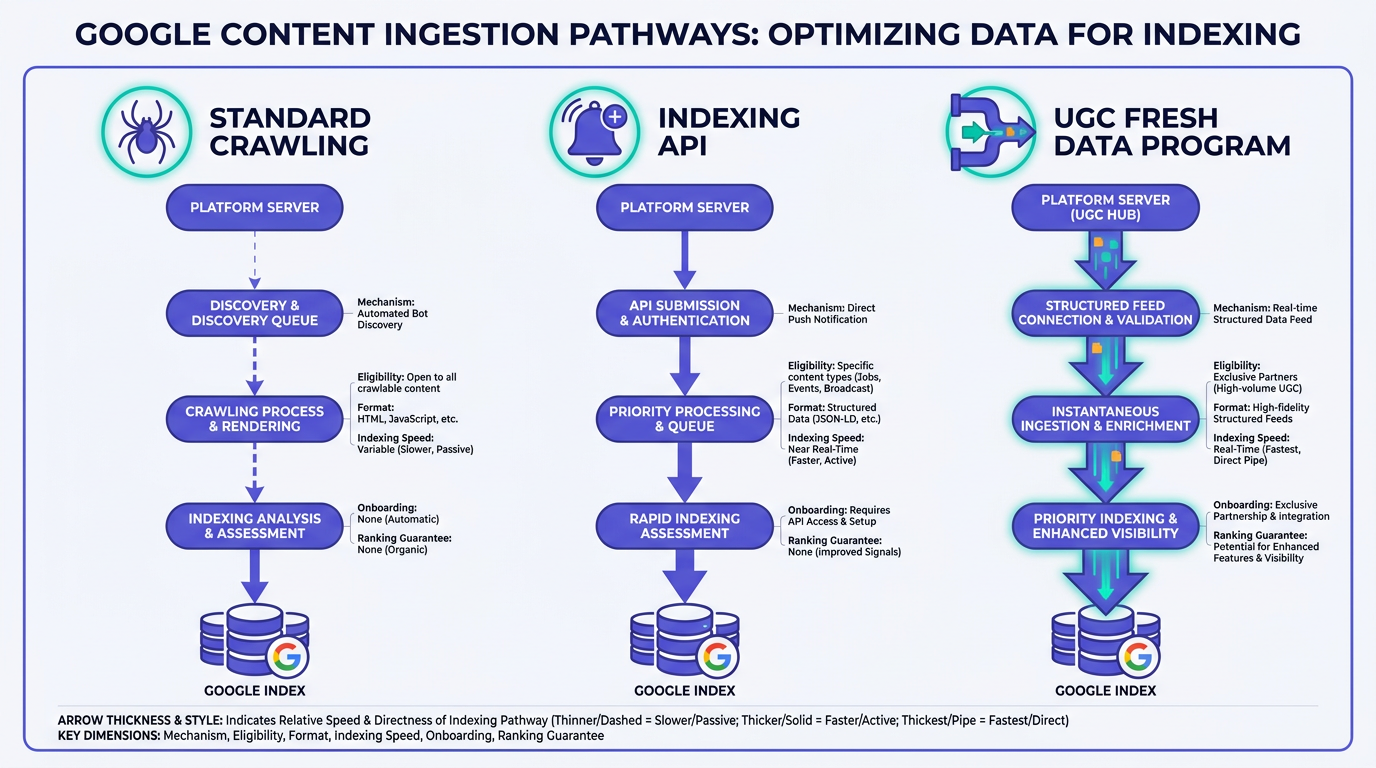
| Dimension | Standard crawling | Indexing API | UGC Fresh Data Program |
|---|---|---|---|
| Mechanism | Googlebot crawls discovered URLs | Sends URL update or removal notifications | Dedicated ingestion pipeline for UGC and interaction signals |
| Eligibility | Crawlable web content | Eligible JobPosting and livestream pages | Approved UGC-focused platforms |
| Format | Crawlable pages discovered through links and sitemaps | API URL notifications | Validated JSON-LD payloads and on-page structured data readiness |
| Indexing speed | No guarantee | No guarantee | No guarantee |
| Application or onboarding | No special program application | API setup and applicable approval/quota requirements | Application and selection required |
| Ranking guarantee | No | No | No |
| Each pathway has distinct eligibility and implementation requirements, but none guarantees indexing speed or rankings. |
The Nine Eligibility Requirements, Ranked by Failure Rate
Google officially outlines six broad eligibility criteria. For a practical platform audit, these can be expanded into nine checks covering content focus, accessibility, authorship, technical readiness, moderation, and freshness. A platform with the wrong content model cannot patch its way into eligibility.
Content and Access Requirements That Disqualify Immediately
Requirement 1: Public accessibility. Submitted content must work without a login, paywall, or app gate. "Sign up to read" flows fail immediately, excluding many Slack-style communities, gated Discourse instances, and private forums. Eligible content must be public and paywall-free (Search Engine Land, 2026).
Requirement 2: Authentic, non-anonymous authorship. Every submitted post must be attributable to a creator with a public profile. Google does not explicitly require creators to reveal their legal identities, so publicly accessible pseudonymous profiles are not automatically disqualified. Retrofitting identity is a product-model change, not a technical fix.
Requirement 3: Original user-generated content. Google requires user-generated content to be created by independent users rather than the platform itself. Platforms primarily republishing third-party discussions should assess whether their content meets this definition before applying. User generated content seo google depends on platform-level originality, not merely a unique page URL.
Technical Readiness: Schema, Feeds, and Forum Structured Data Google Requires
Requirement 4: DiscussionForumPosting or SocialMediaPosting schema markup on every submitted URL. Platforms must use, or be prepared to implement, valid on-page structured data such as DiscussionForumPosting or SocialMediaPosting. Google's forum markup guidance includes author and datePublished fields and requires appropriate post content properties, which can include text, images, or videos. The official DiscussionForumPosting specification lists the properties, while Google's discussion forum structured data documentation explains its use in Search features.
Requirement 5: A compliant structured data feed Google can poll. Google requires the technical ability to implement secure OAuth 2.0 authentication and strictly validated JSON-LD payloads. Detailed integration specifications are provided after acceptance, so teams should not assume a particular feed format or polling mechanism before onboarding.
Requirement 6: Stable, canonical URLs. Session- or feed-based addresses that change per request disqualify a platform. Every item needs a permanent, crawlable URL. Teams handling platform-level properties in Google Search Console should audit this before applying. Estimate implementation effort after auditing your existing structured data, authentication capabilities, and content-delivery infrastructure. Google does not publish a standard development timeline for preparing an application.
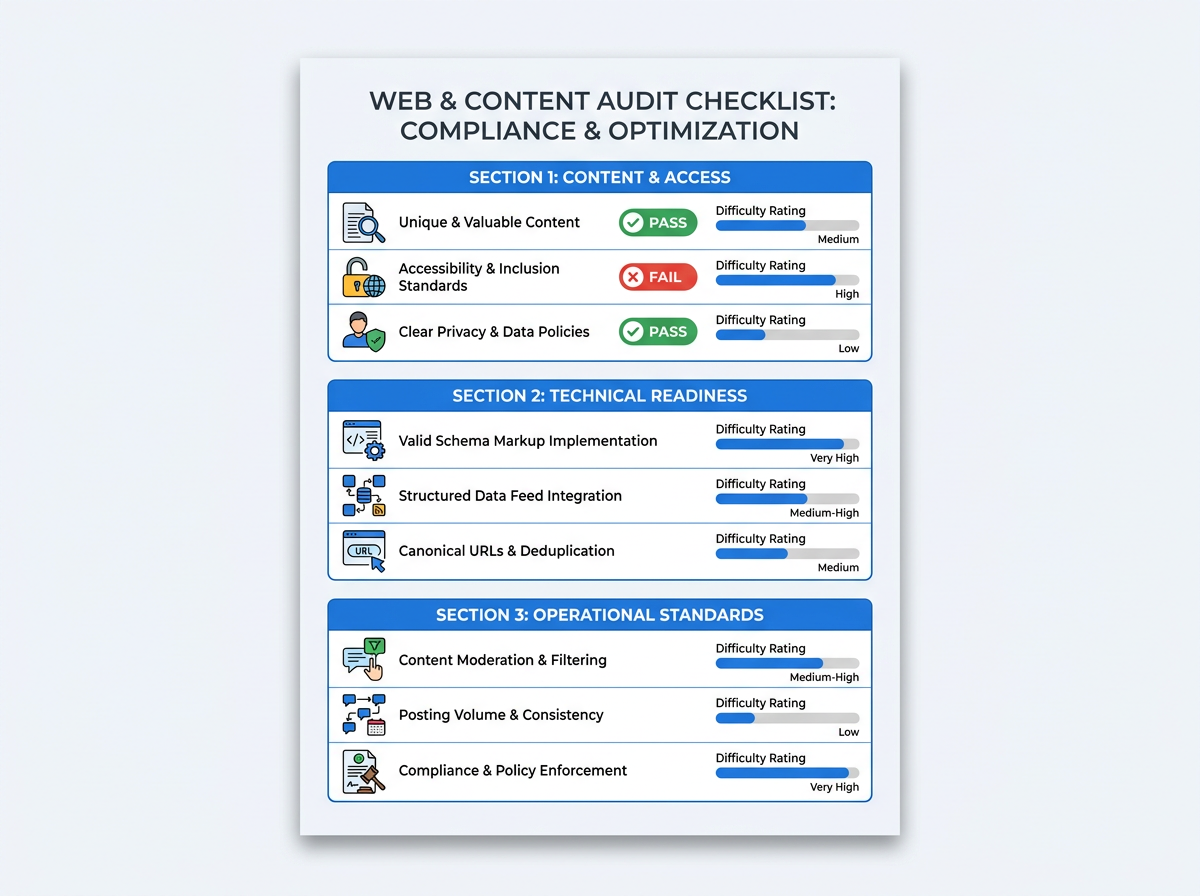
Moderation, Freshness, and Operational Standards
Requirement 7: Active content moderation. Google wants evidence of spam filtering, policy enforcement, and quality controls, not a statement of intent. Documented workflows can strengthen an application; data transparency for platforms is useful here.
Requirement 8: Consistent posting volume and freshness. Activity must be regular. Google requires high UGC volume, a significant user base, and the ability to submit fresh content quickly. Platforms must also be able to provide regular engagement-counter updates within 72 hours of content creation. Google needs a steady stream, not periodic bursts.
Requirement 9: Compliance with Google's general webmaster guidelines and structured data policies. Compliance with Google's Search Essentials and spam policies is an important readiness check, but Google's published UGC Fresh Data Program criteria do not list every possible manual action or content-quality issue as an automatic rejection condition. A clean Search Console history is an advantage.
How Quickly Must Platforms Submit Fresh Posts?
Google expects submitted UGC to be as fresh as possible, ideally delivered within minutes of creation. Platforms must also be capable of sending regular updates to engagement counters within 72 hours of the original post.
These signals can include interactions such as comments, likes, and shares, depending on the content and implementation. This means eligibility is not just about publishing frequently. Platforms need infrastructure that can detect new posts, prepare valid structured data, and deliver timely updates without relying on occasional manual exports.
Google provides detailed technical integration instructions after a platform is selected. Teams should validate their operational readiness without assuming undocumented API specifications.
The Application Process and Expected Response Window
Apply through Google's interest form, not Search Console or an API dashboard. Google says applicants should receive a status response within six to eight weeks. Acceptance is not guaranteed, and Google has not publicly documented a standard rejection-feedback or reapplication process. Scope the build, test every criterion, and fix identifiable blockers before submitting.
Warning: Before applying, review Google's published eligibility criteria and resolve identifiable technical or content-quality gaps. Google states that applicants can expect a response within six to eight weeks, but does not specify a fixed timeline for reapplications.
Common Misconceptions About the Programme
"It's just a faster Indexing API." No. The API flags a URL for crawling; the UGC programme supplies structured content directly. Treating them as interchangeable wastes engineering time.
"Acceptance means my content will rank higher." The programme speeds discovery, not ranking. Organic search visibility still depends on relevance, helpful content, and Google's broader ranking systems. E-E-A-T is a useful quality framework, not a standalone ranking factor. Faster indexing gets a page into consideration sooner.
"Any site with a comment section qualifies." Google is targeting platforms where user discussion is the primary content, not a blog's comments or product reviews. For operators pursuing scale elsewhere, Programmatic SEO is a complementary route.
Who This Programme Is Actually For
Google has previously established content-sharing relationships with major platforms such as Reddit. The UGC Fresh Data Program provides an application-based ingestion option for other qualifying platforms, but Google has not published a list of accepted participants or a minimum eligibility threshold. Niche Discourse communities and vertical Q&A platforms fit the stated model when they combine volume, public content, structure, and identifiable authors.
Faster content processing may help platforms make timely discussions available for discovery. However, appearance in Google Search does not guarantee citations or mentions across AI answer engines. Vizup can help teams monitor their visibility across these discovery surfaces.
Key Takeaways
- The UGC Fresh Data Program is a structured-feed pipeline, not a crawl shortcut or Indexing API variant.
- Its nine checks cover access, schema readiness (discussionforumposting schema and socialmediaposting schema), and moderation.
- Gated content, anonymous posting, and unstable URLs are immediate disqualifiers.
- Every submitted URL needs valid DiscussionForumPosting or SocialMediaPosting markup with nested required properties.
- Acceptance speeds content processing; it does not guarantee rankings, SERP visibility, or citations by AI answer engines.
- Estimate development work from your platform audit, then account for Google's stated six to eight week status-response window.
- Audit all nine requirements before committing engineering resources.
For qualifying platforms, Google's UGC Fresh Data Program offers a new way to submit timely user-generated content. But faster processing is only one part of organic visibility. Platforms still need to understand whether their discussions are discoverable, how their content performs in Search, and whether their brand appears in relevant AI-generated answers.
Vizup helps brands connect these signals through its Organic Autopilot, combining AI agents, human experts, and SEO, AEO, and GEO workflows to monitor, create, optimise, publish, and learn across Search, Social, Communities, AI Answer Engines, and Local Discovery.
Frequently Asked Questions
How does Google's Indexing API differ from the UGC Fresh Data Program?
The Indexing API notifies Google that a URL should be crawled. The UGC Fresh Data Program sends structured content through a dedicated feed, bypassing crawl-then-parse. The API is limited to specific schema types; the programme is an application-only ingestion path for community and forum platforms.
Does the UGC Fresh Data Program guarantee higher rankings for forum content?
No. Google says participation does not guarantee submitted content will appear in Search results. The programme accelerates content processing, while organic visibility still depends on relevance, helpful content, and Google's broader ranking systems. E-E-A-T is a quality framework, not a standalone ranking factor.
Which structured data markup does the UGC Fresh Data Program require?
Each submitted URL needs valid DiscussionForumPosting or SocialMediaPosting markup, with correctly nested author, datePublished, and text properties. Review the full specification at schema.org's DiscussionForumPosting page.
How long does Google take to respond to a UGC Fresh Data Program application?
Google says applicants should receive a status response within six to eight weeks. Acceptance is not guaranteed, and Google has not publicly documented a standard rejection-feedback process, reapplication process, or fixed timeline for reapplications.
Can a marketplace or review site with comments qualify for the UGC Fresh Data Program?
Usually not. Google limits eligibility to platforms where user-generated discussion is the primary content. Product reviews and blog comments do not qualify; the target is dedicated public community and forum platforms with significant user activity.
