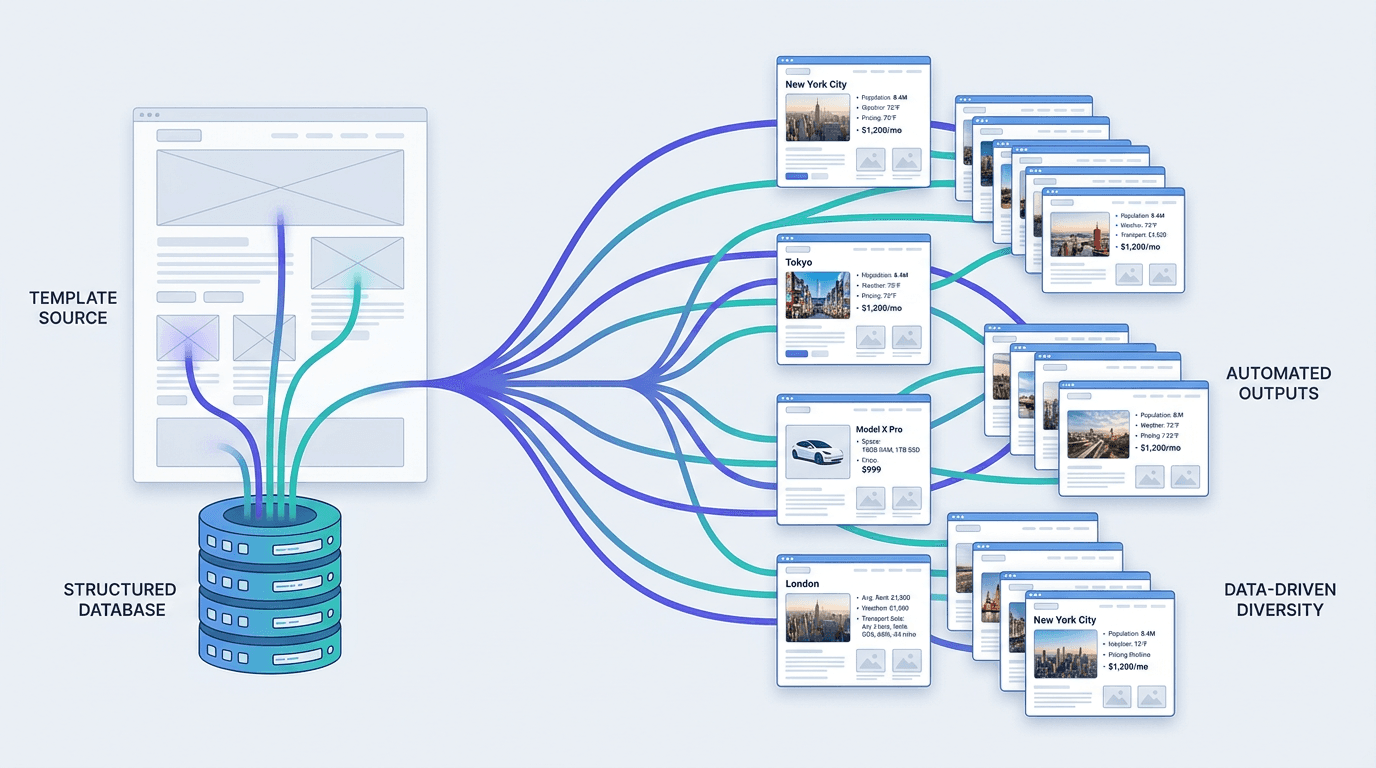
Programmatic SEO (pSEO) is how teams turn structured data and a reusable page template into a lot of pages fast, with each URL mapped to a specific long-tail query. Instead of hand-writing every page, you build a framework that pulls from a database and publishes hundreds or thousands of pages that, together, capture broad search demand.
None of this is brand-new. Zillow, TripAdvisor, and Zapier have leaned on programmatic content for years (Semrush, 2025). What is different in 2026 is the operating environment: AI enrichment layers are common, crawl-budget management matters more, and Google's quality signals are less forgiving. If you're planning a scalable SEO campaign this year, you need a clear view of how pSEO actually works, where it fits, and where it tends to break.
For teams scaling programmatic SEO in 2026, the challenge is no longer just publishing pages. It is knowing which pages are indexed, which ones earn visibility, and how they appear across search and AI-driven answer engines. Vizup helps teams monitor (as well as create) that full digital presence so programmatic SEO becomes an iterative growth system rather than a one-time publishing push.
Why Programmatic SEO Matters for Growth Teams
Traditional content scales like labor: one writer, one page. Programmatic SEO changes the math. Pair one solid template with a dataset of 10,000 rows and you can ship 10,000 indexable pages, each built to answer a slightly different query. For founders and growth leads running lean, that can be the difference between competing on a few head terms and showing up across an entire long-tail category.
pSEO is strongest when the business already runs on structured information. Real estate platforms break inventory down by city, neighborhood, and price range. SaaS companies can enumerate integrations across tools. Travel sites organize destinations by season, activity, and budget. When there's a repeatable pattern in the data, template pages can translate that pattern into organic traffic.
That said, pSEO in 2026 is not a shortcut you can set and forget. Volume helps only when the underlying data and page experience are genuinely useful. Teams that understand why organic marketing is beyond SEO tend to deploy pSEO as one part of a broader acquisition mix, not as the one tactic that will fix everything.
How Programmatic SEO Works: The Core Process
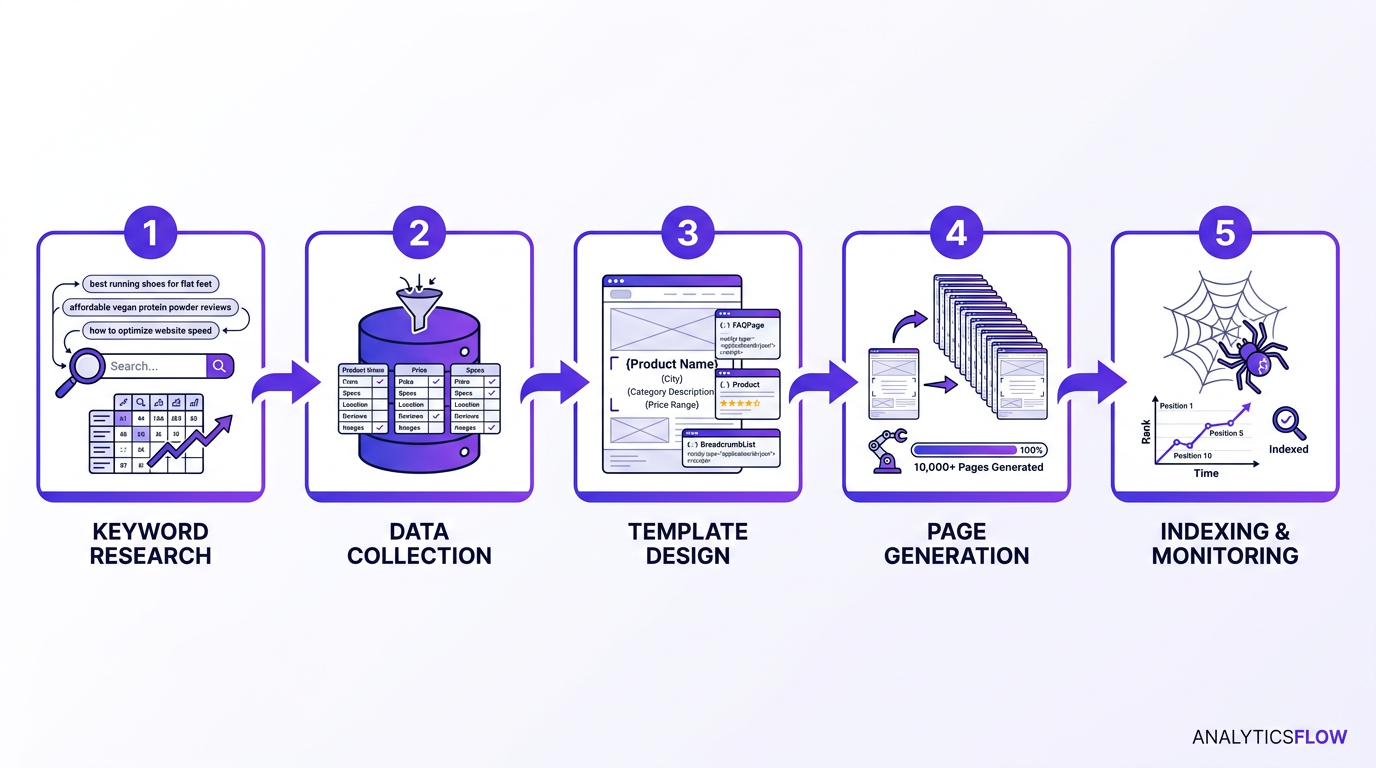
pSEO runs on a five-stage loop. The stages are straightforward, but the failure mode is equally straightforward: skip one, and the whole system gets brittle.
1. Scalable keyword research. Start with a pattern that has thousands of valid variations. "Best [cuisine] restaurants in [city]" or "[software A] vs [software B]" creates a matrix of queries you can actually build around. Ahrefs and Semrush are typically used to confirm that the variants have real demand, not just theoretical combinations. The Ahrefs beginner guide to programmatic SEO lays out the matrix method step by step.
2. Data sourcing and enrichment. In 2026, many teams add an AI layer to enrich raw rows with summaries, comparisons, or localized context. The safer pattern is using AI to enrich within a template, rather than generating entire pages from scratch, because Google's guidance emphasizes creating helpful, reliable, people-first content over scaled pages made primarily for search rankings.
3. Template design. The template sets the layout and the on-page SEO basics (title tag, H1, meta description, schema markup), plus the dynamic zones that pull from specific columns. Strong templates do not rely on placeholders alone. They mix in static editorial sections that frame the data so each page has enough unique, useful substance to clear Google's quality bar.
4. Page generation and publishing. This is where the dataset and template actually merge into production pages. Teams do it through a CMS, a headless setup, or dedicated pSEO tooling. Internal linking matters here more than most teams expect: every generated page should connect to related pages in the same set and to cornerstone content elsewhere on the site. Following sitemap best practices also helps search engines find and prioritize new URLs.
5. Indexing, monitoring, and iteration. Once pages are live, you watch crawl stats, index coverage, and ranking movement. Underperformers need attention: fresher data, a better template, or consolidation into fewer pages. The teams that win treat this as an ongoing loop, not a one-time publishing event.
Page-Type Examples Winning in 2026
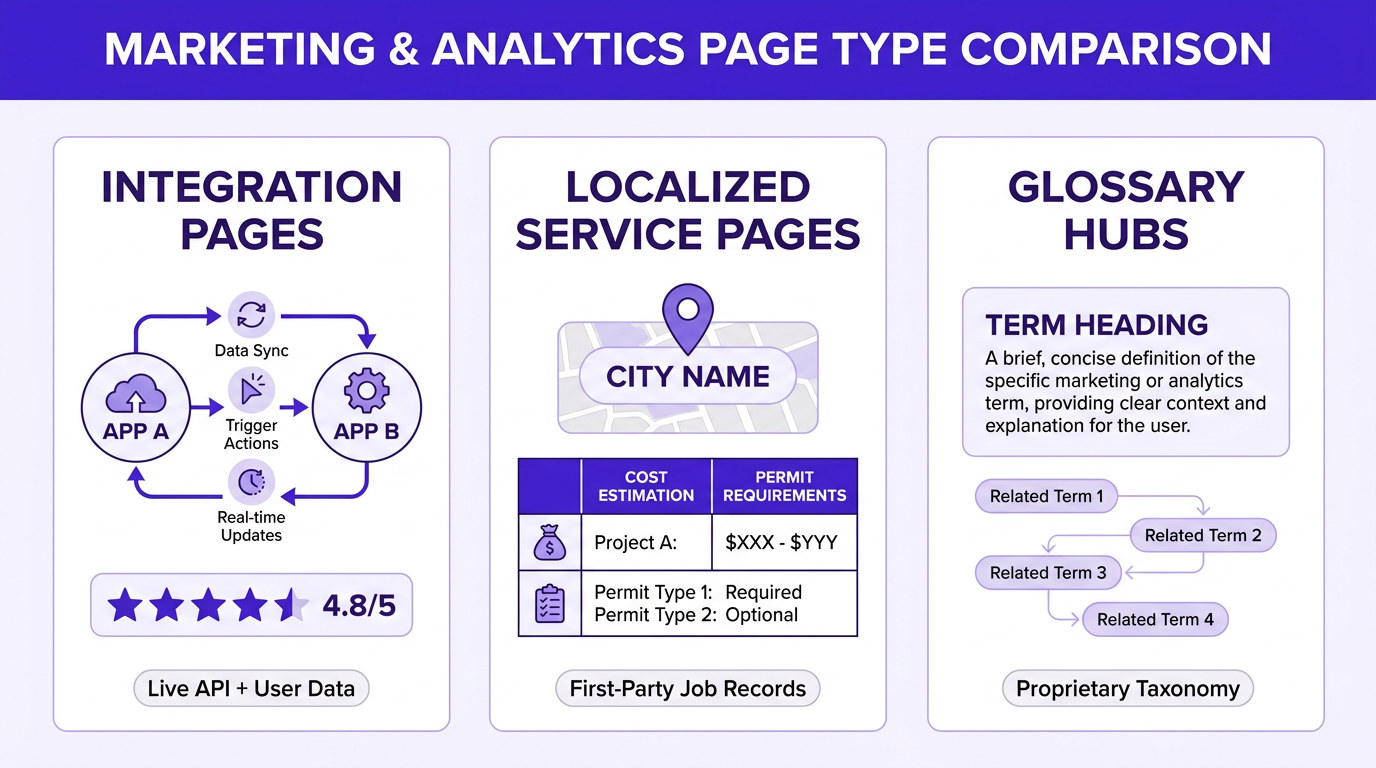
Programmatic pages are not one thing. Here are page types pulling real organic traffic right now, each showing a different way to turn data into a template-driven experience.
Integration and comparison pages. Zapier's "[App A] + [App B] integrations" pages are still the classic example. Each URL surfaces live integration data, user ratings, and workflow templates. In 2026, SaaS teams are extending the same pattern into AI-agent compatibility pages (for example, "Connect [Tool] with [AI Agent]"), tracking growing interest in the role of SEO agents in 2026. Zapier's own breakdown of how they approach programmatic SEO makes the point clearly: proprietary workflow data is what keeps these pages from becoming interchangeable.
Localized service pages. Home-service brands and legal firms often generate city- and neighborhood-level landing pages. The 2026 upgrade is a real data layer: AI-enriched local details like median project costs, permit requirements, and seasonal demand curves based on first-party job records. These pages tend to beat generic location stubs because the information is actually useful, not just a swapped city name.
Glossary and definition hubs. B2B companies publish definition pages targeting "what is [term]" queries at scale. The better versions in 2026 keep the definition tight, then earn the click with extras like interactive elements, related-term graphs, and embedded product context. As an acquisition entry point, this model pairs well with AI content strategy frameworks that help decide what to publish next.
Common Misconceptions About pSEO
"More pages always means more traffic." More pages only helps if each page earns its keep. Google's helpful content system is looking for pages built for users, not pages built to satisfy a keyword spreadsheet. If you publish 50,000 thin pages that just swap city names with no added data, you are inviting the kind of quality action outlined in Google's spam policies for AI content.
"pSEO replaces content writers." Templates still need editorial judgment. Someone has to choose the fields that matter, write the static copy that makes the page coherent, and craft meta descriptions that match intent. Programmatic SEO automates the repetitive assembly work; it does not replace strategy.
Warning: "AI can generate the entire page." Having large language models write a full page for every URL in a programmatic set tends to create quiet duplication and occasional factual drift. In 2026, the safer move is using AI for narrowly scoped enrichment (summarizing a data row, generating a comparison paragraph) while keeping the template structure and editorial guardrails human-designed.
Monitoring and Iterating on Scalable SEO Programs
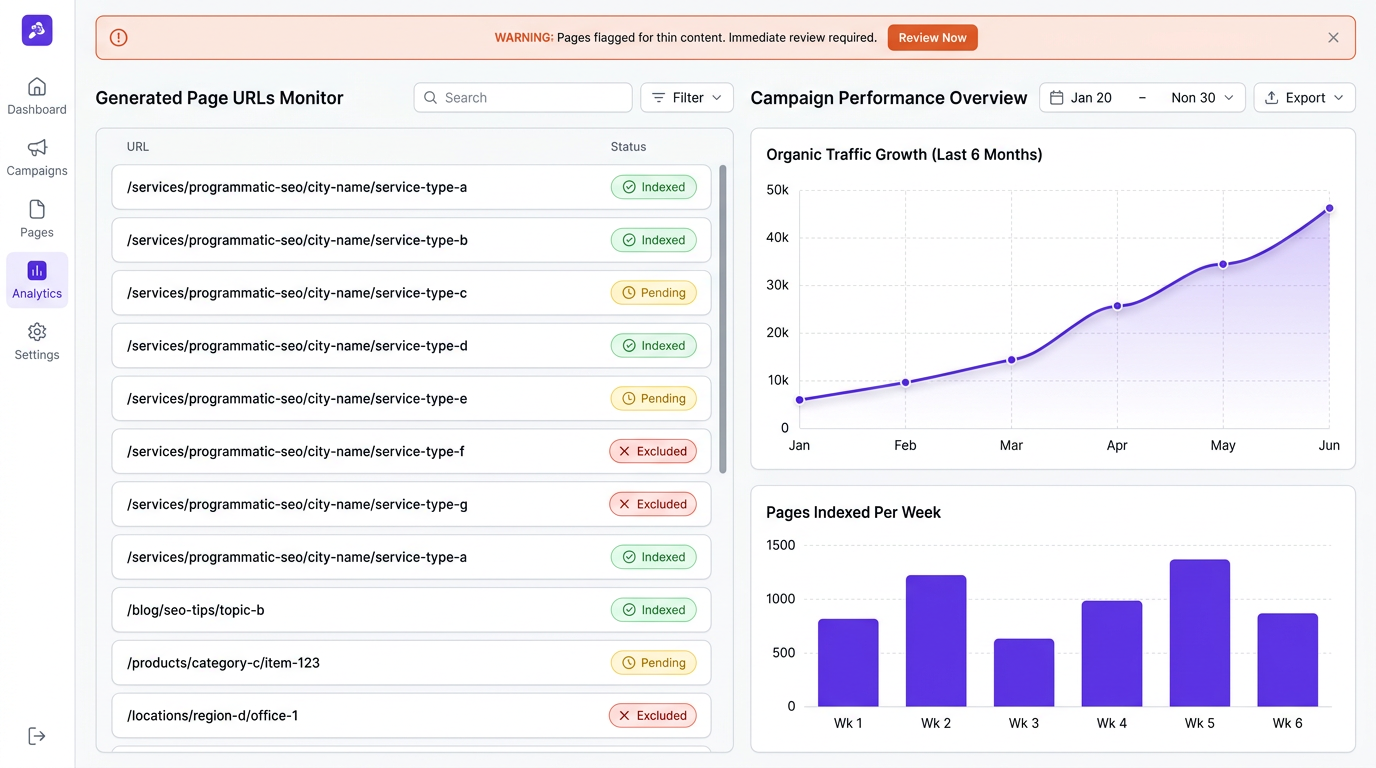
Publishing is only the start. Scalable SEO programs need monitoring so you catch indexing gaps, thin-content issues, and ranking decay early. Google Search Console's index coverage report is the first place to look: if a big chunk of your programmatic URLs show up as "Discovered, currently not indexed," Google is signaling the pages are not worth crawling yet, often because they do not offer enough unique value or internal link equity.
Once indexing is healthy, watch page-level organic sessions and engagement. Pages that win clicks but rack up high bounce rates usually have an intent mismatch: the query promised one thing, and the page delivered another. In many cases, consolidating weak pages into fewer, richer URLs is what brings rankings back. Vizup's digital presence monitoring helps teams track how programmatic pages perform across traditional search, AI-driven answer engines, and broader organic channels. That gives growth teams a clearer view of which templates, topics, and page clusters are actually earning visibility after publication.
Key Takeaways
- Programmatic SEO uses templates and structured data to publish large numbers of pages that target long-tail keywords at scale.
- pSEO performs best when it is built on a dataset competitors cannot easily replicate.
- In 2026, AI belongs in enrichment inside the template, not in mass-producing full pages, which increases quality and penalty risk.
- Winning page types include integration pages, localized service pages, and glossary hubs, each tied to a specific data source.
- Monitoring and iteration are mandatory because low-value programmatic pages can struggle with indexing, rankings, and long-term organic performance.
- Scalable SEO still depends on editorial judgment, strong internal linking, and staying aligned with Google's evolving quality standards.
Frequently Asked Questions
What is programmatic SEO in simple terms?
Programmatic SEO is a way to create many pages by combining a reusable template with a structured dataset. Each URL targets a specific query, so a site can cover thousands of long-tail keywords without writing every page manually.
Is programmatic SEO considered spam by Google?
Not by default. Google's guidance (including its SEO Starter Guide at developers.google.com) comes down to user value. Programmatic pages built on unique data and genuinely useful templates are fine. Pages published only to manipulate rankings with thin or duplicated content can draw penalties.
What tools do teams use for pSEO in 2026?
Teams commonly use headless CMS setups (Webflow, WordPress with custom post types), database connectors (Airtable, Google Sheets via API), and dedicated pSEO platforms. AI enrichment tools are often used to add unique context to each page. For monitoring, Google Search Console is standard, with visibility platforms like Vizup used to track indexing and performance.
How is programmatic SEO different from regular content marketing?
Regular content marketing produces individual pages written and edited one by one. Programmatic SEO uses a template-plus-data model to generate pages at scale. They work better together than alone: editorial content builds authority and trust, while pSEO captures long-tail demand across repeatable query patterns.
What is the biggest risk of programmatic SEO in 2026?
Shipping thin content at scale. If the dataset is shallow or the template fails to surface enough unique information on each page, Google may not index the URLs or may apply a broader quality demotion. The practical hedge is investing in proprietary data and iterating on templates based on performance.
