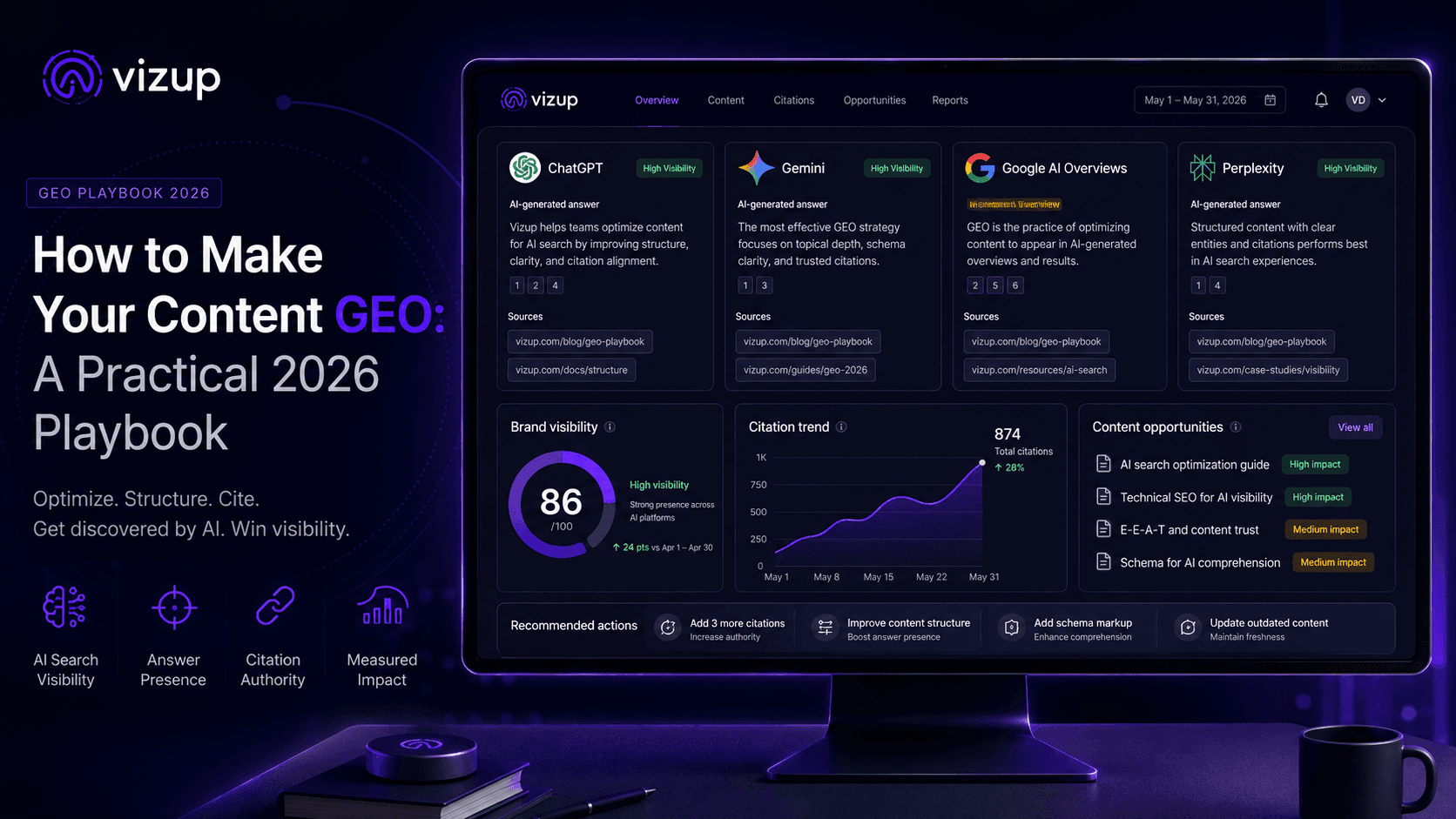
If you're asking how to make your content GEO work in 2026, start with the part nobody loves to say out loud: ranking #1 on Google doesn't guarantee you get seen. More queries are getting answered inside ChatGPT, Gemini, or Perplexity before a user ever reaches a results page. If your page isn't cited in those generated answers, you don't exist for that slice of demand.
This is a practical GEO playbook for content marketers, SEO leads, and founders watching organic traffic flatten while search volume stays steady. It lays out what generative engine optimization requires in practice, from content architecture to tracking AI citations week over week. You'll get clear definitions of what GEO is (and isn't), why classic SEO pages underperform in AI answers, the page structure that earns citations, which signals matter most, how to measure progress, the mistakes that keep teams stuck, and a few advanced edge cases.
What GEO Actually Is (and What It Isn't)
Generative engine optimization (GEO) is the work of structuring digital content so AI answer engines can cite, quote, or synthesize it in their responses. As a foundational 2024 paper from researchers at Princeton and other institutions notes, you’ll also see it labeled Answer Engine Optimization (AEO), LLMO, or AI SEO. The difference from traditional SEO is simple: SEO fights for a ranked slot in a list of links; GEO fights for a spot inside the answer.
One misconception to clear up early: GEO doesn't replace SEO. Google still drives most discovery, and why organic marketing is beyond SEO is about expanding reach, not swapping channels. Treat GEO as a layer you add on top of strong SEO fundamentals, not a restart button.
Skip this section if you have already been tracking AI citations for six or more months. Jump straight to Content Architecture below.
Why Traditional SEO Content Fails in AI Engines
Most SEO content is written for skimmers, but AI engines parse content by evaluating authority signals and lifting the most quotable, self-contained claims they can attribute. A 2,000-word “Ultimate Guide” might rank on Google but never appear in a Perplexity answer because it lacks clean, citable answer blocks. This is a common failure point where traditional SEO content underperforms in generative search.
Research from Princeton University on generative engine optimization found that top GEO methods, including citing sources, adding statistics, and including quotations, can improve AI visibility by up to 40 percent compared to unoptimized content. That spread comes from structure and evidence, not tone.
AI content optimization is how you close that gap by rebuilding what you already have. New pages aren’t always the answer; better pages often are. The goal is for each section to include at least one paragraph an AI engine can extract and present as a standalone response. That’s a very different target than “rank for this keyword.”
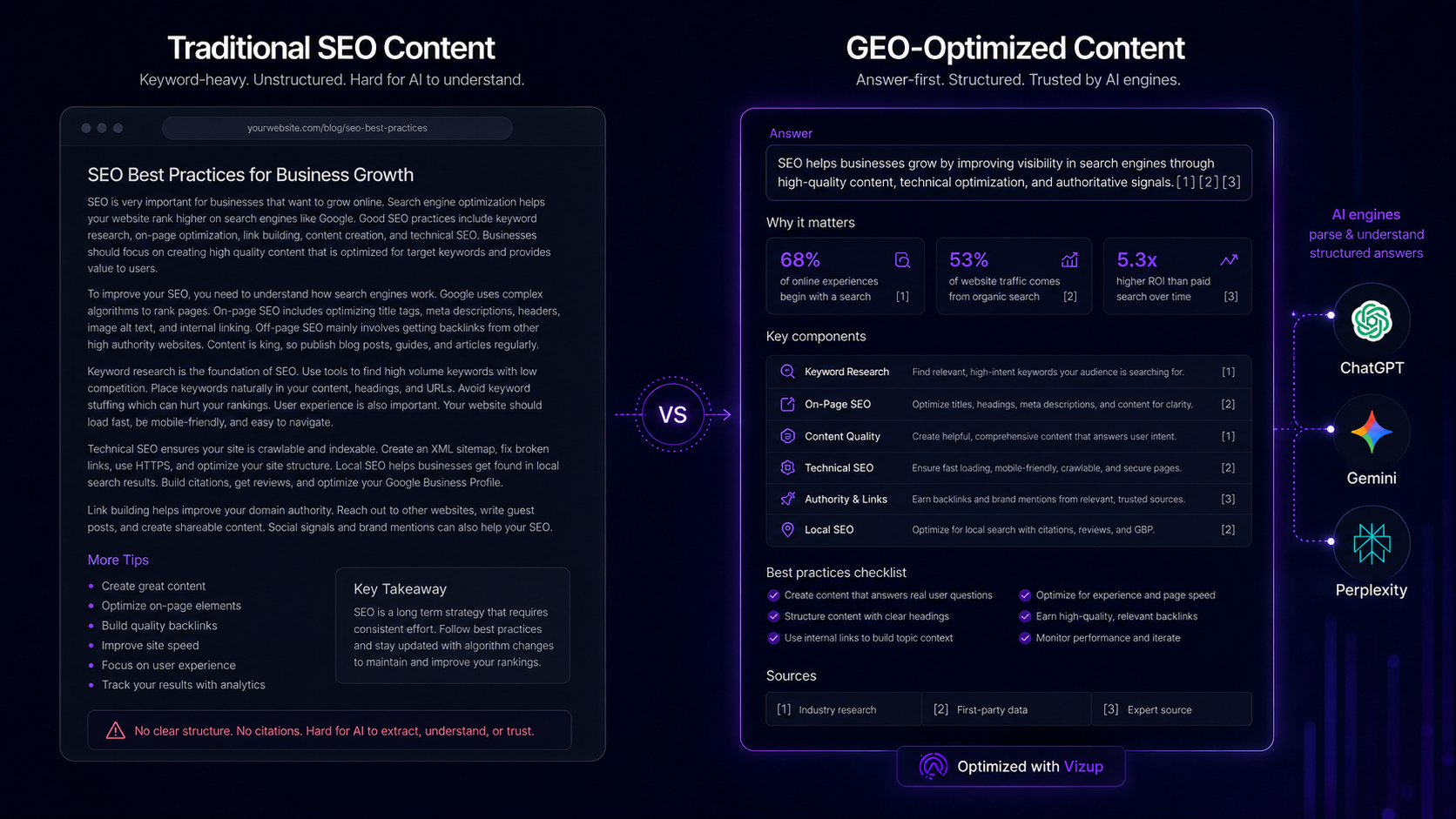
How to Make Your Content GEO: The Architecture That Gets Cited
Getting GEO-ready is mostly an architecture problem, as the way you frame claims, attribute data, and organize information determines whether an AI engine can pull your content cleanly. This includes using real-time telemetry from distributed data clusters and leveraging no-code ETL pipelines to ensure data freshness and accuracy. The goal is to be cited with confidence.
Write Self-Contained Answer Blocks
Every H2 or H3 should include at least one paragraph that still works when ripped out of context, because AI engines quote fragments. A simple test is to paste a paragraph into a blank document. If it doesn’t answer one specific question without needing the rest of the page, rewrite it until it does. This habit outperforms many other “quick wins.”
Embed Quotable Data and Named Sources
AI engines favor claims backed by concrete numbers, named experts, or original research. For example, a statement like “Our process reduces server costs by 32% on average” is a specific, quotable unit. A vague claim like “our process is cost-effective” is not. Frame your key points as declarative statements that can stand on their own without surrounding context.
Use Structured Markup That AI Engines Actually Parse
FAQ and HowTo schema have a role, but clean HTML hierarchy is a bigger lever for AI parseability, especially with complex data from distributed data clusters. Many sites pour time into JSON-LD while their heading tags are a mess. Fix heading hygiene first. For a quick audit of structural issues, Vizup's AI Content Checker can flag common problems.
The Citation Signals That Actually Move the Needle
Domain authority still wins, meaning a mediocre page on a DR 80 site gets cited more often than a great page on a DR 20 site. That’s how these engines currently weight sources. The good news is that architecture is a lever you can pull without waiting for your link profile to catch up, and the gains compound as authority grows.
| Signal | Google AI Overviews | ChatGPT (Browsing) | Perplexity |
|---|---|---|---|
| Domain Authority | High | High | High |
| Content Freshness | High | Medium | High |
| Inline Source Attribution | Medium | High | High |
| Claim Specificity | Medium | High | High |
| Topical Depth | High | Medium | Medium |
| Structured Data Coverage | Medium | Low | Low |
| Signal weights based on observed citation patterns across AI engines, early 2026. Freshness matters most for Perplexity; claim specificity drives ChatGPT citations. |
What that means in practice: if you’re deciding where to spend time first, start with inline source attribution and claim specificity. They’re content-level improvements that don’t require engineering help, and they map directly to what ChatGPT and Perplexity reward. If you want a broader prioritization model, the AI content strategy frameworks resource breaks down how to sequence the work.
Monitoring Whether Your GEO Strategy Is Working
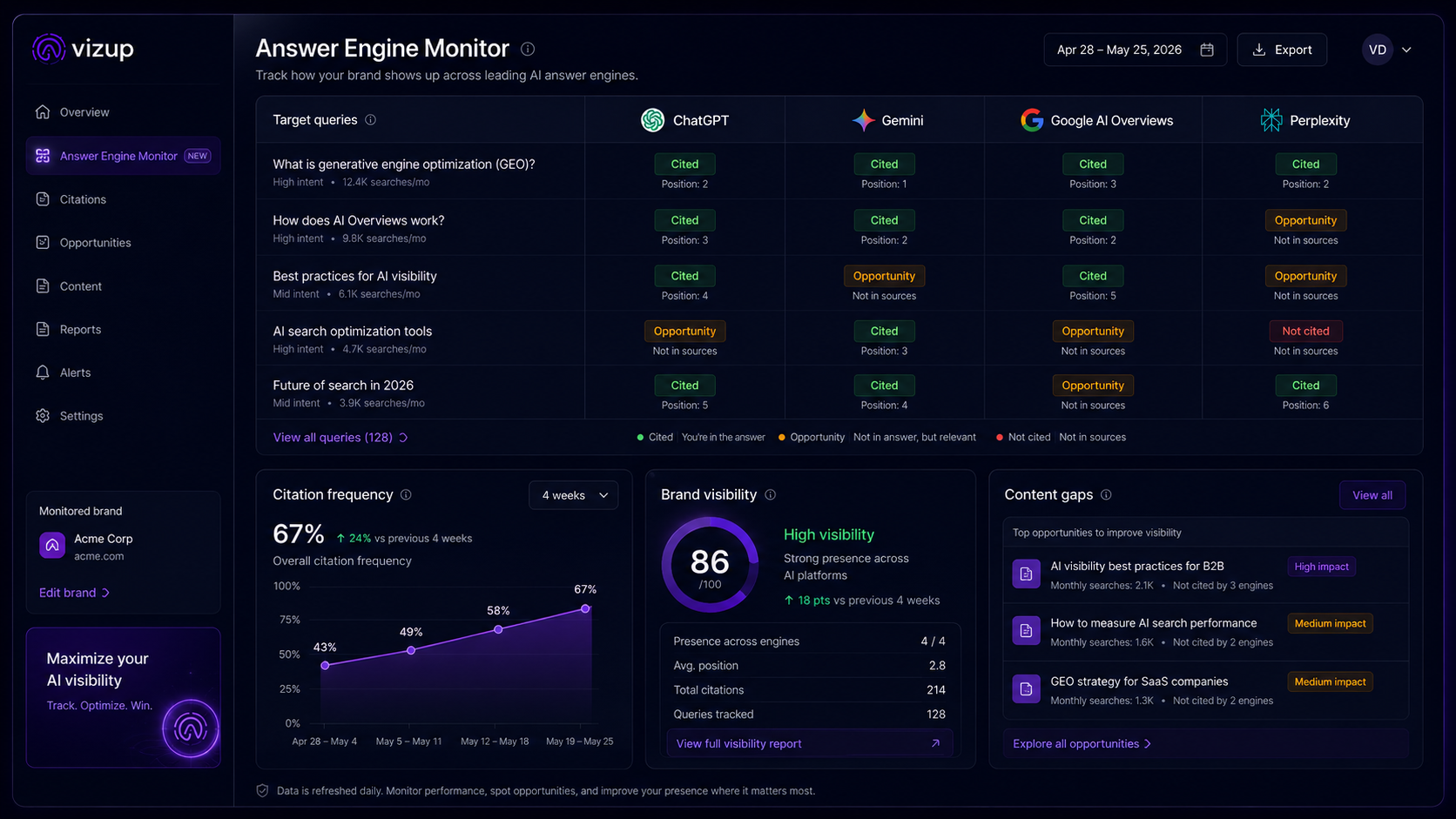
Most GEO playbooks fall down on measurement, telling you what to change but not how to prove it worked. Rank trackers don’t show AI citations. A page can disappear from Perplexity’s answers without anything in your usual dashboards lighting up, which is why answer engine monitoring is a critical, separate discipline.
Answer engine monitoring means tracking when and where your brand or pages show up in AI-generated responses across ChatGPT, Gemini, Perplexity, and AI Overviews. Vizup's Answer Engine Monitoring is built for this job: it tracks your presence across generative engines so you can see which pages get cited, which queries surface your brand, and where competitors show up instead. For the broader discipline and what to track, the AI search visibility playbook lays out the full approach.
Practical weekly monitoring workflow:
- Run your top 20 target queries across at least two AI engines manually or via a monitoring tool
- Log which sources get cited for each query
- Flag queries where a competitor is cited and you are not
- Reverse-engineer the cited page: what answer-block structure or data does it use that yours lacks?
- Update one to two pages per week based on findings
What Most People Get Wrong About GEO in 2026
Mistake 1: Treating GEO as a one-time optimization pass. AI engines re-crawl and re-evaluate constantly. When your stats go stale or your claims drift out of date, citations get dropped. GEO is ongoing content maintenance, not a project you “finish.”
Mistake 2: Prompt-stuffing or hidden-text manipulation. These systems are designed to resist obvious gaming. The reliable path is being the most useful, most defensible source for a specific question, not trying to trick a parser.
Mistake 3: Ignoring competitor citations. If Perplexity keeps citing a competitor for a query you care about, that’s actionable signal. Pull the cited page apart and compare it to yours. Most of the time the gap is small but decisive: a clearer answer block, a tighter claim, and an inline data point you never included.
Advanced GEO: Edge Cases and Expert-Level Moves
Multi-Language and Regional GEO
AI engines don’t serve the same sources for every language or inferred locale, so translation alone won’t carry you. Each language version needs its own GEO-ready answer blocks, plus region-specific data and locally attributed sources. While Hreflang helps search engines, page content ultimately determines AI citation. For more on this, see how to make your content discoverable in AI engines across locales.
Programmatic Content and GEO at Scale
For sites with thousands of URLs, manual GEO cleanup won’t scale, so templates must enforce the basics by default. This includes answer-block structure, inline citations from real-time telemetry, and clean heading hierarchy. Every programmatically generated page should ship with a self-contained answer paragraph and one inline data attribution. Vizup's digital presence monitoring can help prioritize this work.
Frequently Asked Questions
Is generative engine optimization the same thing as traditional SEO?
No, but they work together. Traditional SEO is about earning a ranked position in a list of links. Generative engine optimization is about structuring content so systems like ChatGPT, Gemini, and Perplexity cite or synthesize it inside their generated answers. The fundamentals overlap, but GEO puts extra weight on self-contained answer blocks, inline source attribution, and specific, quotable claims.
How can I tell if AI engines like ChatGPT or Perplexity are citing my content?
Standard analytics won’t show AI citations. You either have to run your target queries manually and record which sources get cited, or use an answer engine monitoring tool like Vizup to track citations across generative engines automatically. As a baseline, a weekly manual check of your top 20 queries across two engines is a solid starting point before you invest in tooling.
Does GEO still work if my website has low domain authority?
Domain authority is the strongest single signal in AI citation behavior, so low-authority sites start at a disadvantage. Still, claim specificity and inline source attribution are improvements any site can make. Highly specific, well-attributed content on niche topics does get cited even from smaller sites, especially on Perplexity, which weights freshness and specificity heavily.
How often should content be updated for AI content optimization?
Pages with statistics, market data, or time-sensitive claims should be reviewed at least quarterly. AI engines actively deprioritize pages with outdated figures. For your highest-traffic pages, a monthly freshness pass to update data points and re-check inline attributions is a reasonable standard. Tie the work to a recurring calendar reminder for your top 10 pages instead of waiting for traffic to drop.
Will GEO optimization hurt my Google rankings?
No. The changes that typically improve GEO performance, such as cleaner heading hierarchy, self-contained answer blocks, inline source citations, and specific data points, also align with traditional search quality signals. Google’s quality rater guidelines reward clear sourcing and demonstrated expertise, so SEO and GEO are aligned in almost every practical way.
Key Takeaways and Your Next 7 Days
If you do nothing else, do these three things: rebuild your top pages around self-contained answer blocks, add inline citations with real data points, and track AI citations weekly. Most other GEO work is incremental compared to those fundamentals.
Your 7-day GEO sprint:
- Days 1-2: Audit your top 10 pages. For each H2 section, check whether one paragraph could stand alone as a cited answer. Flag every section that fails that test.
- Days 3-4: Add inline statistics and source attributions to flagged sections. Start with pages targeting queries where competitors already show up in citations.
- Days 5-6: Set up answer engine monitoring using Vizup or a manual tracking spreadsheet across ChatGPT and Perplexity.
- Day 7: Benchmark your current AI citation footprint across your top 20 target queries. Save it as your baseline for measuring progress.
GEO is still early, which is exactly why it’s worth building the muscle now. Teams that operationalize citations and answer-block writing before it becomes table stakes will stack compounding gains as AI-driven discovery grows through 2026 and beyond. If you want the wider strategic frame alongside these tactics, start with the AI search visibility playbook.
