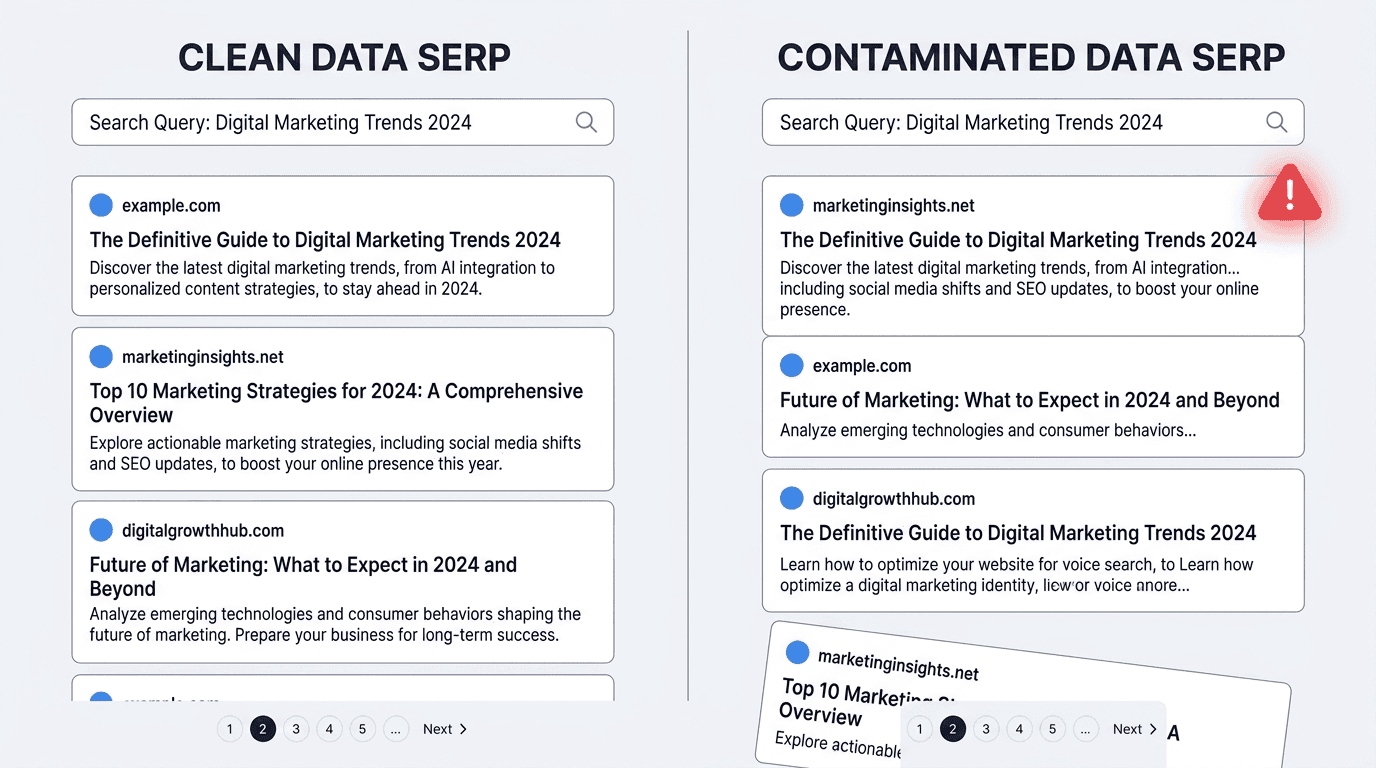
Researchers and rank-tracking providers have observed Google results pages served to automated collection systems that contain swapped, missing, or unusual results. These pages have been described as "poisoned SERPs," although Google has not publicly confirmed that it intentionally serves them to rank trackers. The data then enters SEO reports without a visible error, captcha, or template change.
Your September report showed a sharp, unexplained drop. You reviewed competitors and on-page changes, perhaps even explained the loss to a client. But the data may have been the failure. Since mid-September 2026, evidence has accumulated that a meaningful share of Google rank-tracking data was contaminated at collection. That puts targets, strategy changes, and client reporting on shaky ground. The useful questions are what was measured, how persuasive the evidence is, and how to test your own data.
What Are Poisoned SERPs and Why Did They Appear in September?
"Poisoned SERPs" describes a particular anti-scraping tactic: Google serves a page that looks like an ordinary results page - blue links, featured snippets, People Also Ask - while swapping, shuffling, or fabricating rankings. There is no captcha or 429 error. The HTML parses normally, and the tracker records the output as fact.
It is a sharper version of Google's long-running response to automated SERP collection. Earlier google anti scraping SERP techniques - IP blocks, captchas, rate limits - were obvious because they left holes in the data. Poisoned results fill those holes with plausible noise. For the legal backdrop, see what the Google vs. SerpApi ruling means for SERP data.
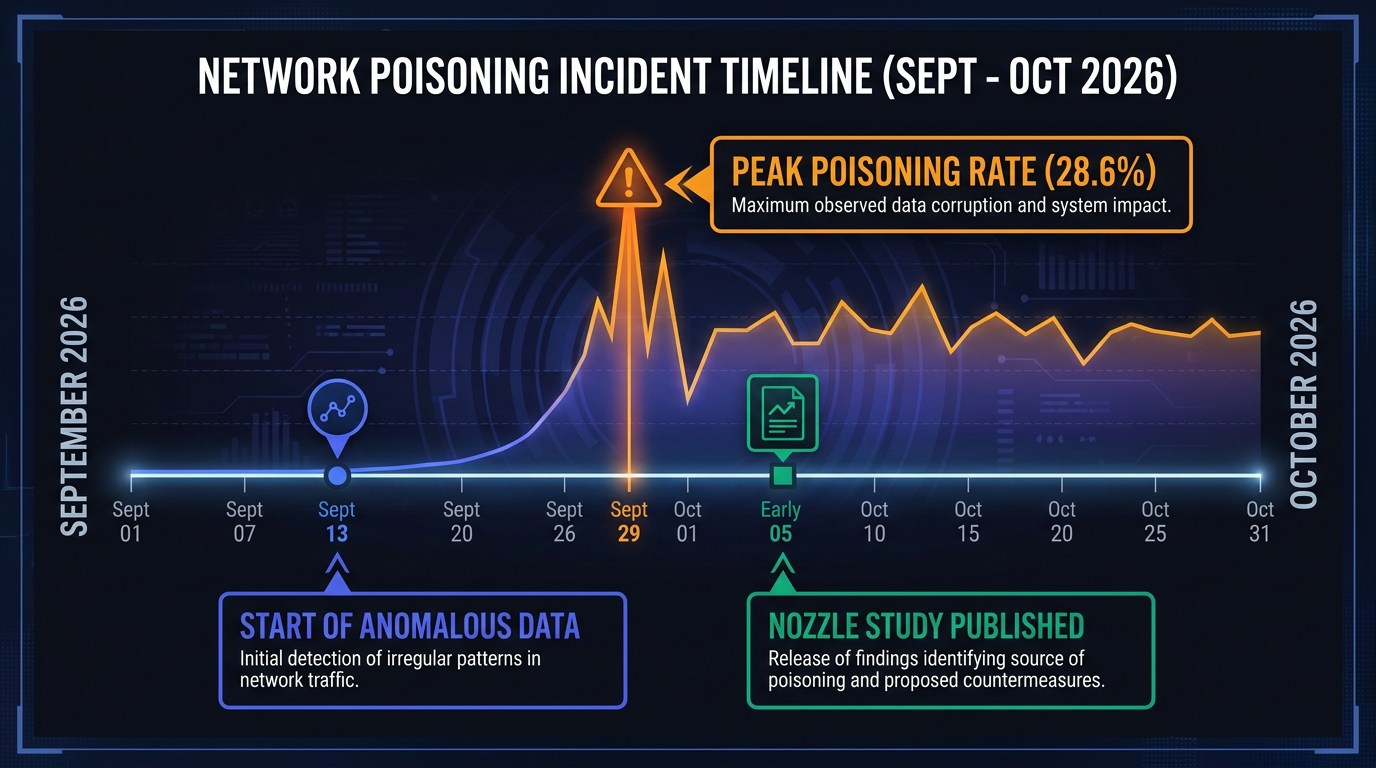
The issue came into focus with the Nozzle poisoned SERPs study, published in October 2026. Nozzle analyzed 27 million Google results pages collected since September 13, 2026 and found 8.4% were poisoned. On September 29, the worst day, the rate reached 28.6%. Nozzle counted a SERP as poisoned when fewer than half of the sites that normally rank for a keyword appeared and the usual sites returned on a later fetch. This is not ordinary volatility, a penalty, or data-center variation; it is evidence of a defense mechanism feeding trackers false SERP results.
How to Tell If Your Data Is Compromised
The problem with rank tracker data integrity is that a standard report cannot reveal the poison. A keyword falling from position 3 to 33 looks exactly like a genuine loss. No raw field separates an algorithmic movement from a collection artifact. Treat the checks below as a set, not a single test. Rates vary by day and collection route, so one clean spot check proves little.
Look for Extreme Volatility Patterns
The clearest symptom is a keyword jumping from page 1 to page 10, then snapping back days later, without on-page changes, an update, or meaningful competitor movement. Genuine drops are usually directional: they hold, or recover gradually after a fix. Poisoned data creates sharp, noisy spikes. Review September and October for your top 50 keywords and flag movements of more than 30 positions in either direction within 48 hours. Clusters after September 13 are a strong warning.
Compare Against a Manual Spot Check
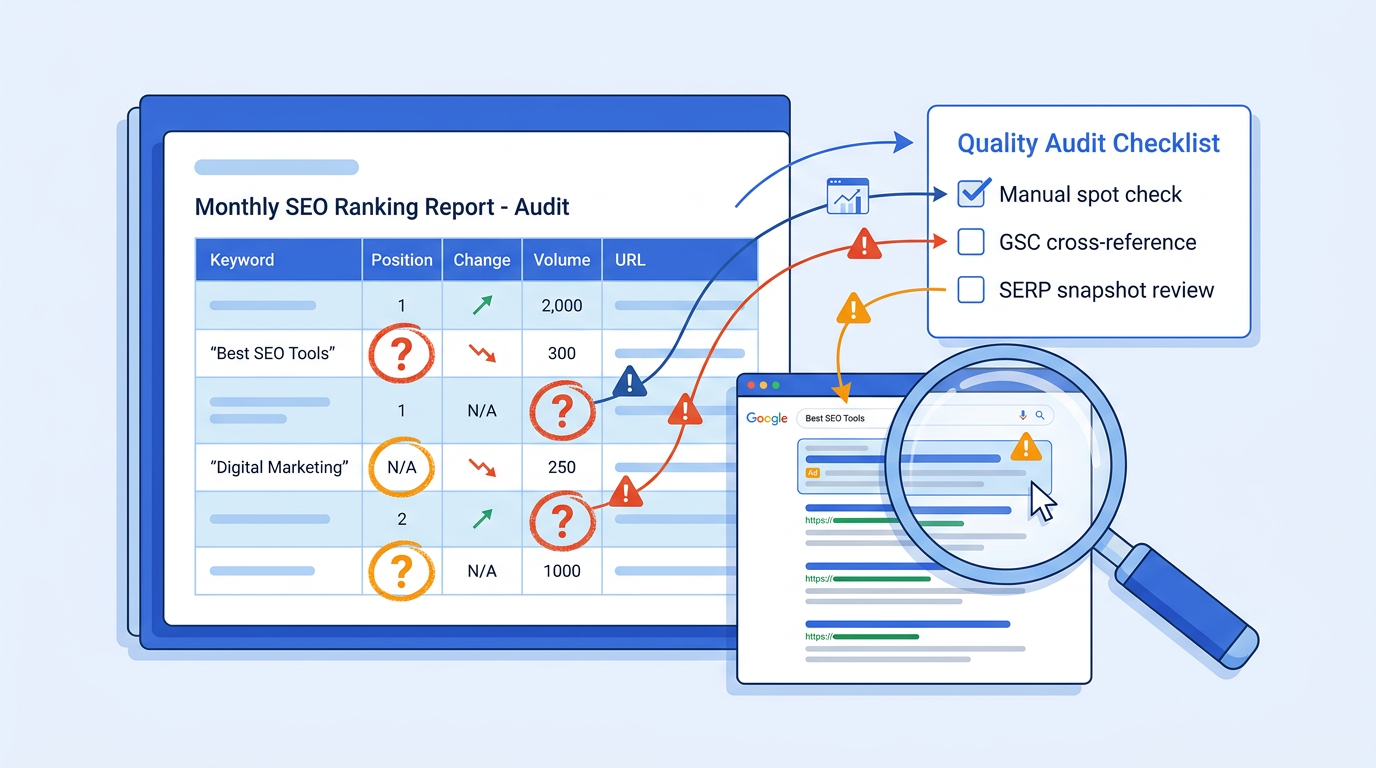
The most direct rank tracking accuracy check is tedious but straightforward: open an incognito window, match the tracked keyword's geo-target, and search manually. If the tool reports a fall from #5 to #89 and the search shows #7, treat that as a serious warning. One search is not conclusive; personalization and data-center lag exist. A 50-plus-position gap is not explained by either. Check 10 to 15 keywords with the largest September movements.
Check for Missing or Swapped URLs
This was the Nozzle study's central finding. A poisoned SERP does not simply remove your URL. It substitutes other URLs, often from much deeper in the original results or from sites with no topical fit. Inspect the full snapshot, if your tool saves one. Do the competing URLs look like recognizable, authoritative results for the query, or obscure pages with the wrong intent? Nozzle's October 2026 research found a tracked site falls out of the top 10 on 2.7% of normal SERPs, versus 58.6% of poisoned ones.
Tip: If your tracker retains full SERP snapshots, export the HTML or URL lists for the most volatile keywords. Compare September and October snapshots for the same terms. A sudden wave of unfamiliar, low-authority domains across keywords collected on one date is the strongest poisoning signal.
Poisoned vs. Real: A Side-by-Side Comparison
A real loss and a collection artifact can look identical in a rank chart. To detect poisoned SERPs, compare several signals at once rather than leaning on one suspicious keyword.
| Signal | Real Ranking Drop | Poisoned SERP Anomaly |
|---|---|---|
| Volatility pattern | A directional drop that holds or recovers gradually | Erratic spikes, with 50+ position jumps in both directions within days |
| SERP composition | Competitors rise; results remain relevant to the query | Irrelevant, low-authority, or nonsensical URLs appear |
| Manual search check | An incognito search with matching geo confirms the drop | Manual search shows a stable or near-original position |
| Likely cause | Algorithm update, penalty, technical issue, or competitor action | Google anti-scraping measure aimed at the collection method |
| Affected keyword scope | Usually concentrated in one topic cluster or site section | Scattered across unrelated keywords, often on one collection date |
| GSC corroboration | Impressions and clicks move in the same direction | GSC remains stable while the tool reports a crash |
| Use multiple signals together. No single row is conclusive on its own. |
The Impact on SEO Reporting and Client Trust
The damage is larger than a handful of bad rows. Agencies may have spent September explaining losses that never happened, then recommended disavows, rewrites, or technical work on phantom signals. For agency rank tracking teams, that is a credibility problem as much as a data problem. A client who finds out last month's head-term narrative rested on corrupted data has reason to question earlier reports too.
Reports already delivered require an uncomfortable response: disclose the problem. Teams that explain the industry-wide issue and show a remediation plan will fare better than those that quietly change figures. Frame the conversation around data transparency: Google's anti-scraping infrastructure is the root cause, the industry was affected, and verification steps now need to be part of reporting.
Common Misconceptions About SERP Data Reliability
The poisoned SERPs finding has also produced a few claims that do not survive scrutiny.
"This is just normal rank fluctuation." No. Normal fluctuation moves positions by a few places as Google re-indexes content and adjusts signals. Poisoned SERPs replace much of the results set with URLs that do not belong there. Nozzle defined poisoning as cases where fewer than half of expected ranking sites appeared and the originals returned later. That is not algorithmic churn.
"Only cheap or low-quality tools are affected." The evidence does not support that. Providers report different rates because of collection infrastructure - proxy networks, request patterns, IP diversity - and filtering, not simply product quality. Reported poisoning rates can vary significantly because collection methods, request patterns, filtering, and verification processes differ between providers. If independent measurement sources strongly disagree on the same keyword and date, treat that disagreement as a signal to investigate rather than choosing one result automatically.
"Google confirmed this is happening." Google has neither publicly confirmed nor denied it. The evidence is third-party analysis of collected data, which means the industry is drawing an inference rather than relying on disclosure. It is a strong inference: Nozzle's dataset is large, the pattern is consistent, and industry reporting from Search Engine Roundtable documented collection anomalies before the term "poisoned SERPs" existed. It remains an inference.
Navigating Rank Tracking Data Accuracy in 2026 and Beyond
Assuming every SERP fetch is reliable is no longer defensible. This does not look like a temporary bug Google will patch or vendors will entirely bypass. Google scraper detection in 2026 is more sophisticated than before, and the direction is toward more escalation. Rank tracking data accuracy in 2026 will depend on redundant collection sources and filtering, not brute-force scraping alone.
Reporting teams need three changes. First, compare rankings with Google Search Console: GSC comes from Google's systems, not scraping. A tool crash paired with stable GSC impressions and average position is suspect. Second, diversify measurement. Absolute positions have always been proxies; visibility, traffic, and conversions are closer to the outcome. Why traffic metrics lie and visibility metrics don't offers a useful way to reset client conversations. Third, press vendors for specifics: their google blocking SERP scrapers detection rate, re-fetch policy, and whether they expose a confidence score or data-quality flag.
Vizup approaches this as part of a broader visibility problem. As an Organic Autopilot for modern discovery, Vizup helps brands monitor, create, optimise, publish, and learn across Search, Social, Communities, AI Answer Engines, and Local Discovery using AI agents, human experts, and live SEO, pSEO, AEO, and GEO tools. That broader view matters when one measurement source becomes unreliable. Instead of treating an isolated ranking movement as the full story, teams can compare Search visibility with traffic, conversions, AI Answer Engine presence, Social, Communities, and other discovery signals before making major decisions. Flagged results are re-fetched, and points that fail verification are marked rather than silently included in reports. For enterprise rank tracking, that distinction matters.
The measurement mix is changing too. As Search Engine Journal reported, the tactic appears aimed specifically at AI scrapers, with rank trackers caught in the blast radius. Tools that monitor AI answer engines and other discovery surfaces alongside traditional SERPs have less single-source exposure. Vizup's best LLM rank tracker tools coverage reflects that shift.
Key Takeaways for Your Team
- Poisoned SERPs are manipulated results served to scrapers. They look ordinary but contain swapped, irrelevant, or missing URLs that corrupt rank data.
- Nozzle found 8.4% of 27 million pages collected since September 13, 2026 were poisoned; the single-day peak was 28.6%.
- Look for 50-plus-position swings within 48 hours, manual-search disagreements, and SERPs crowded with irrelevant low-authority results.
- Audit September and October reporting against Google Search Console, which scraper poisoning does not affect.
- Tell clients about plausible data-integrity issues. Proactive disclosure preserves trust; quiet revisions undermine it.
- Put more weight on visibility, traffic trends, and business outcomes than on absolute rank positions.
- Ask providers how they detect and handle google poisoning rank trackers, including re-fetch logic, confidence scoring, and quality flags.
Frequently Asked Questions
Will Google Search Console data be affected by poisoned SERPs?
No. GSC data comes from Google's internal systems rather than external scraping. Its average position, impressions, and clicks reflect what Google served to users, making it the strongest cross-check during suspected poisoning. If a tracker shows a crash while GSC is stable, the tracker data is very likely compromised.
Are all rank tracking tools affected by this issue?
Any tool that queries Google results can be affected, though the rate differs sharply by provider. Collection infrastructure - proxy diversity, request patterns, and IP rotation - and post-collection filtering both matter. AccuRanker reported reducing its affected rate to around 1%; Nozzle's unfiltered data reached 28.6% on peak days. Ask your provider for its detection and mitigation method.
Is it still worth tracking keyword rankings after this?
Yes, with verification layers. Rank data remains a useful directional signal when checked against GSC, traffic, and manual searches. The mistake is treating one reported position as ground truth. Broaden measurement to visibility scores, SERP-feature share, and AI answer-engine presence, which do not face the same poisoning dynamics.
How can I explain this to my clients without looking like I'm making excuses?
Start with the industry-wide evidence, including Nozzle's finding that 8.4% of 27 million pages were affected. Then make the response concrete: audit affected reports and add GSC checks, manual searches, and SERP snapshot review. Clients are more likely to respect a transparent process than an appearance of perfection. Provide a revised report with flagged points and a plain methodology note.
Does using a VPN or different proxy types prevent poisoned SERPs?
Not reliably. Google's scraper detection in 2026 extends beyond IP identification to behavioral signals such as request timing, headers, JavaScript execution, and mouse and scroll behavior. A different VPN or proxy may lower the rate temporarily but cannot remove the risk. Multi-source verification and processing-layer anomaly detection are more durable. For more on bot detection and SEO data, see Vizup's coverage of how bot checks can remove pages from Google.
