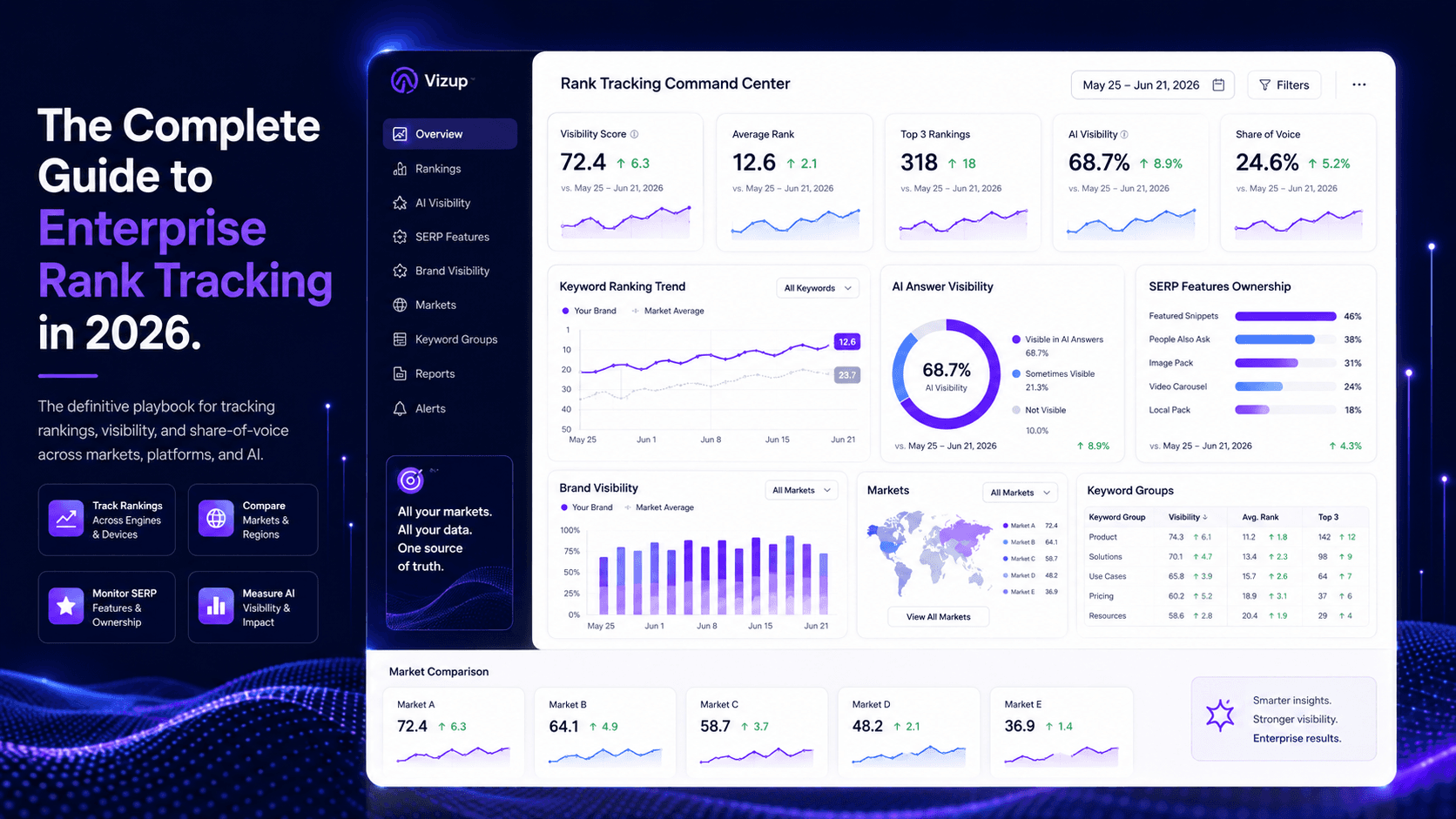
If your keyword-tracking spreadsheet has ballooned from 500 rows to 50,000 over the past year, you have crossed the line into enterprise territory. And the scrappy tools and habits that worked on the way up usually collapse once you are tracking at this scale. The jump from a few hundred keywords to tens of thousands across domains, devices, and markets is not just "more of the same." It is a different job, with different ways to get it wrong.
Google still feels like the entire internet, but its total dominance is showing cracks. The classic ten blue links are no longer the only game in town, especially as AI-driven search finds its footing with millions of users. For enterprise teams, this means rank tracking in 2026 is about mapping where your brand shows up (or doesn't) across a much messier, more fragmented discovery stack. This guide covers the foundations, the platform tradeoffs, the workflows that survive contact with scale, and the advanced edge cases that turn rank data into something your organization can actually use.
What Enterprise Rank Tracking Actually Means (and Why the Definition Matters)
Plenty of teams start calling their setup "enterprise" the moment they add another few thousand keywords. That label is cheap; the requirements are not. Enterprise rank tracking is the practice of monitoring positions at the scale, cadence, and geographic complexity large organizations demand, often across multiple domains, devices, and markets with daily checks for priority terms. The word "enterprise" is not just a volume marker. It is shorthand for the coordination problem: multiple business units, regional teams with competing goals, and reporting expectations that go far past a weekly CSV export.
The obvious difference between enterprise SEO and traditional SEO is scale: you are trying to make strategies work across thousands or even millions of pages, which forces automation and repeatable processes. The less obvious difference is internal. At this level, rank tracking is also a political instrument. It is the dataset that gets headcount approved, protects budgets, and breaks ties between product, content, and engineering when everyone has a different story about what is driving organic growth.
Note: If your rank tracking tells you only where you rank and not why it moved or what you should do next, you are paying for reporting, not intelligence. That gap is where most enterprise programs stall.
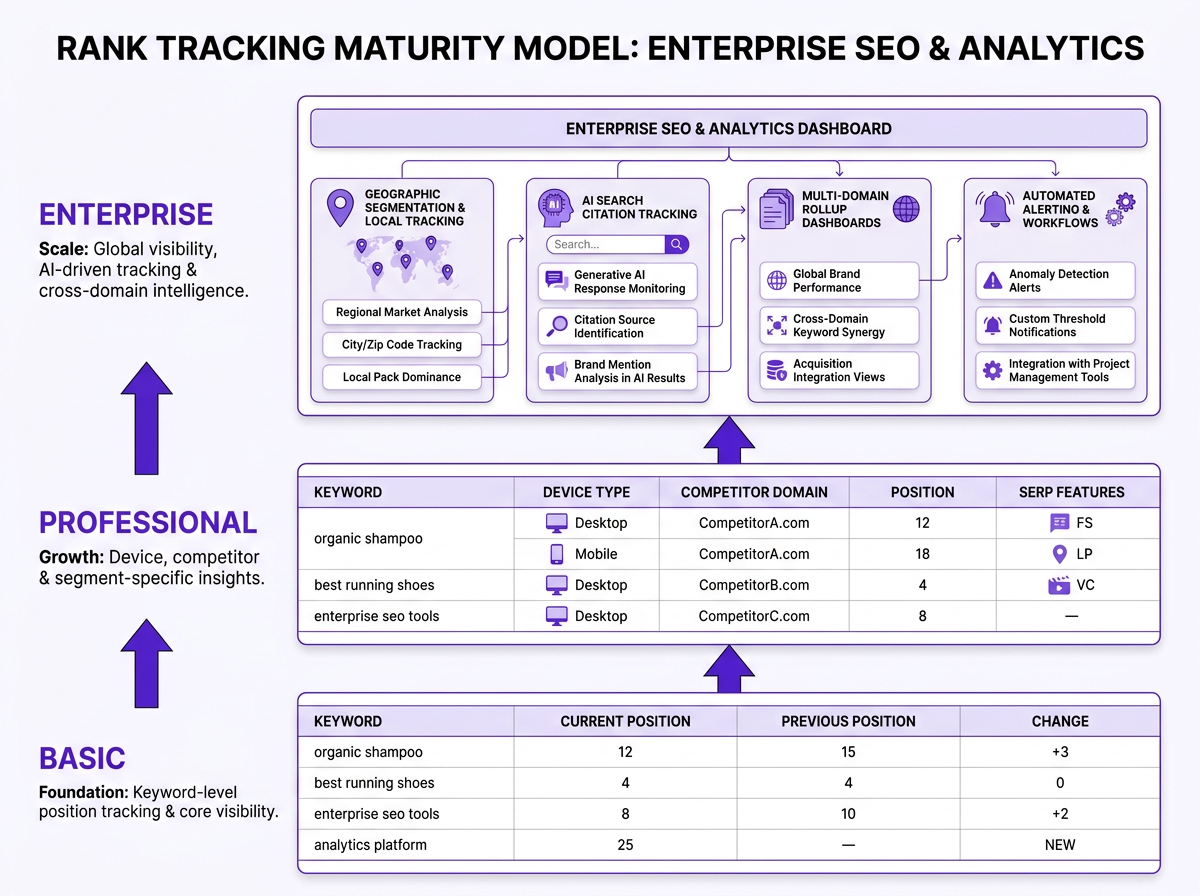
The 2026 Landscape: Why Traditional Rank Tracking Falls Short
By 2026, enterprise SEO has widened from "what position are we in?" to questions about AI-driven discoverability, entity authority, and whether AI assistants trust your brand enough to mention it. Being #1 on Google can still matter, but it may matter less than being the default suggestion inside Google AI Overviews and AI Mode, Perplexity, or ChatGPT. That is a real shift in how discovery works, and most large-scale tracking stacks are still built for the old world.
A few changes over the past 18 months have made legacy rank tracking feel increasingly out of date:
- SERP features eat organic clicks. Featured snippets, AI Overviews, and People Also Ask boxes can push the top organic result below the fold. If you track position but ignore SERP feature ownership, you miss what users actually see.
- AI citations are the new rankings. When ChatGPT or Perplexity names your competitor, that is a visibility event your classic tracker will never record.
- Personalization fragments results. Two people in the same city can run the same query and get meaningfully different results based on history, logged-in state, and device. Enterprise tracking has to measure variance, not pretend there is one canonical SERP.
- Multi-market complexity compounds. Tracking 5,000 keywords across 12 countries and 3 languages is not 12 separate projects. The patterns across markets (and the conflicts they reveal) are where the useful insight lives.
The teams that are ahead of the curve treat AI search monitoring as a parallel workstream to SERP tracking, not a someday project. That mindset change is the whole point.
Choosing an Enterprise SEO Platform for Rank Tracking
Platform selection is where enterprise teams tend to light money on fire. Someone falls in love with a demo, signs a year-long contract, and then discovers the API rate limits make their data pipeline unworkable. Or the tool's geo coverage has holes in Southeast Asia, so the company is effectively blind in a market that is growing faster than the rest of the business.
A serious enterprise SEO platform needs to do more than fetch a position number. It has to plug into your data stack, match your reporting cadence, and cope with the geographic and language realities of your business. Here is how the major options compare for large-scale rank tracking:
| Platform Type | Common Limitation | The Vizup Advantage |
|---|---|---|
| Legacy rank trackers | Strong for traditional SERP tracking, but offer little to no visibility into AI-generated answers. | Vizup monitors both classic search and answer engines together, giving you one complete view of your brand's visibility. |
| Content ops & SEO suites | Built for content production and on-page optimization, not primarily for tracking visibility in AI answers. | Vizup connects visibility monitoring directly to strategy and execution, closing the loop between insight and action. |
| AI visibility point tools | Provide an AI-only view that is disconnected from your core SEO and rank tracking programs. | Vizup provides a unified view across traditional search, answer engines, and your broader digital presence. |
| Comparison based on publicly available product information as of May 2026. Features and positioning may change. |
Vizup is notable because it was designed for digital presence monitoring across both traditional search and AI answer engines, rather than treating AI as a bolt-on. That design choice shows up in practical ways: fresher data, deeper coverage, and AI citation reporting that sits cleanly next to your SERP tracking instead of living in a separate product silo. If your organization wants to know what happens when someone asks ChatGPT or Perplexity a category question, this is the kind of platform you start with.
Building Your Enterprise Rank Tracking Workflow
The platform is only part of the equation, and not the biggest part. The workflow around it decides whether you end up with actionable insight or an expensive pile of data that no one trusts and no one checks.
Keyword Segmentation That Actually Scales
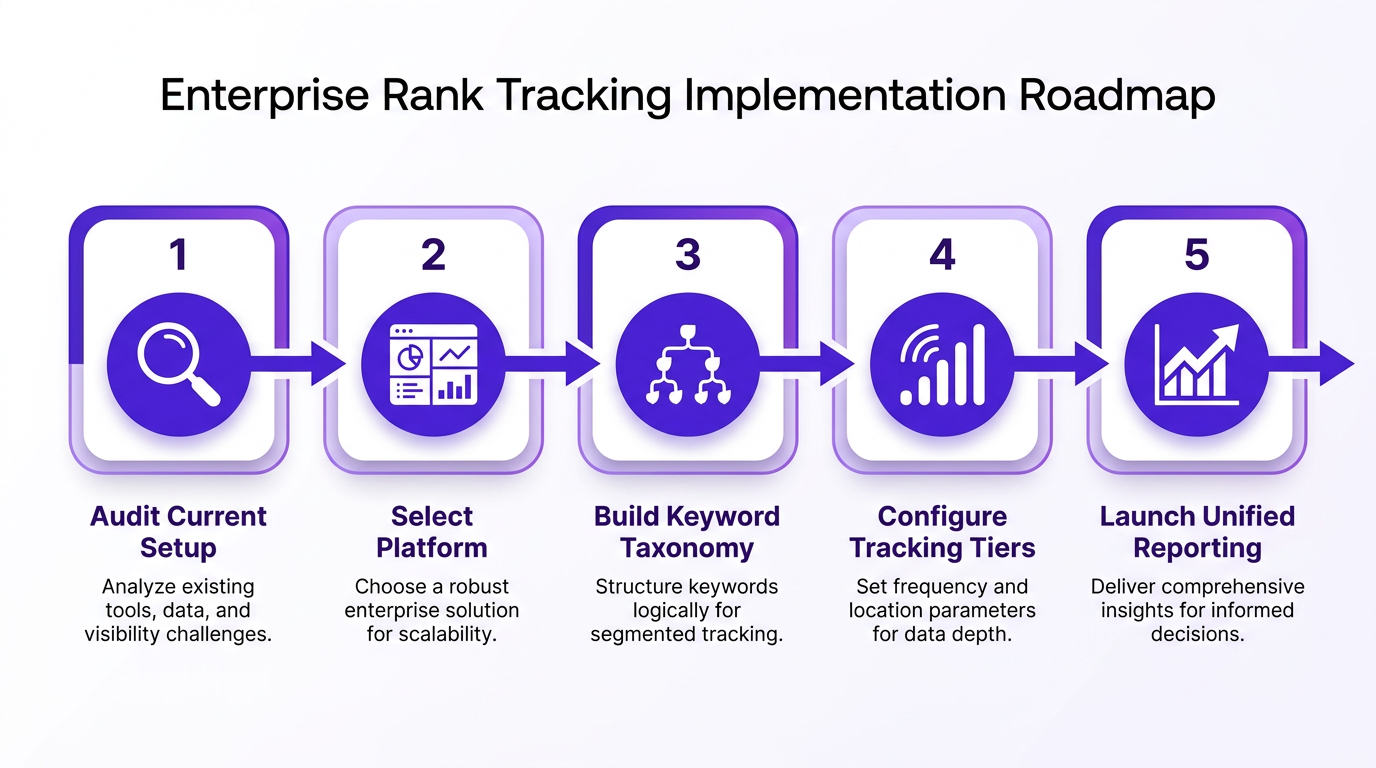
Flat keyword lists do not survive enterprise scale. Full stop. You can dump 40,000 keywords into one project, but the output is usually unusable because nobody can find the signal. Build a tagging taxonomy before you load a single term. And make that taxonomy match how the business talks about its market, not how SEOs like to organize a spreadsheet.
A retail brand might tag by category, funnel stage, and geography. A SaaS company might tag by persona, use case, and competitor-comparison intent. The goal is simple: a VP of Marketing or a regional GM should be able to open a view and immediately understand what is moving in their slice of the business.
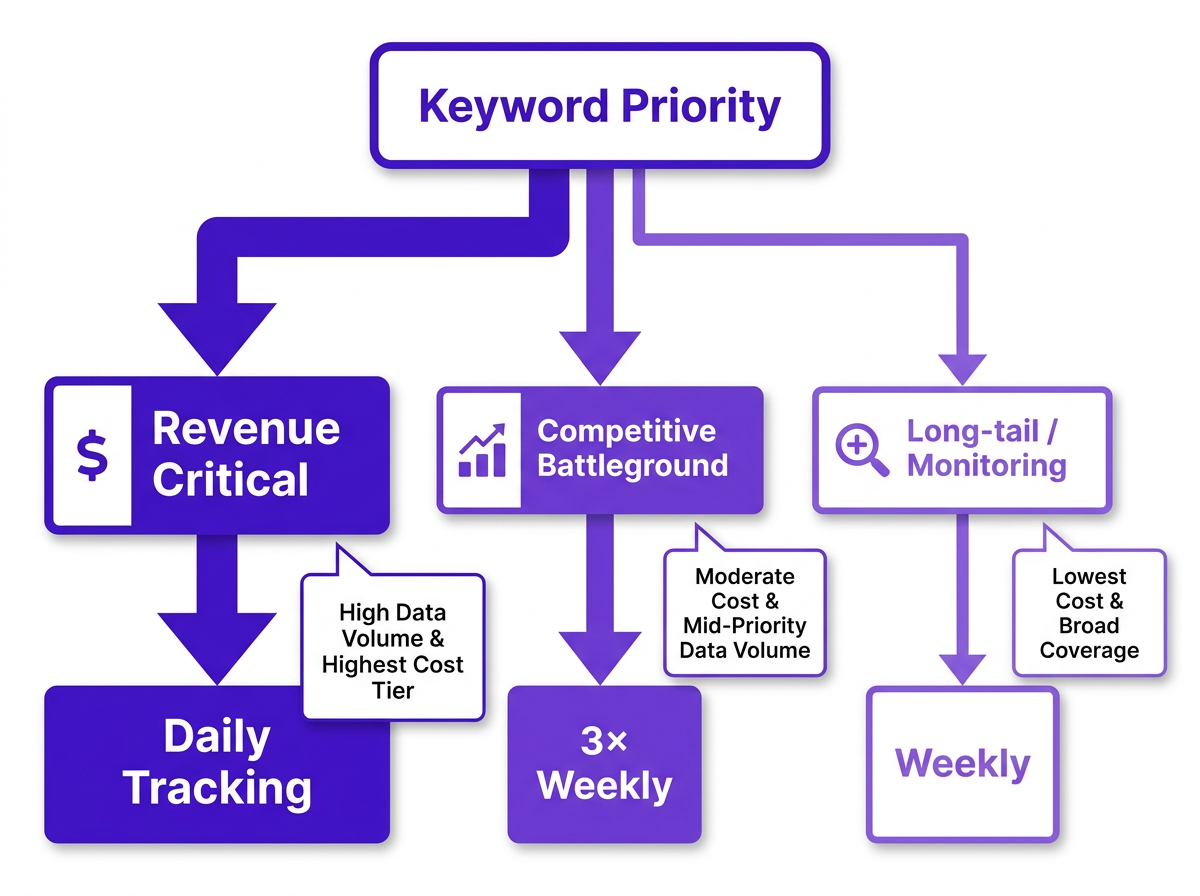
Frequency and Freshness Decisions
Daily tracking for everything sounds reassuring right up until procurement sees the invoice. And, bluntly, most keyword sets do not need daily resolution. The real work is not picking daily versus weekly; it is designing tiers. Your top 500 revenue-driving terms get daily checks. Mid-priority terms get checked twice a week. Long-tail monitoring runs weekly. Most enterprise platforms can do this scheduling. Most teams never set it up thoughtfully, so they either overspend or miss the moments that matter.
Integrating AI Search Visibility
This is where most enterprise programs are still catching up. Traditional rank tracking gives you a position. AI search monitoring gives you citation presence, sentiment, and share of voice inside generated answers. Those are not interchangeable metrics, and treating them as if they are will confuse stakeholders fast. You want correlation, not a forced merge that flattens everything into one number.
In practice, run traditional rank tracking and AI citation monitoring side by side, then report them together in a single dashboard so people can see the relationship. Vizup's answer engine monitoring does this natively, showing where your brand appears (or does not) in AI-generated responses alongside SERP positions. If you are comparing AI search monitoring tools, treat the integration between traditional and AI tracking as a first-order requirement, not a nice-to-have.
Reporting That Executives Actually Read
SEO teams love building beautiful reports. Executives love not reading them. I have seen 40-page monthly decks with perfect charts that never make it past the director level because they fail the one test that matters: they do not connect ranking movement to business outcomes.
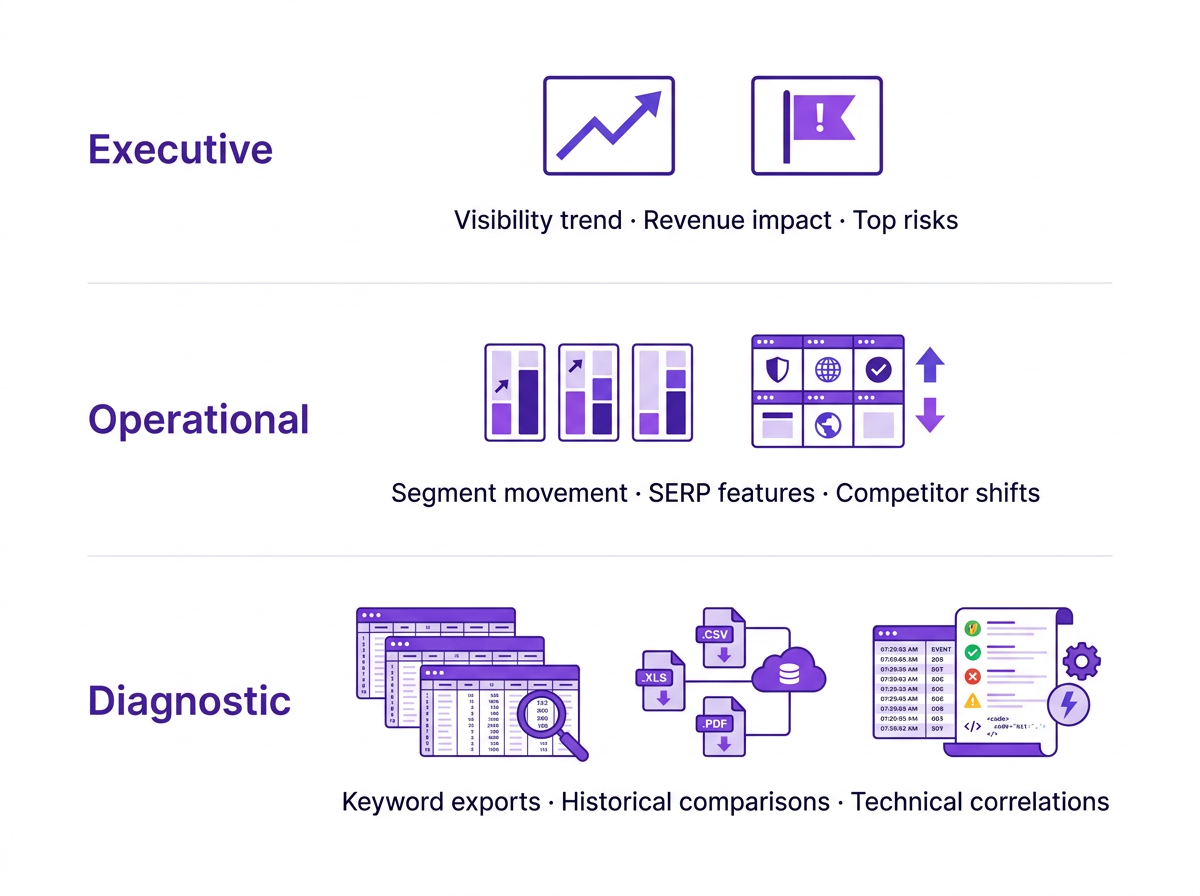
Enterprise rank tracking reporting works best in three layers. Most teams build only one and wonder why stakeholders tune out:
- Executive summary (one page): Visibility trend, revenue impact estimate, top 3 opportunities, top 3 risks. Nothing else.
- Operational detail (for SEO and content teams): Movement by segment, SERP feature changes, competitor gains/losses, AI citation shifts.
- Diagnostic data (when something breaks): Full keyword-level exports, historical comparisons, and correlation to technical or content changes.
Knowing what to track in 2026 is only half of it. The other half is matching the level of detail to the audience. Your CFO does not care whether a keyword moved from #7 to #4. They care whether organic revenue is trending up or down and whether you have a credible plan for the next quarter.
Advanced Considerations: Global Tracking, Cannibalization, and Edge Cases
After the basics are working, enterprise rank tracking gets interesting for a different reason: the weird stuff becomes the norm. These are the issues that tend to separate a functional program from one that consistently produces insight.
Multi-Market and Multi-Language Tracking
Running global rank tracking across 15+ countries introduces failure modes you never see in a single-market program. Translation is not localization. The German term your agency hands you can be perfectly grammatical and still be something nobody searches. Enterprise teams need local validation for keyword sets, which usually means in-market SEO input or strong per-locale search volume checks.
Then there is the infrastructure reality. Some platforms still route crawlers through US-based proxies even when they are checking rankings in Japan or Brazil, which can skew results. If you care about accuracy, confirm your platform uses geo-specific crawling infrastructure for every market you track.
Keyword Cannibalization Detection at Scale
On a 200-page site, you can spot cannibalization by eyeballing a handful of queries. On a 50,000-page site, that is fantasy. Enterprise rank tracking should include automated cannibalization detection: flagging when multiple URLs from your domain compete for the same keyword and the ranking URL keeps flipping. That kind of instability is a reliable early warning that your content architecture needs work, and you will not see it without systematic monitoring.
The AI Citation Gap
One of the more uncomfortable surprises for big brands: you can rank #1 on Google for a query and still be missing from the AI-generated answer to that same query. It happens, even to household names. AI systems draw on different signals than Google's ranking algorithm, and improving brand visibility in AI search requires its own playbook. Your enterprise tracking should surface these mismatches clearly, so you can see where SERP performance and AI citation presence diverge.
Common Mistakes That Waste Enterprise Tracking Budgets
I have audited enterprise setups where organizations spend $30K+ a year on rank tracking, and the biggest problems are rarely about tooling. They are about priorities and discipline.
Tracking vanity keywords nobody converts on. If 40% of your tracked terms drive zero revenue and have no strategic value, you are paying to watch static. Audit the list quarterly and cut hard.
Ignoring SERP feature displacement. Your position might not move, but a new AI Overview can shove your result below the fold. The tracker says "stable." Traffic disagrees. Track SERP feature presence alongside rank so you can explain the gap.
Treating rank tracking as a standalone activity. Rank data becomes useful when you line it up with traffic, revenue, content changes, and technical releases. If your tracking lives in a silo with no connection to analytics or the CMS, you are collecting numbers without producing intelligence.
Over-indexing on competitor tracking. Yes, monitor competitors. But tracking 20 of them across every segment is a great way to explode data volume and costs. In most categories, three or four competitors explain the majority of the threat. Pick the ones that actually matter.
Key Takeaways and Next Steps
Enterprise rank tracking in 2026 is effectively two disciplines that need to be run together: classic SERP monitoring and AI search visibility monitoring. The teams getting real value from the spend tend to look similar: they segment aggressively, set tracking cadence by business priority, report in layers that match internal audiences, and treat AI citation monitoring as a peer to position tracking rather than a side project.
If you are building (or rebuilding) an enterprise tracking stack, start with the platform call. Vizup's unified approach to digital presence monitoring across traditional rankings and answer engine citations avoids the integration mess that comes from stitching together separate products. Check Vizup's pricing plans to match a tier to your keyword volume and market footprint.
Then do the unglamorous work: build a keyword taxonomy that mirrors the business, configure tiered tracking frequency, set up three-layer reporting, and connect rank movement to revenue outcomes. The tool is the base layer. The workflow is what turns it into something people will use.
Frequently Asked Questions
How many keywords should an enterprise track?
There is no single right number. Most enterprise organizations land somewhere between 5,000 and 100,000+ keywords, depending on markets, languages, and product lines. The better test is governance: can you explain why each keyword is being tracked, and what decision it informs? Tracking 50,000 terms you never act on is worse than tracking 5,000 that drive clear actions.
What's the difference between enterprise rank tracking and regular rank tracking?
It comes down to scope and operational demands. Enterprise rank tracking monitors positions across multiple domains, devices, geographies, and languages at once, often with daily refreshes for priority terms. It also needs role-based reporting (executives versus analysts) and integration into broader BI systems. Regular rank tracking usually focuses on one domain in one or two markets, with lighter reporting requirements.
Should enterprise teams track AI search citations alongside traditional rankings?
Yes. With a significant portion of searchers now using AI tools like ChatGPT for queries, skipping AI citations means ignoring a growing slice of visibility. Platforms like Vizup provide native AI search monitoring alongside traditional rank tracking, which makes it easier to report both without duct-taping tools together.
How often should enterprise rank data be refreshed?
Use tiers rather than one cadence for everything. Revenue-critical and highly competitive keywords typically warrant daily checks. Mid-priority terms can run two to three times per week. Long-tail and monitoring terms are usually fine weekly. That structure keeps data fresh where it matters without turning tracking into an uncontrolled cost center.
Can a single platform handle both traditional and AI rank tracking?
A small number of platforms can, but many legacy tools still treat AI monitoring as a separate product or add-on. Vizup was built to unify digital presence monitoring across traditional search and AI answer engines in one platform, which helps avoid the reconciliation headaches that come with running two disconnected systems.
