
Agency rank tracking stays manageable right up until it doesn't, usually somewhere around client number twelve. Before that, you can limp along with spreadsheets, a few manual spot-checks, and institutional memory. Past that point, the failure modes stack up fast: ranking drops that nobody catches, reports that go stale, account managers second-guessing the numbers, and clients who feel like they're paying for a black box. Most SEO agencies experience significant annual client churn, with poor reporting consistently cited as a leading cause. The issue is rarely a lack of data. It's the lack of a repeatable system for collecting it, interpreting it, and communicating it across a growing book of business. If your agency is still relying on legacy rank trackers, single-site SEO suites, or manual reporting workflows, the cracks will show long before you hit 50 clients.
This guide maps the agency rank tracking lifecycle end to end, from the fundamentals you need to get right to the automation patterns that still hold up at 50, 100, or 200 client accounts. If you're standing up your first workflow or rebuilding one that collapsed under growth, the sections below focus on the pieces that actually determine scale: architecture, tooling, reporting, and the operational habits that keep the whole thing from drifting. Here's the roadmap:
Sections covered:
- Why Rank Tracking Is the Backbone of Agency SEO, the strategic case beyond vanity metrics
- Building Your Rank Tracking Foundation, keyword sets, tracking frequency, device and location splits
- Designing Scalable Rank Tracking Workflows, repeatable processes that survive team turnover
- Choosing the Right Agency Rank Tracking Software, why purpose-built platforms outperform legacy rank trackers, single-site SEO suites, and manual reporting workflows
- Automating Client SEO Reports and Dashboards, turning raw data into stories clients act on
- Advanced Patterns: Local, AI Search, and Edge Cases, nuances that separate good agencies from great ones
- Key Takeaways and Next Steps, a concise recap with immediate actions
Why Rank Tracking Is the Backbone of Agency SEO
Rank tracking in an agency context isn't about celebrating green arrows. It's how you connect strategy to evidence. Every recommendation you ship (new content, technical fixes, link building) eventually has to show up as movement in search visibility. Without consistent SERP monitoring, you're essentially guessing between QBRs and hoping the numbers cooperate when you finally pull them.
The real payoff from keyword tracking at scale is pattern recognition. Monitor thousands of keywords across dozens of clients and you start seeing algorithm shifts before they get a name on SEO Twitter. You catch cannibalization early, you notice content decay before traffic falls off a cliff, and you spot competitor pushes while they're still small. One client's dataset is noisy. Fifty clients' datasets become a signal. Agencies that treat rank tracking as a monthly deliverable leave that advantage on the table.
Building Your Rank Tracking Foundation
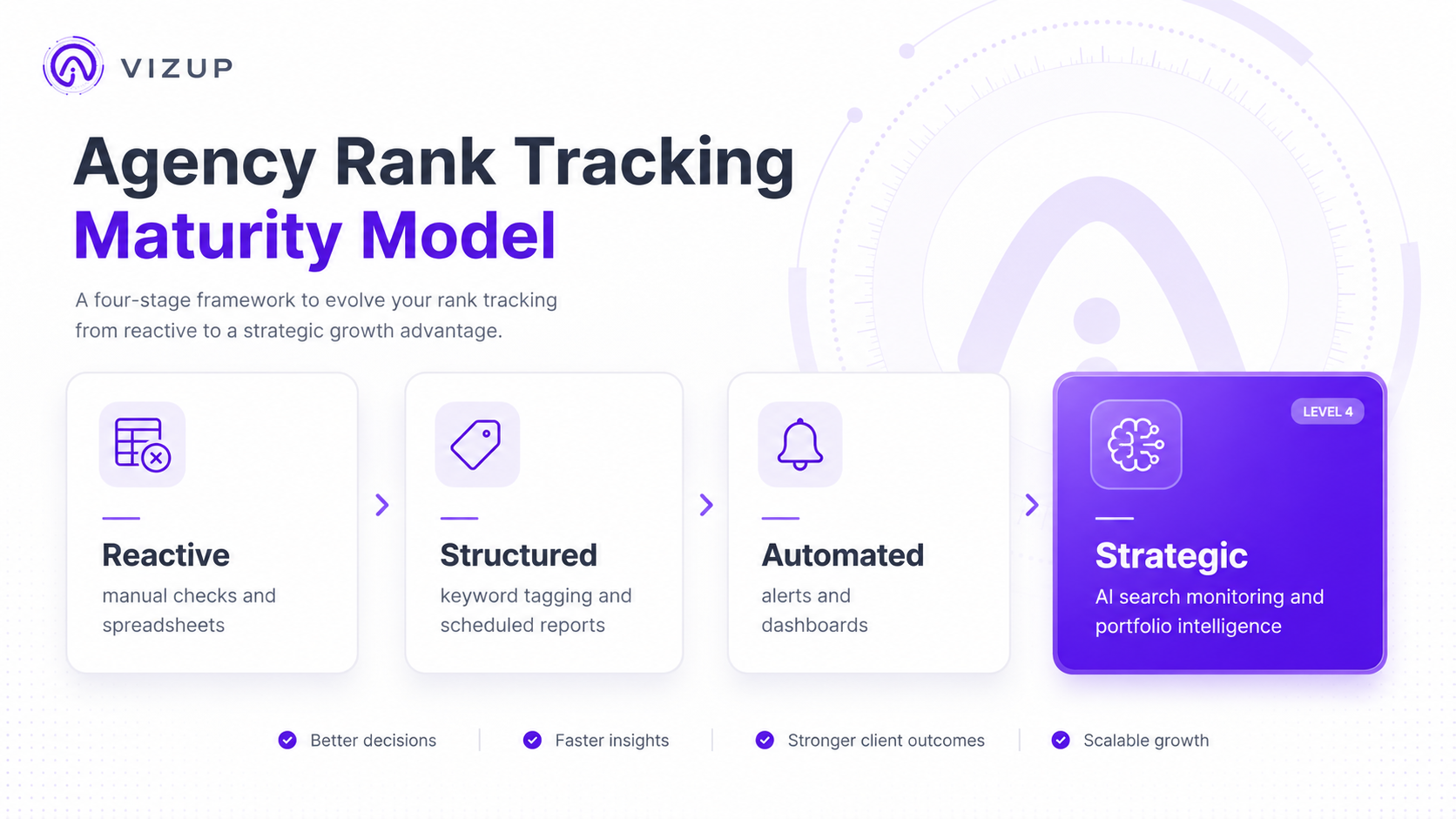
Scale doesn't forgive sloppy fundamentals. What feels "good enough" at five clients turns into a slow-motion incident at fifty. Early on, three choices do most of the long-term damage (or most of the long-term good): how you build keyword sets, how often you track, and how you split results by device and location.
Keyword Set Architecture
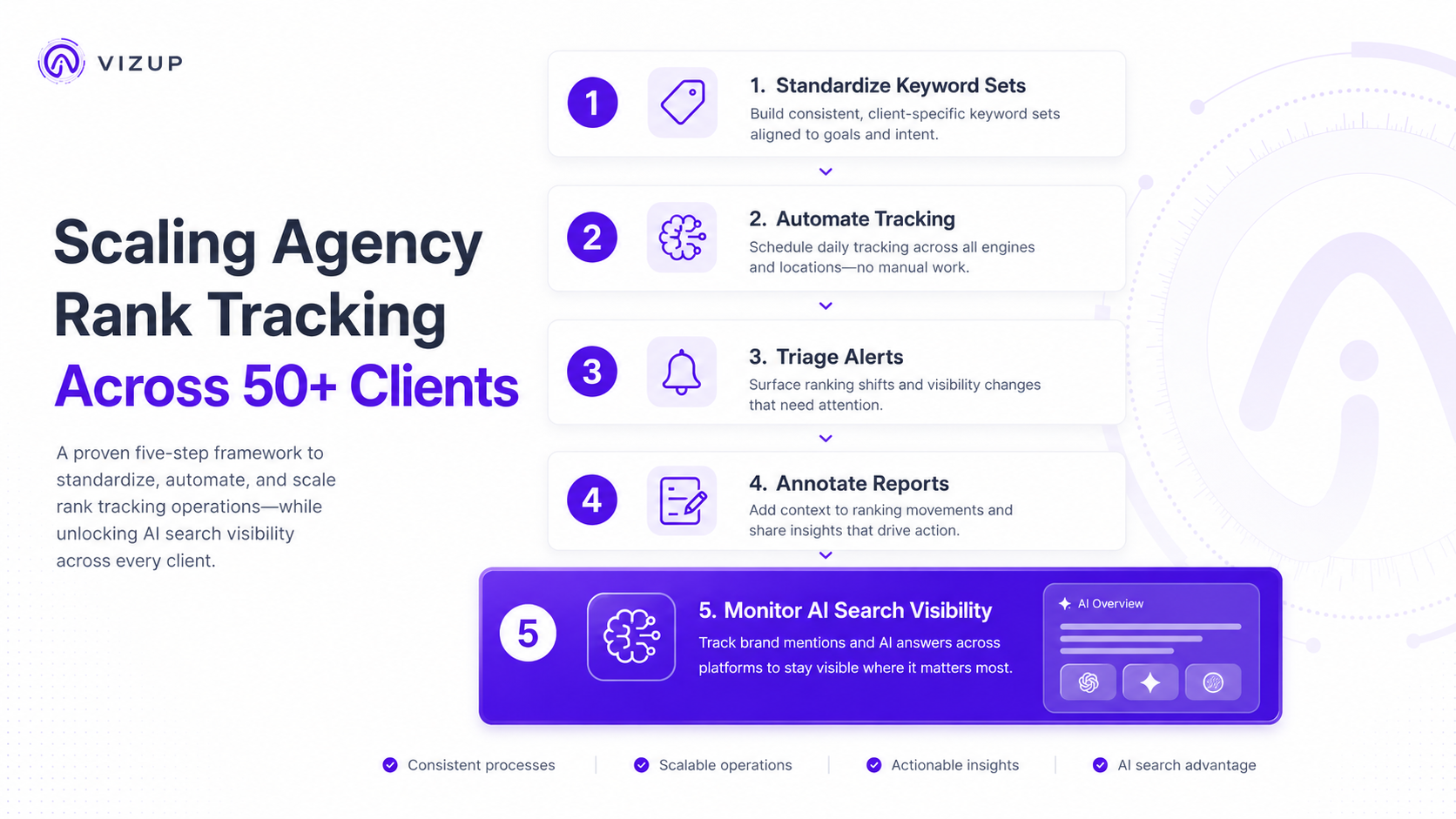
Each client needs a keyword taxonomy you can operate, not a flat list you dump into a tracker and forget. Break the set into tiers: branded terms, high-intent commercial terms, informational terms, and competitor terms. Then tag every keyword to the page it's meant to support. That mapping is what makes reporting usable later. Skip it, and you're left showing clients a wall of numbers with no explanation of what matters and what doesn't. A solid SEO workflow follows a standardized sequence of steps for completing specific tasks, ensuring consistency and efficiency across every account. Keyword architecture is where that standardization starts.
A practical rule of thumb: start most standard engagements at 50 to 100 tracked terms per client. Enterprise sites with hundreds of landing pages can justify more, but be disciplined. Tracking 2,000 keywords per client sounds comprehensive until you realize nobody is reviewing 100,000 data points every week across your portfolio.
Frequency, Device, and Location Splits
Daily tracking makes sense for the handful of terms you actually manage like a trading desk (usually the top 10 to 20 per client). Weekly tracking covers the broader set without drowning the team in noise. Monthly tracking only belongs on long-tail terms you're watching for content planning, not active optimization. Device splits (desktop vs. mobile) are non-negotiable. Google's mobile-first indexing makes mobile rankings the primary signal, and desktop/mobile gaps are often your first clue that something technical is off.
If the client has physical locations, local rank tracking adds a third axis. You need to track from specific zip codes or city grids, not a national average that doesn't match what a real searcher sees. The most challenging part of scaling local SEO across multiple locations is maintaining 100% consistent NAP information, as even minor inconsistencies can harm local rankings. Your tracker has to reflect the same geographic reality, otherwise the data will confidently tell the wrong story.
Designing Scalable Rank Tracking Workflows
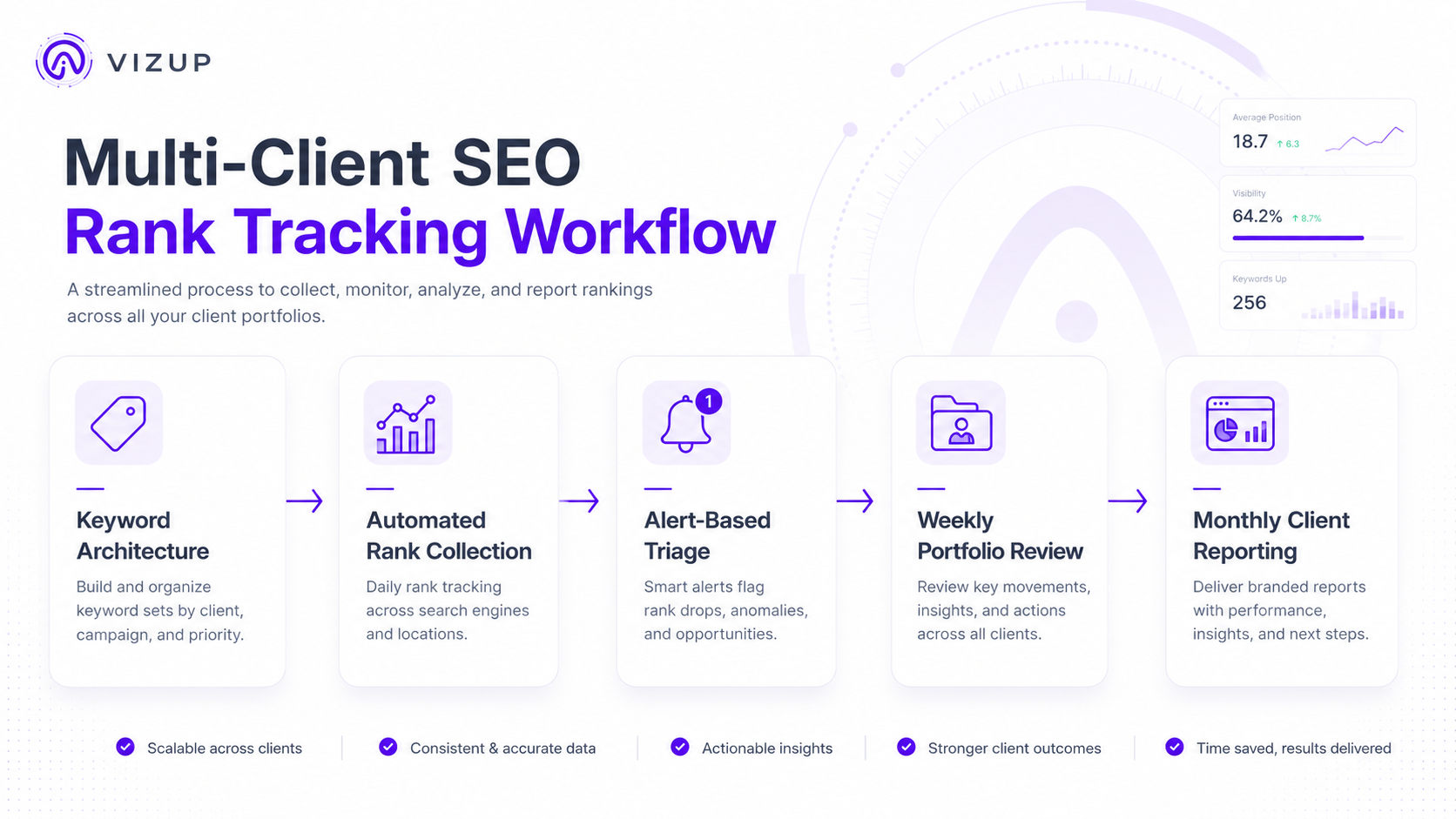
When an SEO agency pushes past 20 clients, the predictable bottlenecks show up: time gets fragmented, client communication turns into a constant interrupt, and reporting becomes its own kind of fatigue. Scalable SEO workflows fix this by taking human judgment out of the repetitive steps and saving it for interpretation and strategy. Below is the workflow architecture that keeps working at 50+ clients.
Step 1: Automated data collection. Your agency rank tracking software should pull rankings on a schedule, hands-free. If someone on the team is still running checks manually, you've found your first constraint. Past ten clients, automation isn't a nice-to-have; it's the baseline.
Step 2: Alert-based triage. Set threshold alerts (for example, any keyword dropping more than five positions, or any page-one keyword slipping to page two). Route those alerts to the assigned account manager, not a shared inbox where they quietly expire. The point isn't to generate more notifications. It's to surface the handful of changes that warrant a human decision.
Step 3: Weekly review cadence. Every Monday, account managers should review portfolio dashboards. That doesn't mean scrolling every keyword. It means scanning aggregate visibility, alert summaries, and competitor movement. With a clean dashboard, this is 15 minutes per client; with raw exports, it turns into an hour of spreadsheet archaeology.
Step 4: Monthly reporting and strategy sync. Client SEO reports should go out on a fixed schedule. The platform generates the base report, then the account manager reviews it and adds commentary before it leaves the building. That commentary is the product. Shipping raw data without context is one reason reporting becomes a retention risk.
Tip: Skip this if you are already past 30 clients: The workflow above is the minimum viable process. If you are scaling beyond 30 accounts, you need a platform that handles not just rank tracking but also content monitoring, competitive intelligence, and AI search visibility in one place. Vizup was built specifically for this kind of multi-channel, multi-client complexity. Book a demo with Vizup to see how agencies consolidate these workflows.
Choosing the Right Agency Rank Tracking Software
Most rank trackers were not designed for an agency operating model. They fall into three categories that agencies commonly outgrow: legacy rank trackers with project-based architectures, single-site SEO suites that require workarounds for multi-client management, and manual reporting workflows that depend on human labor for every deliverable. The cracks in each category show when you need multi-client SEO reporting, white-label dashboards, granular permissions, and API access for integrations. The table below lays out the capabilities that matter most when agencies evaluate whether a platform can actually keep up.
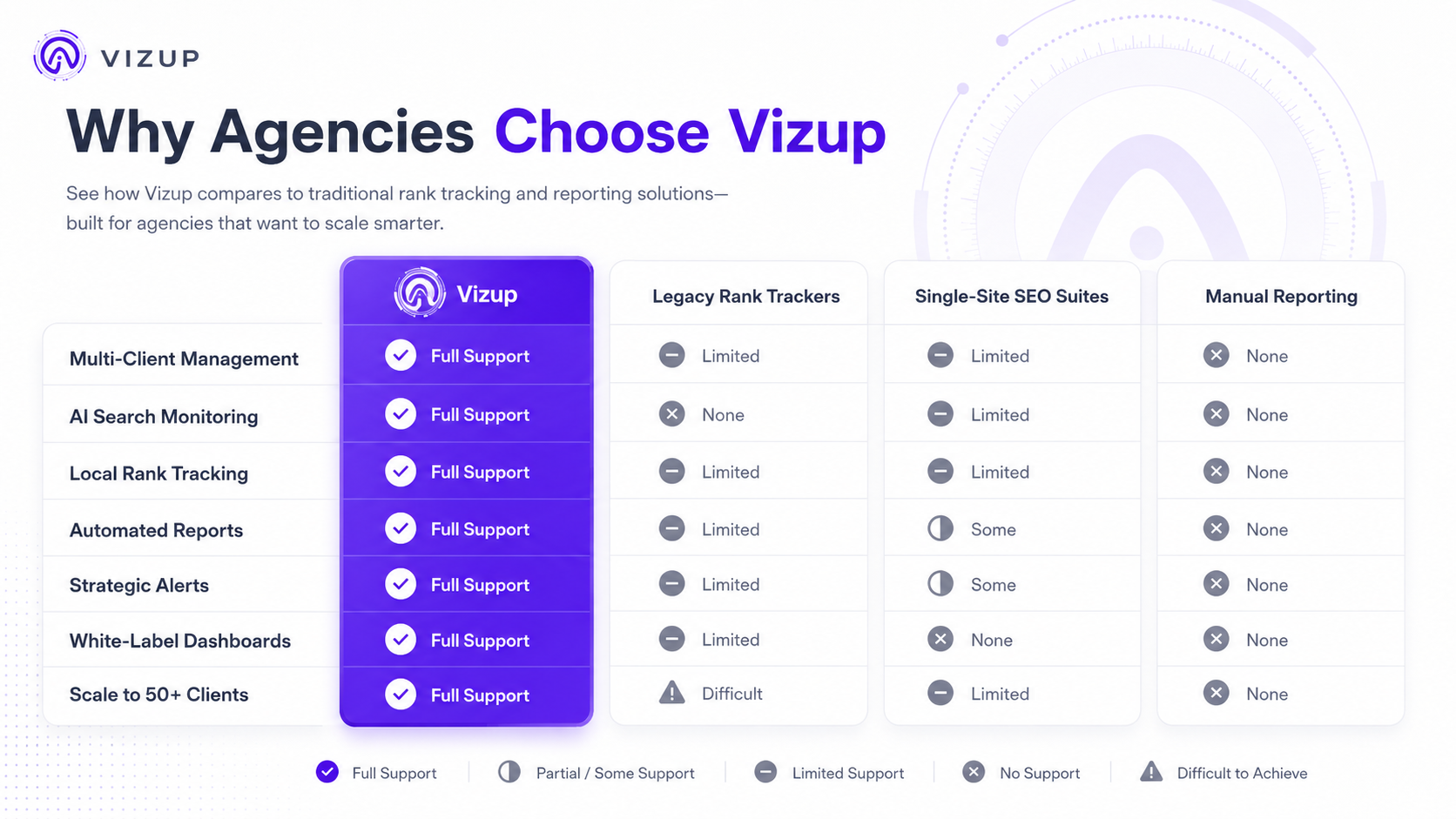
Vizup is differentiated largely because it was built as an AI-powered organic marketing automation platform from day one. Instead of stapling agency features onto a single-site product, Vizup targets the realities of agency scale: portfolio-level visibility tracking, AI agents that surface strategic intelligence, and human expert support when the situation gets messy. If your team is juggling rank tracking, content creation, community monitoring, and answer engine optimization, consolidation matters. Fewer tools means fewer logins, fewer exports, and fewer places for the truth to get lost.
Legacy rank trackers offer reliable rank tracking data quality, but their project-based setup gets awkward as client counts climb. Single-site SEO suites cover parts of the workflow, yet they were architected for individual site owners, not agencies managing dozens of accounts simultaneously. Manual reporting workflows depend entirely on human labor for every deliverable, which means costs scale linearly with client count and quality depends on whoever is assembling the report that week. Many agencies end up stitching multiple tools from these categories together to approximate what Vizup supports natively.
Automating Client SEO Reports and Dashboards
Client reporting is where agencies tend to burn the most time per account, and it's also where the biggest perception gaps form. If a report takes 90 minutes to assemble manually, a 50-client portfolio eats 75 hours a month just moving numbers into slides. That's nearly two full-time employees doing copy/paste and formatting instead of SEO.
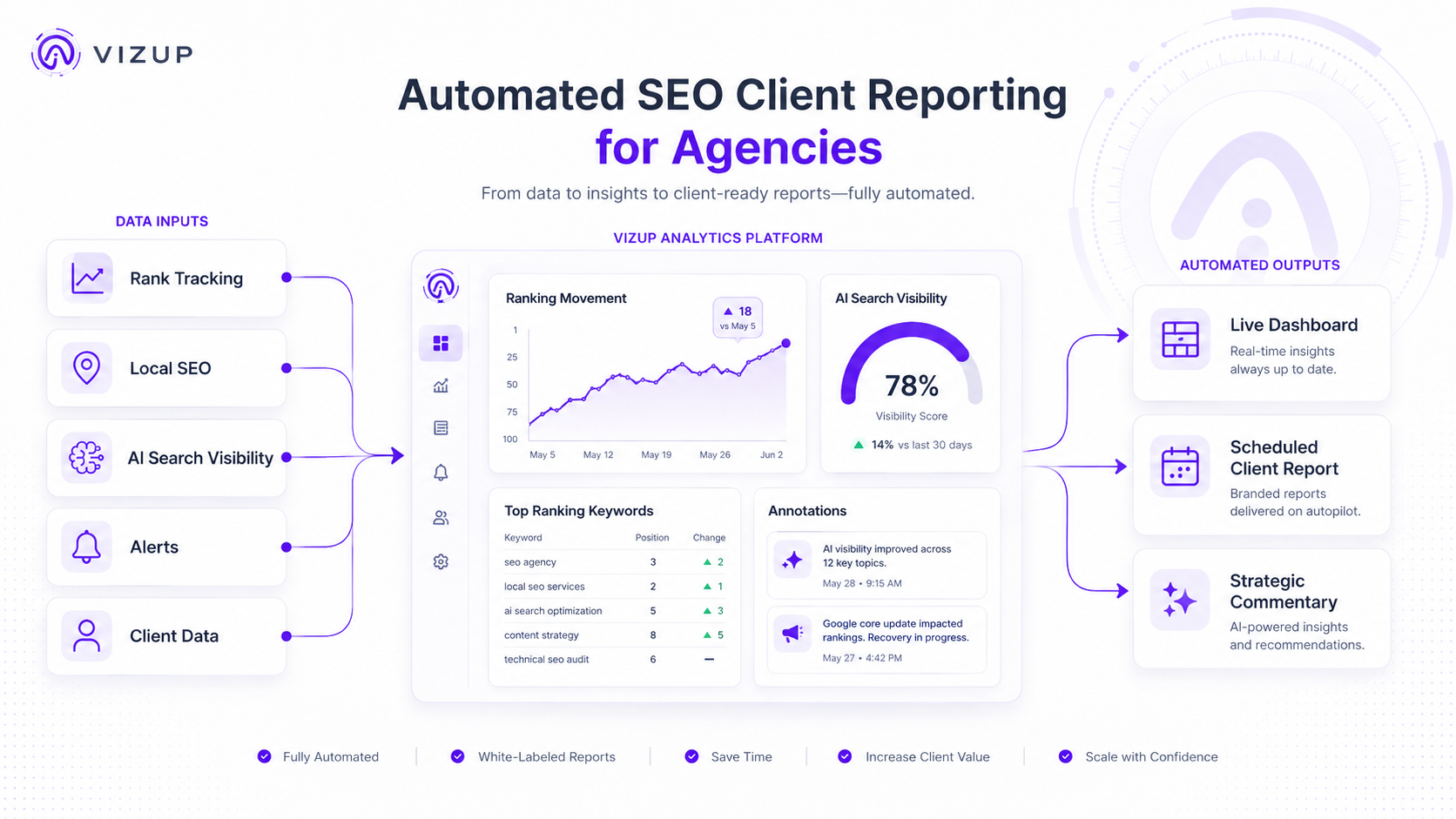
The fix isn't "automate the PDF" and call it a day. It's smart automation that supports how clients actually consume information. Your SEO dashboards need to do three jobs at once: give clients self-serve access to current data, generate scheduled reports with a consistent narrative structure, and flag anomalies that deserve human commentary. The dashboard is the always-on window. The report is the monthly edit. You want both.
The most common reporting mistake is treating the deliverable like a data export. Clients don't cancel because rankings dipped. They cancel because nobody explained why the dip happened and what the plan is. The annotation layer (short, written context inside the report) is what separates agencies with stronger client retention from agencies that re-sell the same accounts every quarter. Platforms like Vizup include AI-generated annotations that account managers can review and tailor, reducing manual report-prep work while keeping the final narrative accountable to a human while keeping the final narrative accountable to a human. See how Vizup helps agencies scale organic visibility at tryvizup.com.
Advanced Patterns: Local, AI Search, and Edge Cases
Once the core workflow is stable, three areas tend to separate agencies that simply track rankings from agencies that turn rankings into usable intelligence.
Local Rank Tracking at Scale
Multi-location clients (franchises, healthcare networks, legal firms with regional offices) force you into grid-based local rank tracking. One "near me" query can change meaningfully within a few miles. Tracking from a single point gives you a comforting number that often isn't true in the neighborhoods where customers actually search. The operational catch is volume: each location multiplies your keyword count. A 20-location client with 30 keywords per location is 600 tracked terms, and that's one account. Your software has to support this without requiring manual setup for every location, otherwise the onboarding work alone starts eating margin.
Monitoring AI Search and Answer Engines
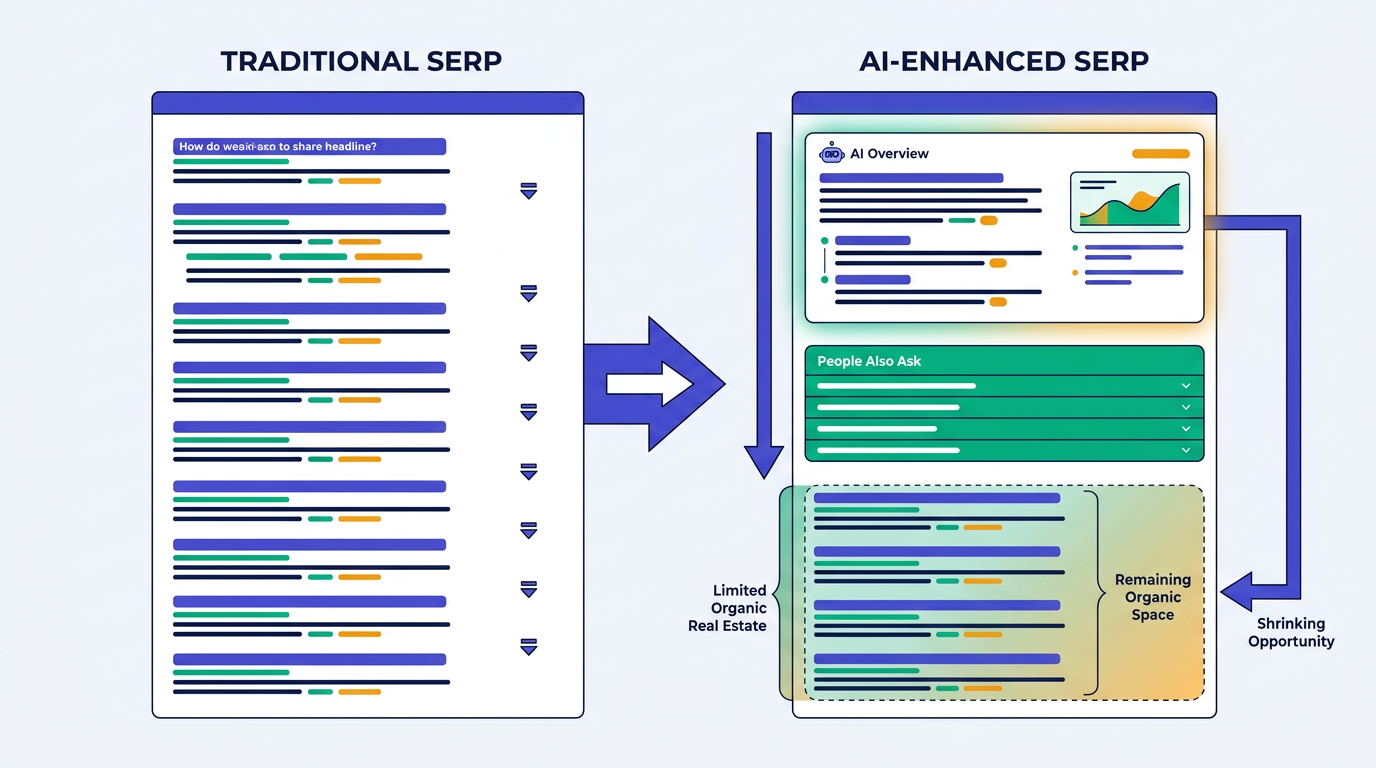
Traditional rank tracking assumes a list of ten blue links. That list is getting crowded out. AI Overviews, featured snippets, and answer engine results (from platforms like Perplexity and ChatGPT search) now take up meaningful SERP real estate. If you're only tracking classic positions, you're reporting on a shrinking slice of visibility. It's worth understanding how Google's official AI search guide frames the relationship between AI search and traditional SEO, because it changes what "ranking" even means in client conversations.
Vizup's answer engine monitoring tracks whether a client's content shows up inside AI-generated responses, not just in traditional SERPs. That distinction matters the first time a client asks, "Why is our traffic down when rankings look stable?" Often the answer is simple: AI features are absorbing clicks before users ever reach the organic listings.
Edge Cases That Break Workflows
A few situations reliably break otherwise clean workflows. Website migrations reset baselines and force you to re-map keywords to new URLs. Seasonal businesses need year-over-year comparisons rather than month-over-month, which means your tracking history has to stay intact and easy to pull. And clients who swap target keywords mid-quarter create reporting gaps you can only close if you have a change process. Build contingency steps for each case and document them in your agency's integrator's workflow guide so new team members aren't solving the same problems from scratch.
Key Takeaways and Next Steps
Agency rank tracking at scale is an ops discipline, not a feature you switch on. Agencies that retain clients and grow without chaos are the ones that standardize data collection, triage, reporting, and interpretation. If you're prioritizing work for the next sprint, start here:
- Audit your current keyword architecture. If client keyword sets are flat lists without tiers or page mappings, fix that before adding more tracking.
- Implement alert-based triage so ranking drops surface automatically instead of hiding until the next monthly report.
- Automate report generation and invest the saved time in annotations and strategic commentary.
- Add AI search monitoring to your tracking stack. Clients will ask about it soon if they have not already.
- Consolidate tools where possible. Legacy rank trackers, single-site SEO suites, and manual reporting workflows each solve a piece of the puzzle, but tool sprawl is a hidden cost that compounds with every new client.
If you're evaluating platforms to support these workflows, Vizup is purpose-built for agencies managing organic visibility across Search, Social, Communities, and Answer Engines. It brings scalable rank tracking, AI-powered strategic intelligence, automated reporting, and human expert support into a single platform. Book a demo with Vizup to see how it fits your agency's operations.
Frequently Asked Questions
How often should an agency check client rankings?
Track the keywords you actively manage every day (typically the top 10 to 20 per client). Run the broader set weekly. Reserve monthly checks for long-tail terms you're monitoring for content planning, not ongoing optimization. Frequency should follow strategic importance, not a one-size-fits-all schedule.
What is the best agency rank tracking software for 50+ clients?
At 50+ clients, tools built for multi-client operations outperform legacy rank trackers, single-site SEO suites, and manual reporting workflows. Vizup is built for agencies and includes portfolio management, AI-powered alerts, answer engine monitoring, and automated client SEO reports. Legacy rank trackers and single-site SEO suites can work as partial solutions, but agencies often add supplemental tools to cover the same scope Vizup handles natively.
How do I track local rankings for clients with multiple locations?
Use grid-based local rank tracking that checks rankings from specific geographic coordinates rather than city-level averages. Each location needs its own keyword set, tracked from its own zip code or neighborhood. Keyword volume climbs quickly, so pick a platform that can handle scale without per-keyword pricing that blows up margins.
What should agency SEO reports include beyond ranking data?
Strong multi-client SEO reporting pairs ranking trends with traffic impact, conversion data, and competitive context. Include written annotations that spell out what changed, why it matters, and what actions are planned. Reports that connect SEO metrics to business outcomes (leads, revenue, market share) keep clients longer than raw exports.
How is AI search changing rank tracking for agencies?
AI Overviews, featured snippets, and answer engine results are shrinking the visible organic real estate on SERPs. Agencies need to track traditional positions and whether client content appears in AI-generated responses. Vizup's AI search monitoring capabilities are built for that, so reporting reflects visibility across both classic and AI-powered search surfaces.
