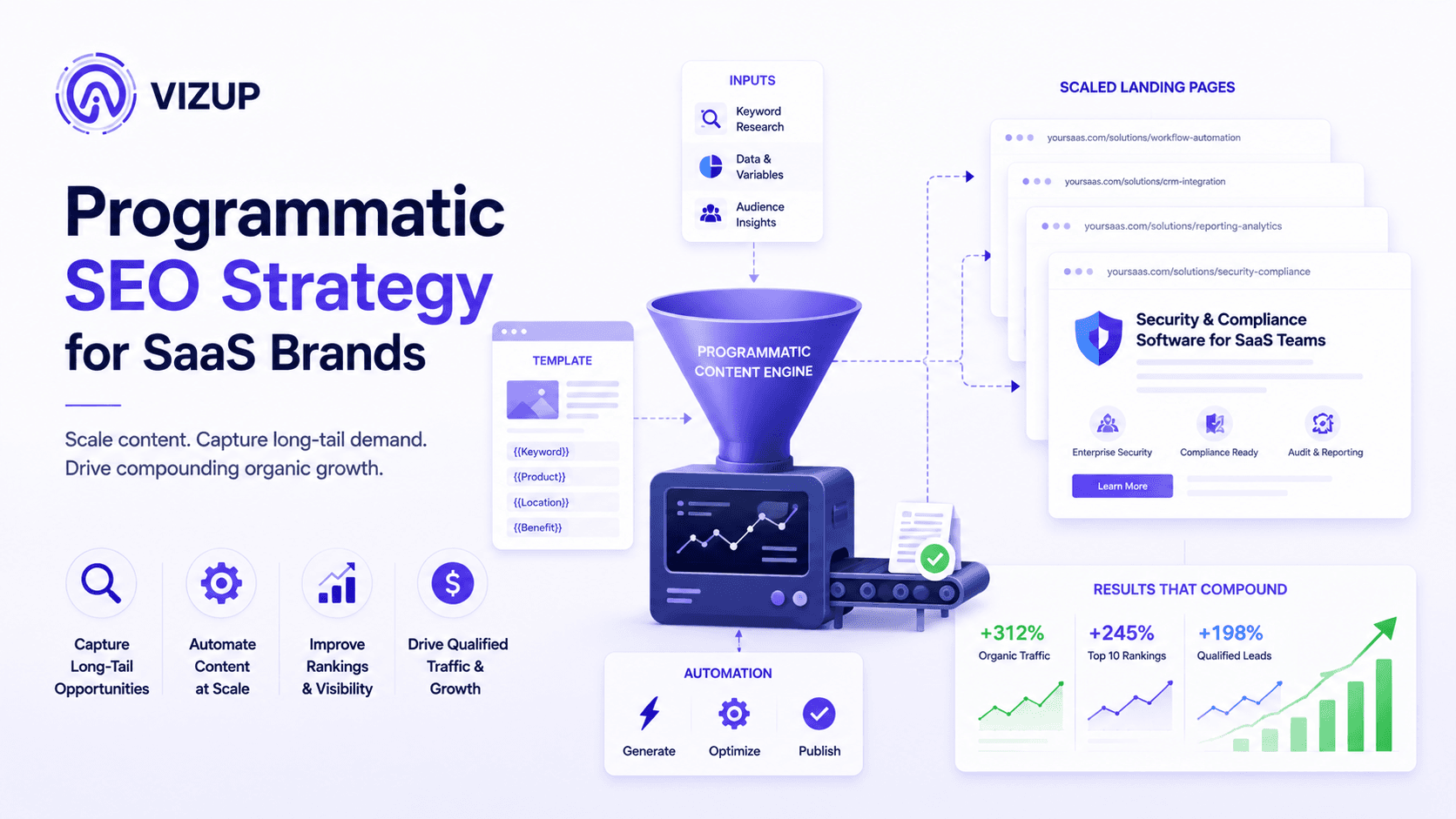
Most SaaS teams still ship landing pages one at a time. Meanwhile, the companies pulling away are using a single template to generate hundreds of high-intent pages and picking up rankings across the long tail. A programmatic SEO strategy pairs structured data with reusable templates to publish search-optimized pages at scale, with each URL aimed at a specific query. When it works, you get compounding SaaS organic growth without hiring your way into a bigger content calendar.
For SaaS teams, the real advantage is not just publishing pages faster. It is building a repeatable system where strategy, content quality, CMS execution, indexation, rankings, and AI answer visibility can all be measured and improved over time. That is where a platform like Vizup fits into the workflow. This playbook outlines the seven steps for turning long-tail demand into a repeatable system: 1) Identify your keyword matrix, 2) Build your data layer, 3) Design your page template, 4) Set up your internal linking architecture, 5) Generate and QA pages, 6) Launch and monitor indexation, and 7) Iterate based on performance data. If you want the broader context first, the programmatic SEO explainer on the Vizup blog is a solid baseline before you start building.
What You'll Need Before You Start
Get the plumbing right before you generate a single URL. You need a CMS that can create pages dynamically: Webflow, Next.js with a headless CMS like Contentful or Sanity, WordPress with custom post types, Shopify, Framer, or even a Custom CMS can all do the job. You will also want keyword tooling (Ahrefs, Semrush, or Google Keyword Planner) plus a spreadsheet for modeling the matrix and the underlying dataset. The non-negotiable is a structured data source: your product database, a public API, a scraped dataset, or a curated CSV where each row maps cleanly to one future page. And yes, you still need the basics of on-page SEO (title tags, meta descriptions, heading hierarchy), because pSEO does not excuse sloppy fundamentals.
Alongside your CMS, keyword tools, and dataset, you also need a way to turn raw SEO opportunities into a structured content plan and publishing workflow. Vizup helps teams think through that strategy like an SEO expert: which page types are worth building, which content clusters support the rollout, where AI visibility matters, and how each page should connect back to business goals. Vizup is designed to work with most modern CMS setups, so teams can integrate it with their existing publishing stack instead of rebuilding their website workflow from scratch. Once connected, teams can move from content planning and optimization to automated publishing in just a few clicks from the Vizup tool. That makes it easier to scale programmatic pages while keeping content quality, SEO structure, and publishing execution in one place
Step 1: Find Your Keyword Matrix
Your keyword matrix is the make-or-break decision. It is a head term paired with a modifier pattern that yields hundreds or thousands of legitimate combinations. You are not hunting for a single monster keyword; you are looking for a repeatable pattern where the combined demand across the set is worth the build and ongoing maintenance.
Vizup can help at this stage by framing the keyword matrix like an SEO strategist would. Instead of chasing every possible modifier, teams can evaluate which patterns have commercial intent, which ones support existing content clusters, and which combinations are most likely to earn visibility across both search results and AI-generated answers.
| Head Term | Modifier Type | Example Combination | Relative Demand | Commercial Intent |
|---|---|---|---|---|
| [Category] for [Industry] | Vertical | CRM for healthcare | High | High |
| [Competitor] alternatives | Comparison | HubSpot alternatives | Very High | Very High |
| [Integration] + [tool type] | Integration | Slack project management tools | Medium-High | High |
| Best [tool type] for [use case] | Use case | Best analytics tools for ecommerce | High | High |
| [Feature] software for [company size] | Segment | Invoicing software for freelancers | Medium-High | Medium-High |
| How to [action] with [tool] | Tutorial | How to automate reports with Zapier | Medium | Medium |
| Volume figures are aggregate estimates across all modifier combinations, not per individual keyword. |
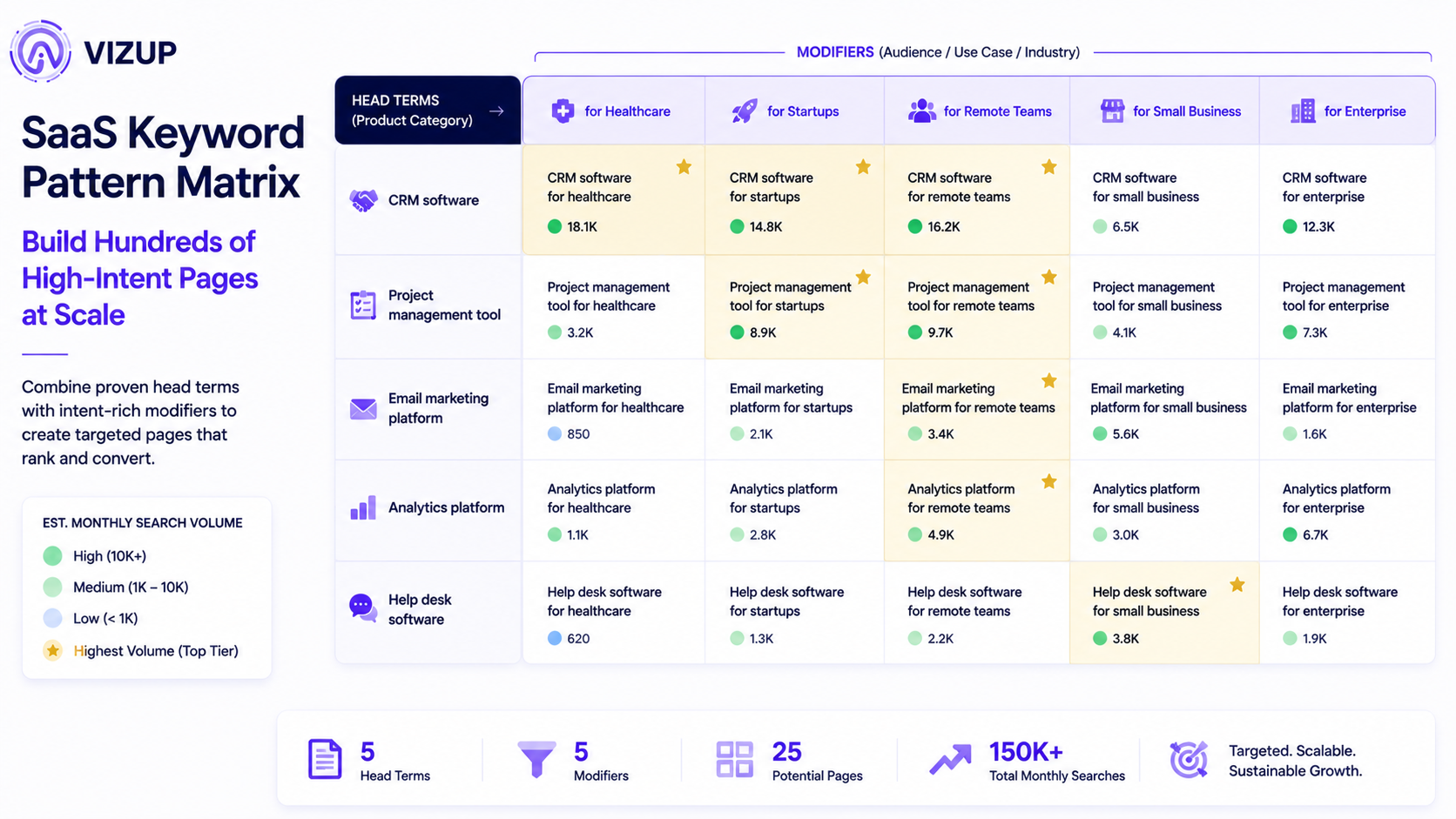
A keyword matrix maps head terms against modifiers to surface hundreds of targetable long-tail queries.
Step 2: Build Your Data Layer
This is the point where SaaS pSEO stops being "template duplication" and starts looking like a real product surface. Each page needs its own substance, not a keyword swap in a generic paragraph. Model your data as a flat table or JSON where each row equals a page and each column becomes a variable you can render: target keyword, vertical, a short context blurb, relevant feature bullets, pricing data, and whatever review signals you can pull programmatically.
Good sources for programmatic SaaS pages include your own product database, G2 or Capterra review APIs, integration directories, pricing tables, and feature comparison matrices. Competitor-alternatives builds, in particular, get a lot of mileage out of public review platforms. The richer the data layer, the harder it is for your pages to get written off as thin content. Vizup also fits into the data layer stage because strong programmatic SEO depends on more than rows in a spreadsheet. Teams need the right content variables, comparison points, FAQs, proof points, and AEO-friendly fields for each page. Vizup helps turn structured inputs into content that is useful for users, understandable for search engines, and easier for AI answer engines to cite.
Step 3: Design Your Page Template
Template SEO is closer to editorial design than it is to a growth hack. The job is to ship pages that feel deliberate, not auto-spun. The strongest programmatic SaaS pages usually share four building blocks, and each one should tie back to a field in your dataset. This is where Vizup's content and optimization workflow becomes useful. A strong pSEO template needs more than dynamic H1s and swapped variables. It needs useful sections, clear formatting, answer-ready copy, metadata, internal links, and page-level differentiation. Vizup helps teams create and optimize templates so each generated page feels intentional, not auto-spun.
Anatomy of a high-performing programmatic SaaS page:
- Dynamic H1 and meta title pulling directly from the keyword matrix so every page targets a distinct query.
- A short contextual intro paragraph using conditional logic (for example, if the vertical is healthcare, reference compliance requirements; if it is ecommerce, reference conversion rate).
- A data-rich body section featuring comparison tables, feature lists, pricing data, or curated recommendations drawn from your data layer.
- Social proof or trust signals such as review counts, star ratings, and customer logos, pulled dynamically where your data source supports it.
Note: Tip: The 'would I bookmark this?' test: If the answer is no, the fix is usually more unique data, tighter scope, or merging the page into a stronger neighbor. Google's helpful content system is not friendly to pages that exist purely to catch queries. Every programmatic URL should earn its spot by answering a real question.
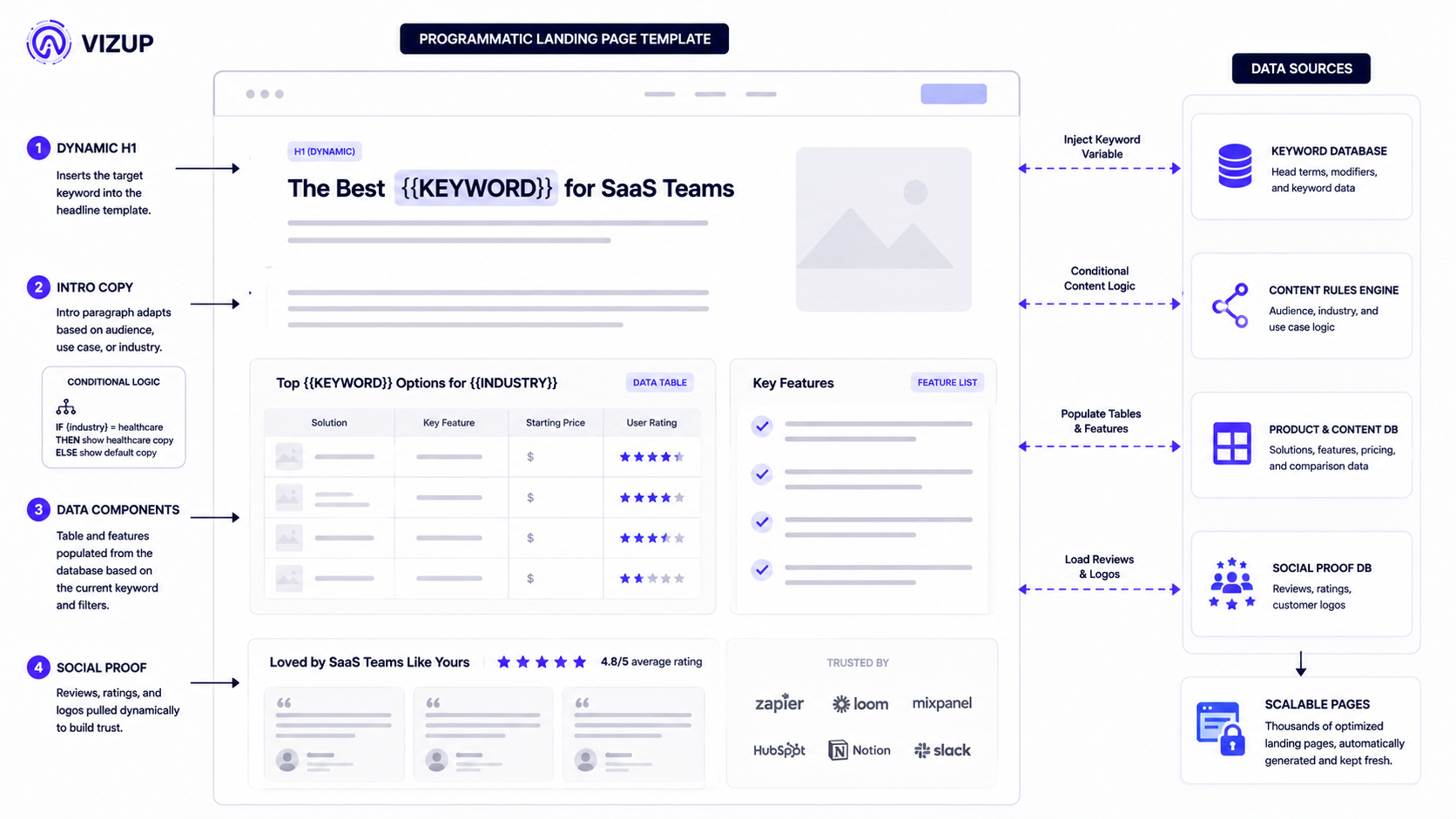
Each section of the template maps to a specific column in your data layer, ensuring every page is uniquely substantive.
Step 4: Architect Your Internal Linking Plan
Internal links are the difference between a directory Google understands and a pile of URLs it never prioritizes. At SaaS pSEO scale, discovery and prioritization do not happen by accident. If your programmatic pages are orphaned, they will struggle to rank no matter how clean the template is.
A practical default is a three-tier hub architecture. Put a hub page at the top (for example, /best-seo-tools/) and feed it links from your highest-authority blog posts and product pages. In the middle tier, publish category pages like /seo-tools-for-ecommerce/ that aggregate and route users into the directory. At the bottom, your individual programmatic pages (like /seo-tools-for-shopify-stores/) should get links from their parent category and a handful of contextual cross-links to adjacent pages. Breadcrumbs should mirror the hierarchy on every page. When you launch, do not wait for the new directory to "earn" equity on its own; point existing authority into it immediately. The SaaS content marketing guide on the Vizup blog walks through how to find the posts that already carry the most link equity and are worth tapping.
Vizup can support this stage by helping teams connect programmatic pages to the broader content ecosystem. That means identifying hub pages, supporting blog posts, category pages, and contextual internal links that help search engines understand the directory. For AI search, this also strengthens topical coverage, making the brand easier to associate with the category.
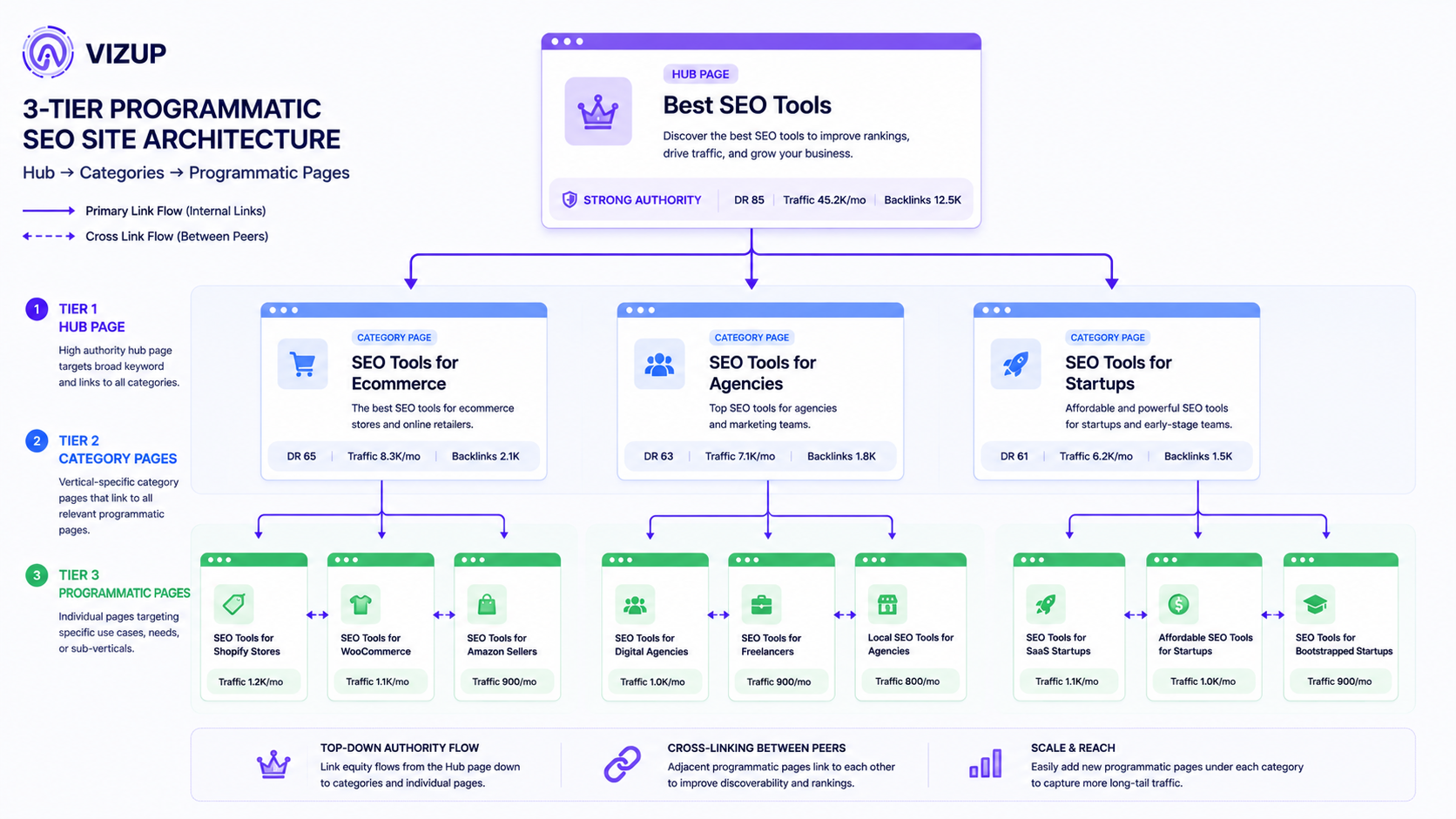
A three-tier hub architecture ensures every programmatic page is reachable within two clicks from a high-authority parent.
Step 5: Generate Pages and Run QA
Resist the urge to publish the full directory at once. Start with a test batch of 20 to 50 pages, review the output, and fix template, metadata, and content issues before scaling. Once the pages look right, verify them the way Google sees them. Spot-check a handful in Google Search Console's URL Inspection tool to confirm they are crawlable and indexable. This matters even more for JavaScript-rendered pages, which can look perfect in a browser while failing to render for Googlebot. Finding that problem on 30 pages is a nuisance; finding it after you ship 2,000 is a fire drill.
Before scaling from 50 pages to 500, Vizup can help teams review whether pages are actually useful, optimized, and differentiated. This is where teams can catch thin content, weak metadata, missing sections, duplicate patterns, and pages that are unlikely to earn citations or rankings. Programmatic SEO works best when generation and quality control move together. Once the test batch passes QA, Vizup can help push optimized pages into your connected CMS, making it easier to move from approved content to live programmatic pages without a manual copy-paste publishing process.
Step 6: Launch, Index, and Monitor
Submit your XML sitemap in Search Console, and keep programmatic URLs in their own sitemap so you can monitor them cleanly. Launch in cohorts of 100 to 200 pages instead of dumping everything on day one. After each cohort, watch indexation rate and crawl stats. If Google is indexing only a small portion of the URLs you submit, stop expanding and diagnose the issue before adding more surface area.
Use Vizup to monitor what happens after your programmatic pages go live. Teams can track which pages get indexed, which ones begin ranking, where visibility improves, and which pages appear in AI-generated answers across platforms like ChatGPT, Perplexity, and Google AI Overviews. This matters because SaaS buyers are no longer discovering brands only through blue links. Vizup helps connect programmatic SEO performance with AI search visibility, so teams can see whether scaled content is actually creating discoverability. If you want the bigger picture on AI visibility, the Vizup guide to improving brand visibility in AI search pairs well with your launch monitoring plan.
Step 7: Iterate Based on What the Data Tells You
Give the cohort four to six weeks, then sort your programmatic pages into three buckets. Winners land on page one or two and mostly need upkeep (fresh data, small improvements). Contenders sit on pages three through five and usually need more unique content, stronger internal links, or consolidation with a near-duplicate. Dead weight is anything that is not indexed, or stuck beyond page five with no sign of climbing.
Dead weight should not linger. Noindex it, or redirect it into a stronger parent page. Keeping low-quality pages live wastes crawl budget and can drag down the pages that are actually performing. This loop, pruning and improving based on what shows up in Search Console and rankings, is what makes pSEO a strategy instead of a one-time page dump. The teams that win treat programmatic directories like living systems: expand what works, cut what does not, and revisit the whole thing quarterly. Vizup becomes especially useful after the first cohort has data. Teams can identify which pages need stronger content, which topics deserve expansion, which URLs should be consolidated, and where AI visibility is emerging. Instead of treating pSEO as a one-time launch, Vizup helps turn it into an ongoing optimization loop.
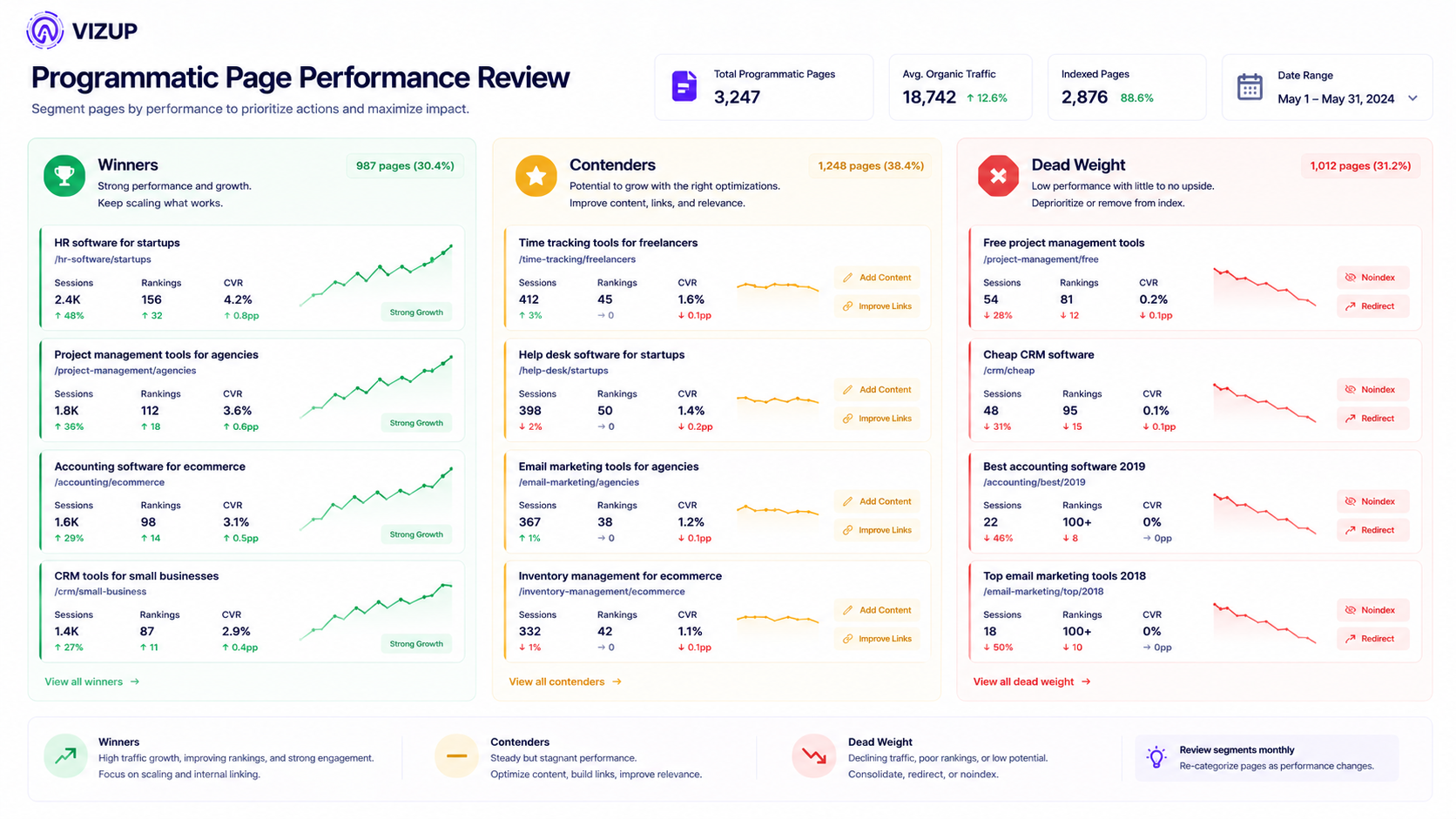
Quarterly segmentation keeps your programmatic directory lean and focused on pages that earn their crawl budget.
Common Mistakes That Kill Programmatic SEO for SaaS
Avoid these five pitfalls:
- Generating pages with no unique value. Swapping a city name or tool name into identical copy produces doorway pages. Google's classifiers are good at spotting those patterns at scale.
- Ignoring indexation limits. Google does not index thousands of weak pages just because you published them. Watch the Coverage report in Search Console weekly for the first 90 days.
- No internal linking strategy. Orphaned programmatic pages rarely rank, even with a strong template. Link equity has to reach every page in the directory.
- Choosing a keyword matrix with no commercial intent. Volume without intent turns into traffic that does not convert. Every matrix should map to a real stage of the buyer journey.
- Treating pSEO as 'set and forget.' Markets move, competitors ship new pages, and Google's quality thresholds change. Put a quarterly review on the calendar for every programmatic directory you launch.
Many of these mistakes happen when teams separate page generation from strategy, CMS execution, quality control, and monitoring. Vizup helps close that gap by giving SaaS teams a workflow for planning smarter pages, creating and optimizing content, publishing into their CMS, tracking indexation, and measuring visibility across both search engines and AI answer platforms.
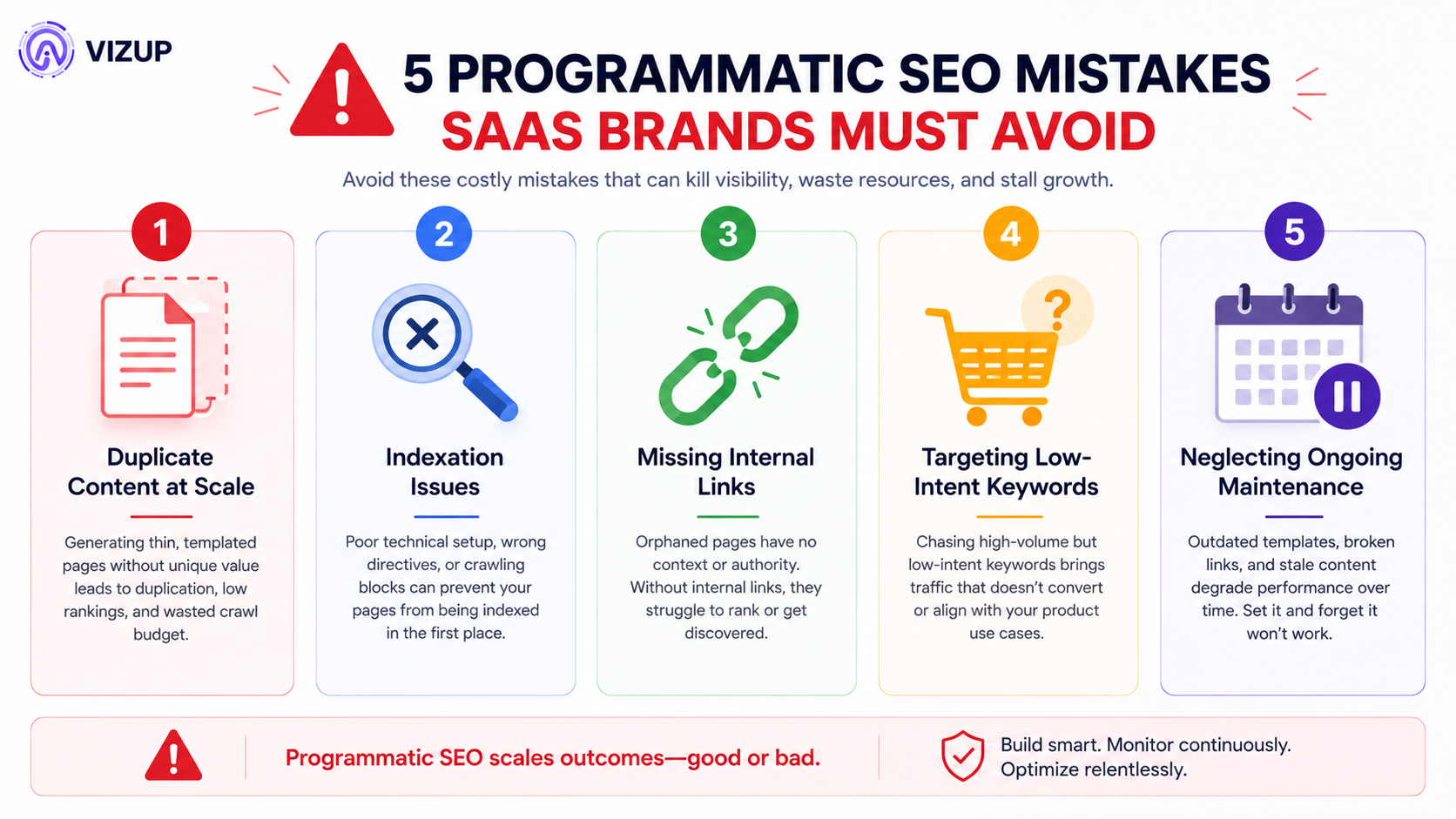
Each of these mistakes is recoverable, but catching them before launch is far less costly than fixing them after.
Summary and Next Steps
A programmatic SEO strategy for SaaS brands comes down to seven moves: validate a keyword matrix, build a data layer with real substance, design a template that produces pages people would actually use, wire up an internal linking hierarchy, generate and QA in batches, launch in cohorts while watching indexation, then iterate quarterly based on what wins and what stalls. Run it well and you are building durable infrastructure, not chasing a short-lived trick.
Next step: audit your existing site for programmatic opportunities using the matrix patterns in the table above. Start small with a cohort of 30 to 50 pages on your highest-confidence pattern, then expand only after you see clean indexation and early ranking traction. Vizup can help you plan the strategy, create and optimize scalable content, integrate with your CMS, automate publishing, monitor indexation, track organic growth, and understand where your brand appears across AI answer engines. If you want to build programmatic SEO as a repeatable growth system instead of a risky page dump, book a demo with Vizup.
